The Restorer of Rainy Afternoons
Kaelen’s workshop smelled of ozone, old paper, and the faint, synthetic cherry scent of neural conductor gel.
Synopsis
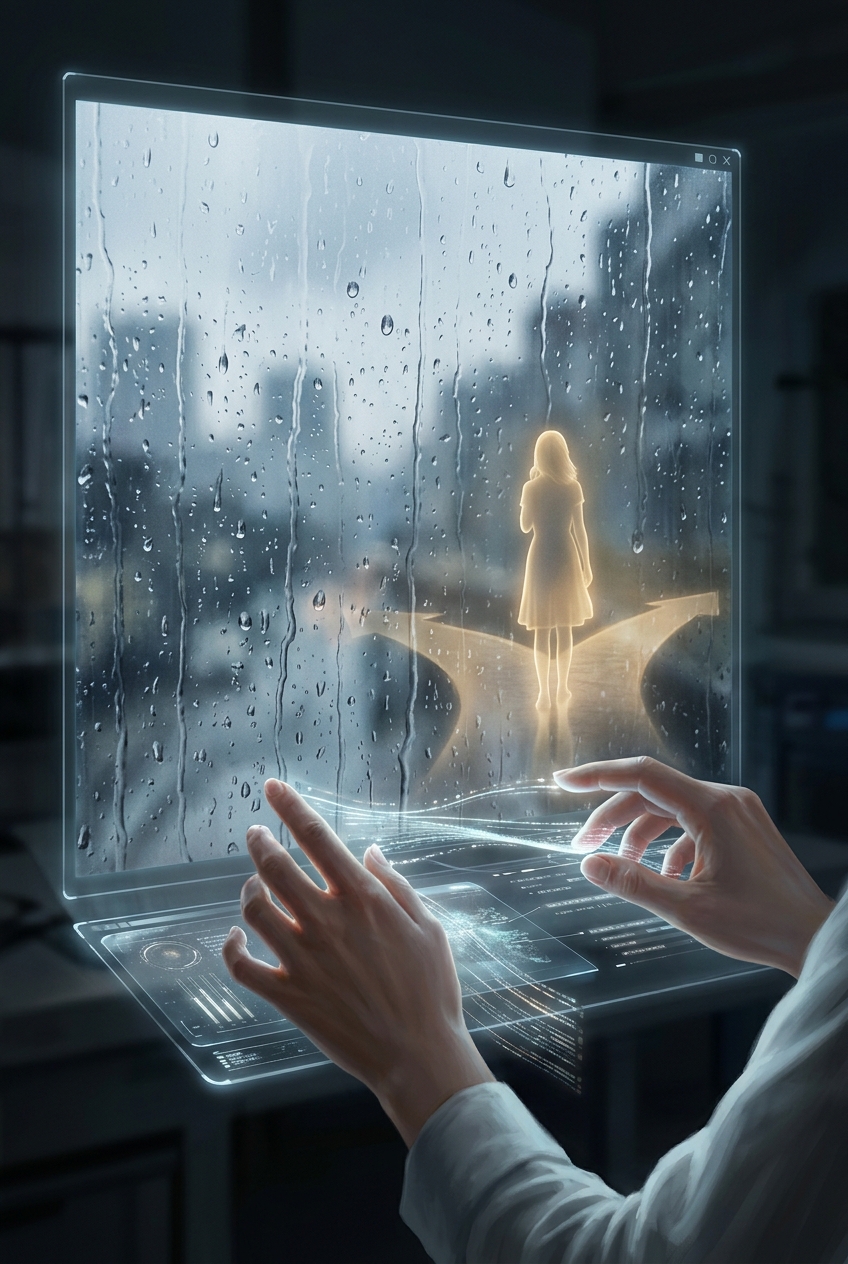
Kaelen, a jaded Mnemonic Restorationist who specializes in polishing the 'trophy memories' of the wealthy, takes on an unusual client: an elderly woman named Elara Vance. She wants him to restore a heavily corrupted and seemingly mundane memory of a rainy afternoon. As Kaelen meticulously rebuilds the quiet moment, he uncovers a deliberately suppressed 'ghost layer' within the memory. Venturing into this forbidden data reveals a pivotal, forgotten choice from Elara's youth, forcing her to confront the truth of her life's path and inspiring Kaelen to re-evaluate his own vicarious existence.
The Restorer of Rainy Afternoons
Story
Kaelen’s workshop smelled of ozone, old paper, and the faint, synthetic cherry scent of neural conductor gel. He called it The Eidolon Archive, a name far grander than the reality of the small, wood-paneled room tucked into a quiet city artery. Here, he practiced the delicate art of mnemonic restoration. He was less an archivist and more a luthier for the mind, sanding down the rough edges of time, re-stringing frayed sensory data, and polishing tarnished emotions until they gleamed like new.
His current project lay suspended in the holographic cradle at the center of the room: a memory shard belonging to a corporate magnate named Tethys. The shard, a flawless quartz crystal, pulsed with a cold, blue light. The memory was a classic ‘trophy moment’: the summit of Everest Prime on Mars, a panorama of crimson dust and impossibly distant stars. Kaelen had spent a week sharpening the bite of the wind, amplifying the color saturation of the sunrise, and subtly sweetening the client’s memory of his own triumphant shout, editing out the waver of oxygen-deprived fear.
He was good at his job. He could take a faded, pixelated recollection of a first kiss and restore the phantom taste of cheap wine and mint. He could rebuild the sound of a lost parent’s laughter from the faintest neural echoes. But mostly, he dealt in triumphs. People didn’t pay to relive their quiet despairs or their mundane joys. They wanted the highlight reel, curated and enhanced for perfect recall.
The shop’s bell chimed, a real brass bell he’d insisted on, a quaint anchor in his sea of technology. An elderly woman stood in the doorway, silhouetted against the bright, bustling street. She moved with a practiced elegance that her advanced age could not diminish, her silver hair coiled in a precise bun. She was Elara Vance.
“Mr. Kaelen?” she asked, her voice a soft, cultured melody.
“Please, call me Kael.” He wiped a smudge of conductor gel from his fingers. “How can I help you, Ms. Vance?”
Instead of a pristine quartz shard, she placed a small, clouded piece of agate on his counter. It was an old model, a personal recording, not a commercial mnemo-crystal. Its surface was scarred with microscopic fractures, its internal light a flickering, sickly yellow.
“I have a memory I would like restored,” she said. “It is… important.”
Kaelen picked it up, his touch gentle. He interfaced the agate with his diagnostic pad. The data was a mess, a maelstrom of corrupted files and sensory static. He managed to pull a single, degraded file tag: Rain. Reading. Arion.
“This is heavily damaged, Ms. Vance. The decay is… extensive. It might be impossible to retrieve anything coherent.”
“Please, try,” she said, her composure unwavering. She slid a credit chip across the counter. “This is for your time. There will be a significant bonus upon successful restoration.”
Kaelen glanced at the figure on the chip. It was an absurd amount, enough to pay his rent for a decade. More than Tethys was paying for his touched-up Martian holiday. All for a corrupted memory of rain.
“What am I restoring, exactly?” he asked. “A storm? A particular book?”
“A feeling,” she replied, her gaze distant. “I wish to restore a feeling.”
The first dive was like swimming through mud. Kaelen, linked to the shard through his own neural interface, floated in a gray void buzzing with static. There was no image, no sound, just the ghost of sensation. He pushed deeper, using his own focus as a lodestone, searching for a stable data point.
He found a flicker. The smell of wet earth after a dry spell—petrichor. He isolated it, amplified it, used its unique sensory frequency to align a handful of other fragments. A sound emerged from the static: the soft, rhythmic drumming of water against glass. Then, another: the crisp rustle of a turning page.
It was painstaking work. For a week, he spent his days sifting through the digital noise of Elara’s memory. In the evenings, she would come to the shop for playback sessions. She’d recline in the plush restoration chair, a delicate silver neuro-link placed on her temple, and he would feed her the fragments he’d recovered. Her own mind, a living archive, would resonate with the authentic pieces, helping him distinguish signal from noise.
“The tea,” she murmured during one session, her eyes closed. “It was chamomile. With a single drop of honey.”
Kaelen made a note, diving back into the shard’s gustatory data. He found it: a faint, floral warmth, almost completely overwritten by decades of decay. He carefully rebuilt it, molecule by virtual molecule. The memory was slowly taking shape. A sunroom, filled with the soft, gray light of a rainy afternoon. Two worn armchairs. A steaming mug on a small wooden table. Books.
And a man. Or rather, the impression of a man. His presence was a warm weight in the opposite chair, a quiet breathing that was part of the room’s rhythm. But his face, his voice, his very identity—they were a void, the most corrupted part of the memory. This was Arion.
“Why this memory, Elara?” Kaelen asked one evening, after a particularly draining session. “Out of a whole life, why this quiet afternoon?”
She looked at him, her eyes holding a deep, ancient sadness. “In a life filled with noise,” she said softly, “silence can become the most precious memory.”
Kaelen, whose life was spent in the clamor of other people’s grandest moments, felt that sentiment resonate within him. He lived vicariously, a spectator to triumphs he’d never earned and loves he’d never felt. His own memories felt thin and colorless by comparison.
He became obsessed. He ran a deep-level diagnostic on the shard, a process that took a full night cycle. The results flickered onto his screen just before dawn. Beneath the layers of natural decay, his instruments detected something else: the faint signature of deliberate suppression. A ghost layer. Someone—likely a young Elara herself—had tried to erase a piece of this memory, pushing it down so deep it had nearly taken the rest of the file with it.
Restoring it would be like performing psychic surgery. One wrong move could shatter the entire memory, turning the fragile peace of that rainy room into permanent, irretrievable static.
He told her the next day. He laid out the risks, the near-certainty of failure. He expected her to balk, to choose the safety of the incomplete but pleasant memory he had already rebuilt.
She met his gaze without flinching. “I am eighty-seven years old, Kael. I have lived with the ghost of this memory my entire adult life. I am no longer afraid of ghosts. I just want to see its face. Please. Restore it all.”
The final restoration felt different. It was no longer a job; it was a pilgrimage. Kaelen and Elara linked to the shard together, their consciousnesses intertwined in the fragile, reconstructed world of the sunroom.
He guided her through the familiar sensations: the scent of chamomile and rain, the comfortable weight of the armchair, the soft wool of her sweater. The memory was stable, peaceful. The form of Arion sat across from her, a book resting in his hands. As before, he was a pleasant, featureless presence.
“I’m going in,” Kaelen subvocalized, his thought-voice a whisper in their shared mental space.
He focused on the void where Arion’s identity should be, on the faint tracery of the ghost layer. He gently funneled energy into the suppressed data, coaxing it, weaving the threads of light and sound back into the tapestry.
The room flickered. The sound of rain warped into a harsh shriek. The scent of petrichor became the acrid smell of burning wires.
“Hold on, Elara,” Kaelen urged. “Focus on the rain. Keep the memory anchored.”
She squeezed her eyes shut in the real world, her breathing shallow. In the memory, she was a rock. The drumming of the rain on the glass became a steady heartbeat, a metronome pulling the fracturing world back into rhythm. The room solidified.
And Arion looked up from his book.
He had a kind, thoughtful face and eyes the color of a summer sky. When he spoke, his voice was warm and clear, a sound that cut through decades of silence.
“I heard back from the Kepler Arts Colony,” he said, a quiet excitement in his tone. “I’ve been accepted. The transport leaves at the end of the month.”
The reconstructed memory, once silent, now held a voice. This was the suppressed moment, the emotional core. Kaelen felt like an intruder, a witness to something profoundly private.
Young Elara, her face a mask of carefully controlled emotion, said nothing. Arion leaned forward, his expression earnest. “Come with me, Elara. We can have a life there. A real one. Just… come with me.”
It was not an ultimatum. It was an invitation. A door opening to a different world, a different life.
The memory held its breath. The rain pattered against the glass, each drop a ticking second. Kaelen watched young Elara, saw the war in her eyes between love and duty, adventure and security. He knew, from his research into her public life, that she had married Marcus Thorne, a powerful industrialist, just six months after the date stamp on this memory. She had chosen security. She had chosen the life her family expected.
But the memory wasn't about the choice. It was about the moment before the choice.
Young Elara finally looked at Arion. Kaelen braced for the rejection, the tearful farewell he assumed she had suppressed. But it never came.
She reached across the small space between them and put a hand on his arm. She smiled, a sad, fragile thing.
“Listen to the rain,” she whispered. Then she leaned over and rested her head on his shoulder, closing her eyes.
And that was it. The memory ended. Not with a bang, but with a quiet, heartbreaking deferral. She hadn't said no. She had simply said nothing. She had let the moment, and the man, drift away on a tide of silence.
The neural link disengaged with a soft click. Kaelen felt a profound sense of exhaustion, as if he’d lived a lifetime in a few hours. He looked over at Elara. Tears were streaming down her wrinkled cheeks, but she was smiling.
“Thank you,” she whispered, her voice thick with emotion.
“He asked you to go with him,” Kaelen said, his own voice hushed.
“Yes.” She wiped a tear away with a steady hand. “For sixty years, I told myself a story. I told myself that my family forced me to marry Marcus, that I was a victim of circumstance, that I had no choice. I suppressed that part of the memory because it was easier to live with a tragedy than with a mistake.”
She looked around the workshop, at the gleaming tools and the memory shards of other people’s lives. “The truth is… I was scared. Arion offered a world of paint and poetry and uncertainty. Marcus offered a life of comfort and predictability. I didn't choose Marcus. I just… failed to choose Arion. I chose silence.”
The confession hung in the air, heavy and honest.
“Restoring this memory,” she continued, her voice gaining strength, “it’s not about regret. It’s about… forgiveness. Forgiving that frightened girl I used to be. You haven’t given me back a memory, Kael. You’ve given me back my own story.”
She stood up, her elegance fully returned. She left the clouded agate shard on the counter. “I don’t need this anymore. I don’t need to replay it. I just needed to remember it properly, just once.”
After she left, Kaelen stood alone in the quiet of his archive. The shop seemed different, the air charged with the weight of Elara’s revelation. He looked at the Tethys shard, its perfect, cold blue light pulsing with a manufactured triumph. It felt hollow, a beautiful lie.
He then picked up Elara’s agate. It was just a stone now, its internal light faded. It held the memory of a rainy afternoon, a quiet room, and a choice not made. It was mundane, painful, and more real than any mountain on Mars.
For years, Kaelen had been a curator of endings, a polisher of past glories. He’d lived his life in the secondhand glow of others. But Elara hadn’t wanted a polished memory. She had wanted a true one, with all its sharp edges and painful revelations, because it was hers.
Kaelen walked to the door of The Eidolon Archive and flipped the sign from ‘Open’ to ‘Closed’. The sun was beginning to set, casting long shadows down the city street. The air was cool and smelled faintly of rain on the way. For the first time in a very long time, he felt no desire to step back into the curated perfection of a memory. He felt the urge to walk out into the fading light and make one of his own.
More from Short Stories