The Department of Verdant Reclamation
Leo had memorized the precise shade of gray of his cubicle walls. It wasn’t battleship gray, which had a hint of blue; nor was it slate gray, which felt too organic.
Synopsis
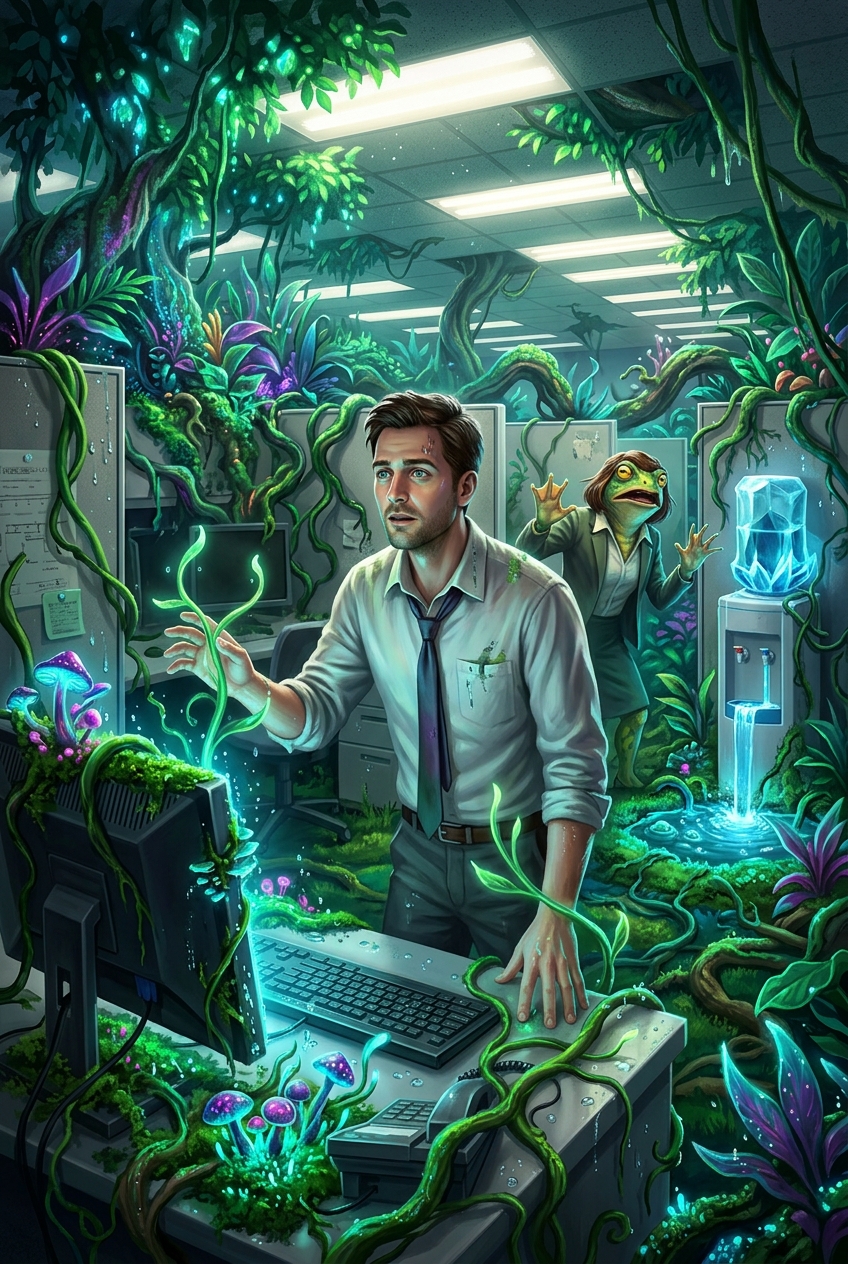
Leo, a despondent data-entry clerk at the monolithic Consolidated Synergies, discovers his bleak cubicle is inexplicably transforming into a primordial, bioluminescent swamp. As moss overruns his keyboard and the water cooler begins dispensing life-giving water, Leo secretly cultivates the burgeoning ecosystem, finding a quiet purpose that defies corporate logic. His tyrannical manager, Brenda, who is herself slowly metamorphosing into an amphibian, sees the 'unauthorized flora' as a threat to productivity and vows to have it sanitized. On the day of the purge, with the help of an observant colleague, Leo makes a final stand, fully unleashing the magic of the swamp to reclaim their sterile office floor and forge a new, wondrous department within the heart of the corporate machine.
The Department of Verdant Reclamation
Story
title: "The Department of Verdant Reclamation" date: "2024-07-26" slug: "the-department-of-verdant-reclamation" genre: "Magical Realism / Office Absurdism" tone: "Whimsical, Satirical, Hopeful" word_count: 3254 status: "complete" generated_by: "Codex"
The Department of Verdant Reclamation
Story
Leo had memorized the precise shade of gray of his cubicle walls. It wasn’t battleship gray, which had a hint of blue; nor was it slate gray, which felt too organic. This was memorandum gray, the color of forgotten directives and pointless addendums. It was the color of his life at Consolidated Synergies, a place where souls came to be formatted into spreadsheets.
His job, for the past seven years, was to perform “data actualization,” a term so wonderfully meaningless that it could only have been invented by a committee. In practice, it meant he transferred numbers from one digital box to another, ad infinitum. The fluorescent lights hummed a constant, oppressive B-flat, a sound that vibrated deep in his teeth. The air tasted of recycled ennui and burnt coffee.
It started with the moss. On a Tuesday, after a particularly grueling data-actualization sprint, he noticed a patch of green on the corner of his keyboard’s spacebar. It was no bigger than a thumbnail, but it was a vibrant, impossible kelly green. He scraped it off with a paperclip, assuming it was a remnant of a sad desk-lunch. The next morning, it was back, a perfect velvet circle, shimmering faintly under the B-flat hum.
He didn’t tell anyone. At Consolidated Synergies, any deviation from the norm was a potential demerit on your quarterly performance review. Unauthorized flora was likely a Level 2 infraction, somewhere between “improper use of company letterhead” and “fostering a non-synergistic environment.”
By Friday, the moss had traced delicate, fractal patterns across the entire keyboard. It felt cool and soft under his fingertips. Strangely, his typing speed increased. The numbers flowed from his brain to the screen with a fluid grace he’d never known. He started his lunch break with a productivity score of 112%, a personal best.
His manager, Brenda, noticed. Brenda was a woman held together by hairspray and a rigid belief in Key Performance Indicators. She patrolled the cubicle farm in sensible heels that clacked on the linoleum like a metronome of doom.
“Leo,” she said, her voice a sharp crackle. “Your metrics are… exemplary this week.” She peered at his screen, her eyes narrowing. “Have you implemented a new workflow paradigm?”
“Just… focusing,” Leo mumbled, instinctively covering his keyboard with his hands.
Brenda’s gaze flickered to his desk. “What is that smell? Is that… dampness? The HVAC system is calibrated to a humidity of 45%. Any deviation must be reported.” Her skin, Leo noticed, had a peculiar, waxy sheen to it, and her blinking was becoming less frequent, more deliberate.
After she clacked away, Leo took a tentative sniff. She was right. The air around his desk smelled of petrichor, of damp earth after a long rain. He looked down. The memorandum-gray carpet beneath his chair was now the color of rich peat, and it squelched faintly when he shifted his weight.
This was when fear should have set in. A rational person would have called Facilities Management, or perhaps an exorcist. But Leo had been rational for seven years, and it had brought him nothing but memorandum gray. He felt a different emotion bubbling up: curiosity.
Over the next week, the transformation accelerated. The humming of the server room down the hall began to sound less like failing machinery and more like a chorus of crickets. Tiny, bioluminescent fungi sprouted from the fabric of his cubicle wall, casting a soft, blue-green light that was far kinder than the overhead fluorescents. He started turning his desk lamp off.
He became a secret gardener. During his lunch breaks, he’d fetch water from the cooler. He’d noticed it had changed, too. The filtered corporate water, which had always tasted of plastic and faint despair, now ran clear, sweet, and cold. It tasted of mountain springs. When he watered a particularly stubborn patch of moss creeping up his monitor stand, a tiny fern uncurled its fronds from a crack in the plastic casing.
“It’s beautiful,” a voice whispered.
Leo jumped, nearly upsetting a small puddle that had formed near his CPU tower. It was Anya, from Accounting. She held a sketchbook and a pen, her expression one of quiet wonder. While everyone else wore the corporate uniform of gray, black, and beige, Anya always had a splash of color—a bright scarf, a pair of painted earrings.
“I, uh…” Leo stammered. “It’s a… spill.”
Anya smiled, a genuine expression so rare in this building it was like seeing a hummingbird. “I don’t think so.” She opened her sketchbook. It was filled with intricate drawings of impossible plants, of flowers with geometric petals and trees that grew in spirals.
“You see it too,” Leo breathed, a wave of relief washing over him.
“I’ve been seeing things for years,” she said, tapping a drawing of a vine that looked suspiciously like the one now snaking out of the ethernet port on his wall. “I just thought I was the only one. This is the first time it’s ever… bloomed like this.”
They became quiet co-conspirators. Anya would bring him pages from her sketchbook, identifying the strange flora. The bioluminescent fungi were, apparently, ‘Whisper Caps,’ and the moss was ‘Chronoweave.’ The fern on his monitor was a ‘Spore of Memory.’ He learned that the sweet water from the cooler could coax life from the most sterile environments.
Meanwhile, Brenda was devolving. Her voice had acquired a low, guttural croak. Her skin was now a mottled green-brown, and she’d taken to catching flies with a startlingly long tongue during conference calls. Her obsession with Leo’s section grew.
“Leo! The humidity in this quadrant has reached 78%!” she’d rasp, her wide, unblinking eyes fixed on him. “This is a violation of Section 4, Sub-clause B of the Environmental Standards Mandate! It’s… unprofessional!”
Leo would just nod, calmly actualizing data as a delicate, magenta orchid bloomed from his mouse cord.
The climax arrived on a Thursday. Brenda, now more amphibian than manager, croaked her way to Leo’s cubicle. Her blazer was stretched tight across her broadening back, and her fingers were webbed.
“That’s it!” she gurgled, pointing a damp, wobbly finger at a small, clear pond that had formed where the guest chair used to be. A single, perfect water lily floated on its surface. “This is a gross dereliction of corporate synergy! I’m calling in a full Sanitization Protocol. They’ll have this… swamp… bleached and sterilized by noon. And you,” she fixed him with her wide, lidless stare, “are fired.”
Panic seized Leo. This was his world. The soft light, the smell of life, the quiet hum of growth—it was the only real thing in this entire concrete box. He looked at Anya, who had rushed over. She gave him a firm, determined nod.
He knew what he had to do.
As the Sanitization Team, two beefy men in white hazmat suits, arrived with chrome canisters of industrial-grade fungicide, Leo stood up. He walked calmly to the water cooler, filled his “World’s Okayest Data Analyst” mug to the brim, and drank the sweet, clear water in one long gulp.
He felt a cool energy spread through him, a connection to the network of roots beneath the carpet, to the mycelium in the walls. He returned to his desk and placed his hands on the mossy keyboard.
Brenda let out a triumphant croak. “Too late, Leo! Your non-compliant ecosystem is about to be synergized into oblivion!”
The hazmat team raised their sprayers.
Leo closed his eyes and typed. He wasn’t entering data. He was writing a new language, a series of commands not for the server, but for the world he had nurtured. He typed the feeling of rain on leaves, the pattern of a snail’s shell, the deep peace of a forest at midnight.
The effect was instantaneous.
A great, gentle pulse of soft green light emanated from his cubicle. The Chronoweave moss on his keyboard flared, spreading across the floor in a tidal wave of green, tripping the hazmat team. Thick, sturdy vines, covered in glowing Whisper Caps, erupted from the walls, wrapping harmlessly around the men’s limbs and lifting their spray canisters to the ceiling. The sprinkler heads in the ceiling didn’t spray water; they showered the room in a fine mist of pollen and luminous spores.
The entire wing of the seventh floor transformed. Cubicle walls became moss-covered hillocks. The dropped ceiling dissolved to reveal a canopy of giant, overarching ferns, their fronds filtering the B-flat fluorescents into a gentle, dappled glow. The carpet became a network of clear, bubbling streams. The server room’s hum deepened into the drone of a thousand happy bullfrogs.
The two hazmat guys hung suspended in the air by vines, looking utterly bewildered. Brenda, in the shock of it all, seemed to complete her transformation. She shrank, puffed up, and landed with a wet plop on the lily pad in Leo’s pond, a fully-fledged toad wearing a tiny, ridiculously tight blazer.
Leo stood in the center of it all, breathing in the rich, loamy air. Anya was beside him, laughing with pure joy as a glowing blue butterfly, hatched from a chrysalis on her monitor, landed on her finger.
Upper management, faced with an anomaly that couldn’t be quantified, analyzed, or sanitized, did the only thing a corporation knows how to do: they quarantined it. A memo was circulated citing a “localized, ongoing atmospheric and botanical event.” The entire wing was sealed off.
They left Leo and Anya inside. Their paychecks still arrived, their job titles quietly changed from “Data Actualization Clerk” and “Accounts Reconciliation Specialist” to the much vaguer “Ecological Systems Monitor.”
Leo never missed the memorandum gray. His days were no longer about transferring numbers between boxes. He tended to the Whisper Cap groves, charted the migration of the tiny, iridescent beetles that lived in the server racks, and consulted with Anya on the proper cultivation of the Dreamsong Orchids that now grew where the copy machine used to be.
Sometimes, late at night, when the only light came from the moon-like glow of the largest fungus cluster, he would sit by the pond. The toad in the tiny blazer would blink at him from her lily pad, letting out a low, mournful croak that sounded suspiciously like the word “metrics.”
Leo would just smile, feel the soft moss beneath his feet, and get back to work in his new department, the first and only branch of Consolidated Synergies that was actually, truly, alive.
More from Short Stories