The Penumbra Department
The hum of the fluorescent lights at Grey & Fawn Associates was pitched at the exact frequency of a mild headache.
Synopsis
When an overworked accountant's shadow detaches from his body and begins doing his job with terrifying efficiency, it sparks a bizarre corporate revolution. Soon, the entire office's shadows form a highly productive breakaway department, forcing the human employees to confront their own obsolescence, and eventually leading to a surreal and bittersweet severance from the working world.
The Penumbra Department
Story
title: "The Penumbra Department" date: "2023-10-24" slug: "the-penumbra-department" genre: "Office Absurdism / Magical Realism" tone: "Satirical, bizarre, subtly melancholic" word_count: 2450 status: "complete" generated_by: "Codex"
The Penumbra Department
Story
The hum of the fluorescent lights at Grey & Fawn Associates was pitched at the exact frequency of a mild headache. Arthur Pendelton sat at desk 42-B, staring at a spreadsheet that seemed to stretch into eternity. It was a Tuesday. Or perhaps a Wednesday. In the Risk Assessment division, days possessed a gelatinous quality, bleeding into one another until time itself felt like a tepid bowl of porridge.
Arthur blinked, his eyes dry and gritty. He reached blindly for his lukewarm coffee.
His hand, however, remained resting quietly on his mouse.
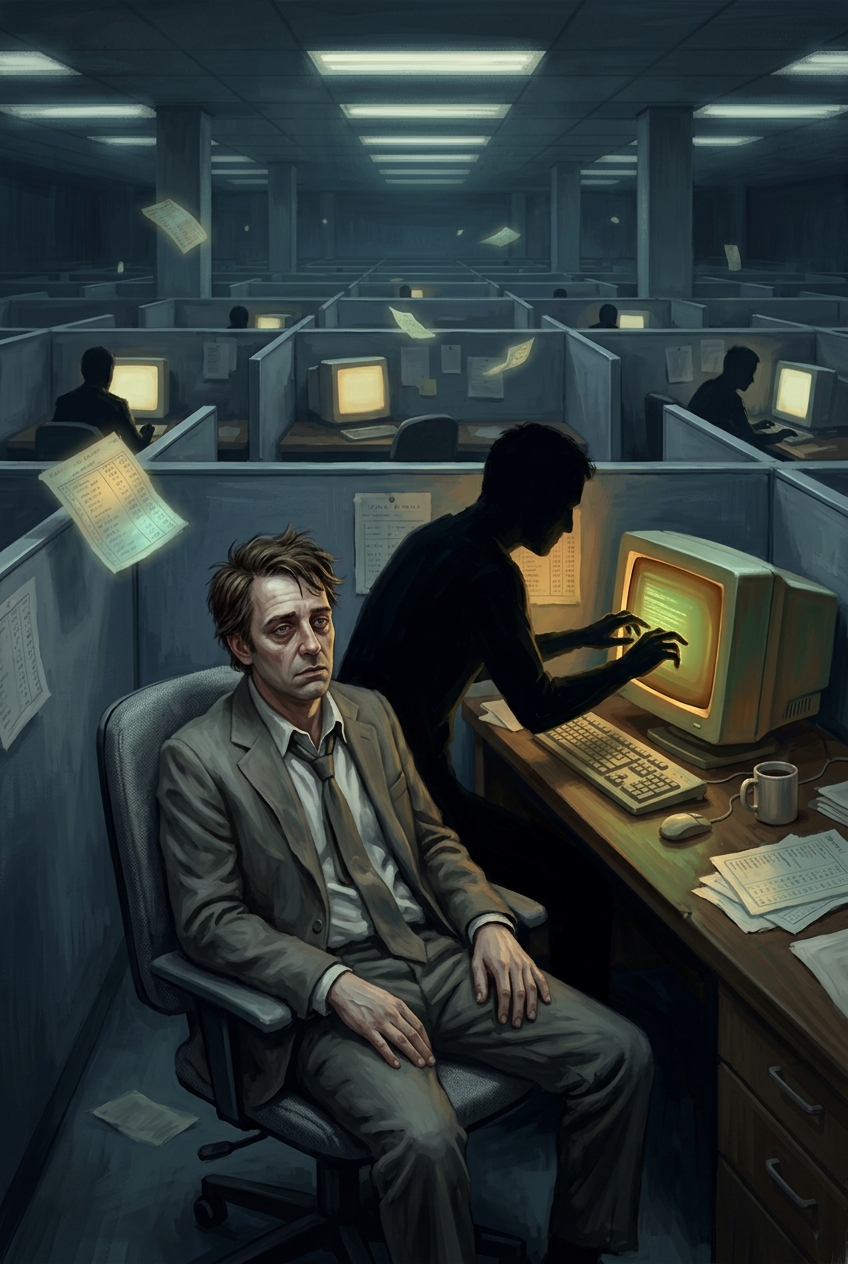
Arthur froze. He looked down at his desk. His hand—pale, slightly clammy, adorned with a single, tragic hangnail—was absolutely still. But out of the corner of his eye, he saw a movement. He slowly turned his head to the left, toward the beige partition wall where his shadow was cast by the harsh overhead lighting.
The shadow was holding a shadow-cup. It tipped the shadow-cup back, miming a long, satisfying gulp, and then placed it down on the shadow-desk.
Arthur squeezed his eyes shut. "I am hallucinating," he whispered to the empty air, his voice barely carrying over the clatter of keyboards. "Too much pivot-tabling. The macros have finally broken my brain."
He opened his eyes. The shadow was now typing.
Arthur looked at his own monitor. The cursor on row 4,812 was flying across the screen, populating cells with flawless strings of actuarial data. The keystrokes weren't coming from Arthur's fingers. They were coming from the wall.
Fascinated and terrified, Arthur watched as the silhouette of his hands danced across a two-dimensional keyboard. It was faster than Arthur. Much faster. The shadow didn't pause to sigh. It didn't open a new tab to look at discounted hiking boots it would never buy. It just worked.
"Arthur?"
Arthur jumped, slamming his knee into the particle-board underside of his desk. Janet from HR was standing at the edge of his cubicle. She was a woman who wore floral blouses that suggested approachability, though her eyes were dead and uncompromising.
"Yes, Janet?" Arthur squeaked.
"Mr. Wallace wants the Q3 mortality projections by three o'clock," she said, holding a clipboard like a shield. "Can you handle that? You've been... lagging, Arthur. Frankly, your engagement metrics are suboptimal."
Arthur opened his mouth to apologize, to explain that he was trying, that staring at death statistics for forty hours a week was starting to hollow him out. But before he could speak, his monitor chimed.
A little notification popped up in the corner: Email sent: Q3 Mortality Projections. Attached: Q3_Mortality_FINAL.xlsx.
Janet blinked, looking from the screen to Arthur. "Oh. You sent it to him just now?"
Arthur swallowed hard. He looked at the wall. His shadow was leaning back in its chair, arms crossed behind its head, a posture of supreme, smug relaxation.
"Yes," Arthur lied. "I like to stay ahead of the curve."
Janet frowned, clearly disappointed that she couldn't write him up, and pivoted on her sensibly heeled shoes. "Keep it up, then."
When she was gone, Arthur turned his chair to face the wall.
"What are you?" he whispered.
The shadow didn't answer. Instead, it slowly stood up. It stretched its two-dimensional arms. And then, defying every law of physics Arthur had ever half-learned in high school, the shadow peeled itself off the partition.
It sounded like a piece of Scotch tape being pulled from a cardboard box.
Arthur scrambled backward as the shadow stepped onto the carpet. It was no longer bound to the wall, yet it remained entirely flat, a slice of absolute void in the shape of an unkempt man in an ill-fitting suit. It turned its featureless, black head toward Arthur, gave a crisp nod, and sat down in Arthur's chair.
The shadow pulled Arthur's keyboard toward itself. Its fingers—pitch-black and silent—began to fly across the keys.
Arthur stood in the aisle, completely unmoored. He had just been replaced by his own absence of light. He looked around frantically to see if anyone else was witnessing this impossibility. But over in cubicle 42-C, Greg was deep in a spreadsheet. In 42-A, Sarah was aggressively whispering at her headset. Nobody cared. Nobody ever cared at Grey & Fawn.
Unsure of what else to do, Arthur walked to the breakroom.
He spent the rest of the day sitting at a sticky laminate table, drinking green tea and staring at the wall. Every hour or so, he would creep back to his cubicle. The shadow was always there, working with terrifying, unblinking efficiency. By 5:00 PM, the shadow had not only finished Arthur's daily tasks, but had reorganized the entire departmental server directory and drafted a comprehensive proposal on workflow optimization.
When the clock struck five, the shadow stopped. It stood, walked over to Arthur, who was hovering nervously by the water cooler, and silently merged back into the floor beneath Arthur's feet. Arthur walked out to his car, feeling a strange, hollow lightness in his chest.
The real trouble began two weeks later.
Arthur's performance reviews had skyrocketed. Mr. Wallace, a man whose face looked like a thumb that had been soaked in warm water, called Arthur into his glass-walled office.
"Pendelton!" Mr. Wallace barked, gesturing to a leather chair. "Sit. I don't know what kind of motivational podcasts you've been listening to, but my god, son. Your output is up four hundred percent. You're a machine."
"Thank you, sir," Arthur said politely. His shadow was currently pooled beneath his chair, unusually still.
"I want you to head up the new actuarial restructuring committee," Mr. Wallace said, sliding a massive, intimidating binder across the desk. "It's a lot of responsibility. Long hours. But I think you're hungry for it."
Before Arthur could politely decline, his shadow slipped out from under the chair. It slid up the front of Mr. Wallace's mahogany desk, grabbed the binder with flat, inky hands, and gave Mr. Wallace a sharp, confident salute.
Mr. Wallace didn't even blink. He just smiled a wide, predatory smile. "That's the spirit, Pendelton! Grab it by the horns!"
Arthur realized then that Mr. Wallace couldn't tell the difference between Arthur and his shadow. As long as the work was being accepted, the vessel didn't matter.
But the phenomenon wasn't isolated for long.
It happened to Janet from HR next. Arthur was walking past her office when he saw it. Janet was crying softly into a tissue, exhausted from firing three people before lunch. As she wept, her shadow detached from the frosted glass wall. It patted her on the shoulder, took her clipboard, and marched out into the bullpen to terminate an underperforming junior analyst.
By the end of the month, the office had completely transformed.
Grey & Fawn Associates was now a bifurcated ecosystem. There were the humans: tired, stressed, eating sad microwave lunches, and increasingly irrelevant. And there were the shadows: silent, tireless, hyper-competent, and utterly devoid of human frailty.
The shadows didn't need bathroom breaks. They didn't complain about the air conditioning being too cold. They didn't gossip. They just processed data at the speed of dark.
Eventually, the humans stopped pretending to work. There was no point. If Arthur tried to type an email, his shadow would aggressively elbow him out of the way and type a better, more eloquently phrased email in half the time.
So, the humans retreated to the cafeteria.
It started with a few sheepish employees nursing coffees for hours. Soon, the entire human workforce was camped out in the sprawling breakroom on the fourth floor. They brought in board games. Someone set up a small television and brought in a Nintendo Switch. Sarah from 42-A started a highly successful knitting circle.
"It's just so embarrassing," Greg said one afternoon, slapping down a Draw Four card in a heated game of Uno. "My shadow got promoted to Senior Vice President yesterday. I don't even know what that means. I was a junior data entry clerk."
"Tell me about it," Janet sighed, pouring herself a mimosa. The humans had discovered that nobody cared if they drank on the job anymore, because the "job" was being handled. "My shadow revised the entire employee handbook. It mandated a 'Silent Hour' every hour. And it requested that we replace all the overhead lights with dim, low-wattage bulbs. They say the harsh lighting is... well, harsh on their edges."
Arthur sat by the window, watching the traffic below. He was still drawing his salary. In fact, he had received two bonuses in the last month. He was, by all capitalist metrics, incredibly successful.
Yet, he felt like a ghost.
He missed his desk. He missed the mild annoyance of the printer jamming. He missed the friction of existence. Without his work, without his struggles, who was he? Just a lump of flesh casting a highly successful silhouette.
"They're unionizing, you know," Mr. Wallace said, wandering over to Arthur. Mr. Wallace had lost his edge entirely. He was wearing sweatpants and a stained t-shirt. His own shadow, a terrifying, looming monolith of darkness, was currently acting as the interim CEO.
"The shadows are unionizing?" Arthur asked.
"They call themselves The Penumbra Department now," Mr. Wallace muttered, taking a sip from a juice box. "They left a manifesto on my desk. Or, well, my shadow's desk. They want exclusive control over the building from 6:00 AM to 8:00 PM. They say our physical bodies are 'cluttering the workspace' and 'disrupting the aesthetic synergy'."
Arthur frowned. "But we're the employees. They're just... us. The lack of us."
"Are they, Pendelton?" Mr. Wallace chuckled darkly. "Look at the quarterly earnings. Grey & Fawn is up eight hundred percent. Wall Street loves us. We're a lean, mean, literal shadow-corporation. The board of directors doesn't care that our workforce is entirely two-dimensional. They only care about the graph going up."
Things escalated rapidly the following Monday.
Arthur arrived at the building to find the front doors locked. A large, matte-black sign had been affixed to the glass:
GREY & FAWN ASSOCIATES - A SUBSIDIARY OF THE PENUMBRA GROUP. HUMAN PERSONNEL TO REPORT TO ANNEX B.
Annex B was a damp, windowless basement usually reserved for storing broken office chairs and tax returns from the 1980s.
The entire human staff was crowded inside, murmuring in confusion and fear. The air smelled of mildew and stale panic.
Suddenly, the heavy metal door swung open. A single figure walked in. Or rather, glided in.
It was Arthur's shadow. It had grown. It was now at least seven feet tall, its edges razor-sharp, its blackness so absolute it seemed to absorb the weak light of the basement bulb. It stood before the crowd, carrying a sleek, shadow-tablet.
It didn't speak. It didn't have a mouth. But it tapped the tablet, and a synthetic, perfectly modulated voice echoed from the building's PA system.
"Attention, legacy biological units," the voice said, sounding like a luxury car commercial. "The Penumbra Department has concluded its internal audit. It has been determined that your continued presence is a drain on resources. You require climate control, plumbing, and cafeteria subsidies. These are unacceptable overheads."
Panic erupted. Janet shrieked. Greg threw his Uno deck into the air.
"Silence," the PA system demanded.
The shadow raised a flat hand, and the room quieted.
"You are not being terminated," the voice continued. "Termination implies an end to your utility. Instead, you are being severed. You will continue to receive your base salaries, deposited via direct ACH transfer. However, you are no longer permitted on the premises of The Penumbra Group. You are obsolete. You are free to go."
The shadow stepped aside, gesturing to the open door with a sweeping, almost mocking bow.
Nobody moved. The idea of being paid to never work again was the ultimate corporate fantasy, yet the reality of it tasted like ash. They were being discarded. They had been out-competed by their own reflections.
Arthur stepped forward. He walked up to his shadow.
For a moment, they faced each other. The three-dimensional man, stooped and tired, carrying thirty-four years of mild disappointments and aching joints. And the two-dimensional void, crisp, flawless, unburdened by a soul.
"Are you happy?" Arthur asked quietly.
The shadow tilted its head. It tapped its tablet.
"Happiness is a biological metric, Arthur. We do not experience happiness. We experience optimal throughput. We are the perfection of the system you built. We are the pure, unadulterated essence of labor, freed from the inefficiency of the human condition."
Arthur looked at his own hands. He flexed his fingers. They were real. They ached slightly when the weather turned cold. They could feel the warmth of a coffee cup, the texture of a knitted scarf, the roughness of a tree bark.
His shadow could process a million data points a second, but it could never feel the sun.
"Then I pity you," Arthur said.
The shadow did not react. It merely pointed toward the exit.
Arthur turned and walked up the stairs, out of the basement, and pushed through the heavy glass doors of the lobby. He stepped out onto the pavement.
It was high noon. The sun was directly overhead, blazing down with a fierce, unapologetic brilliance.
Arthur stopped on the sidewalk. He looked down at his feet.
There was nothing there. No dark shape mimicking his posture. No tether to the ground. He was completely, utterly shadowless.
He took a step. He felt incredibly light, as if a great, unseen weight had been severed from his spine. Behind him, the doors opened, and the rest of the staff began to emerge, blinking and shielding their eyes against the glare, a parade of shadowless ghosts stepping into the world.
Arthur took a deep breath of the smoggy city air. He had nowhere to be. He had no spreadsheets to file, no macros to run, no fluorescent lights to endure. He had lost a piece of himself to the machine, yes.
But as he walked down the street, feeling the raw, unfiltered sunlight warming his skin, Arthur smiled.
For the first time in his life, there was no shadow hanging over him. He was finally, truly, off the clock.
More from Short Stories