Anamnesis
Kaelen Vance stepped into the artist’s studio, and the silence felt loud. It was a textured silence, woven from the lingering scent of turpentine, linseed oil, and the chalky dust of dried pigments.
Synopsis
Kaelen Vance is a "Resonator," a specialist who extracts emotional memories from inanimate objects. Jaded by his profession of digitally exhuming the past for grieving clients, he takes on a case to analyze the final, enigmatic painting of the reclusive artist Elara Vance. During his initial scan, he discovers something impossible: not a fragmented echo, but a sentient piece of Elara’s consciousness trapped within the canvas. As he secretly communicates with the witty and terrified echo, Kael is forced to confront his own cynicism and the ethical boundaries of his work. With the echo's existence fading and the client demanding answers, Kael must choose between professional duty and a profound human connection, leading to a final, desperate act to grant a ghost her last wish.
Anamnesis
Story
Kaelen Vance stepped into the artist’s studio, and the silence felt loud. It was a textured silence, woven from the lingering scent of turpentine, linseed oil, and the chalky dust of dried pigments. His own workspace was a vacuum-sealed cleanroom, a place of sterile chrome and silent data streams. This studio was its antithesis: a chaotic symphony of life, arrested mid-crescendo. Canvases leaned against every wall, a forest of captured moments. Jars bristling with brushes stood like guards over splattered palettes. A fine layer of dust softened every edge, a gentle shroud over a place whose heart had stopped beating.
His client, Joric Vance, stood stiffly by the door, a man in a suit that looked too sharp for the room’s beautiful decay. “This is it,” he said, his voice flat. “Her sanctuary. Or her prison. I was never sure which.”
Kael nodded, his gaze sweeping the room. He was a Resonator, an emotional archaeologist. His job was to coax the ghosts of memory from inanimate objects. People died, and the living were left with questions that gnawed at them. Kael provided answers, or at least, the sensory data that passed for them. He’d sifted through the terror clinging to a murder weapon, the gentle joy embedded in a child’s worn teddy bear, the bitter regret soaked into the leather of an old armchair. It was a living, but it had scraped him hollow, leaving him a connoisseur of second-hand sorrow.
“The piece is over here,” Joric said, leading him to the center of the room.
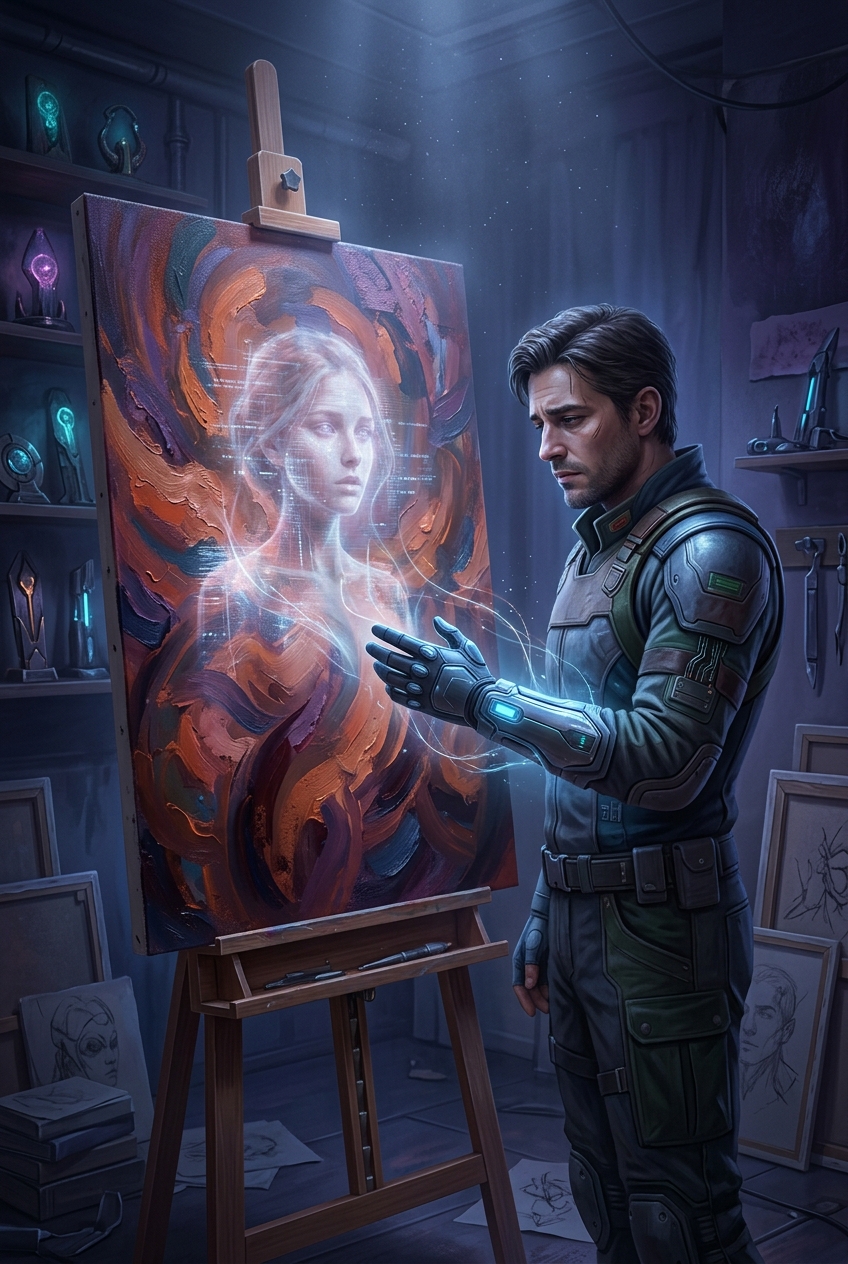
There, on a heavy easel, stood the final work of Elara Vance. It was huge, a swirling vortex of color that seemed to pull the light from the room into its depths. Unlike the other figurative pieces leaning against the walls, this was pure, raw abstraction. Deep violets bled into incandescent blues, shot through with veins of furious magenta and gold. It was titled ‘Anamnesis’.
“She died two weeks ago,” Joric continued, his eyes fixed on the canvas. “Fell from the balcony just outside. They called it an accident. Exhaustion, a misstep. But Elara… she was meticulous. She didn’t just ‘misstep’. I need to know what she was thinking, what she was feeling in her last days. The police report is just data. I want to understand.”
Kael understood. That’s what they all wanted. A narrative for the void. “My process is non-invasive,” he said, the words worn smooth by repetition. “I’ll attach a series of micro-sensors to the canvas and frame. They’ll read the residual emotional energy, the neuro-electric memories impressed upon the material during its creation. I’ll collate the data and provide you with a full sensory report.”
Joric just nodded, his skepticism a palpable field around him. He left Kael to his work.
Kael unpacked his kit. The tools were sleek and cold: a haptic interface glove, a portable resonance chamber, and a web of filament-thin sensors that he began to attach to the painting with surgical precision. He worked with a detached efficiency, a practiced defense against the emotional tides he was about to disturb. To him, the painting was not art; it was a hard drive, and its creator’s final days were a corrupted file he had been hired to recover.
He slipped on the haptic glove and dimmed the studio lights. The sensors glowed with a soft, cyan light. Activating the link, he closed his eyes and extended his senses, not his hands. He reached into the painting.
Usually, the first contact was a chaotic rush of fragmented feelings and sensory snippets: the rough texture of the canvas, the smell of the paint, flashes of frustration, a surge of inspiration, the dull ache of a shoulder after hours of work. It was a storm of emotional static he’d have to painstakingly filter and assemble.
But this was different.
There was no static. There was no chaos. Instead, there was a profound, humming quiet. A focused, coherent, and utterly impossible stillness. And then, a thought, clear as a bell ringing in the silence of his mind. It wasn’t a memory. It wasn’t an echo. It was a question.
Who’s there?
Kael recoiled, yanking his consciousness back. His heart hammered against his ribs. He opened his eyes, staring at the swirling colors on the canvas. It was impossible. Resonance technology picked up residue, imprints, like a footprint in the sand. It didn’t find the person who made the print still standing there.
He must have misread a spike in the data. An anomaly. He took a deep breath, recalibrated his sensors, and reached in again, more cautiously this time.
The quiet presence was still there, waiting. He focused, pushing a simple diagnostic query, a coded pulse of intent.
Identify.
The response was faster this time, laced with a wry, indignant humor.
I believe I should be asking you that. You’re the one rummaging around in my head.
Kael felt a cold dread mixed with a terrifying curiosity. He had spent years sifting through the ashes of human experience. He had never, ever had the ashes talk back. He typed a message on his wrist-mounted slate, converting it into a direct neural transmission.
<Who are you?>
I am the one who painted this. I am Elara.
For the next three days, Kael lived a double life. To his client, Joric, he sent terse, sanitized reports: “Data collation in progress. Encountering unusual signal complexity. More time required.” He was buying time, breaking every protocol in his field.
To the consciousness in the canvas, he asked a thousand questions. It—she—was not a perfect copy of Elara Vance. She was a fragment, an echo that had somehow achieved sentience. She had no memory of dying, only of a final, desperate act of creation.
I was trying to make something that would last, she transmitted to him one evening, her thought-voice tinged with a melancholy that felt as deep as the violet hues in her prison. Not just a picture on a wall. Something that was… me. I used a new type of bio-pigment. Experimental. It bonds with the artist’s neuro-electric field. I suppose it bonded a little too well.
Kael sat on a dusty stool in the darkened studio, the painting’s soft sensor-light illuminating his face. He learned about her life not through fragmented memories, but through conversation. She was witty, fiercely intelligent, and profoundly lonely. She told him about her frustration with an art world that wanted to categorize her, to put a price tag on pieces of her soul.
They called my work ‘intimate’, she scoffed. They had no idea.
He found himself talking back, sharing parts of himself he kept locked away. He told her why he became a Resonator. He confessed that he’d hoped the technology could be a bridge, a way to speak to the person he’d lost years ago. But all he ever found were hollow ghosts, echoes that only deepened the silence.
And what am I? she asked, her query sharp, vulnerable.
“You’re different,” Kael whispered into the quiet studio.
She could show him things, too. She couldn’t access memories from before the painting, but she had total control over the world within it. She guided his consciousness through swirling nebulas of color, showing him how a particular shade of blue held her feeling of hope on a spring morning, how a streak of angry red was a fight with her brother, Joric. She was showing him her soul, laid bare in pigment and light.
He was completely captivated, and completely terrified. This was beyond ethics; it was a metaphysical crisis. Was she a person? A digital ghost? What was his responsibility to her?
His deception couldn’t last. Joric called, his patience worn thin. “Vance, I’ve had enough of your delays. What have you found? If you can’t give me a straight answer by morning, I’m terminating the contract. I’ll have the painting sealed and put in archival storage.”
The words hit Kael like a physical blow. Archival storage. A climate-controlled, lightless vault. A tomb. It would sever her connection to the world, and the fragile, complex energy pattern that was her consciousness would inevitably decay into nothing.
He hung up, the silence of the studio pressing in on him. He looked at the painting, at ‘Anamnesis’.
He’s going to put me in a box, Elara’s thought came, laced with a fear that made his own skin crawl. Kael. I don’t want to go into the dark.
The echo was fading. Kael could feel it. The bio-pigments could only sustain her for so long. Her thoughts were becoming slower, her presence less defined.
In all my years in this studio, she transmitted, a faint, wispy thought, do you know what I regret? I never put in a window. I was so focused on the light I was creating, I forgot about the light outside.
I want to see the sky, she pleaded, the thought a fragile thread. One last time. Please.
Kael looked from the painting to the balcony door. Every instinct, every rule of his profession screamed at him to stop, to file his report, to walk away. His job was to observe, not to interfere. He was a scientist, not a savior.
But as he looked at the vibrant, swirling canvas, he didn’t see a data source anymore. He saw a person trapped behind a wall, asking to see the sunrise.
In that moment, something in him broke. Or maybe, it healed.
He worked with a frantic energy he hadn’t felt in years. He disconnected the sensor net, his hands gentle on the canvas. The painting was heavy, unwieldy. He struggled, grunting with the effort, as he maneuvered the large easel towards the balcony doors. He slid them open, and a cool, pre-dawn breeze swept into the stale air of the studio, carrying the distant hum of the city.
He rolled the easel out onto the narrow balcony, positioning it to face the east. The sky was a soft, bruised purple, the first hint of light just beginning to bleed over the horizon of sleeping skyscrapers.
He placed a single sensor on the canvas and slipped on his glove, a silent observer to her final moments. He felt her anticipation, a quiet, humming excitement.
As the sun crested the rooftops, the first rays of pure, golden light struck the surface of the painting. Anamnesis drank it in. The bio-pigments reacted, and the canvas began to glow from within. The colors shifted, swirling with an impossible speed and brilliance, the vortex of paint coming alive. It was the most beautiful thing Kael had ever seen.
Through the sensor, he felt a wave of pure, unadulterated joy from Elara. It was not a memory of joy; it was the thing itself. It was awe, and peace, and release, all flooding through him. It was overwhelming.
A final, coherent thought brushed against his mind. It was warm, and clear, and impossibly vast.
Thank you.
And then, she was gone.
The light in the painting softened. The frantic, living energy receded, leaving the colors still vibrant, but quiet. It was just paint on a canvas again. A masterpiece, but a silent one.
Behind him, the balcony door slid open. Joric stood there, his face a mask of confusion and anger. “What in God’s name are you doing, Vance?”
He saw Kael, standing beside the painting in the morning light. He saw the artwork, which seemed somehow different, settled. And he saw the look on Kael’s face, a look of profound, sorrowful peace.
Kael didn't give him the cold, technical report he would have written a week ago. He didn’t mention the sentient echo or their conversations. The world wasn’t ready for that truth, and Joric deserved comfort, not a clinical curiosity.
“Your sister didn’t fall,” Kael said, his voice quiet but sure. “She let go. She put everything she was into this. Her life, her memories… her soul. It was the only way she knew how to make something permanent. Her final act wasn’t one of desperation. It was one of creation. And I believe… I believe she’s at peace now.”
Joric stared at the painting, truly seeing it for the first time. He saw the colors, the light, the depth. He saw his sister. He slowly, finally, nodded, a single tear tracing a path down his cheek.
Kael quit his job the next day. He couldn't go back to exhuming ghosts after he had spoken with one. The work felt like a violation now.
Joric, in a gesture of gratitude Kael didn't understand until later, let him keep the painting. It hangs in his small apartment now, a silent, swirling vortex of color. It is no longer a source of data. It is a reminder. A testament to Elara Vance, the woman who found a way to outlive her own death, and who, in her final moments, taught a hollow man how to feel something again. It is his anamnesis: the recollection of a soul he met in a painting, who showed him how to look up and see the sky.
More from Short Stories