Can AI Improve Mental Health Care
Mental health care is in crisis — not enough therapists, astronomical costs, and a stigma that keeps millions from ever seeking help.
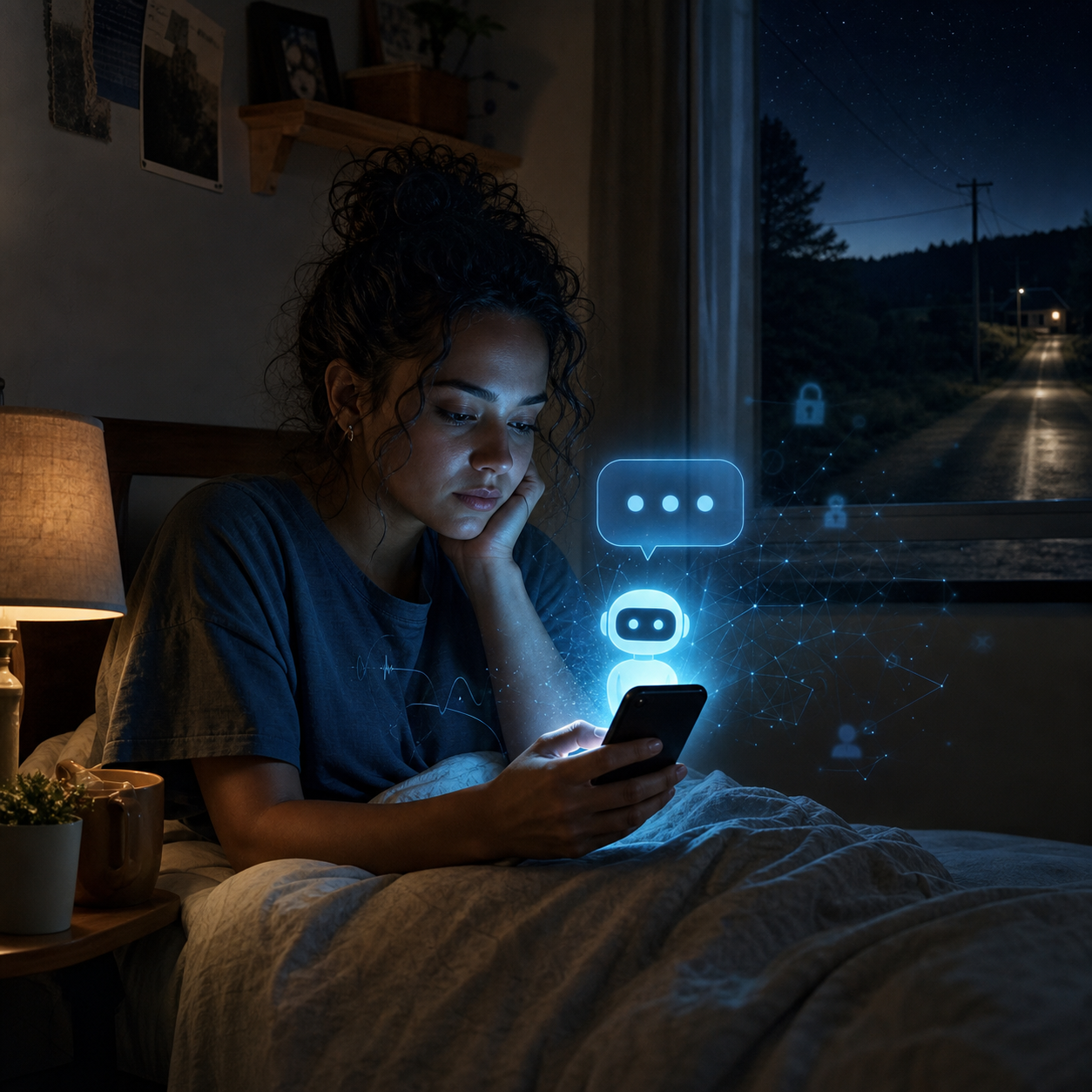
Can AI Improve Mental Health Care?
Date: 12-06-2026 Group: Group3 Host: Vinnie "The Mic" Marino Cast: Buck, Dr. Vega, Harper, Pastor Cole
Topic Description
Mental health care is in crisis — not enough therapists, astronomical costs, and a stigma that keeps millions from ever seeking help. Now Silicon Valley wants to solve it with AI: chatbots that listen at 3 a.m., algorithms that flag suicidal ideation in your texting patterns, and therapy copilots that whisper suggestions into a clinician's earpiece mid-session. The debate isn't just technical — it's about trust, data privacy, the soul, the free market, and whether a small town in rural Oklahoma has the same shot at healing as Manhattan's Upper West Side.
Script
Vinnie "The Mic" Marino
BOOM — welcome to Loud and Wrong, the podcast where we yell first and think second! I'm Vinnie "The Mic" Marino, comin' at ya live from the greatest borough that ever put a person in a straitjacket — Brooklyn, baby! Tonight's topic: Can AI cure your crazy? Can a chatbot save your soul? We got therapy copilots, we got early-warning brain scanners, we got an access revolution or a surveillance nightmare — dependin' on who you ask! And I got FOUR absolute characters in the room with me tonight to find out. First up — he smells like diesel and has opinions about everything — Buck, the voice of rural America!
Buck
Much obliged, Vinnie. Though I gotta say, "can AI cure your crazy" is — how do I put this — the most city-folk way I've ever heard anyone frame a question about human sufferin'.
Vinnie "The Mic" Marino
There he is! Already offended and we are forty-five SECONDS in! Also in the studio — the man who sees a corporate conspiracy in every granola bar — Dr. Vega!
Dr. Vega
Let's say I see patterns in granola bars. There's a meaningful difference.
Vinnie "The Mic" Marino
Sure there is, doc. Sure there is. Also with us — she's built four startups and has opinions about every single one — Harper, our libertarian in residence!
Harper
Happy to be here. And yes, it's four. Not three.
Vinnie "The Mic" Marino
And last but — spiritually, CERTAINLY not least — Pastor Cole, who I'm told did not come here to save my soul but will absolutely try anyway!
Pastor Cole
laughs warmly I make no promises, Vinnie. But I do come in peace.
Vinnie "The Mic" Marino
Alright — let's GET INTO IT. AI therapy copilots. Right now, today, there are apps — Woebot, Wysa, whatever-brand-of-ChatGPT-in-a-bathrobe — people are pourin' their hearts out to chatbots. Is this the future of mental health care, or is this the most depressing tech demo any of us has ever witnessed? Buck — you first. What do folks back home think about this?
Buck
Vinnie, I'm gonna be real with you. Back home, therapy is already seen as somethin' you do when you've completely fallen apart — it ain't Tuesday-afternoon-maintenance like it is in New York. So the idea that now, instead of a real person who knows your family and your land and your history, you're gonna type your problems into a phone screen at two in the morning? That's not mental health care. That's like replacing your doctor with a WebMD printout and callin' it progress.
Harper
Okay, but Buck — that's kind of the whole point. Most people don't have access to a real person who knows their family. Rural areas have the worst therapist-to-population ratios in the country. If someone in a remote county can get genuine support at 2 a.m. on their phone because the nearest therapist is ninety miles away and has a six-month waitlist, that is a real and meaningful net positive. The alternative to AI therapy isn't a warm, wise human therapist — for a huge slice of this country, it's nothing.
Buck
I hear that, Harper, I genuinely do. But "better than nothin'" is the world's lowest bar. You know what else is better than nothin'? Duct tape on a cracked windshield. Don't mean you drive the school bus with it.
Vinnie "The Mic" Marino
EHHHH! That's a TAKE right there, Big Tony! Dr. Vega — you're already makin' that face. What's the conspiracy?
Dr. Vega
Not a conspiracy — an incentive structure. Let's look at who benefits when mental health care pivots to AI. Digital mental health is a multi-billion dollar industry. Venture capital poured over eight billion dollars into digital health in 2021 alone. The companies behind these apps collect extraordinarily intimate data — your fears, your traumas, your 3 a.m. thoughts about whether your life is worth living. Now ask yourself: who owns that data? Who can monetize it? The health insurance industry has a documented history of using personal health information in ways that actively harm the people who disclosed it. I'm not saying the apps are evil. I'm saying: before you hand a corporation the most sensitive thoughts in your brain, examine the incentive structure.
Pastor Cole
Dr. Vega, I rarely say this, but — you're touching on something I feel deeply. The soul is not a dataset. When a person comes to a pastor or a counselor in genuine distress, something sacred happens in that exchange. There is a reason we talk about "bearing witness." A human being who has suffered can look at another sufferer and say, genuinely: I know this darkness. I have been in it. You are not alone. Can a machine do that? Or is it — and I mean this sincerely, not as a rhetorical trick — just a very sophisticated mirror?
Harper
Pastor, I respect that framing enormously. But I'd push back on one thing: can every human therapist do that either? There are bad therapists. Burned-out therapists. Therapists who are excellent with one patient type and harmful with another. The question isn't "AI versus the platonic ideal of therapeutic relationship." It's "AI versus the real, imperfect, expensive, scarce, and deeply unequal system that actually exists right now."
Vinnie "The Mic" Marino
Okay — let's shift gears because I wanna get into the early-warning angle and this is where it gets genuinely WEIRD and I love weird. There are companies building AI that reads your texts, your social posts, your voice patterns, and flags when you're spiraling into a mental health crisis — before you even know you're in one. Buck — I swear to God — what does your county think of that?
Buck
Vinnie, I promise you: you say "the AI is gonna monitor my texts to see if I'm depressed" in my county, and half those folks are gonna assume it's a gun-grab, and the other half are gonna think it's the Rapture. Neither group is gonna opt in voluntarily.
Vinnie "The Mic" Marino
dying laughing Big Tony, we need a sound effect for the Rapture — Harper! You're a libertarian. The surveillance angle here has gotta be keepin' you up at night.
Harper
It's genuinely complicated and I'll give it to you straight. An opt-in early-warning system — where the individual actively chooses to be monitored, controls their own data, and can exit at any time — I can defend that. That's technology serving the individual's stated interests. The second you make it employer-based, insurer-based, or — God forbid — government-mandated, I'm completely out. The line is meaningful consent and real control. Without those, it's surveillance with a therapy hat on, and we should call it what it is.
Dr. Vega
Harper, "opt-in" sounds clean in theory. In practice, when your employer's wellness app says "participate or lose access to your mental health benefit," that's coercion wearing a smiley face. We've seen this exact pattern. Facebook's data collection was technically "optional." Surveillance capitalism is built entirely on "consent" forms no one reads and cannot meaningfully refuse. The history of tech "consent" is a history of manufactured agreement under economic pressure. When the choice is "opt in or forfeit your health coverage," the consent is not free.
Pastor Cole
I want to add something here, and I offer it gently. There is a reason that confession — the act of laying bare the weight of your inner darkness — has always happened in sacred, protected spaces. The confidentiality of the confessional is not merely a legal nicety. It's a theological statement about the dignity of the human person. What these early-warning systems ask us to do is make our innermost selves continuously legible to algorithms, to corporations, to strangers. I think we should mourn, at least a little, what we are being asked to surrender. The question isn't only whether it works. It's what it costs us to live under it.
Buck
You know what this reminds me of? They automated the water treatment a few counties over. Saved money, ran smooth — right up until the sensor malfunctioned and nobody caught it for three weeks because there wasn't a human being in the loop who actually cared whether the water was safe. You hand off something critical to a machine, you better have a person somewhere in that chain who's paying attention and gives a damn.
Vinnie "The Mic" Marino
Alright, alright — I'm gettin' emotional and I can't let the audience see that, so let's talk ACCESS because this is personal for me. I grew up poor in Bensonhurst, okay? Mental health care was not on the menu. You were sad? You went to church. You had a breakdown? Your mother called the priest. The idea of payin' two-fifty an hour to tell a stranger about your childhood — that's a luxury good. So is AI the equalizer? Does it crack open mental health for people who've never had a shot at it?
Harper
That's the strongest argument for AI in this space, and I'll make it plainly: the current mental health system is gated behind money, geography, and a genuinely terrifying waitlist. If you live in a food desert, there's a very good chance you also live in a therapy desert. AI tools are not a replacement for human care — I've said that. But as a first point of contact, a 24/7 resource for the millions who currently have nothing, they have real value. The goal should be sensible regulation: clear standards, real liability, opt-in design. Not prohibition and not a free-for-all.
Dr. Vega
I'll take Harper's point seriously and add a historical caution. The opioid crisis happened, in part, because the pharmaceutical industry marketed OxyContin as an accessible solution to widespread pain — physical pain, and increasingly, psychological pain. The "democratization of pain relief" narrative was used to justify aggressive, catastrophically irresponsible prescribing. "Expanding access" can be a marketing frame for "creating a massive new dependent customer base." I'm not saying AI therapy equals OxyContin. I'm saying: the access argument has been successfully used to sell harm before, and we should ask hard questions about who profits when you stay subscribed, and whether that interest aligns with actually getting you better.
Vinnie "The Mic" Marino
BOOM. Right to it. Risks of bad advice — this is the part that keeps me up at night and I'm not even the one in therapy. AI will get it wrong. What happens when it gets it wrong about someone who's in crisis? Stakes here are life and death.
Pastor Cole
This is where I feel the weight of this conversation most fully. A person in genuine crisis — suicidal, despairing, at the end of their rope — who reaches out, even to a machine, has performed an act of enormous courage. The reaching out itself is sacred. And if what they receive in return is something generic, something tone-deaf, something that accidentally reinforces their worst fears about themselves — the damage is not abstract. Proverbs says, "A word fitly spoken is like apples of gold in settings of silver." The wrong word, in the wrong moment, to the wrong soul is its terrible opposite. We don't yet understand the full weight of what we're gambling.
Buck
And this is where I come back to the human piece. We had a pastor back home who did counseling out of the church. No forms, no insurance codes, no liability waiver. Just a man who'd lived some things and loved his community and had all the time in the world and a pot of coffee that was always on. People opened up to him in ways they'd never open up to a stranger with a clipboard — or a screen. That relationship was the medicine. The AI can answer at 2 a.m., and that matters. But it can't sit across from you in the same pair of boots it's been wearing for twenty years and know what you mean by the way you hold your coffee cup.
Harper
Buck, I actually love that story. And I'd frame it as: that pastor had skin in the game. He lived with those people. His reputation, his relationships, his community were all on the line if he gave bad counsel. That's the model. If a mental health AI gives advice that contributes to a suicide, and the company faces zero legal consequences because they buried a liability disclaimer in paragraph forty of their terms of service — that is the problem to fix. Real accountability. Real liability. Make the companies live or die by outcomes, not subscriptions.
Dr. Vega
Skin in the game is exactly right, Harper. Theranos convinced patients, investors, and federal regulators that it had a breakthrough diagnostic platform. The narrative was compelling — "democratizing lab access." The reality was fraud that harmed vulnerable people who trusted the system. Mental health AI is moving faster than any regulatory framework can track. There is a narrow window before the market locks in practices that will be extraordinarily difficult to unwind. We should use that window.
Vinnie "The Mic" Marino
Alright — I promised Big Tony we'd wrap before he fell asleep back there, so — five seconds, everybody, final word, GO. Buck.
Buck
If you're usin' an app to fix your mental health and there's no actual human being somewhere in that chain who cares whether you live or die — you've built yourself a very fancy placebo and called it a revolution.
Dr. Vega
Follow the data. Who owns it, who profits from it, and whether the incentive to keep you subscribed is the same as the incentive to get you actually well. Ask that question before you open the app.
Harper
If it saves one life in a county with no therapist within sixty miles, that matters. Regulate it with real teeth — liability, transparency, opt-in design. Don't throw it out because it's imperfect. The system it's supplementing isn't perfect either.
Pastor Cole
A person in despair needs to know they are seen, they are known, and they are loved — not by an algorithm processing their sentiment scores, but by another soul who has faced the dark and survived it. Technology can do remarkable things. It cannot love you. And for most of us, in the end, that is what heals.
Vinnie "The Mic" Marino
And THAT — THAT right there — is why I never fire Pastor Cole from this show even when he goes full sermon on me in the last thirty seconds. AI in mental health: promising, terrifying, and probably unstoppable. Like most things worth arguin' about. I'm Vinnie "The Mic" Marino. Keep your receipts, maybe keep your therapist, and for the love of all that is holy — keep your 3 a.m. thoughts somewhere safe. We're out! BOOM!
More from Podcasts