Could Wormholes Ever Be Engineered
Tonight the panel rips into the wormhole question from every angle they've got: the general relativity basics that put wormholes on the math board in the first place, the exotic matter problem that…
Could Wormholes Ever Be Engineered?
Date: 29-04-2026 Group: Group3 Host: Vinnie "The Mic" Marino Cast: Buck (Billy Bob), Dr. Vega, Pastor Cole, Harper
Topic Description
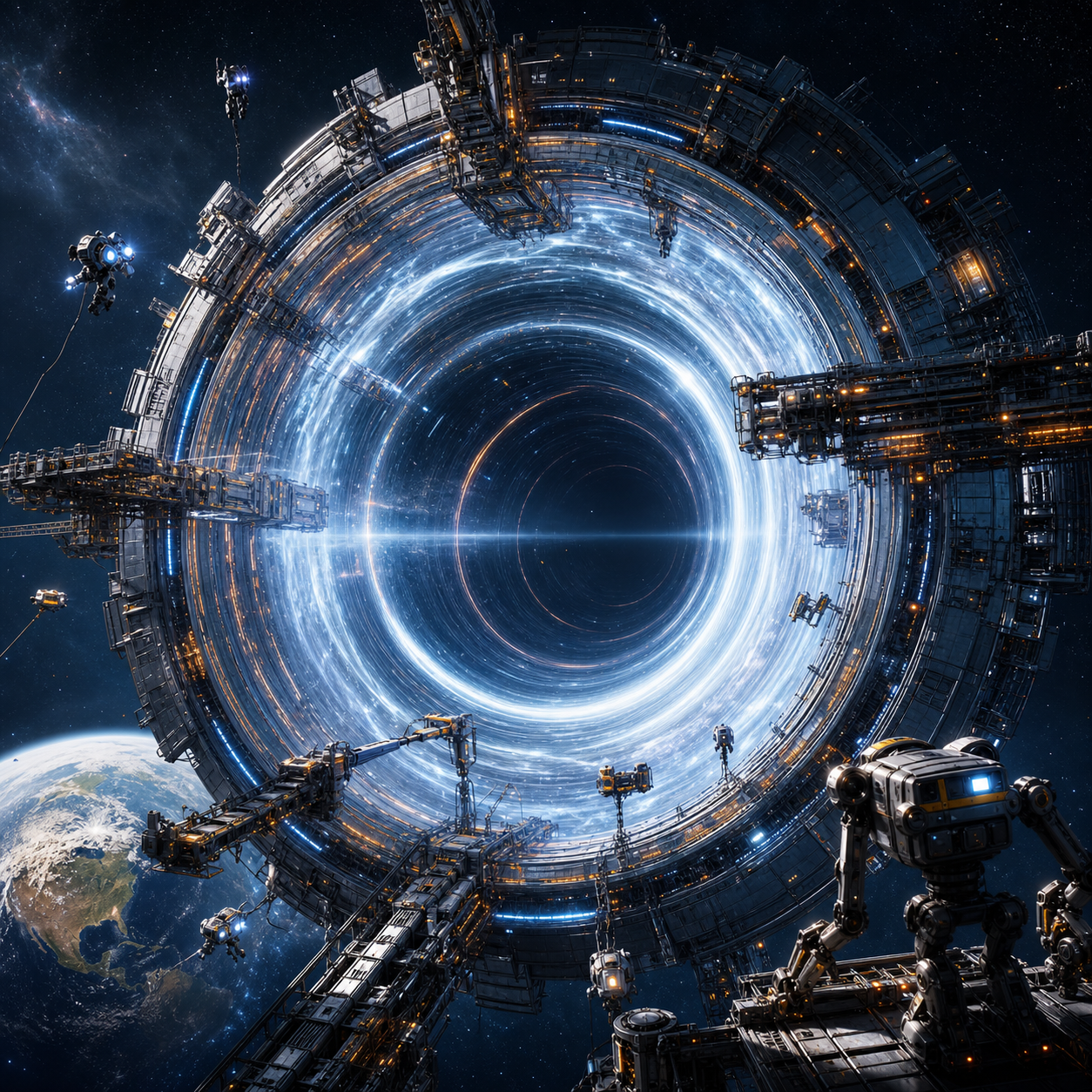
Tonight the panel rips into the wormhole question from every angle they've got: the general relativity basics that put wormholes on the math board in the first place, the exotic matter problem that keeps them stuck there, the split between using a wormhole for travel versus just sending a signal through one, and the very real worry that anybody dumb enough to actually open one might rip a hole in spacetime they can't close. Four worldviews, one impossible-sounding piece of physics, and Vinnie running point with a buzzer in one hand and a coffee in the other.
Script
Vinnie "The Mic" Marino
BOOM — good evening you beautiful degenerates, you're listenin' to The Mic and tonight, tonight, we are not talkin' politics, we are not talkin' sports, we are talkin' WORMHOLES. Yeah, you heard me. Holes. In space. The kind that, supposedly, you fall in over here and pop out next to Alpha Centauri buyin' duty-free. Big Tony, hit the sci-fi sting. whoosh noise. Now look — I got four lunatics in the studio tonight who are gonna fight about this for the next hour, and I love every one of 'em. On my left, the guy who can explain general relativity AND tell you which three FDA panel members got bought off doin' it — Dr. Vega, the calmest paranoid you'll ever meet. Next to him, Pastor Cole, our resident shepherd, here to remind us that God built the universe and might not appreciate us drillin' holes in His drywall. Then we got Harper, the libertarian, the founder type, the guy who hears "wormhole" and starts writin' a pitch deck. And rounding it out, my favorite, BUCK — Billy Bob himself, callin' in from somewhere with a tractor in the driveway and a Yeti cooler full of opinions. Buck, you ready?
Buck
Vinnie, I'm ready as a coon dog at suppertime. I'll be honest with ya right outta the gate — I heard "wormhole" and I thought we was talkin' about somethin' a fisherman cares about. Then my nephew, he's the one with the laptop and the bad posture, he tells me no, Uncle Buck, it's a shortcut through space. And I says, son, the only shortcut I trust is the one behind the Piggly Wiggly, and even that one floods every spring. So I'm comin' in here a skeptic. Y'all are gonna have to sell me hard.
Vinnie "The Mic" Marino
There it is, see — the man's already got a bumper sticker, we ain't even started. Doc Vega — Buck thinks this is fishin' bait. Lay it out. What IS a wormhole? Twenty seconds. Go.
Dr. Vega
Sure. Calmly: a wormhole is a solution to Einstein's field equations of general relativity — specifically a topological shortcut where two distant regions of spacetime are connected by a throat. The math goes back to Einstein and Rosen in 1935. So the first thing to understand is, this isn't speculation pulled out of a science fiction novel — it's a permitted geometry of the same equations that already correctly predict GPS satellite drift, gravitational lensing, and the orbit of Mercury. The mainstream view is: the equations allow it, but the physics required to stabilize it is something we've never observed.
Vinnie "The Mic" Marino
Whoa whoa whoa — "permitted geometry," fuhgeddaboudit, doc, you lost the truck drivers in row three. Buck, translate. Five-minute-tailgate version.
Buck
Alright, lemme have a swing at it. Imagine you got a piece of paper, right? You draw a dot on the left side, a dot on the right side. Long way to walk between 'em with a pencil. Now you fold the paper so the two dots touch. Poke a pencil through. THAT'S the wormhole. The doc is sayin' the universe, accordin' to Einstein, is the kinda paper you can fold. The problem is, ain't nobody ever seen it folded. We just got the math sayin' it COULD fold. That about right, doc?
Dr. Vega
That's actually a clean analogy, Buck. The catch is the pencil. To keep the throat open long enough for anything to cross, you need what's called exotic matter — matter with negative energy density. Casimir effect experiments have measured tiny, fleeting amounts of negative energy between conducting plates, so it's not zero, but the quantities required to hold open a meter-wide stable wormhole are estimated to be larger than the mass-energy of Jupiter. Possibly several Jupiters.
Pastor Cole
If I may step in gently here — I want to honor the science, because I think Scripture is clear that creation is intelligible and we're invited to study it. Psalm 19 says the heavens declare the glory of God. So I'm not against the math. What concerns me, Vinnie, is the leap from "the equations allow this" to "we should build one." That's a different kind of question. From a Christian perspective, the universe was designed with structure and limits, and those limits often exist for our protection. Genesis isn't a physics textbook, but it teaches us that humans repeatedly want to seize what wasn't given. Babel comes to mind.
Vinnie "The Mic" Marino
Babel! Pastor's already droppin' Babel in the second segment. I love it. Harper — you're the founder, you hearin' "negative Jupiters of exotic matter" and you're tellin' me what, this is a Series A?
Harper
Calm, direct: I'm hearing "extremely speculative R&D with effectively infinite capital requirements and zero near-term return," and that doesn't necessarily kill it. It just means it's the wrong vehicle for private capital today. The interesting question for me is the incentive structure around the research itself. Right now, exotic-matter work lives in physics departments funded by grants, which means it moves at grant-cycle speed and gets shaped by what reviewers consider respectable. If we want progress, we should be honest that government and academia aren't the only paths — DARPA-style prizes, private foundations, and decentralized research collectives could absorb the risk that pure markets won't. But Pastor, with respect, "the limits exist for our protection" is the same argument that was used against vaccination, against electricity, against — frankly — the printing press. Compared to what?
Pastor Cole
Harper, I hear you, and I'd push back gently. I'm not arguing every limit is sacred — that would be silly. I'm arguing for discernment about which ones are. There's a difference between "we shouldn't print books" and "we shouldn't try to engineer a tear in the fabric of reality." One is a tool; the other is closer to playing at being God. The Christian tradition has always distinguished between dominion — wise stewardship of creation — and presumption, reaching for what wasn't given. I think wormhole engineering, if it ever became real, would force us to ask which one we're doing.
Dr. Vega
Pastor, I respect the framing, and I want to offer the materialist version of the same concern, because I think we're identifying the same risk through different vocabularies. You're calling it presumption. I'd call it unmodeled spacetime instability. Kip Thorne and others have shown that even if you stabilize a wormhole, exposing it to ordinary quantum fluctuations may cause the throat to collapse violently — and "collapse" in this context potentially means a focused gamma-ray burst, or worse, propagating curvature damage to the surrounding spacetime. We don't know. The honest answer is: we genuinely don't know what happens when one fails. That uncertainty alone is the strongest case against rushing.
Vinnie "The Mic" Marino
Hold the phone. HOLD THE PHONE. Did you just say a busted wormhole could shoot a gamma ray? Big Tony, cue the air-raid siren. eeeh-OOOH eeeh-OOOH. Buck — we got cows in the field. Are the cows safe?
Buck
Vinnie, the cows are FINE because nobody's buildin' one of these in Hopkins County any time soon. But I'm gonna tell ya somethin', and the doc'll back me up — every single thing humans have ever built, every single one, somethin' went sideways the first time. The Wright brothers crashed. The first cars caught fire. My cousin Darryl tried to weld a deer stand to the side of his garage and now he ain't got a garage. So the idea that we're gonna poke a hole in space and it's gonna go smooth on the first try? Whaddaya kiddin' me. Where I'm from, if you can't explain it in five minutes over a tailgate, nobody's buying it — and "we might accidentally fire a death ray" ain't a five-minute pitch, fellas.
Vinnie "The Mic" Marino
Cousin Darryl's garage! I love this man. Alright — let's pivot. Travel versus comms. Doc, settle this. If we ever DID build one — which it sounds like is roughly never — do you put a person through it, or do you just FaceTime through it? Because I'd take a phone call from Mars over a one-way trip any day of the week.
Dr. Vega
That's actually the most defensible direction. A communication wormhole — even a microscopic, transient one — would only need to pass information, not mass. The exotic matter requirements scale dramatically downward. Some theorists argue a sub-atomic-scale traversable wormhole could in principle let you transmit a signal in zero proper time across vast distances. Now — speculative, clearly marked — if you wanted to find a use case that's both scientifically less absurd and economically meaningful, instantaneous interstellar communication is the one. The travel version stays science fiction for the foreseeable future. The signal version is at least less impossible.
Harper
That's where I get genuinely interested. From a builder standpoint, the unit economics flip when you're moving bits instead of bodies. Latency is one of the most expensive variables in modern infrastructure — high-frequency trading firms have spent billions shaving microseconds off New York-to-London. A hypothetical wormhole comms link, even at obscene cost, has a target market. Whereas a wormhole transit system competing with, what, a generation ship? You're solving a problem nobody can afford to have. So if I'm allocating speculative capital, I'm chasing the comms version every time. Bits, not butts.
Vinnie "The Mic" Marino
"Bits not butts" — Harper, you might be the first libertarian I ever hugged. Pastor, you got something to say about that face. I see the face.
Pastor Cole
I do, Vinnie, thank you. I want to be careful here — I'm not opposed to communication technology. The printing press, the telegraph, the internet, all of those carry the gospel further than any of us could on foot. So the category of long-distance communication is not the issue for me. What gives me pause is two things. First, the assumption that faster is always better — Scripture and pastoral experience both teach that some of the deepest formation happens at human speed, in covenant communities, face to face. And second, if we're talking about contacting unknown intelligences across the galaxy, I'd want us to ask: what do we have to say, and who exactly are we inviting into the conversation? Those are old questions, but they're not silly ones.
Buck
Pastor, I'm with ya on that last bit. Whoever picks up the phone, you better make sure you wanna hear from 'em. My mama always said don't holler into the woods if you ain't ready for what hollers back. And to Harper's point about money — look, I'm a small-town guy, I get it, signals make sense, bodies don't. But I'll tell you what bothers me. We can't even keep the cell tower up when there's a thunderstorm in Henderson County. Y'all wanna build a comm system across light-years? Fix the roads first. Fix the broadband first. The folks in flyover country are still loadin' a YouTube video at dial-up speed, and you're tellin' me about Alpha Centauri.
Vinnie "The Mic" Marino
Ehhh, BOOM. Tony, he just nailed every politician in the country with one line. Alright we gotta hit the spacetime instability thing harder, because Vega slipped a death ray in there and I'm not lettin' it go. Doc — gimme the worst case. Realistically. Somebody opens this thing. What's the headline?
Dr. Vega
Calmly — and I'll stay on the side of evidence and inference, not vibes. The worst plausible cases break into three tiers. Tier one: localized failure, the wormhole collapses, you get a high-energy radiation burst comparable to a small stellar event, devastating in a region but bounded. Tier two, more speculative: the throat closure propagates as a curvature instability, and you get something we genuinely don't have language for — a kind of expanding region where the local geometry is no longer well-behaved. Tier three, which I think is unlikely but not impossible: vacuum decay triggered or accelerated by exotic-matter manipulation. Tier three ends civilization. Now — and this is important — I am explicitly labeling tier three as speculation. I'm not saying it's likely. I'm saying it's not zero, and the asymmetry between "we get a faster phone call" and "the universe ends" is a profound argument for caution.
Harper
And this is exactly where I think we agree, Vega — even if we disagree on framing. A technology where the failure mode is "potentially civilization-ending" is not one you let move fast and break things. I'm pro-experimentation, but I'm also pro-skin-in-the-game. The right structure isn't a ban — bans drive research underground or to less-careful jurisdictions. The right structure is liability. Anyone working on exotic-matter manipulation should be insured against a non-trivial fraction of the worst case. Watch how fast the timelines stretch out when actuaries get involved. Markets are very good at pricing tail risk when you let them.
Pastor Cole
And here, Harper, we find common ground I didn't expect. I'm not asking for a ban from a pulpit — I don't think that's the church's role in a pluralistic society. I'm asking for humility, which is in short supply in Silicon Valley AND in academic physics. The technical word in my tradition is "fear of the Lord" — not fear in the sense of terror, but reverence. An awareness that we are creatures, not the Creator. If a liability framework is what gets the scientific community to that posture, I'll take it. We're trying to get to the same place by different roads.
Vinnie "The Mic" Marino
Pastor and Harper agreein'? Tony, mark the tape, this is a holy moment. Buck, take us home, gut check. Bottom line — wormholes, ever?
Buck
Vinnie, my gut says this. Math on a chalkboard ain't a hole in space. I respect the doc, I respect Harper's pitch deck, and Pastor's right that we oughta walk soft. But I been around long enough to know — every twenty years some genius tells country folk we're about to live in the future, and twenty years later I'm still drivin' the same kinda truck and the bridge over Sandy Creek is still out. So could we engineer a wormhole? Maybe. Should we, before we got reliable internet in West Virginia? Naw. Fix what's busted in front of you before you go pokin' at what's busted in the cosmos. That's my final answer.
Dr. Vega
I'd add one closing note, and it'll surprise no one — follow the money. Watch which agencies are funding this research, who's on the advisory boards, and whether the public conversation is being shaped by people who stand to benefit from secrecy. The pattern with transformative physics has historically been classification first, public knowledge later. I'm not claiming there's a black program working on this — I have no evidence of that. I'm saying that if one ever existed, the incentive structure to keep it quiet would be overwhelming. So skepticism is warranted in both directions: skeptical of the hype, skeptical of the silence.
Harper
For me, the takeaway is simple. Don't ban it, don't subsidize it blindly, don't moral-panic it. Price the risk, demand transparency, and let the smartest people in the world chase the comms version while the travel version stays in textbooks where it belongs. Empower researchers, hold them accountable, and don't pretend top-down control is going to outsmart the math. Compared to a federal moratorium, a robust liability regime is both more libertarian and, weirdly, more cautious. That's the play.
Pastor Cole
And from my seat: study creation, marvel at it, teach our children that the universe is intelligible because it was made by a rational God who invites us to know Him through what He's made. But hold the engineering of reality itself with trembling hands. There's a reason the saints prayed before they read, before they built, before they spoke. We could use a little of that posture in the lab. Grace and peace to all of you.
Vinnie "The Mic" Marino
And there it is — physics, theology, free markets, and a man named Buck who's worried about a deer stand. That's why we do the show, baby. Wormholes? Maybe one day. The internet in Henderson County? Honestly, less likely. Tony, hit the outro, get these geniuses some sandwiches, and we'll see y'all tomorrow night. BOOM.
More from Podcasts