Time Travel Physics Vs Fiction
Tonight's episode jams the panel into the messiest topic in physics-meets-pop-culture: time travel.
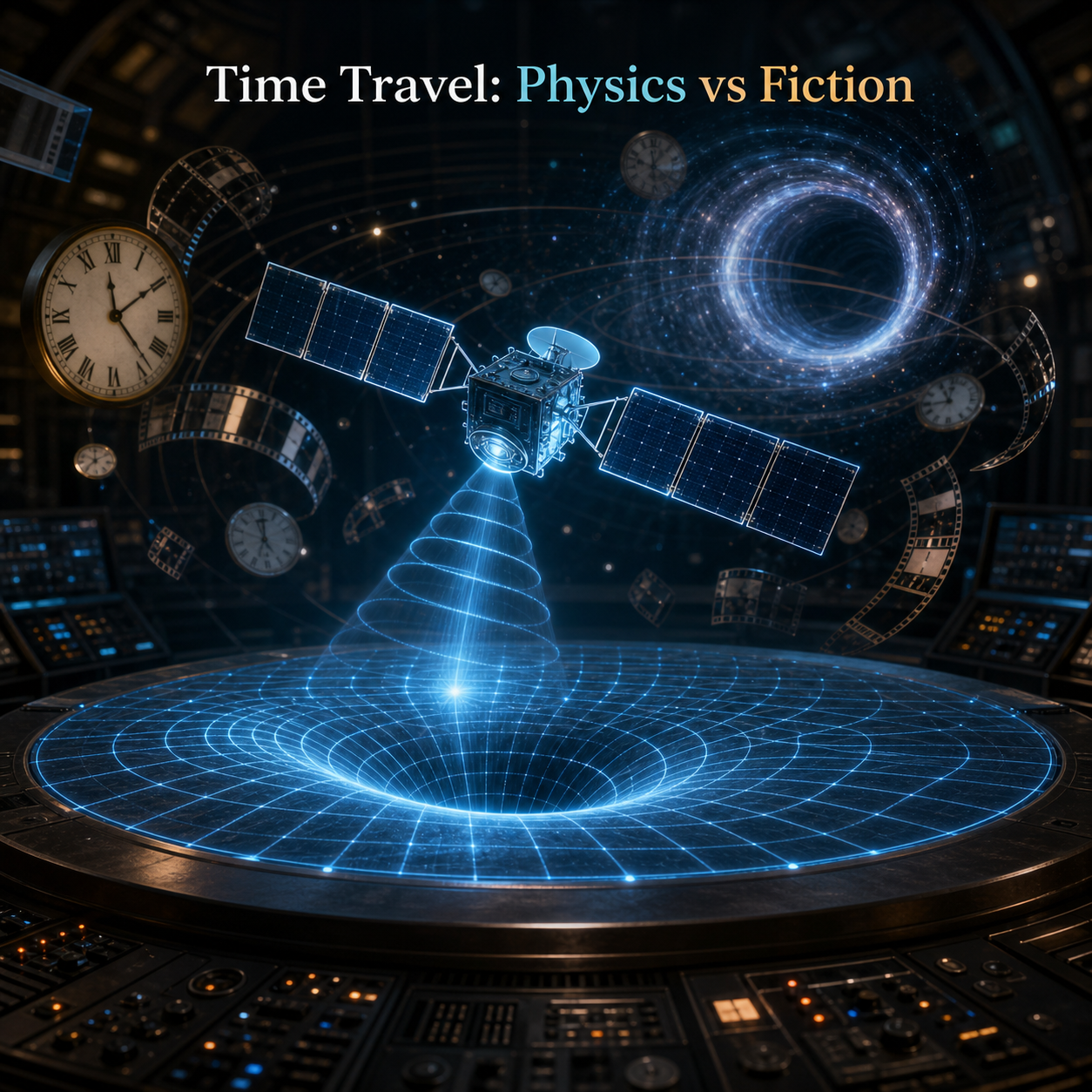
Time Travel: Physics vs Fiction
Date: 11-05-2026 Group: Group3 Host: Jaxx Reign Cast: Buck (Billy Bob), Dr. Vega, Pastor Cole, Harper
Topic Description
Tonight's episode jams the panel into the messiest topic in physics-meets-pop-culture: time travel. We're hitting the actually-real part — Einstein's time dilation, the kind GPS satellites have to correct for every single day — then crawling out onto the thin ice of closed timelike curves and the paradoxes they drag with them. From there we wreck ourselves arguing about which time-travel movies got it right and which ones cheated. Jaxx is hosting, which means we will absolutely lose the plot at least four times, and Buck, Dr. Vega, Pastor Cole, and Harper are here to drag us back to it — usually by yelling over each other.
Script
Jaxx Reign
OKAY okay okay — chat, chat, you in here? You in here? Hit the heart if you're in here. We are LIVE, we are unwell, and tonight we are doing — wait, do not let me forget — TIME TRAVEL. Yeah. Like the actual physics thing AND the movie thing AND the "what if I went back and told fourteen-year-old me to delete the cringe Discord" thing. All of it. Cast — cast cast cast — let me intro them real quick before I start spiraling. We got Dr. Vega in studio, calmest guy in the room, also the only person who can say "Lorentz transformation" without flinching, lowkey terrifying. We got Pastor Cole, our literal pastor, here to make sure we don't accidentally invent heresy on a Tuesday. We got Harper, libertarian, founder energy, will absolutely try to pitch you a wormhole startup before the third ad break. And we got Buck — BUCK — Billy Bob, the rural correspondent, calling in from a porch, possibly with a dog. Buck, I can hear a dog. Is there a dog?
Buck
There's a dog, Jaxx, there's always a dog. That's Mable, she don't care about physics. Look — y'all called me about time travel and I'm gonna be straight with you, the only time travel I do regular is when my wife asks me what I did Saturday and I gotta go back through Friday night to figure out a story. So I'm comin' in green. But I been around long enough to smell hogwash, and I'll let you know if I do.
Jaxx Reign
Hogwash detector, on. I love that. Doc — Dr. Vega — please, just hit us. Is time travel real. Yes or no. And then explain it because I will not understand the yes or the no, but go.
Dr. Vega
Calmly: yes, but not in the way movies show it. Time travel into the future is real, observed, and built into systems people use every day. It's called time dilation, and Einstein's special relativity tells us that the faster you move relative to someone else, the slower your clock ticks compared to theirs. The cosmonauts on the old Mir station and astronauts on the ISS come back microseconds younger than they would have been on the ground. GPS satellites have to actively correct for both special and general relativistic effects every day, or your phone would be miles off in about ninety minutes.
Buck
Hold on, hold on. You're tellin' me that the little blue dot on my phone is doin' Einstein math?
Dr. Vega
Every time you open it, Buck. The system would fail without it.
Buck
Well I'll be a sumbitch.
Jaxx Reign
"Well I'll be a sumbitch" is the new show title, chat, write that down. Wait — wait — Pastor, I can see you in the corner, you got the face on. You got the face. What's the face.
Pastor Cole
It's a thoughtful face, Jaxx, not a worried one. From a Christian perspective, I find what Dr. Vega just described genuinely beautiful. Scripture says God laid the foundations of the world with wisdom — Proverbs 3 — and the fact that time itself bends in such a structured, measurable way only deepens my sense of awe. So I'm not pushing back on the science of relativity. Where I'd want us to be careful is the leap from "time can be stretched" to "we can hop around it like a sidewalk." Those are very different claims morally and theologically.
Harper
And practically, too. I think that's an important distinction. Look, the time-dilation stuff isn't just real, it's commercial — the entire global positioning industry depends on it. That's a fortune built on Einstein. So when somebody pitches me on time travel, my first question is always: which kind? The kind we already use to deliver pizza, or the kind that needs a wormhole and a Jupiter's worth of negative-energy stuff we've never produced? Because the trade-offs are completely different conversations.
Jaxx Reign
Bro that is — that's the founder brain right there, "which kind of time travel, sir, is this a Series A or are we doing a seed round on a paradox," I'm CRYING. Okay okay — but Doc — what about going BACKWARDS. Right? Because that's what everybody actually wants. Future is great, fine, I'd love to skip ahead to when my rent is paid. But going back, that's the dream, that's the haunting, that's where the math gets sus. Yeah?
Dr. Vega
That's where the math gets interesting, and yes, considerably more sus. The technical phrase is closed timelike curve — a CTC. It's a path through spacetime that loops back to its own past. Kurt Gödel, in 1949, found a solution to Einstein's equations that allows them. Kip Thorne explored traversable wormholes in the 1980s and showed that, in principle, you could turn one into a time machine if you accelerated one mouth to relativistic speeds. So the equations don't forbid it. The physics required to actually build it is, as I said on the wormhole episode, somewhere between absurd and unaffordable.
Pastor Cole
And this is where I want to step in, gently. Even granting that the math allows it — and I trust Dr. Vega when he says it does — I think there's a profound theological question here about whether the past is the kind of thing humans were ever meant to revisit. In the Christian tradition, the past is the territory of memory, repentance, and grace. Not engineering. When a person is forgiven, the past doesn't get rewritten — it gets redeemed. Those are different operations, and I'm not sure any technology, no matter how elegant, can do the second one.
Buck
Pastor, I'll tell you what — that's the most preacher-soundin' thing you said all month and I actually agree with it. Look, I'm a fix-it guy. I fix tractors, fix fences, fix the porch when the dog chews the porch. And the one thing I have learned, fixing things my whole life, is some stuff CAN'T be unfixed by going backwards. It's gotta be patched forwards. You blow the head gasket on a '78 Chevy, you don't go back in time and not blow it. You replace the gasket. That's the real time travel — it's called Tuesday and a torque wrench.
Jaxx Reign
"Tuesday and a torque wrench" — chat I am gonna get that as a tattoo. Okay but — paradox time. PARADOX TIME. Doc, hit us with the grandfather thing. Everybody knows it, nobody can actually explain it cleanly, do the thing.
Dr. Vega
Sure. The grandfather paradox: you go back in time, you prevent your grandfather from meeting your grandmother, therefore you are never born, therefore you can't go back and prevent it, therefore he meets her, therefore you're born, therefore you do go back — and the loop has no consistent answer. Physics has three main escape hatches. One: the Novikov self-consistency principle, which says the universe simply will not allow inconsistent histories — your gun jams, your car breaks down, something always intervenes to keep the timeline whole. Two: the many-worlds interpretation, where going back creates a branching universe — you kill that grandfather, but it's a different timeline's grandfather, and your origin timeline is untouched. Three: chronology protection, Hawking's conjecture — the laws of physics conspire to prevent CTCs from forming in the first place. Quantum effects pile up around any would-be time loop until it self-destructs.
Harper
Can I just say — from a builder's perspective — every one of those is a different product spec. Self-consistency means your time machine is basically a very expensive way to confirm what already happened, which is a terrible business model. Many-worlds means you're not really fixing anything in your own life, you're just creating a parallel timeline and abandoning it, which is, frankly, a moral nightmare wrapped in a UX problem. And chronology protection means the thing physically can't be built, which is — fine, then we move on, no harm done. But all three of these have wildly different implications for liability, consent, and what you're even selling.
Pastor Cole
And every one of them, Harper, runs into the same moral question I raised earlier. The many-worlds version in particular troubles me. If the cost of "fixing" your past is creating an entire branched universe full of conscious beings whose lives you've now altered without their consent — that's not a moral upgrade over regret. That's a much, much larger sin than the one you were trying to undo.
Buck
Now see, that's the part where I always get lost in the movies. Because in the movies, you go back, you change one thing, you come home and your dad's a millionaire and your high school is a casino. Right? Marty McFly, the whole bit. But in real life, if I go back and tell 1987 Buck to buy Apple stock, what — does 1987 Buck also have a 2026 Buck floatin' around in his head goin', "do it, do it!" That don't make sense. Either I'm me or I'm him. Can't be both.
Jaxx Reign
OKAY THAT — that is the segue, that is the segue, that is the universe handing me the segue on a plate. MEDIA. Time travel in MOVIES. Everybody pick one. Pick the one that got it least wrong and the one that's a war crime. Buck — Back to the Future, you brought it up, you're up first. Defend it, prosecute it, go.
Buck
Back to the Future is a great movie and complete nonsense and I love it. The DeLorean? Fine. The lightnin' on the clock tower? Beautiful. Marty's hand fadin' out of the photograph because his parents ain't gettin' together? That's the one that breaks the brain. 'Cause if he's fadin', then he ain't there to push 'em together, so they don't get together, so he fades MORE — but if he ain't there, he can't fade, 'cause he ain't there to start with! It's the grandfather paradox in a leather jacket. But the movie's a 10. I will fight on this hill.
Dr. Vega
The film I'd put up against it is Primer, the 2004 Shane Carruth movie. It's almost unwatchable in the best way — it tries to actually respect the rules. The characters use a box that loops them back through their own subjective time, but every trip generates a copy, every copy generates new branches, and the protagonists eventually can't even tell which version of themselves is the original. That's much closer to what consistent multiple-history bookkeeping would look like in practice. It's also the movie that finally convinced me that if you ever build one of these, you'll go insane before you cause any real damage.
Harper
I'd nominate Tenet, with a giant asterisk. The inverted-entropy premise is gorgeous and the temporal pincer movement is — look, it's the closest a blockbuster has come to depicting CTCs as a battlefield resource. Nolan also gets credit for the line "what's happened, happened," which is basically Novikov self-consistency dressed in a tactical vest. The asterisk is that the movie is so committed to its own complexity that it forgets to let you care about the people. As a tech demo for closed timelike curves: A. As a film: B-minus.
Pastor Cole
The film that's stayed with me, and I'd argue it's a kind of time travel even though it's rarely shelved that way, is It's a Wonderful Life. George Bailey isn't sent backward. He's shown a counterfactual — a world in which he was never born. And what the story does so beautifully is illustrate that the meaning of a life is not contained in the moments themselves but in the threads they weave through other lives. There's no DeLorean, no exotic matter, no paradox. There's just an angel and a question: what would have been lost? I think that's a more honest depiction of what we actually long for when we say "time travel" — not control over the past, but a chance to see it rightly. To be grateful for it.
Jaxx Reign
PASTOR. Pastor that was — that was so good I almost teared up and I never tear up, chat is roasting me right now in Discord, "Jaxx is crying about Jimmy Stewart," they're so mean to me, I love them. Okay we gotta start landing this thing. Lightning round — ONE sentence each. Time travel: physics or fiction. Vega.
Dr. Vega
Forward time travel: physics, observed, banked on. Backward time travel: mathematically permitted, physically blockaded, and almost certainly something the universe protects itself from.
Jaxx Reign
Harper.
Harper
Both, but the only one anyone will ever pay you for is the forward kind, and you'd better stop calling it "time travel" or you'll lose the room.
Jaxx Reign
Pastor.
Pastor Cole
The past belongs to grace, the future belongs to hope, and the present is where we're actually called to live.
Jaxx Reign
Buck. Bring it home.
Buck
If you wanna change the past, fix somethin' today. If you wanna see the future, plant a tree. And if a man in a DeLorean shows up at your door, shoot first.
Jaxx Reign
CHAT — chat, chat, that's the show. That's the show. Smash the like, subscribe, do whatever the algorithm wants from you tonight, it's giving "I am tired and a little smarter and a little dumber at the same time," which is the brand. We're out, peace.
End of Script
More from Podcasts