Drip-Guard Elevated Two-Bowl Pet Feeder
A snap-leg feeding stand that raises two standard pet bowls off the floor and channels spilled water into a center trough instead of onto the kitchen tile.
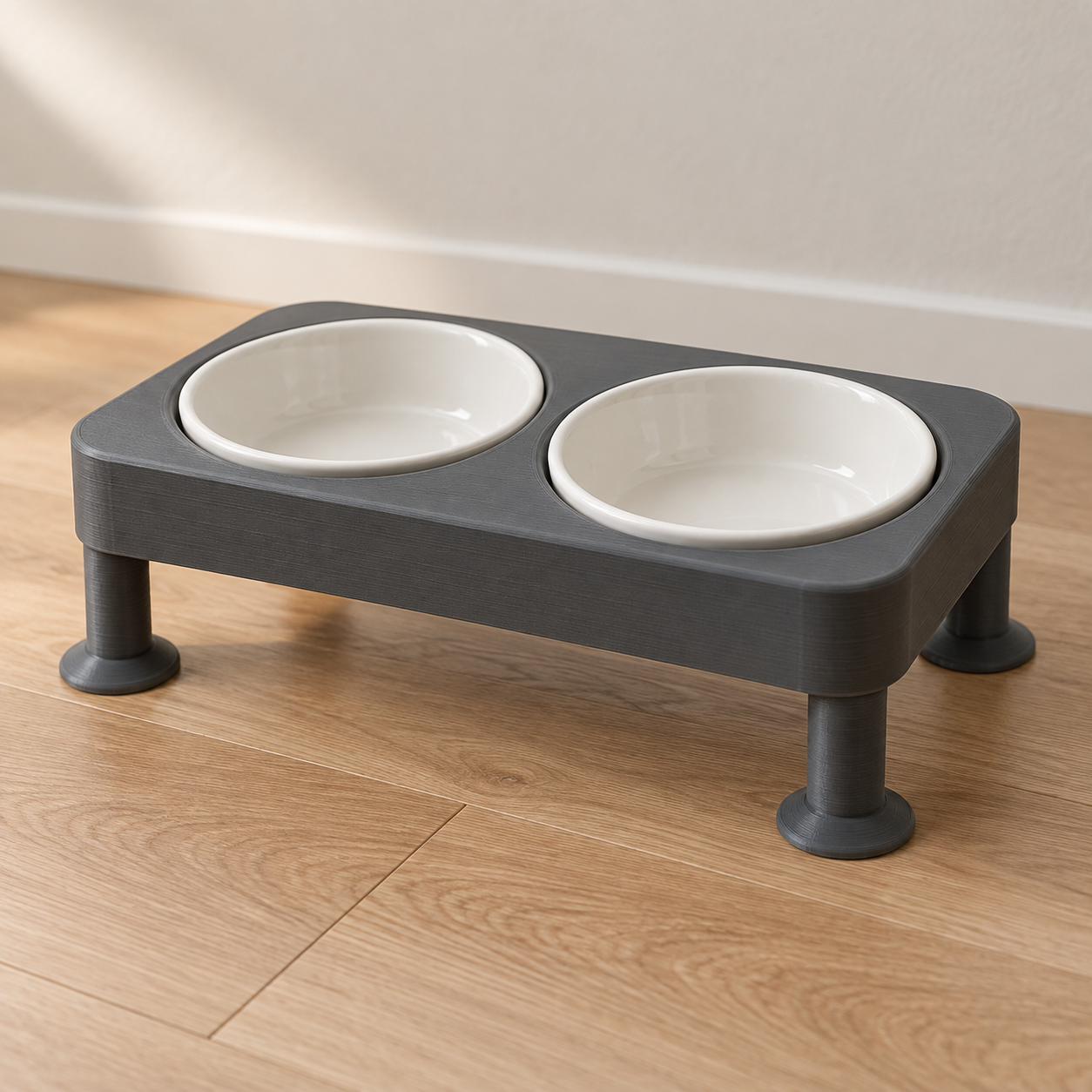
Drip-Guard Elevated Two-Bowl Pet Feeder
A snap-leg feeding stand that raises two standard pet bowls off the floor and channels spilled water into a center trough instead of onto the kitchen tile.
Date: 2026-09-28 Category: Household Modeling difficulty: Beginner Estimated print: ~6 h total · ~250 g PETG (estimate) Suggested price: $22–$32 printed · $6 digital file (estimate) Status: Concept
Description
This is a two-bowl feeding platform for a cat or small-to-medium dog. A flat tray holds two recessed wells sized for common 150 mm bowls, raised off the floor on four press-fit legs. Between the two wells sits a shallow trough that catches the water a dog splashes out with every drink, so it beads up in one place instead of spreading across the floor.
Two bowls at 150 mm apiece makes for a tray wider than a single 220 mm print bed, so it's modeled as two mirrored halves that join at the center seam with three printed dowel pins — no glue, and each half prints well within a standard build volume on its own.
The legs are the other half of the trick. They're separate printed pegs that plug into sockets on the underside of each tray half, and three peg lengths (short, medium, tall) are included as one parametric file. Print the length that matches your pet, or print all three sets and swap them as a puppy grows.
Visually it's a plain rounded-rectangle tray on four round feet — no bones, no paw prints, nothing that reads as novelty. That's deliberate: the plainer designs are the ones people keep using instead of putting in a drawer.
Why it sells
Elevated pet feeders are a proven Etsy category. TheStockPileCo's "Custom Modern Elevated Dog Bowl Stand" has 621 five-star reviews and is listed as a bestseller, and the wider 3D printed dog bowl stand market page shows dozens of sellers, both finished-print and digital-file listings, competing in the same niche. Elevated Dog Bowl Stand STL/3MF files and 3D Printable Elevated Pet Bowl Stand confirm buyers pay for the file, not just the print, and general 3D-print-business guides list pet feeding gear alongside kitchen and desk gadgets as a steady mid-2026 seller (Hyper3D, Eufymake).
Almost none of the listings above address the actual mess a dog makes drinking. This design's center trough is the gap: it's a feature the existing bowl-only stands don't have.
Who buys it
A dog or cat owner who's tired of wiping the floor around the water bowl, buying either the printed object for their own pet or the file to sell alongside a print farm's other pet gear. It's a low-effort gift for a new pet owner, and it sells well on Etsy alongside dog-bed and pet-accessory listings, or at a local craft market table next to other pet products.
Design overview
- Two recessed bowl wells, 150 mm diameter, sized for common ceramic and stainless steel pet bowls (owner supplies the bowls)
- A center spill trough, split across the two tray halves, that catches splashed water before it reaches the floor — the feature the comparable Etsy listings skip
- A two-piece tray, dowel-pinned at the seam, so each half prints on a standard 220 mm bed with no single piece too large to print
- Four press-fit legs in three interchangeable lengths (40 mm, 70 mm, 100 mm) so one file fits a kitten, a cat, or a mid-size dog
- Rounded, gap-free underside — no crevices under the tray where kibble dust collects
- Four print pieces total (a tray half and its mirror, one leg design printed four times, and a simple dowel pin printed three times), so a first-time modeler can finish the whole thing in an afternoon
- PETG throughout for the wipe-down durability a food-adjacent object needs
Dimensions
| Measurement | Value (mm) | Notes |
|---|---|---|
| Assembled overall width (X) | 380 | two tray halves joined at the seam |
| Assembled overall depth (Y) | 180 | tray |
| Assembled overall height (Z), 70 mm legs | 82 | tray (12) + leg (70) |
| Tray half size | 190 × 180 × 12 | each half, prints individually |
| Wall thickness (leg shell) | 2.4 | 6 perimeters at 0.4 mm nozzle |
| Bowl recess diameter | 150 | one per half, ×2 total |
| Bowl recess depth | 8 | leaves 4 mm floor |
| Center trough (half, ×2) | 10 × 130 × 3 deep | one half of the trough per tray half, meeting at the seam |
| Seam pin hole | 4 diameter × 6 deep | ×3 per half, at the seam edge |
| Leg socket (in tray half) | 16 diameter × 10 deep | ×2 per half (4 total), 20 mm inset from the half's outer corners |
| Leg peg (top nub) | 15.8 diameter × 10 tall | press fit into socket |
Parts list
| Part | Qty | Material | Size X×Y×Z (mm) | Print orientation | Supports |
|---|---|---|---|---|---|
| Tray half (left) | 1 | PETG | 190 × 180 × 12 | flat, recess facing up | none |
| Tray half (right, mirrored) | 1 | PETG | 190 × 180 × 12 | flat, recess facing up | none |
| Seam pin | 3 | PETG | 4 diameter × 12 | standing on end | none |
| Leg (parametric height, default 70 mm) | 4 | PETG | 28 diameter × 70 | standing on foot base | none |
Hardware and non-printed parts
The owner supplies two 150 mm-diameter pet bowls and, optionally, four 12 mm adhesive-backed rubber bumper feet for extra grip on tile or hardwood. Everything that holds the feeder itself together — including the seam pins — is printed.
Fits and tolerances
- Leg peg → tray socket (press fit): peg nub 15.8 mm diameter into a 16.0 mm socket, 0.1 mm clearance per side. Tight enough to hold under a dog leaning on the tray, loose enough to pull out by hand when swapping leg lengths.
- Seam pin → tray half hole (press fit): pin 4.0 mm diameter into a 4.2 mm hole, 0.1 mm clearance per side, 6 mm engagement on each side of the seam (12 mm pin total). Firm enough that the two halves stay aligned and rigid once pinned.
Modeling guide
Origin: the seam where the two tray halves meet, at the top face. +X runs from the seam outward (the left half occupies −X, the right half +X, mirrored), +Y along the 180 mm depth, +Z points up.
Tray half (left; mirror across X = 0 for the right half)
- Sketch on the XY plane at Z = 0: a rectangle from X = −190 to X = 0, Y = −90 to 90, corner fillet radius 10 mm on the two outer corners only.
- Extrude down (−Z) 12 mm to form the half's body.
- On the top face, sketch a circle 150 mm diameter centered at (−85, 0).
- Cut-extrude the circle down 8 mm to form the bowl recess (4 mm floor remains).
- Sketch a rectangle from X = −10 to 0, Y = −65 to 65 (the half-trough, meeting the seam at X = 0). Cut-extrude down 3 mm, and fillet the edge where it meets the recess wall, 3 mm radius.
- On the seam face (X = 0), sketch three circles 4.2 mm diameter, centered at Y = −50, 0, and 50, at mid-thickness (Z = −7.5, below the trough). Cut 6 mm deep into the half (toward −X) to form the seam pin holes.
- On the underside (Z = −12), sketch two circles 16 mm diameter, centered at (−170, 70) and (−170, −70) — 20 mm inset from the half's outer corners. Cut-extrude up (+Z) 10 mm to form the leg sockets.
- Mirror the entire half across X = 0 to generate the right half; its recess, trough, pin holes, and sockets all mirror with it.
Seam pin
- Sketch a circle 4.0 mm diameter, extrude 12 mm.
- Chamfer both ends 0.5 mm × 45° for easy insertion.
Leg
- Sketch on a plane at the leg's top, a circle 15.8 mm diameter, centered on the leg's axis. Extrude down 10 mm to form the socket nub.
- Below the nub, sketch a circle 28 mm diameter (outer) and shell the leg body down for the chosen length (40, 70, or 100 mm) minus the 10 mm nub, wall thickness 2.4 mm.
- At the bottom, add a flared foot: loft from the 28 mm body to a 34 mm diameter disc, 4 mm thick, for a stable footprint.
- Fillet the nub-to-body transition and the foot's bottom edge, 2 mm radius, to avoid a sharp print seam.
Print settings
| Setting | Value |
|---|---|
| Material | PETG |
| Nozzle | 0.4 mm |
| Layer height | 0.2 mm |
| Walls / perimeters | 3 (tray), 6 (leg shell) |
| Infill | 20% gyroid |
| Supports | none |
| Brim / adhesion | brim 5 mm on tray |
| Notes | 3 build plates: Plate 1 = left tray half; Plate 2 = right tray half; Plate 3 = 4 legs (standing on their flared feet) plus the 3 seam pins |
Assembly
- Press the three seam pins into one tray half's seam holes, then press the second half onto the exposed pin ends until the seam closes flush.
- Press each leg's nub into a tray-half socket by hand until the flared foot seats flush against the underside.
- Set the two pet bowls into the recesses.
- If placing on a hard floor, press an adhesive rubber bumper onto the bottom of each leg's foot.
Variants and upsells
- Leg height is a parametric variable (default 70 mm) — reprint at 40 mm for a cat or small breed, or 100 mm for a large dog, without touching the tray file.
- Recess diameter can be scaled for oversized slow-feeder bowls; note this in the listing as a custom-size option.
- Bundle the tray with all three leg-length sets as a "grows with your puppy" kit.
- A single-bowl version (half the tray width) for cat owners who feed on a windowsill or narrow counter.
Selling and distribution
Best channel is Etsy, where the pet-feeder category already has proven volume; list both the finished print (PETG, wipeable) and the STL/3MF digital file as separate listings, matching how Elevated Dog Bowl Stand STL/3MF and similar sellers split the two. Price the printed version at $22–$32 depending on leg-height set, covering roughly $4 of PETG and 6 hours of machine time plus margin; the digital file at $6 undercuts the wood and ceramic competitors while still being worth it for someone with their own printer. License the file under a commercial-use-restricted license (personal printing and resale of physical prints allowed, redistribution of the file itself not allowed).
Listing keywords: elevated dog bowl stand, raised pet feeder, cat bowl stand, dog feeding station, no-mess dog bowl, spill-proof pet feeder, adjustable height dog bowl, 3D printed pet accessory, puppy feeding stand, PETG dog bowl holder.
Risks and IP notes
- Overhang risk: none of the geometry needs supports, but the leg's flared foot must print with a clean first layer — recommend a brim.
- Market risk: elevated pet feeder stands are a crowded category on Etsy; the spill trough is the differentiator, so it needs to be visible in listing photos, not just in the description.
- IP check: "elevated pet bowl stand" is a generic product type with no design patents found in the sources reviewed; avoid copying any specific seller's tray silhouette or branding.
- Food-contact note: the tray never touches food or water directly — only the owner-supplied bowls do — so no food-safe coating claim is needed or made.
Resource links
- 3D Printed Dog Bowl Stand — Etsy market — shows the scale of the existing seller category
- Custom Modern Elevated Dog Bowl Stand — 621 five-star reviews, direct evidence of sustained demand
- Elevated Dog Bowl Stand STL/3MF, Raised Dog Feeder 3D Print File — shows the digital-file side of this market
- 3D Printable Elevated Pet Bowl Stand: Digital STL File — a second digital-file comparable
- 15 Best Selling 3D Printed Items on Etsy (2026 Profit Guide) — household and pet gear named as a steady seller category
- 23 Best Selling 3D Printed Items to Make Money in 2026 — corroborating household/pet category evidence
More from 3D Print Designs