Slide-Lid Pocket Sliding-Block Puzzle
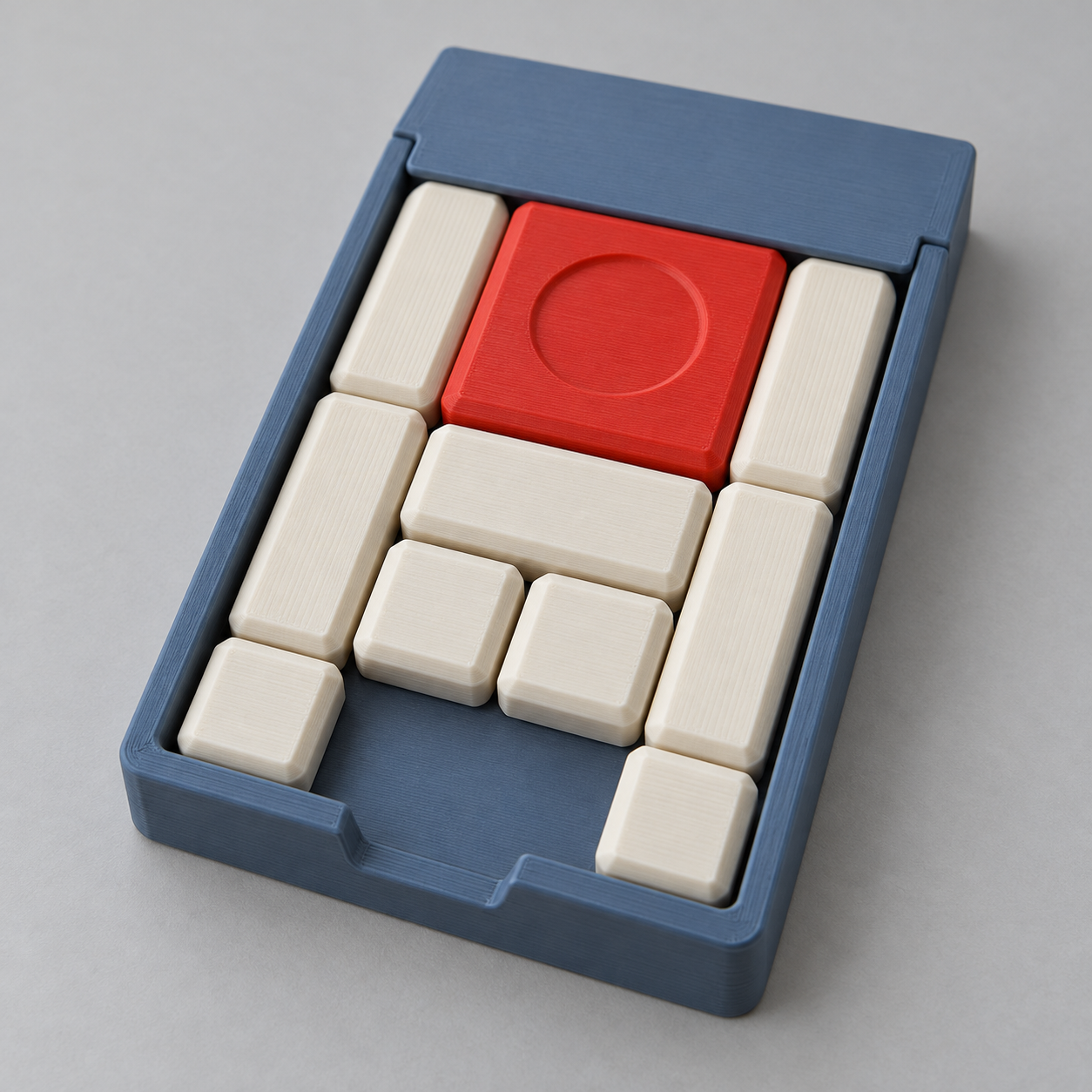
A pocket-sized version of the classic 4 × 5 sliding-block puzzle with a lid that clicks shut over the pieces, so it goes in a bag mid-solve and comes out with nothing lost.
Slide-Lid Pocket Sliding-Block Puzzle
A pocket-sized version of the classic 4 × 5 sliding-block puzzle with a lid that clicks shut over the pieces, so it goes in a bag mid-solve and comes out with nothing lost.
Date: 2026-10-10 Category: Puzzles and Games Modeling difficulty: Beginner Estimated print: ~4.3 h total · ~79 g PLA (estimate) Suggested price: $14–$20 printed · $3 digital file (estimate) Status: Concept
Description
The puzzle is the old one, often called Klotski or Huarong Dao: ten blocks in a 4 × 5 tray with two empty cells. One 2 × 2 block starts at the top centre, and you slide pieces around until it reaches the bottom centre. The famous starting layout takes 81 moves at best. People have been losing to it for about a century.
This version is a tray 80 × 98 × 14.8 mm with 18 mm cells. A 2 mm lid slides in along grooves in the long walls from the top end and clicks shut over a small ridge, holding every block in place, even upside down in a backpack. With the lid off, you play as normal.
At the bottom end, the goal end, a 30 mm notch is cut down to half the wall height. It works as a window: when the big block arrives, you see its face in the gap. The block can't slide out because it's wider than the notch and the bottom 4 mm of wall is still there. It's a small touch, but it makes the goal obvious to someone who's never seen the puzzle.
Why it sells
Printable sliding puzzles are popular files. Printables has a fully captive, print-in-place sliding tile puzzle in 4 × 4, 5 × 5 and 6 × 6 versions (Printables 71486). MakerWorld has a Klotski board with the standard pieces, one 2 × 2, five 1 × 2 and four 1 × 1, all loose (MakerWorld 879669), and numbered 5 × 5 and 6 × 6 sliding puzzles (MakerWorld 586193). Printed Klotski sets, including pirate-themed versions, sell on eBay (eBay). The puzzle itself is a traditional design with a long public history (Wikipedia). For a seller, Pixup3D's craft-fair guide says small fidget items and desk toys are easy to carry, cheap to make, fun to demo, and land around $10–$20 (Pixup3D). A puzzle you can hand someone at the table fits that.
The Klotski prints I found are a board with loose pieces. Tip the board and the solve is gone; drop it in a bag and the pieces scatter. The captive tile puzzles solve that with a frame, but only for equal square tiles. This one keeps the classic mixed-size blocks and adds a lid.
Who buys it
Puzzle fans and parents who want a screen-free toy for car trips, flights and waiting rooms. It's a stocking-stuffer, a teacher's desk puzzle, and an impulse buy at a craft-fair table where people can try it. Online they search Etsy for "sliding block puzzle", "Klotski" or "brain teaser".
Design overview
- Classic 4 × 5 Klotski layout on 18 mm cells: one 2 × 2 block, five 1 × 2 blocks (four standing, one lying across), four 1 × 1 blocks.
- 2 mm slide-in lid that clicks shut over a 0.8 mm ridge and holds all ten blocks. The lid is the thing the listed Klotski prints lack.
- Goal window at the bottom end so the target is visible.
- The 2 × 2 block has a shallow Ø20 circle recessed in its top so it stands out even in one colour.
- Every part is a rectangle with chamfers. A beginner can model it in an afternoon.
- No supports, no hardware.
Dimensions
| Measurement | Value (mm) | Notes |
|---|---|---|
| Overall width (X) | 80 | Tray |
| Overall depth (Y) | 98 | Tray |
| Overall height (Z) | 14.8 | Tray; the lid sits inside, its top 2 below the wall tops |
| Wall thickness | 4 | Long walls and end walls; floor 2.4 |
| Cell pitch | 18 | 4 columns × 5 rows |
| Play pocket | 72 × 90 | From z 2.4 up |
| Lid grooves | 2 deep × 2.4 tall | Into the long walls at x ±36 to ±38, z 10.8 to 13.2 |
| Lid entry cut | 76 wide | +Y end wall lowered to z 10.8 |
| Goal window | 30 wide | −Y end wall cut from z 6.4 up |
| Lid | 75.6 × 95.8 × 2 | |
| Lid snap ridge | 60 long × 1.6 base × 0.8 tall | Triangular, on the lid underside at y = 44 |
| Finger dish | Ø13.8 × 0.8 | Lid top, centred at y = 40 |
| Big block | 35.4 × 35.4 × 7.4 | Ø20 × 0.6 circle recessed in its top |
| Domino block | 17.4 × 35.4 × 7.4 | ×5 |
| Small block | 17.4 × 17.4 × 7.4 | ×4 |
| Block top chamfer | 1 | All blocks |
Parts list
| Part | Qty | Material | Size X×Y×Z (mm) | Print orientation | Supports |
|---|---|---|---|---|---|
| Tray | 1 | PLA | 80 × 98 × 14.8 | Floor down | none (2 mm groove ceilings print as short overhangs) |
| Lid | 1 | PLA | 75.6 × 95.8 × 2.8 | Top face down, ridge up | none (the Ø13.8 finger dish on the bed side bridges) |
| Big block | 1 | PLA | 35.4 × 35.4 × 7.4 | Bottom down | none |
| Domino block | 5 | PLA | 17.4 × 35.4 × 7.4 | Bottom down | none |
| Small block | 4 | PLA | 17.4 × 17.4 × 7.4 | Bottom down | none |
Hardware and non-printed parts
None — fully printed.
Fits and tolerances
- Blocks ↔ pocket and blocks ↔ each other (sliding): each block is its cell footprint minus 0.3 mm per side (18 → 17.4, 36 → 35.4). That's looser than the usual 0.2 because a block can rub on four neighbours at once, and PLA on PLA drags. Slop across a full row is 1.2 mm on a 4-block row, which still reads as a tight grid.
- Lid ↔ grooves (sliding): 75.6 wide in a 76 slot, 0.2 per side. 2.0 thick in a 2.4 groove, 0.2 above and below.
- Lid ridge ↔ lowered end wall (snap): the ridge is 0.8 tall and the lid can lift 0.4 in its groove, so the ridge has to ride 0.4 over the wall top. The lid flexes that much over its 76 mm width, and it clicks.
- Blocks ↔ lid (clearance): block tops at z 9.8, ridge bottom at z 10.0, lid underside at z 10.8. The ridge clears the top row by 0.2.
Modeling guide
Tray. Origin at the centre of the bottom face. +X across the tray, +Y toward the lid entry end (the top of the puzzle), +Z up. The goal end is −Y.
- Sketch on XY a rectangle 80 × 98 centred on the origin, corner R 4. Extrude 14.8.
- Cut the play pocket: rectangle x −36 to 36, y −45 to 45, corner R 0.5, from z 2.4 to 14.8.
- Cut the lid grooves: rectangles x 36 to 38 and x −38 to −36, y −47 to 49, from z 10.8 to 13.2. Then cut the end groove x −38 to 38, y −47 to −45, z 10.8 to 13.2, so the lid seats into the −Y end wall.
- Cut the lid entry: x −38 to 38, y 45 to 49, from z 10.8 to 14.8.
- Cut the goal window: x −15 to 15, y −49 to −45, from z 6.4 to 14.8.
- Chamfer the outer bottom edge 0.5. Fillet the wall tops R 0.5.
Lid. Origin at the centre of its underside, same axes as the tray when installed.
- Sketch a rectangle x −37.8 to 37.8, y −46.8 to 49. Extrude 2 (z 0 to 2).
- Snap ridge: sketch on the YZ plane a triangle with base y 43.2 to 44.8 at z = 0 and apex at (y 44, z −0.8). Extrude x −30 to 30.
- Finger scoop: subtract a sphere of radius 30 centred at (0, 40, 31.2). It leaves a dish Ø13.8 × 0.8 deep in the top face near the entry end.
- Chamfer the leading edge at y = −46.8 by 0.5 top and bottom so it finds the grooves.
Blocks. Origin at the centre of each block's bottom face.
- Big block: rectangle 35.4 × 35.4, extrude 7.4. Cut a Ø20 circle 0.6 deep from the top face at the centre.
- Domino block: rectangle 17.4 × 35.4, extrude 7.4. Make 5.
- Small block: rectangle 17.4 × 17.4, extrude 7.4. Make 4.
- On every block: chamfer top edges 1, bottom edges 0.3.
Print settings
| Setting | Value |
|---|---|
| Material | PLA |
| Nozzle | 0.4 mm |
| Layer height | 0.2 mm |
| Walls / perimeters | 3 |
| Infill | 20% grid |
| Supports | None |
| Brim / adhesion | None |
| Notes | Print the big block in a contrasting colour (the classic is red). Make sure the slicer's elephant-foot compensation is on (0.15 mm) or the blocks will bind on their bottom edges. All 10 blocks fit on one plate. |
Assembly
- Drop the blocks into the tray in the starting layout, reading from the top (+Y) end. Rows 1 and 2: domino, big block, domino. Row 3: domino, the lying domino, domino. Row 4: domino, two small blocks, domino. Row 5: small block, two empty cells, small block. The four standing dominoes fill both side columns down to row 4.
- To close, slide the lid in from the top end, ridge down, until it clicks.
- Goal: get the big block to the bottom centre, where it shows through the goal window.
Variants and upsells
- Layout cards: a 30-card deck of other starting layouts, each a pattern of coloured squares with no text, as a printed paper add-on.
- Engraved lid: a personalised name on the lid (blank in the mockup), at $4 extra.
- Giant desk edition: 30 mm cells, 134 × 164 tray, still fits the 220 mm bed.
- Themed blocks: original animal or robot reliefs on the block tops. Never characters from a franchise.
- Puzzle trio: this plus a captive 15-tile slider and a burr puzzle as a bundle.
Selling and distribution
Etsy and craft fairs suit the printed version: it's a $15 impulse gift, and at a fair the lid trick is easy to demo. Pricing: about 79 g PLA and 4.3 h of machine time (estimate) costs under $2 in filament; $14–$20 is the craft-fair sweet spot Pixup3D describes and covers Etsy fees plus a padded mailer. The file can go on Printables and MakerWorld at $3, or free with a paid commercial license, since free Klotski files already exist. License the file CC BY-NC.
Listing keywords: sliding block puzzle, Klotski puzzle, Huarong Dao, brain teaser, travel puzzle, pocket puzzle, block puzzle game, logic puzzle for adults, kids puzzle game, stocking stuffer puzzle, screen free toy.
Risks and IP notes
- Blocks bind on elephant's foot. Mitigation: 0.3 bottom chamfer on every block and a note to turn on elephant-foot compensation.
- The lid ridge wears and stops clicking. Mitigation: PLA wears slowly at 0.4 interference; offer a replacement lid file free to buyers.
- Small parts. Blocks under 18 mm are near choking size for toddlers. Mitigation: list it for ages 8 and up, and don't market it as a toddler toy.
- Cheap competition. Mass-made wooden Klotski sets are cheap. Mitigation: sell on the travel lid, the colour choice and personalisation.
- IP check. The puzzle and its classic layout are traditional. Check trademark registrations before using "Klotski" in a listing title, and don't use the names or images of any branded sliding-block games.
Resource links
- New Captive Sliding Tile Puzzle, 100% print-in-place (Printables 71486) — captive sliding tiles in 4 × 4, 5 × 5 and 6 × 6
- Klotski sliding puzzle (MakerWorld 879669) — board with loose 2 × 2, 1 × 2 and 1 × 1 tiles
- Sliding puzzle 5 × 5 and 6 × 6 (MakerWorld 586193) — numbered sliding puzzles
- Klotski listings (eBay) — printed Klotski sets for sale, including pirate-themed versions
- Klotski (Wikipedia) — history of the 4 × 5 puzzle and its Huarong Dao relative
- What to Sell at Your First Craft Fair as a 3D Printer (Pixup3D) — small fidget items and desk toys sell well at fairs at $10–$20
More from 3D Print Designs