Dish Duel — Rack-Launch Spinning Top Pair with Arena
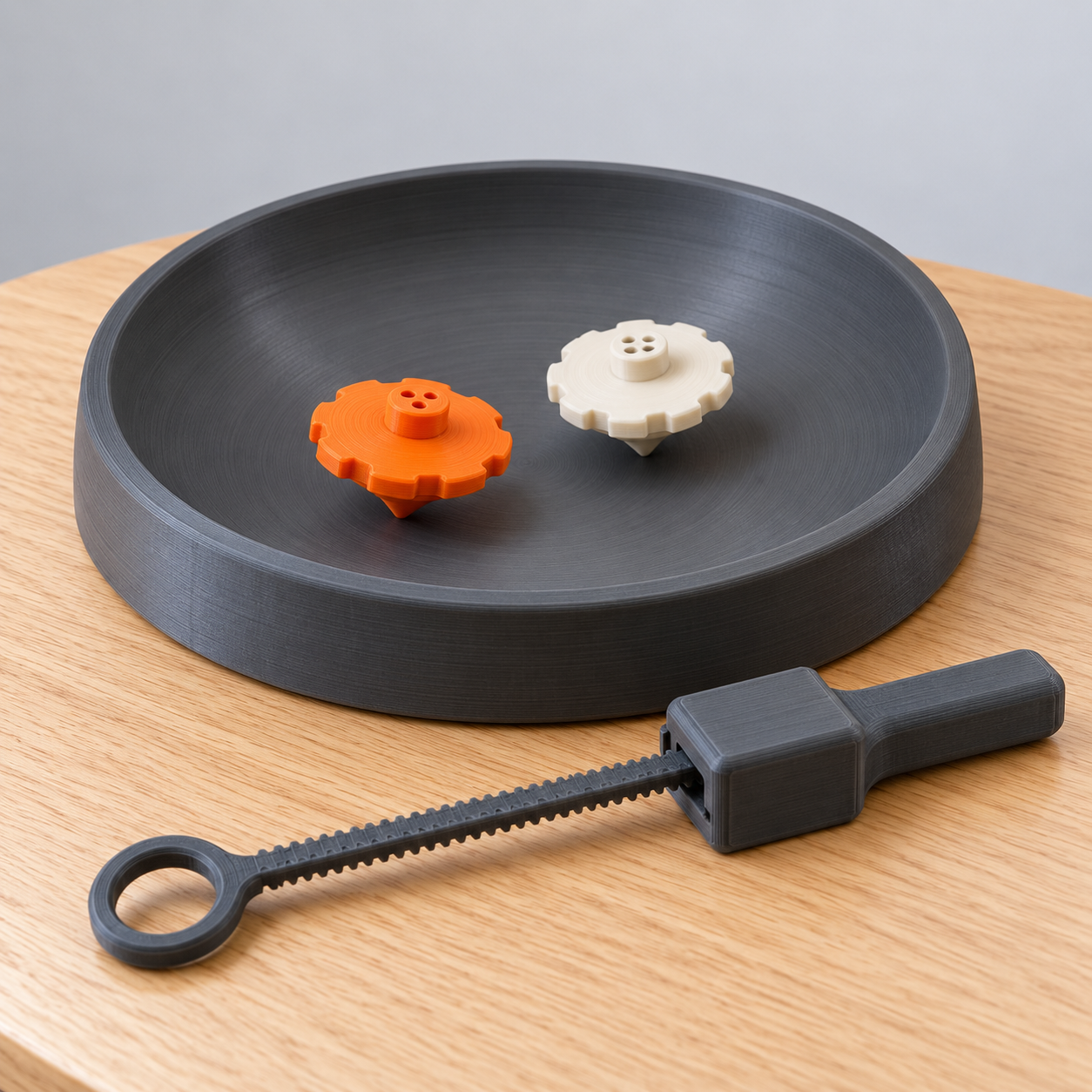
Two printed battle tops, a rack-and-pinion launcher and a 200 mm dish arena in one box, so two kids (or two coworkers) can duel the moment it's unpacked.
Dish Duel — Rack-Launch Spinning Top Pair with Arena
Two printed battle tops, a rack-and-pinion launcher and a 200 mm dish arena in one box, so two kids (or two coworkers) can duel the moment it's unpacked.
Date: 2026-10-05 Category: Toys and Fidgets Modeling difficulty: Advanced Estimated print: ~12.5 h total · ~250 g PLA + PETG (estimate) Suggested price: $24–$34 printed set · $6 digital file (estimate) Status: Concept
Description
A complete two-player spinning-top set. The arena is a shallow round dish, 200 mm across, with a curved floor that slopes the tops toward the middle, so they meet and knock into each other. Each top is a 44 mm disc with eight square notches around the rim and a short hub on top. Underneath, a swappable tip pushes into a D-shaped socket: a sharp cone for long, steady spins or a flat tip that skates around the dish and hits harder.
The launcher is a hand-sized block with a handle. Inside it, a 12-tooth pinion spins a three-prong fork that drops onto the top's hub. Set the top in the dish, lower the launcher onto it, pull the toothed rack straight out, and lift away. The top keeps spinning; the fork slides off the hub.
An upgrade slot makes the tops worth tinkering with. Each top has four hex pockets that take M6 nuts, so a player can add steel mass for longer spins, or leave them empty for a lighter, twitchier top.
Why it sells
Spinning tops and launchers are a busy category on MakerWorld. Designs there include a one-piece top that prints with no supports and no assembly (MakerWorld 1311899), a high-performance "Boost Launcher" that pairs a rack-and-pinion with a planetary gearbox (MakerWorld 1233085), and plain spinning tops (MakerWorld 3234917). Printables has a coil-launched top as well (Printables 282970). There's in-person demand too: Hong Kong's PMQ design center has run a battle-spinning-top 3D-printing workshop (PMQ). A craft-fair guide for print sellers calls fidget items "gold at any craft fair" because they're small, cheap and fun to demo (Pixup3D).
The gap: the listings I found sell a top, or a launcher, or a top plus launcher. None of them ship the arena. A set with two tops and a dish is a complete game that sells as a gift, and the dish is what makes a craft-fair demo work.
Who buys it
Parents and grandparents shopping for kids aged 8 and up, usually as a birthday or holiday gift. Second buyer: adults who want a desk toy to play in the office. Etsy and craft-fair tables reach the first group; MakerWorld file buyers are hobbyists who print it for their own kids.
Design overview
- Arena: a 200 × 32 mm dish with a spherical floor (R 196) that drops from 28 mm at the edge to 4 mm at the center, and a chamfered rim lip.
- Two tops, 44 mm discs with a 16 mm hub, eight 4 × 2.5 mm rim notches, and three drive holes in the hub.
- Swappable tips in a D-socket: sharp cone ("stamina") or flat 10 mm pad ("attack"). Two of each ship in the set.
- Four M6 hex-nut pockets per top for optional steel weight. This mass upgrade is what the listed tops don't offer.
- Launcher: a 12-tooth module-1 pinion turned by a 150 mm toothed rack with a pull ring, about 3.5 turns per full pull (132 mm of engaged rack over a 37.7 mm pitch circumference).
- Ground launch: the top sits on the arena floor during the pull, so there's no latch to wear out.
- Every part prints flat on its largest face with no supports.
Dimensions
| Measurement | Value (mm) | Notes |
|---|---|---|
| Overall width (X) | 200 | Arena diameter, the largest part |
| Overall depth (Y) | 200 | Arena diameter |
| Overall height (Z) | 32 | Arena height |
| Wall thickness | 3 | Arena rim lip (r 97 to 100) |
| Arena floor depth at center | 4 | Floor surface z at r = 0 |
| Arena floor height at edge | 28 | Floor surface z at r = 94 |
| Arena floor arc radius | 196.08 | Spherical, center on axis at z = 200.08 |
| Top disc diameter × thickness | 44 × 7 | |
| Top hub diameter × height | 16 × 10 | Hub top at z = 17 |
| Rim notches | 4 × 2.5 | ×8, tangential width × radial depth |
| Drive holes | Ø3.8 × 6 deep | ×3 on hub top, radius 5, 120° apart |
| Tip socket | D-hole Ø8.2, flat at 3.6 from center, 6.2 deep | Underside of top |
| Tip shaft | D Ø8.0, flat at 3.5 from center, 6 long | |
| Nut pockets | hex 10.2 across flats × 5.2 deep | ×4 at radius 14, top face of disc |
| Pinion | 12 T, module 1, 20° pressure angle, 8 face | Pitch Ø12, tip Ø14 |
| Rack | module 1, 47 teeth from x = 12 to 160, 8 face | Pitch line 7.25 from back face; 193 long with pull ring |
| Launcher housing | 50 × 96 × 14 | Including 60 mm handle |
| Rack channel | 8.4 high × 8.85 wide | Full length of housing along X |
| Fork prongs | Ø3.0 × 4 | ×3 at radius 5 |
Parts list
| Part | Qty | Material | Size X×Y×Z (mm) | Print orientation | Supports |
|---|---|---|---|---|---|
| Arena dish | 1 | PLA | 200 × 200 × 32 | Flat bottom down | none |
| Top body | 2 | PLA | 44 × 44 × 17 | Disc bottom down, hub up | none |
| Sharp tip | 2 | PETG | 10 × 10 × 14 | Shaft end down, cone up | none |
| Flat tip | 2 | PETG | 10 × 10 × 11 | Flat pad down, shaft up | none |
| Launcher housing | 1 | PLA | 50 × 96 × 14 | Floor down | none |
| Launcher cap | 1 | PLA | 50 × 36 × 9.6 | Outer face down, pin up | none |
| Pinion spindle | 1 | PETG | 14 × 14 × 15.5 | Gear face down, neck up | none |
| Fork hub | 1 | PETG | 18 × 18 × 8 | Disc down, prongs up | none |
| Rack | 1 | PETG | 193 × 36 × 8 | Flat on its side, teeth in the XY plane | none |
Hardware and non-printed parts
- M3 × 16 mm countersunk screw ×2 (cap to housing, threading into printed 2.6 mm pilot holes)
- M6 hex nut, 10 mm across flats × 5 mm, zinc-plated steel, ×8 (optional weight, up to 4 per top)
- Cyanoacrylate glue, a drop, to fix the fork hub on the spindle neck
Fits and tolerances
- Tip shaft ↔ top socket (press): D-shaft Ø8.0 in a Ø8.2 D-socket, 0.1 mm per side. The flat (3.5 vs 3.6 from center) stops the tip spinning in its socket. Kids swap tips by hand, so this stays at the loose end of press.
- Pinion neck ↔ housing floor bore (running): Ø8.0 neck in a Ø8.4 bore, 0.2 mm per side.
- Cap pin ↔ pinion bore (running): Ø6.0 pin in a Ø6.4 bore, 0.2 mm per side. The cap shoulder leaves 0.4 mm axial play above the pinion.
- Fork hub ↔ pinion neck (press, glued): Ø7.8 bore on a Ø8.0 neck, 0.1 mm interference per side, plus a drop of glue, because the fork takes the full launch torque.
- Fork prongs ↔ top drive holes (loose): Ø3.0 prongs in Ø3.8 holes, 0.4 mm per side. This one is deliberately loose so the prongs drop out of a spinning top without dragging it.
- Rack ↔ housing channel (sliding): rack 8.0 high in an 8.4 channel and 0.2 mm off the back wall, 0.2 mm per side.
- Pinion ↔ housing pocket: pinion tip Ø14 in a Ø15 pocket, 0.5 mm radial clearance.
- M6 nut ↔ top pocket (drop-in): 10.2 across flats for a 10.0 nut, 0.1 mm per side. Snug enough not to rattle out of a spinning top.
Modeling guide
Each part has its own origin, given at the top of its steps. +Z is always up in print orientation unless the step says "mounted".
Arena dish (origin: center of the flat bottom face, +Z up)
- Sketch on the XZ plane a closed half-profile: (0, 0) → (100, 0) → (100, 32) → (97, 32) → (94, 28), then an arc from (94, 28) to (0, 4) with radius 196.08 and center at (0, 200.08), then close back to (0, 0).
- Revolve 360° around the Z axis.
- Fillet R 2 on the outer top edge (r = 100, z = 32) and R 1 on the inner rim edge at (94, 28).
Top body (origin: center of disc bottom face, +Z up; mounted the same way up)
- Sketch on XY a Ø44 circle; extrude 7.
- Sketch on the disc top face (z = 7) a Ø16 circle; extrude 10 to z = 17.
- Rim notches: sketch a 4 (tangential) × 2.5 (radial) rectangle at the rim, its outer edge on r = 22, centered at angle 0°; cut through the disc (z 0 to 7). Circular-pattern ×8 at 45°.
- Nut pockets: on the disc top face (z = 7), sketch a hex 10.2 across flats with one pair of flats perpendicular to the radius, centered at (14, 0); cut 5.2 deep (to z = 1.8). Circular-pattern ×4 at 90°, starting at 22.5° so each pocket sits halfway between two notches.
- Drive holes: on the hub top (z = 17), Ø3.8 circles at radius 5, angles 90°, 210°, 330°; cut 6 deep.
- Tip socket: on the bottom face (z = 0), sketch a Ø8.2 circle at the origin trimmed by a line at y = −3.6 (a D-shape, flat on −Y); cut 6.2 deep.
- Chamfer 1 × 45° on the disc bottom outer edge; chamfer 0.4 on the drive-hole and socket mouths.
Sharp tip (origin: center of shaft end face, +Z up toward the point)
- Sketch on XY a Ø8.0 circle trimmed by a line at y = −3.5 (D-shape); extrude 6.
- Sketch on the XZ plane the closed half-profile (0, 6) → (4, 6) → (5, 7) → (0, 14) → back to (0, 6). Revolve 360° around Z. This gives a 45° collar from Ø8 to Ø10, then a cone to the point.
- Fillet the point R 0.8.
Flat tip (origin: center of the pad bottom face, +Z up toward the shaft)
- Sketch on XY a Ø10 circle; extrude 5. Chamfer the bottom edge 1 × 45°.
- On the pad top face (z = 5), sketch the D-shape (Ø8.0, flat at y = −3.5); extrude 6 to z = 11.
Launcher housing (origin: center of the bottom face at the pinion axis, +Z up, rack runs along X)
- Sketch on XY a rectangle x −25 to 25, y −18 to 18, corner radius 3. Add a handle rectangle x −10 to 10, y 18 to 78, end radius 10 at y = 78. Union and extrude 14.
- Pinion pocket: on the top face, Ø15 circle at (0, 0); cut 11 deep (to z = 3).
- Floor bore: Ø8.4 circle at (0, 0); cut through.
- Rack channel: sketch on the YZ plane a rectangle y −13.45 to −4.6, z 3 to 11.4; cut through all along X (both directions).
- Pilot holes: Ø2.6 at (−19, 10) and (19, 10), 10 deep from the top face.
- Fillet R 1 on all outer vertical edges of the handle; chamfer 0.5 on the channel ends.
Launcher cap (origin: center of the outer face, +Z up in print orientation; mounted, the pin points down into the housing)
- Sketch on XY a rectangle x −25 to 25, y −18 to 18, corner radius 3; extrude 3.
- On the inner face (z = 3), sketch a Ø10 circle at (0, 0); extrude 2.6 (shoulder). On its top, a Ø6.0 circle; extrude 4 (pin). Pin top at z = 9.6.
- Screw holes: Ø3.4 through at (−19, 10) and (19, 10), with a 90° countersink to Ø6.4 on the outer face.
Pinion spindle (origin: center of the gear's bed face, +Z up; mounted inverted, with the neck pointing down through the housing floor)
- Generate a spur gear: 12 teeth, module 1, 20° pressure angle, face width 8 (Fusion Spur Gear add-in, Onshape Spur Gear FeatureScript, FreeCAD Gear workbench, or OpenSCAD BOSL2
spur_gear). Place it on XY, extrude z 0 to 8. - Bore: Ø6.4 circle at the origin on the bed face; cut 5 deep (z 0 to 5).
- Neck: on the gear's top face (z = 8), Ø8.0 circle; extrude 7.5 to z = 15.5.
- Chamfer 0.3 on the gear's bed-face edge to offset elephant's foot.
Fork hub (origin: center of disc bottom face, +Z up in print orientation; mounted, the prongs point down)
- Sketch on XY a Ø18 circle; extrude 4.
- Bore: Ø7.8 through at the origin.
- Prongs: on the top face (z = 4), Ø3.0 circles at radius 5, angles 90°, 210°, 330°; extrude 4 to z = 8. Chamfer the prong tips 0.5.
Rack (origin: bottom-left of the rack bar's back face, rack flat on the bed, +X toward the leading end, +Y toward the teeth)
- Bar: rectangle x 0 to 160, y 0 to 6; extrude 8.
- Teeth: generate a module-1, 20° straight rack profile with its pitch line at y = 7.25 (dedendum 1.25 below, addendum 1 above). Pattern 47 teeth starting at x = 12 at 3.1416 pitch. Extrude 8.
- Chamfer the first tooth at x = 160 by 1 mm on both flanks so it finds the pinion.
- Pull ring: Ø36 outer / Ø24 inner ring centered at (−15, 4.125); extrude 8. Its outer edge overlaps the bar end by 3 mm (to x = 3), which joins the two.
- Fillet R 0.5 on all top edges.
Print settings
| Setting | Value |
|---|---|
| Material | PLA for arena, top bodies, housing, cap; PETG for tips, pinion spindle, fork hub, rack |
| Nozzle | 0.4 mm |
| Layer height | 0.2 mm (0.12 mm for pinion spindle and rack) |
| Walls / perimeters | 3 (top bodies and pinion: 100% infill, so walls don't matter) |
| Infill | Arena 10% gyroid; housing and cap 20% gyroid; top bodies, tips, pinion, fork, rack 100% |
| Supports | None |
| Brim / adhesion | Arena: brim 5 mm; rack: brim 3 mm; everything else none |
| Notes | Print both top bodies in contrasting colors so players can tell them apart mid-spin. Solid tops spin longer; don't cut their infill. |
Assembly
- Press one sharp tip into each top body's socket, flat of the D lined up with the flat of the socket.
- Optional: drop up to four M6 nuts into each top's hex pockets, always in opposite pairs so the top stays balanced.
- Push the pinion spindle's neck down through the housing floor bore from inside the pocket. The gear sits on the floor; its bore faces up.
- Press the fork hub onto the neck sticking out below the housing, prongs pointing down, with a drop of glue. Leave about 0.5 mm between the fork and the housing bottom.
- Fit the cap so its pin drops into the pinion bore; fasten with the two M3 × 16 screws.
- To launch: set a top tip-down in the center of the arena, lower the launcher so the prongs enter the drive holes, slide the rack in from the −X side, teeth toward the pinion, until the ring stops at the housing, then pull it straight out in one fast stroke and lift the launcher.
Variants and upsells
- Extra top packs: new rim shapes (6 blunt lobes, 12 fine teeth, a smooth ring) sold in pairs at a lower price than the full set.
- Tip packs: ball tip, wide flat, and a TPU rubber tip that grips the floor for erratic movement.
- Weighted edition: ship with the eight M6 nuts installed and charge more.
- Color sets: team colors chosen by the buyer (any two colors, no team names or logos).
- Fast launcher: a two-stage version with a 3:1 gear stage for higher spin speed, as a paid file upgrade.
- Larger arena: a four-segment 300 mm arena that keys together for parties.
Selling and distribution
Craft fairs and Etsy suit the printed set; a duel in the dish is the demo. MakerWorld suits the file, since its audience prints toys for their own kids and expects multi-part toy files with print profiles. Pricing: about 250 g of filament ($5), eight nuts and two screws ($1), and roughly 12.5 h of machine time on one printer (all estimates). At $24–$34, a two-color set clears Etsy fees and shipping. Add-on top packs at $8–$12 lift the order value. Sell both print and file. License the file CC BY-NC so print farms can't resell it without a commercial license, sold separately.
Listing keywords: spinning top set, battle top arena, 3d printed spinning top, top launcher, spin top toy, desk duel game, kids gift spinning top, rack launcher top, fidget spinning top, stocking stuffer toy, two player top game.
Risks and IP notes
- Launch torque can strip the pinion or snap a prong. Mitigation: print pinion, fork and rack in PETG at 100% infill, and use 0.12 mm layers on the gears so teeth stay smooth.
- Unbalanced tops wobble. Mitigation: tell users to add nuts in opposite pairs, and print tops with seams aligned to "sharpest corner" so the seam stays at one notch.
- Small parts (tips, nuts) are a choking hazard. Mitigation: label the set ages 8+, never market it to young children, and check toy-safety rules in your sales region (US CPSIA, EU EN 71) before selling printed toys.
- Trademark and IP. Big commercial battle-top brands hold trademarks and patents on their launch and lock systems. This design uses a plain ground launch and a generic dish; never use a brand name in titles or tags, and search design patents for "spinning top launcher" before listing.
- Saturated free files. Mitigation: compete on the complete set and the arena, not on the top alone.
Resource links
- One-piece printable spinning top (MakerWorld 1311899): a no-support, no-assembly top showing the simple end of the category
- Boost Launcher, high performance (MakerWorld 1233085): rack-and-pinion plus planetary launcher for propellers and tops
- Spinning Top (MakerWorld 3234917): another current spinning-top listing
- Spinning top toy with coil (Printables 282970): a coil-launched printed top
- Battle spinning top x 3D printing workshop (PMQ): an in-person workshop built around printed battle tops
- What to Sell at Your First Craft Fair as a 3D Printer (Pixup3D): why small fidget toys sell at craft fairs
More from 3D Print Designs