The Meridian Canopy Courier
THE MERIDIAN CANOPY COURIER
15 Verdure, Year 53 of the Green Compact · Edition 2 "Plant the Future; Harvest the Present"
LEAD
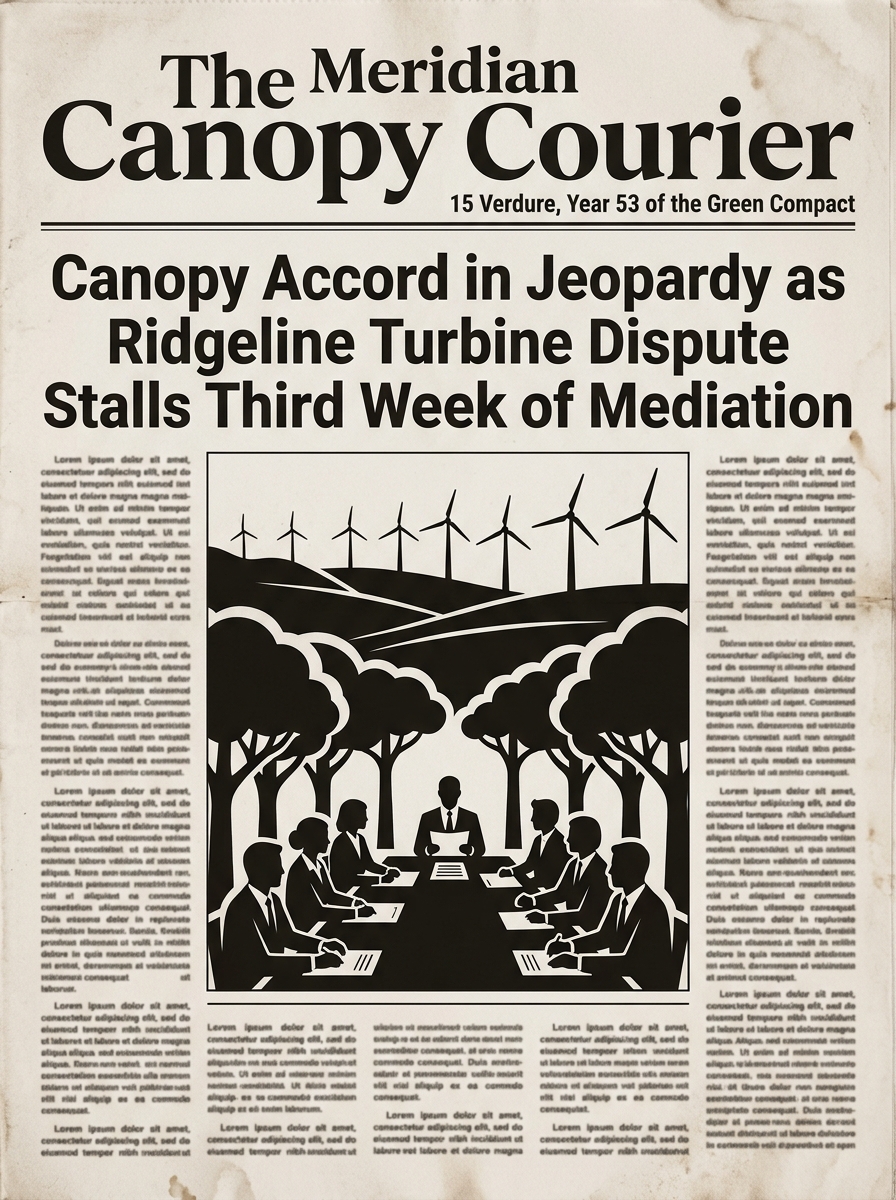
Canopy Accord in Jeopardy as Ridgeline Turbine Dispute Stalls Third Week of Mediation
By Sanna Virel, Regional Commons Correspondent
Accord negotiations between New Meridian's Northern Terrace Cooperative and the neighboring Saltmarsh Confederation entered their third suspended week today, as mediators scrambled to contain a dispute over access to the contested Ridgeline Wind Corridor — a narrow band of sustained high-altitude airflow that powers both communities' turbine arrays and has long been considered a shared resource of the greater Meridian commons.
What began as a landmark achievement in inter-community governance has unraveled with uncomfortable speed. Eighteen months ago, delegates from both sides gathered in Brightwater Hall to sign the Canopy Accord, a treaty hailed across the Confederated Shoreline territories as proof that resource-sharing between communities could be codified without coercion. The accord established a seasonal draw protocol: Saltmarsh would receive priority wind allocation during the damp winter months when solar generation lagged, while the Northern Terrace would claim priority during the long summer harvests when cooling and preservation demands peaked.
The agreement lasted less than a year before the first tremors appeared.
Last month, maintenance crews from Saltmarsh erected a new line of "priority capture" turbines along the contested eastern ridgeline — units the Northern Terrace's engineers argue lie squarely within the shared metering zone and effectively siphon wind energy before the protocol activates. Internal modeling circulated by the Terrace's grid council suggests the unauthorized array could reduce their allocated draw by as much as 22 percent during peak autumn storm season.
"What's a covenant worth if one party starts laying foundations in the commons before the ratification ceremonies have even finished?" said Brenna Solvay, spokesperson for the Northern Terrace Energy Commons Council. "We opened our grid schematics. We shared our storage projections. We came to this table in complete transparency. And now we're watching a quiet land-claim go up on the ridgeline."
Saltmarsh representatives have disputed that framing with equal firmness. Senior delegate Renor Thal argued the disputed turbines sit within boundary coordinates his community has held easement rights over for three generations. "The Accord was designed to supplement what already exists — not to dissolve prior rights," Thal said in a brief address to the Neutral Commons Assembly. "We have not violated a single line of the treaty."
Mediators from the Assembly — a rotating council of elder facilitators drawn from unaffiliated settlements — have called for a technical survey of the ridgeline boundary before the full delegations reconvene. That survey is scheduled for mid-Verdure, and its findings are expected to either anchor or end the Accord's remaining legitimacy.
The standoff arrives at a fraught moment for both communities. The Northern Terrace has operated under a solar shortfall since an unusually overcast spring, and Saltmarsh's expanded aquaculture terraces have driven a 14 percent spike in baseline electricity demand. Neither community can easily absorb a prolonged disruption to shared wind resources.
Community members on both sides have expressed a quiet exhaustion with the impasse. "We built this city — this whole way of living — on the principle that no one hoards the wind," said Yara Kesslin, a rooftop gardener and longtime trustee of the Meridian Canopy Commons. "When we start litigating airflow, something foundational has broken."
Both delegations have agreed not to erect new infrastructure in the contested zone during the survey period — a small concession that mediators describe as fragile but meaningful.
BELOW THE FOLD A
Hillside Quarter Runs a Full Week on Waste Warmth Alone
By Petra Sundval, Green Engineering Correspondent
The Hillside Quarter's community grid hit an unprecedented milestone this week: for seven consecutive days, every dwelling, workshop, and communal kitchen in the district drew its full power allocation from a single source — the heat rising off four neighborhood compost processing towers. Engineers at the Meridian Thermal Cooperative announced the achievement after integrating a new "heat-cascade dynamo" — a compact system that captures rising thermal energy from active composting biomass and converts it into usable current without combustion. The system produces no exhaust and requires no external battery buffer. "Compost has always been the city's hidden battery," said lead engineer Odalys Fenn. "We just learned to read it." The Cooperative plans to expand the prototype to twelve additional waste-heat nodes across the city by next Harvest season, with a full grid-integration report expected by Year 54.
BELOW THE FOLD B
Kelp-Silk Membrane Wins City's Highest Innovation Laurel
By Tomás Arwen, Culture & Innovation Desk
A team of young bioengineers from the Seaward Research Collective won the 53rd Commons Innovation Prize this week for developing a living membrane fabric woven from cultivated kelp fibers and spider-silk analogs — a material that filters water, air, and industrial run-off at the molecular level without synthetic chemistry or powered pumping. The membrane, dubbed the Silverweed Lattice, mimics the natural selectivity of cellular membranes observed in tidal organisms, allowing beneficial minerals to pass while trapping contaminants as small as half a nanometer. Panel judges called it "an engineering achievement that is also, somehow, beautiful." The team, whose average age is 26, has pledged to release the full growing-and-weaving protocol under a Commons Open License, making it freely available to any collective in the Confederated Shoreline territories. Several coastal communities have already requested consultation sessions.
CLASSIFIEDS
- SEEKING experienced mycelium-network tender for the South Market district; partial barter in seasonal produce accepted. Contact the Commons Board, node 7.
- LOST — one hand-carved rain gauge, pale birchwood, inscribed "For all seasons." Last seen near the Verdant Overpass on 12 Verdure. Return to Household Nessa, Terrace Row 4.
- ROOFTOP GARDEN SHARE available — half-panel on the Coppice Cooperative's eastern face, good southern exposure, irrigation included, first two growing cycles free. Ask for Dov at the evening commons meeting.
- SKILLED WOODWRIGHT seeks apprenticeship in living-wall construction; three years' experience with cob, timber, and cordwood; willing to travel within the Confederated Shoreline. Send word to the Craftworkers' Node, Level 2.
- COMMUNITY FERMENTATION CIRCLE invites new members — join us every third Windday for grain mash, cider culture, and miso tending. No experience needed, only curiosity. Meetinghouse 9, Lower Terrace.
- FOUND — one solar lantern with green glass panel, unlit, left at the Canopy Walkway on 13 Verdure. Claim at the Commons Office before end of month.
- RAIN-HARVEST SURPLUS — 1,200 liters of filtered cistern water available for trade or gift to households in need. Contact the Northern Quarter Rain Guild, node 12.
WEATHER
A warm southern airstream carrying moisture from the Saltmarsh estuaries is expected to bring scattered afternoon showers to New Meridian's upper terraces through midweek, with temperatures resting comfortably in the high-teens. Wind speeds along the Ridgeline Corridor will climb to 34 knots by Windday evening — ideal for the turbine networks, though residents of the elevated Canopy Walkways are advised to secure their growing frames.