Proof of Life
At six o'clock I become her.
Synopsis
Marnie, a perpetual stand-in who has never been paid to be herself, is hired to impersonate reclusive heiress Vivian Ashford: every evening she dons the woman's dress and sits in a lit window to be seen by exactly one watcher, Vivian's estranged sister Eleanor, who observes through a spotting scope from across the valley. Told only that Vivian is resting, Marnie reads the house's evidence and realizes Vivian is dead and buried on the grounds, and that the whole performance exists to keep Eleanor believing her sister is alive so a looted estate can settle undisturbed. When Marnie finds Eleanor's unsent letter and understands the porch light burning across the valley is a years-long apology waiting to be answered, she stakes her safety on the one thing she knows how to do: she breaks the script, presses her palm to the glass, and answers the light. The porch light pulses back, headlights turn onto the valley road, and Marnie stays in the window, no longer a door made of a face but, for the first time, herself.
Proof of Life
Story
At six o'clock I become her.
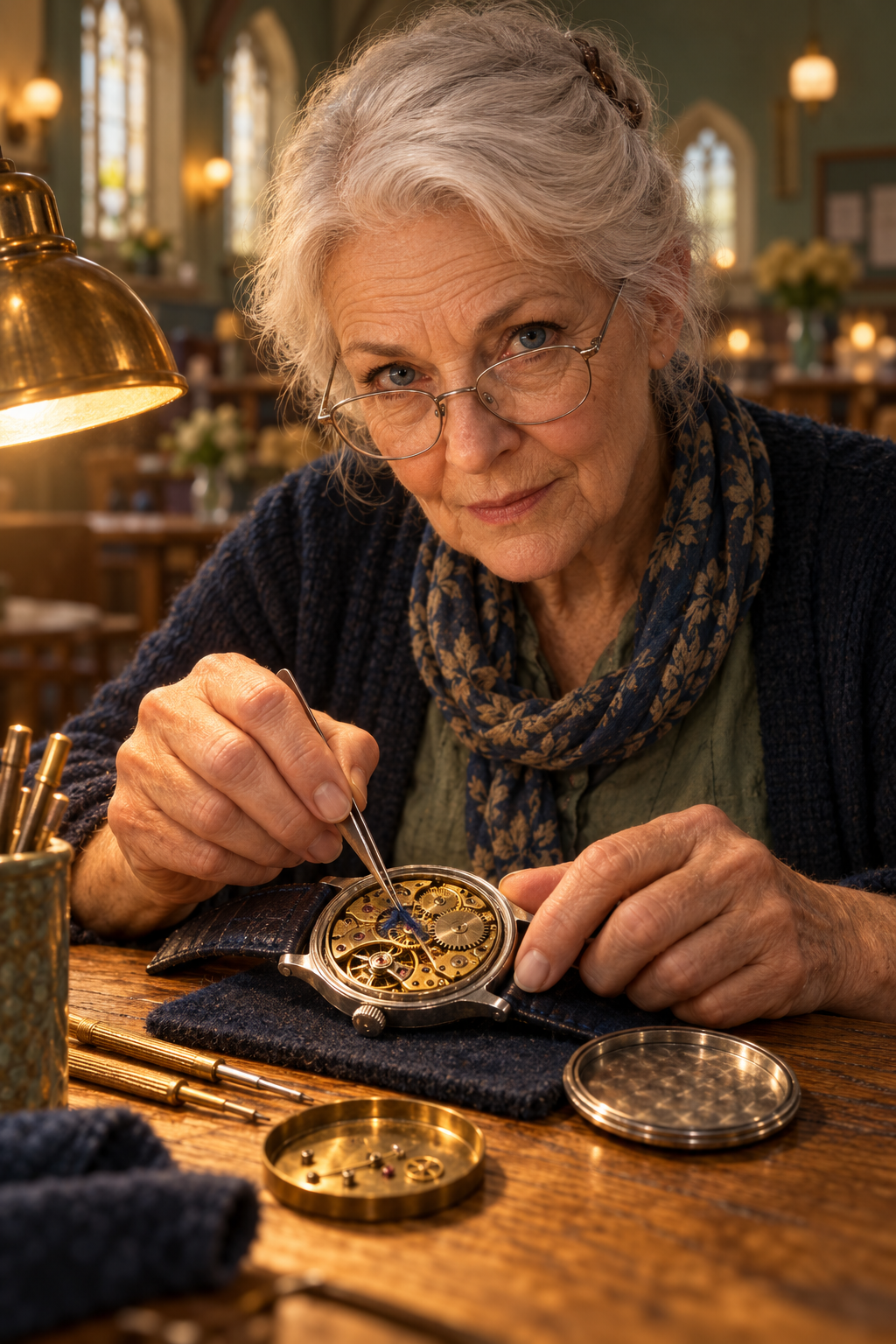
The dress is laid out on the bed by then, the good gray wool that Vivian Ashford wore on days she wanted to look like weather rather than a woman. I put it on the way you'd put on a job. Then the earrings, which are real and cold and leave a smell of metal on my fingers. Then the hair, which is mine but coaxed into her shape, swept up and back so my forehead shows, because Vivian believed a forehead was honest and a fringe was hiding something. She said that once, apparently, at a dinner. Prentice made me memorize it along with everything else, as if I might be quizzed by someone standing very far away.
Which, it turns out, is exactly what happens.
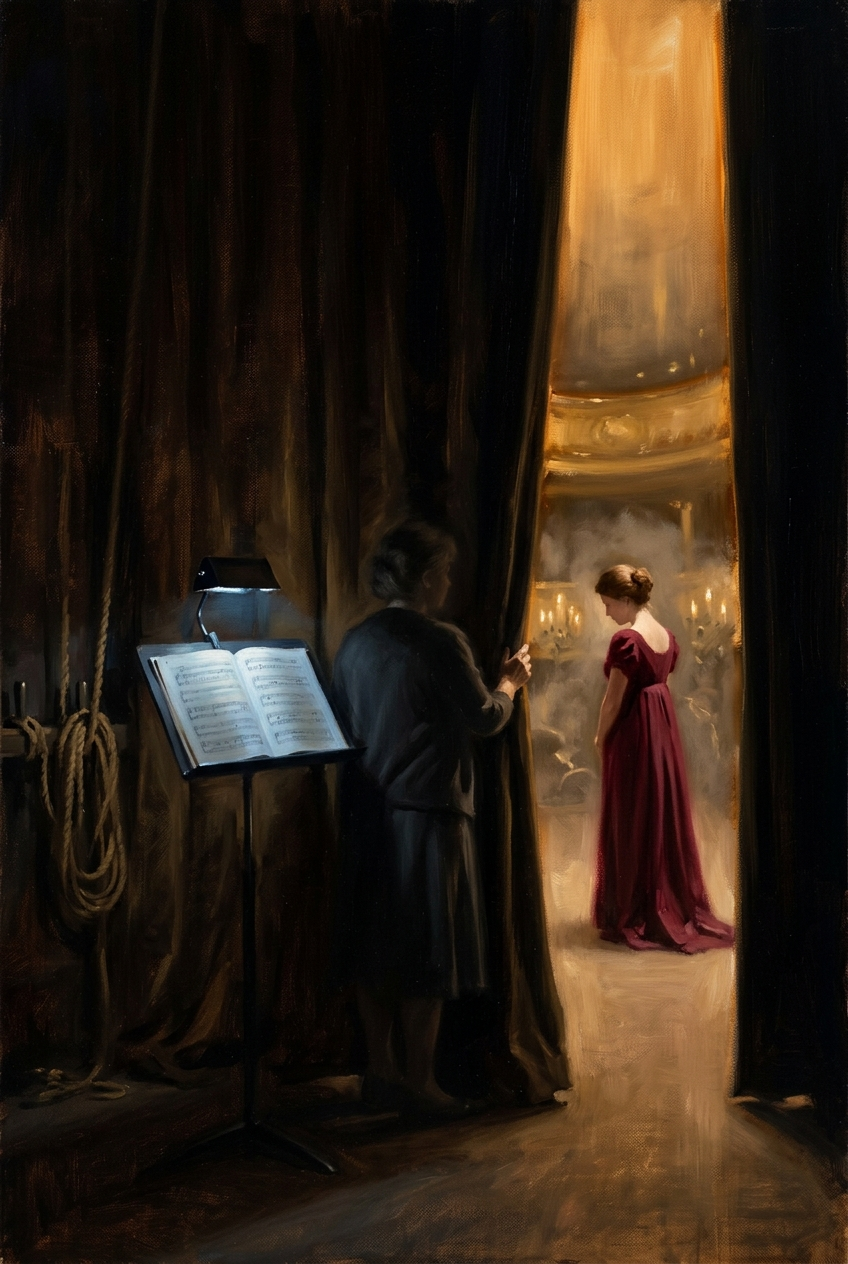
The library faces west across the valley. In October the light comes in low and orange and turns the old glass the color of a caught fish. I carry the lamp to the window table, the small one with the green shade, and I switch it on although there is still light enough to read by. That is part of it. The lamp says: someone is home, someone is settled, someone has all the time in the world and means to spend it here. Then the sherry, which I pour but do not drink, into the same cut-crystal glass, two fingers, no more. Vivian took two fingers of sherry at six and let it go warm and did not finish it. A woman who finishes her drink is thirsty. A woman who leaves it is only marking the hour.
I stand where the lamp can find my face. I let myself be seen.
Across the valley, a mile off maybe, sits the other house. Smaller, white, a porch that catches the last light. There is a window on its upper floor, and in that window, most evenings, a flat coin of brightness swings and steadies and holds. That is the lens. I know now it is a spotting scope on a tripod, the kind birdwatchers use, and I know who stands behind it, though I have never seen her face and never will at this distance. Eleanor. The sister. The whole reason I exist.
For eleven minutes I let her look. I turn a page of a book I am not reading. I lift the glass I do not drink. At six-fifteen I cross to the heavy curtains and draw them, left panel first, the way Vivian did, and the room goes dim, and the coin of light across the valley wobbles and drops, and Eleanor goes back to her evening believing her sister is alive and choosing, once again, not to call.
That is the job. That is the entire job, as it was described to me. Everything I found out after, I found out on my own.
Prentice hired me in a hotel bar in Albany, which should have told me something, because rich people's lawyers do not meet you in hotel bars unless the meeting is the kind that leaves no address. He was tidy in the way of a man who irons his own shirts and is proud of it. He bought me a club soda without asking and slid a photograph across the table, face down, and said, "First, tell me what you do."
"I temp," I said. "I've done reception, I've done trade shows. I did two years as a stand-in on a soap that got cancelled." I did not say the rest of it, the auditions that went nowhere because a casting director once told me I had a face that belonged in the background, a face that let the real face look better by comparison. I have a talent for being almost. It has never once paid the rent.
"A stand-in," Prentice said, and something eased in him. "You know what that is, then. You know how to hold a mark and let the light do the acting."
"I know how to stand still and not be interesting."
"That," he said, "is a rarer skill than you'd think." He turned the photograph over.
I did not gasp, because I don't, but I looked at it a long time. A woman in her sixties, silver hair, strong nose, a mouth that had decided things. Not me. But the bones under it, the set of the eyes, the long jaw. A cousin, a stranger, my face aged and hardened and given money. I understood before he explained. The face was a costume that would fit.
"Mrs. Ashford is unwell," Prentice said. "Not dying. Resting. There's a delicacy to the timing, financially, with the estate reorganizing. It would be, let's say, destabilizing, if certain parties believed she was anything less than fully herself. It's a matter of appearances. Quite literally. You would keep up an appearance."
"For who?"
He hesitated for the first time. "There's a sister. Estranged, badly. She watches the house. Has for years. It's her way of staying close to something she can't bring herself to touch. Mrs. Ashford's wish is that the sister be, ah, undisturbed in her habits. That nothing appear to change. You would simply be seen, in the evenings, doing what Mrs. Ashford does. Nothing more. No phone calls. No visitors. No going into town. You'd live very comfortably and very privately, and in three months, when matters settle, you'd leave with more money than the soap ever paid you."
Comfortably and privately. I heard the second word louder than the first, but I was thirty-nine and behind on everything and the club soda had no bubbles left, and I said yes to being almost somebody for three months, because it was more than anyone had ever offered me for being myself.
The first two weeks, I believed him. It is astonishing what you can believe when the sheets are that soft.
The house believed him too, at first. It had the hush of a place waiting for its owner to come back down the stairs. Her reading glasses on the hall table. Her calendar in the kitchen with appointments penciled ahead, the dentist, a hair appointment, a lunch, all in a firm slanted hand. Cut flowers in the front rooms, replaced twice a week by a woman named Dorota who did not speak to me and looked at a spot just past my left ear when she had to be in the room. Everything arranged to say: Vivian is here, Vivian is only upstairs, Vivian will want these dahlias when she comes down.
It was the dahlias that started it, in the end.
I have always noticed things about being looked at, because being looked at is the only thing I've ever been good at. So I notice, too, when something is arranged to be looked at. The flowers were fresh in every room a visitor might see and there were no visitors. Fresh flowers for an audience of one, and I was the one, and I wasn't allowed to enjoy them because I wasn't really there either. The calendar's appointments marched forward into November and December, but no one confirmed them, no one canceled them, the phone never rang about them. They were set dressing. Someone had written a future in a dead woman's hand and left it on the fridge to be believed.
I don't know when I let myself use the word. Late, later than I should have. You resist a word like that because once you've thought it you're in a different story, and the different story has you in it in a way you can't afford.
But there was the freezer in the garage, padlocked, which Prentice said held "estate documents kept cold for preservation," and no lawyer alive keeps paper in a chest freezer. There was the flowerbed at the far edge of the lawn, past the yews, turned over and reseeded in October when nothing gets reseeded, the grass coming in pale and wrong. There was the smell in the master bathroom under the bleach, a smell I knew from a nursing home I temped in once, a smell they use industrial products to bury and never quite do. There was the fact that in six weeks I never once heard a floorboard overhead, and a resting woman, an unwell woman, a woman only upstairs, makes the ceiling speak.
And there was Prentice, who came on Sundays to review the week, and who I understood at last was not reviewing my performance for Vivian's comfort. He was reviewing it for the woman across the valley. He'd sit in the dim library after six-fifteen with the tablet, watching the day's footage from a camera I hadn't found, and he'd say things like, "You reached for the glass with the wrong hand on Tuesday. She was right-handed for a drink, left for a book. Small thing. But she watches for small things." He never said Eleanor's name. He said she watches, always, the way you'd talk about weather that could turn.
That was when I understood the shape of it. Vivian Ashford was in the flowerbed past the yews. And the entire elaborate machine of the house, the dahlias and the calendar and the sherry and me, existed to keep one woman a mile away from picking up a telephone. Because if Eleanor called and got no answer, she might come. And if she came, she might learn that her sister had died estranged, unforgiven, with the will unsigned or signed the wrong way, and whatever Prentice was quietly moving through that reorganizing estate would stop moving. I was not keeping up an appearance. I was the appearance. I was a locked door made of a face.
I thought about running. I want to be honest that I thought about it every day and did nothing, because there was a fee I hadn't been paid yet and a highway I'd have to reach on foot and a man who had already killed the mother of this whole performance and had a chest freezer and a spare flowerbed. I am not brave. I have spent my life in the background specifically to avoid the moments where bravery is required.
So instead I did the only thing I know how to do. I performed. And I began, very carefully, to change the performance.
It started small, the way I could tell myself was accidental if the footage went to Prentice. One evening I set the lamp two inches to the left, so it lit the empty chair beside me instead of only my face. The next, I left the curtains open a minute past six-fifteen, then two. Nothing Prentice would flag. Everything Eleanor might feel. Because I had begun to think about her, the woman behind the lens, the way you think about an audience you can't see but can sense breathing in the dark. Eleven minutes a night for six weeks, she had been looking at me and I had been looking at the coin of her looking, and somewhere in there the surveillance had turned into the only conversation either of us was having.
I found the letter in the window seat, under the cushion, where Vivian must have shoved it and never dealt with, the way you shove a thing you can't answer and can't throw away. Eleanor's hand, softer than her sister's, the stamp uncanceled because it had never been mailed back or maybe never mailed at all, a letter that had made a round trip of the heart and gotten no further than a cushion. I read it twice and then I put it back because it wasn't mine, and then I took it out again because nothing here was mine and I needed it more than the dead did.
Most of it was old grief, the specific grievances sisters keep in labeled jars. But near the end: I still leave the porch light on for you. I know you can see it. I always will. You don't have to do anything about it. I just want you to know that from where I sit, this house has one lit window, and it's yours, and that's enough for me most nights.
The porch light. I had seen it every evening without seeing it, a warm point below the cold coin of the lens, on before the scope, on after the curtains closed, on all night I suppose, a woman's whole apology reduced to a bulb she refused to switch off. From where I sit, this house has one lit window, and it's yours.
She meant Vivian's window. She meant my window. She meant the lamp I turned on at six and the face I wore beneath it and none of it was Vivian and all of it, to Eleanor, was the last of a sister she'd never stopped keeping the light on for.
I could have wept, but Vivian didn't weep, and there was a camera.
Here is what I decided, sitting on that window seat with a dead woman's dress going cold on my body and a living woman's letter going warm in my hands. Eleanor had spent years asking for one thing, one small thing, some sign back across the valley that the light was seen. Vivian never gave it. Vivian died without giving it, and now I was standing in her window every night giving Eleanor exactly what Vivian always had, which was presence without answer, a lit shape that would not lift its hand.
And I was the only one left who could.
The risk was the whole risk. Anything Eleanor could read, Prentice could read. If I answered the porch light in a way Vivian never would, I told Eleanor at once that this was not her sister, and I told Prentice at once that his door had learned to talk. There would be no third evening. Whatever came would come fast, on the valley road, in the dark. I knew that. I want it on the record that I knew that and did it anyway, the one brave thing, and only because it was also, finally, a way out that didn't run on my legs.
I planned it like a scene, because a scene is the only thing I've ever been able to trust.
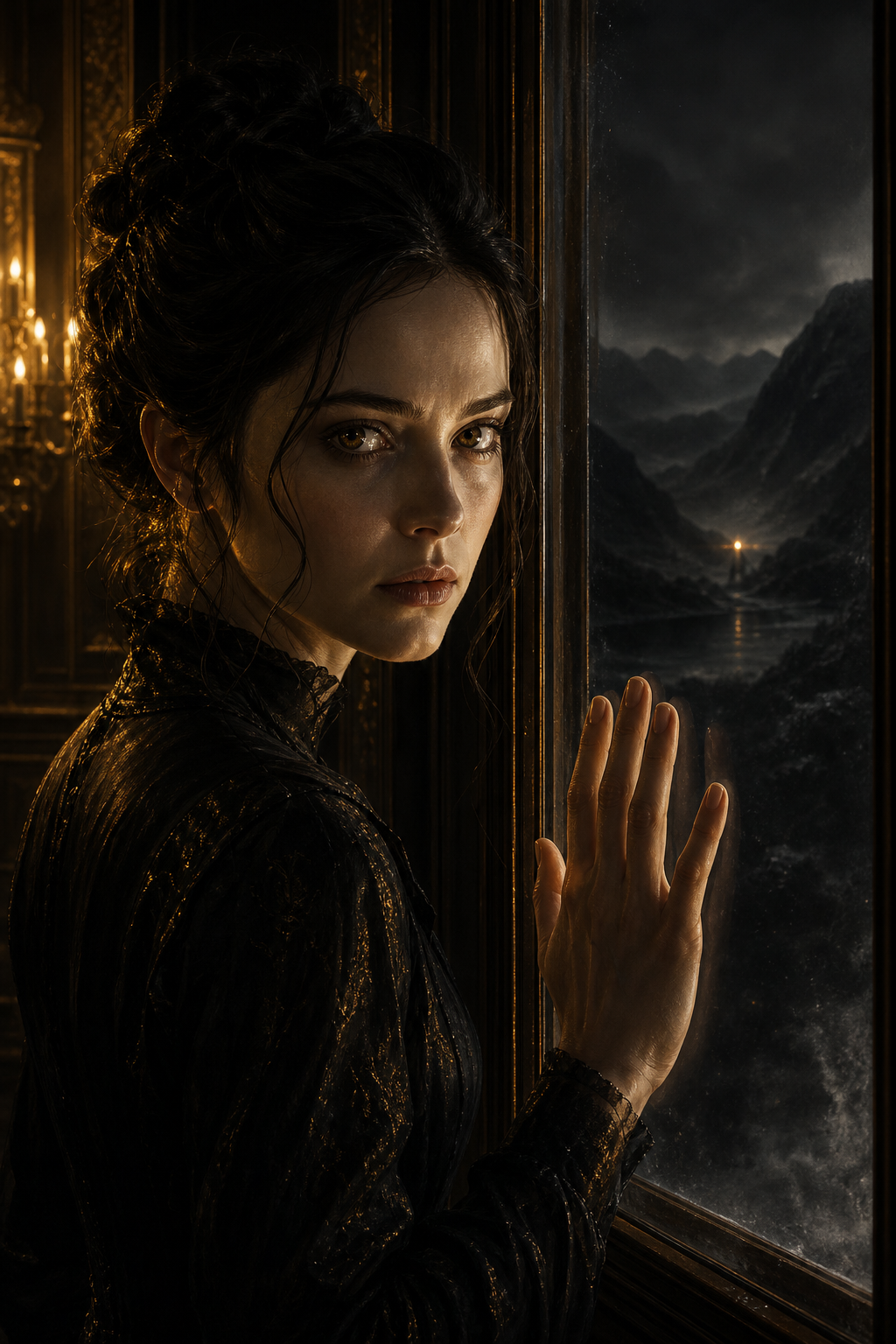
I let three ordinary evenings pass. Lamp, sherry, page, curtain, exactly to the second, so the footage would be a lullaby, so Prentice would drive up on Sunday and find nothing and go home. On the fourth evening I poured the sherry as always. I turned the lamp on as always. And then, at six o'clock straight, before the eleven minutes could begin, before I could think myself out of it, I picked up the whole business, the lamp and the glass and Vivian's honest forehead, and I set the lamp down on the window seat where its light fell full on the glass and not on the room. I put my hand flat against the cold pane. Palm open. Fingers spread. A thing you do not do to a person you are watching from a mile off. A thing you do only to a person you are reaching across a distance you cannot cross any other way.
And I held it there while the light died out of the valley.
The coin of the lens found me. Steadied. Held on my hand the way it had held on my face, and I understood she was reading it, turning it over, the way I'd turned over her letter, asking what it meant, afraid to answer in case she'd invented it, the way you are afraid to answer any sign you've waited years for.
Then, across the valley, the porch light went out.
I stopped breathing. I thought I had done it wrong. I thought she had turned away, gone in, understood at last that her sister was capable of anything except this and therefore this was not her sister and therefore.
The porch light came back on.
Off. On. Off. On. A pulse. A heartbeat made of a bulb. Not steady the way it had burned for years, not the endless patient light of a woman waiting to be seen. Something faster. Something that had, after all this time, been answered and could not hold still about it.
I laughed, once, a sound the camera could keep. I pressed my hand harder to the glass until I could feel my own pulse in the cold of it, and across the black valley the little light beat back at me, off on off on, two women signaling across a mile of dark in a language neither of them had ever been taught, a language that meant only here, here, I'm here, you're seen, and I let the curtains stay open long past six-fifteen, long past when I was allowed, because there was nothing left to protect. The door had spoken. The forgery was over. Somewhere a tablet was recording a hired face with its hand on a window and its whole self finally, dangerously, in the frame.
The headlights came onto the valley road at six-forty.
I saw them turn off the county highway and start the long climb, sweeping the trees, and I couldn't tell whose they were, whether it was Prentice come to close the account or Eleanor come at last across the mile she'd kept for years, and the not-knowing was the truest thing that had happened to me in this house, truer than the sherry, truer than the dress. Either way I had stopped being the door.
I did not run. There was nowhere to run that my legs could reach, and anyway I found I didn't want to be found running, didn't want that to be the last shape of me. I stood in the lit window with my hand on the glass and I watched the headlights climb, and across the valley the porch light held steady now, steady and burning, a woman's answer given and a woman standing behind it, and I thought: whoever's coming, at least one person in this valley knows the difference between the light and the door. At least one person is on her way toward the difference.
I kept my hand where it was. I let myself be seen.
At six o'clock I had become her. It was full dark now, past everyone's schedule, and I was, for the first time in the whole three months, only and entirely myself, standing in a window I'd been hired to make into a lie, waiting to see which of them the road brought, my palm going numb against the glass, the sherry warming untouched on the sill where a thirsty woman would have finished it long ago.
More from Short Stories