Fair Market Value
The dragon wanted to know whether the assessment was deductible.
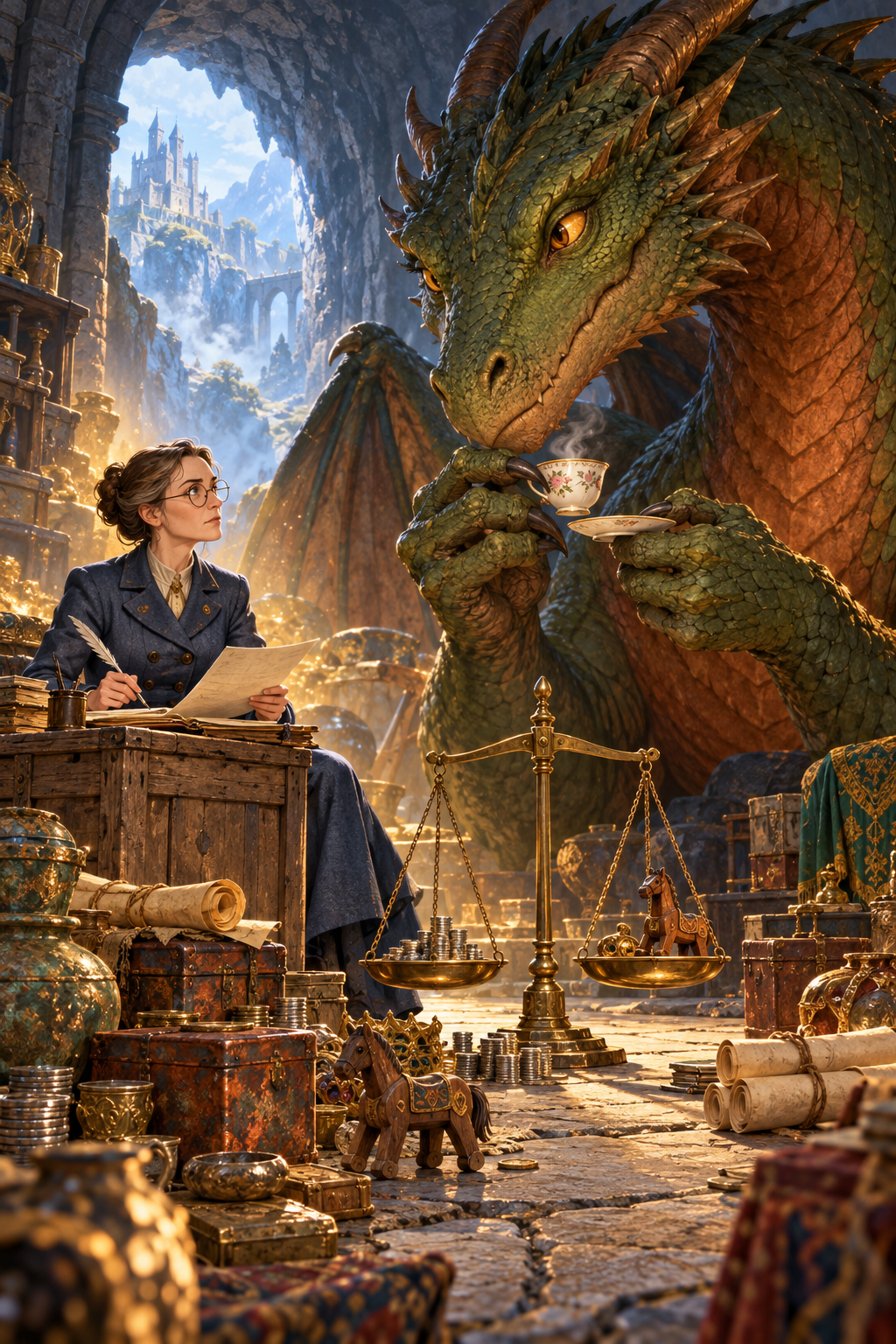
Synopsis
Nell Cobb, a meticulous Third Assessor of the Exchequer, climbs Scarth Fell to value the hoard of the last dragon in the realm under a brand-new Hoard Act, with a promotion dangled if she is thorough. Margery, a four-hundred-year-old dragon who took her name from a cookbook, disputes every valuation upward and murmurs village surnames over teacups and toy horses. Over a long day of weighing and multiplying, Nell realizes the Act is a trap. Its tax must be paid in current coin the hoard almost entirely lacks, and default lets the Crown seize everything. Then a boy arrives with a goat and a tin box, and Nell understands what the hoard really is: three centuries of the valley's deeds, dowries, wills, and savings, kept where no lord or thief could reach them. Using an obscure section of the Statute of Assessments that nobody else bothered to learn, Nell spends the night writing down what has never been written down. When the Undersecretary arrives with six wagons, the whole parish is waiting for him.
Fair Market Value
Story
The dragon wanted to know whether the assessment was deductible.
"From what?" Nell said.
"From the tax." Margery lay along the back of the cave with her chin on a heap of plate, one eye open. It was the colour of a struck match. "If I'm paying for the trouble of being counted, I'd expect to pay less."
"You don't pay for it. The Crown pays me."
"Out of what?"
Nell opened her ledger on a flat stone, uncapped the ink, and decided not to answer that.
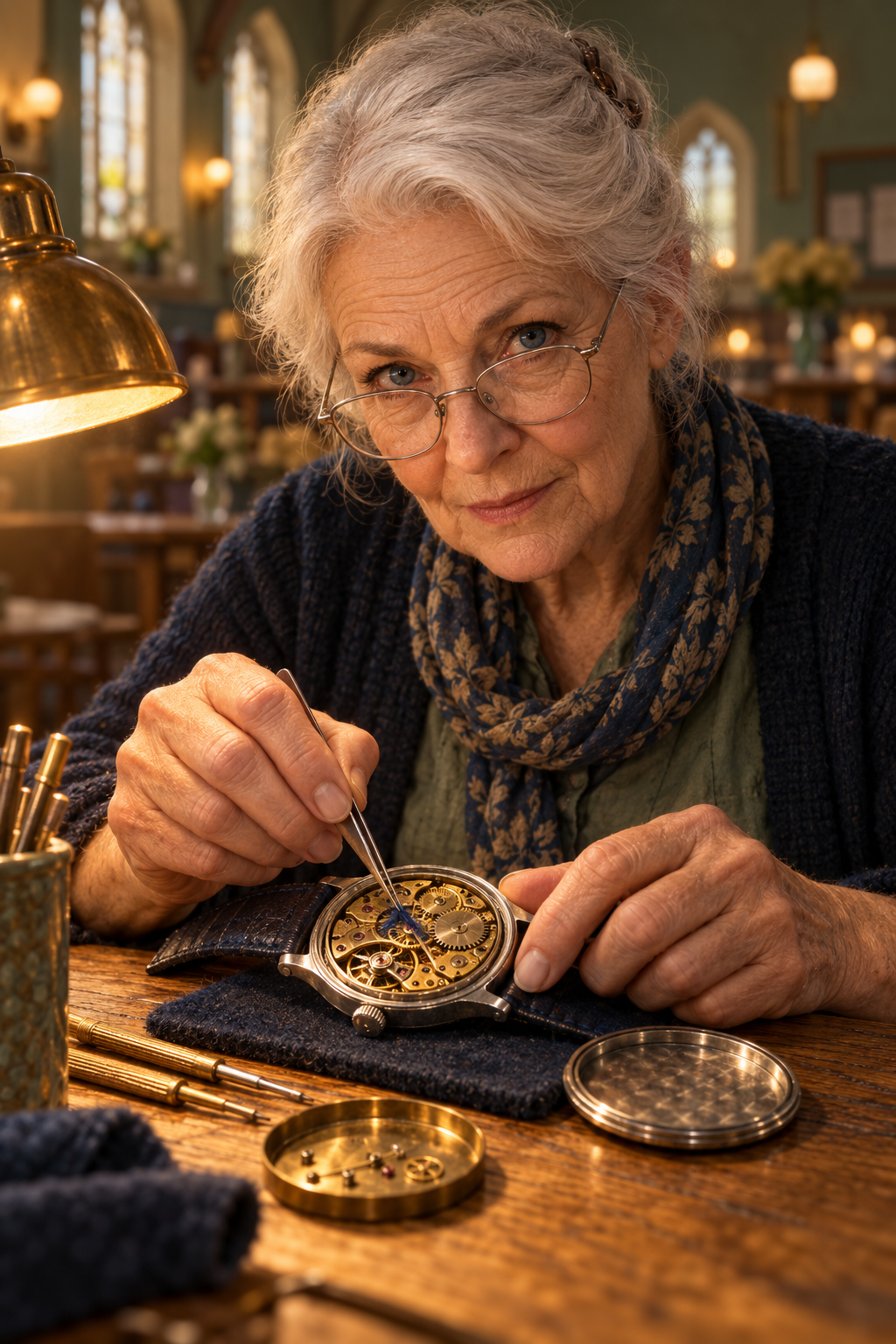
She had walked up from Scarth that morning with the Act in her satchel, a set of brass assay scales, a touchstone, two pencils, a bottle of iron-gall ink, and a letter of appointment. The letter named her Third Assessor of the Exchequer at Harrowgate, which was true, and empowered her to value the hoard of the dragon resident at Scarth Fell and to take such oaths and declarations as the valuation required. Nobody had ever written that sentence before. The Hoard Act was eleven weeks old. It had passed both houses in an afternoon, and as far as Nell could tell it applied to exactly one taxpayer.
Undersecretary Lambe had handed her the commission himself, in his office with the window. "Thorough," he'd said, "is what we want. Every cup and spoon. You're known for thorough, Miss Cobb." Then he had mentioned, as if it had only just occurred to him, that there was a vacancy for Second Assessor. Second Assessors had windows too.
"Before we begin," Nell said, "I need your name for the record. Your full name."
"Margery."
Nell waited. "Is that the full name?"
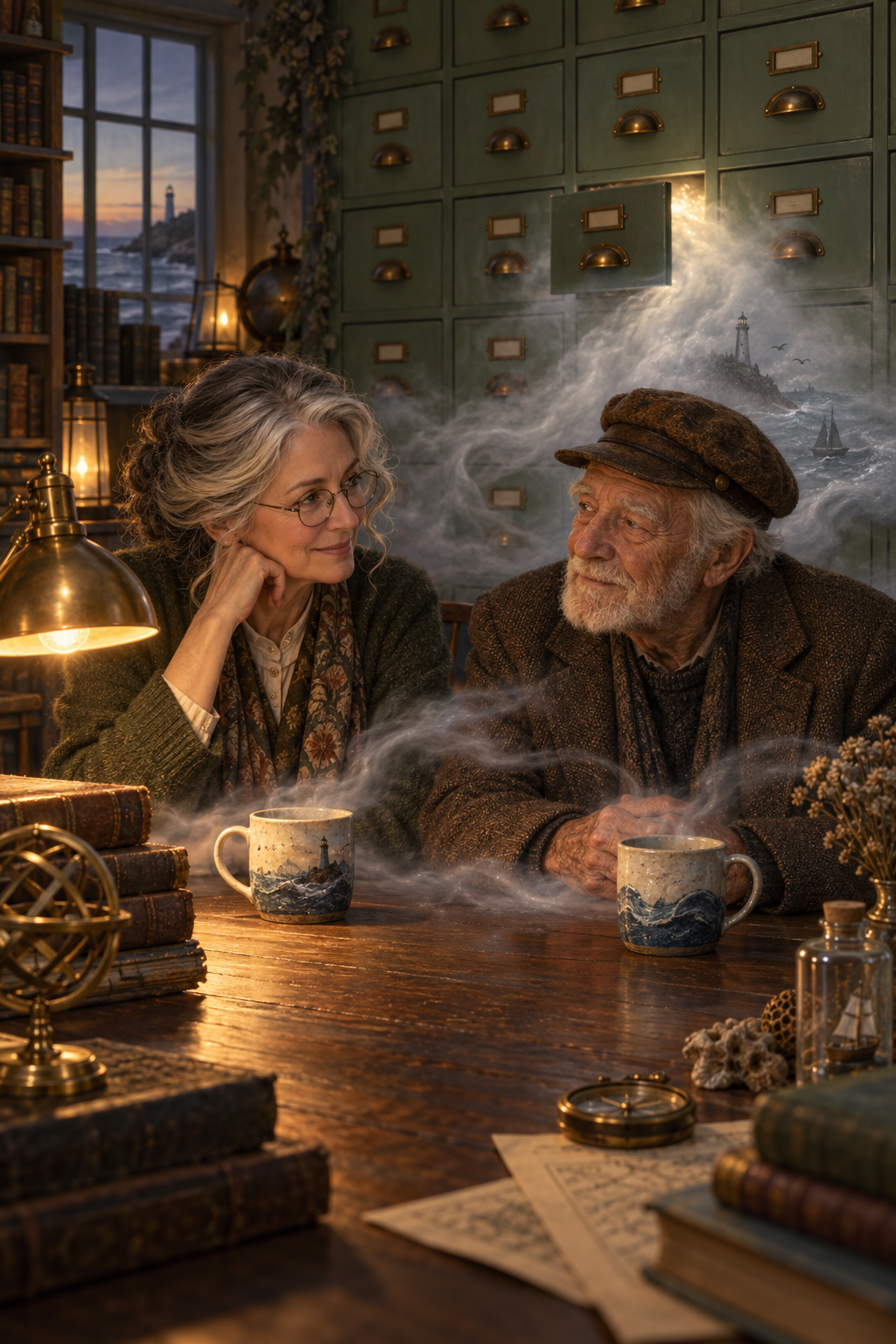
"It's the one I use. I had it off the flyleaf of a cookbook." The eye half closed. "Lovely hand. Margery Stell, her book, 1404. Lots of notes in the margins about suet."
Nell had a question about what had become of Margery Stell, and she could see from the eye that Margery knew she had it.
"She was ninety-one," said the dragon. "Died in her bed. I bought the book at the sale."
Nell wrote Margery and left a space after it, in case.
"Item one," she said, and lifted the nearest thing, a silver ewer with a dent in the lip. She weighed it. She drew a corner across the touchstone and held the streak to the lamp. "Silver, sterling or near it. Two pounds seven ounces. Old work, damaged. Fair market value, three crowns."
"No," said Margery.
"I'm sorry?"
"It's worth more than that."
"Fair market value is the price a willing buyer would pay a willing seller, neither being under compulsion." Nell had examined in it. She had examined in the whole of the Statute of Assessments, all forty sections, including the ones about mills and ferries and goods held in bailment that everyone else in her year had skipped, because the examiners never asked about them. "Three crowns is generous. The dent."
"I made the dent."
"Then it's your dent, and I can't charge you for it."
"Put four."
"I can't put four because you're fond of it."
"I'm not fond of it. It's worth four."
Nell wrote three crowns. In the margin, where she kept the notes nobody else read, she wrote disputes valuations upward. Then she looked at that line for a while. In six years she had assessed millers, wool merchants, a bishop, and a widow who kept her savings in a hollowed-out loaf, and every one of them had sworn their goods were worthless. Nobody had ever argued her up.
By noon she had a rhythm.
The cave was deep and dry and smelled of cold smoke and lamp oil, and under that of something like hot pennies, which she worked out eventually was Margery. The hoard didn't glitter the way it did in the pictures. Most of it was brown. Old gold went the colour of strong tea when nobody polished it, silver went black, and the long ridge of it that rose toward Margery's shoulder looked less like treasure than like the contents of an enormous drawer somebody had stopped sorting around the reign of Edmund the Lame.
There was gold, though, a great deal of it. There was coin in soft collapsing drifts, so worn the kings on it had become thumbprints. There were cups and salvers and a chain of office for a town that no longer existed. Nell weighed handfuls and multiplied, and the column on the left of her ledger grew until she had to start a second page.
There was also a brass bedstead. There was a clock without hands, eleven left boots, a christening gown folded in waxed paper, a jar of buttons, a ploughshare, a sealed letter, and a child's wooden horse with the paint licked off one side.
"Item two hundred and six," Nell said. "Horse, toy, wooden. Nil value."
"Tunney," said Margery.
The pencil stopped. "I'm sorry?"
"Nothing. Go on."
"Item two hundred and seven. Gown, christening, linen and lace. Sixpence."
"Ashcroft."
"Item two hundred and eight." Nell picked up a teacup, white porcelain with a blue rim and a chip out of it the size of a fingernail. "Teacup. No saucer."
"Pell. Agnes Pell."
Nell put the teacup down on the stone, very carefully, the way she would have put down something that might go off. She had read the ballads as a girl, like everyone. She knew what happened to the people who owned the teacups.
"Did you," she began, and found there was no professional way to finish it.
Margery seemed to follow her anyway. She lifted her head off the plate, and the whole ridge of the hoard shifted with a sound like slow surf on shingle. "I haven't eaten anyone since the old king's time," she said. "And he started it."
"Then who is Agnes Pell?"
"A woman in Scarth." Margery lowered her chin again. "You'll want to get on. You've only done the near end."
Nell ate her bread and cheese at the cave mouth, with the valley laid out green and grey below her and the roofs of Scarth like a handful of dropped slates, and read the Act again.
She had read it on the road. She'd read it in Lambe's office. She was a careful reader, but the first two times she'd been reading for what it asked of her, and this time she read it for what it would do.
The rate was one part in three, annually. That was steep, but the Crown was at war with someone most years and taxes were always steep. Section nine said the sum was payable in current coin of the realm within one day of assessment. Section eleven said that on default the Crown might seize the hoard entire.
Nell went back inside and stood in front of the ridge with her ledger open and did the sum she had been not quite doing all morning.
The hoard came to a little over forty-one thousand crowns. A third of that was thirteen thousand seven hundred. Current coin of the realm, the coin with King Aldric's face on it that a tax clerk could accept, she had found in one pile only, near the front. It came to fifty-eight crowns and some shillings. Everything else was old gold, foreign gold, gold from kings who had been dead three hundred years. It was worth a fortune, and as far as section nine was concerned it might as well have been gravel.
She thought about the vacancy for Second Assessor. She thought about Lambe saying every cup and spoon, and about the line in her commission that said the Undersecretary would come up to Scarth tomorrow "to receive the assessment, with such conveyance as may be needful."
You didn't need a conveyance for a ledger. You put a ledger in your coat.
"How many wagons does it take," she said aloud, "to move all this?"
Margery opened the eye. "Why?"
"I'm asking as a matter of valuation."
"Six, if they're good ones." A pause. "Seven if they want the bed."
The boy came up the path in the middle of the afternoon, towing a goat.
He was ten or so, in a coat that had been someone else's first, and he carried a tin box under one arm with the grim care of a child who has been told what will happen if he drops it. He stopped short at the sight of Nell's scales. Then he looked past her into the dark and said, "Afternoon, Mrs. Margery."
"Davy Tunney," said the dragon. "Come in. She's from Harrowgate, she won't bite."
Davy came in. He held out the tin box with both hands, and Margery took it delicately between two claws, and Nell watched an animal that could have bitten through the wagon Lambe was bringing accept a biscuit tin as if it were a sacrament.
"Four crowns and the deed to the cottage," Davy said. "Mam says Uncle Rob's being funny about Grandad's will, and she wants it somewhere he can't get at."
"Nobody gets at it here."
"And that's for you." He nodded at the goat.
"Tell your mother thank you." Margery leaned and set the box down in the ridge, neatly, not tossed. It went beside the wooden horse with the paint licked off. "That was your grandad's," she told him. "He brought it up when he was smaller than you. Said his brothers kept taking it."
Davy looked at the horse, interested and unimpressed, the way children look at evidence that their grandparents were ever young. Then he went down the hill without the goat, and the goat looked at Nell, and Nell looked at the ridge.
She was thinking of the Statute of Assessments, section thirty-one, the one everyone skipped.
"How much of this," she said slowly, "is yours?"
"All of it's mine to keep."
"That isn't what I asked."
"It's what I answered."
"Keeping and owning," said Nell, "are two different words in the Statute."
"They're one word in mine." Margery's tail moved somewhere off in the dark. Something metal toppled and rang. "People in this valley have brought me things for three hundred years. Rings to hold till the wedding, a will nobody's to see till the funeral, a sister's dowry so the brother can't drink it. Nobody robs a dragon. Nobody sues one either. The Lord of Scarth tried to take the mill off the Ashcrofts in my grandmother's day, and he couldn't find the deed, because it was in here." A puff of warm air rolled across the floor and stirred the pages of the ledger. "They come because nobody writes it down. You start writing it down, Assessor, and it stops being a place nobody can get at."
"And if I don't write it down," Nell said, "then tomorrow Undersecretary Lambe arrives with six wagons and twelve men, and you can't pay in current coin, and section eleven lets him take the hoard entire. Davy's deed. The horse. Agnes Pell's teacup. All of it goes to Harrowgate and gets melted down to pay for whatever we're fighting about this year."
The eye didn't blink. Nell hadn't seen it blink all day.
"I could burn the wagons," said Margery.
"You could."
"I won't, though." The head lowered by a degree. "They'd send something worse than wagons next time, and I'm four hundred and eleven, and the stairs here are bad for my hip."
Nell turned to a clean page. She ruled it down the middle with her second pencil, slowly, because her hand was not quite steady, and at the head of the left column she wrote Item and at the head of the right Held for.
"Start at the front," she said. "Every piece. Who brought it, and when, as near as you can remember."
"I remember all of it."
"Then this will go faster than I'd feared."
It did not go fast. It went all night.
Margery remembered everything, and she remembered it in the wrong order and with digressions. The ewer with the dent was not hers. It belonged to the heirs of a man called Hob Fairley, who had left it in 1630 and been killed by a bull, and Margery did not know who his heirs were, and that bothered her more than Nell had expected. The silver salvers had come up with a family fleeing a fire. The chain of office was a town's, and the town had kept a bad mayor once and hidden its chain from him and then forgotten, all of them, all at once, which Margery thought was the funniest thing that had ever happened in the valley.
The old gold was another matter. Nell went into it slowly, handful by handful, waiting to reach the part that was simply a dragon's, the heap of plunder from the ballads. The coins had come up a few at a time, over generations: a farmer's savings, a widow's portion, wages from a lead mine that had shut in 1580 and been kept for children who were now somebody's great-great-grandchildren and had no idea. Margery could name them. She knew whose house each line had moved to, who had married whom, and which branch had gone to the coast.
Nell sent Davy Tunney back down to Scarth at dusk when he came for his mother's receipt, which she wrote out for him on a page torn from the back of the ledger. Tell everyone, she said. Anyone with something kept up here, come up in the morning and bring yourselves. It was the first deposit receipt the dragon of Scarth Fell had ever issued, and Margery watched her write it with the expression of someone watching a stranger rearrange her kitchen.
Around three in the morning Nell found what belonged to Margery.
It was in a niche at the very back, behind the bedstead: a stack of cookbooks, Margery Stell's on top, the suet notes gone brown. A clock without hands. Eleven left boots. ("People only ever lose the one," Margery said. "I don't know why. I find them on the fell.") A shaving mirror. A small blue bottle that had once had something in it and now had nothing. The bedstead itself, which she had taken off a cart that had gone over in a snowstorm, with the driver's agreement, after she'd carried the driver to Scarth.
Nell weighed and valued them. She did not let herself be generous. The ewer had taught her not to be.
"Forty-one crowns, sixteen shillings," she said at last. "That's the hoard of the dragon resident at Scarth Fell."
Margery was quiet for a while.
"It sounds very small," she said, "when you say it like that."
Undersecretary Lambe came up the fell road at ten the next morning, on a grey mare, with six wagons behind him and twelve men of the county guard in their good red coats. He was smiling when he came round the last bend. He stopped smiling at the cave mouth, where the parish of Scarth was standing in a line.
There were sixty-odd of them, in their working clothes, with children on hips and dogs at heel. Old Agnes Pell had been carried up in a chair. Davy Tunney was at the front, as if he'd organised it, and possibly he had.
Nell stood by the flat stone with her ledger and her seal. She had slept for forty minutes on the floor of a dragon's cave and was aware that her hair showed it.
"Miss Cobb," said Lambe. He looked at the line, and the wagons, and the dark beyond the cave mouth, where something very large shifted and settled. "What is all this?"
"The assessment, sir." She held it out. "Total holdings at Scarth Fell, forty-one thousand two hundred and twelve crowns. Less goods held in bailment on behalf of two hundred and fourteen named persons and estates, under section thirty-one of the Statute of Assessments, which applies to every holding not otherwise excepted. The Hoard Act doesn't except anything. The goods of another in one's keeping are assessable to their owner and not to their keeper." She turned the page for him. "Every item, with its owner and the date it was deposited. Sworn declarations from everyone here, taken before me this morning under my letter of appointment. The rest are marked for inquiry, heirs unknown."
Lambe read. He was not a fool, and he read quickly, and she watched him reach the bottom of the second column and the line she had underscored in fresh ink.
"Forty-one crowns," he said.
"And sixteen shillings, sir. Mostly boots. The tax at one third is thirteen crowns, eighteen shillings and eightpence."
"The word of a dragon."
"And of two hundred and fourteen of His Majesty's subjects, under oath." Nell kept her voice level. It came out more level than she'd hoped. "Most of the individual holdings fall below the minimum. A few don't. I'll be sending notices to those people in the ordinary way."
Somewhere in the line, a man who owned a share in a lead mine that had closed in 1580 said something under his breath to his wife.
Lambe looked at the wagons. He looked at the twelve red coats, who were looking at the cave. He looked at the line of farmers and widows and children, who were looking at him, and at Agnes Pell in her chair, who was looking at nothing in particular and humming.
"Thirteen crowns, eighteen and eight," he said. "Payable in current coin. Today."
"Yes, sir."
"From what? By your own reckoning the coin in that cave belongs to half of Scarth."
Nell had known the question was coming since three in the morning. She took her purse out of her satchel and counted it onto the flat stone. Thirteen crowns was most of a month. She had to borrow the eightpence from Davy Tunney's mother.
Lambe watched her do it. Then he wrote a receipt, in a hand that pressed through to the page beneath, and gave it to her without looking at her.
"You'll be Third Assessor," he said, "until you die."
"Yes, sir," said Nell. She was surprised to find that her main feeling was a wish to sit down. "I expect I'll get quite good at it."
The wagons went back down empty, which took a long time on that road, and the village went down after them in twos and threes. Some of them stopped at the cave mouth first and said something into the dark. Agnes Pell's grandson carried her down in the chair, and she was still humming.
Nell packed her scales and her touchstone and her ink. She had two copies of the assessment, because the Statute required two: one for the Exchequer, and one for the taxpayer's own record. Lambe had taken the first. She looked at the second for some time.
Lambe would be in Harrowgate by the end of the week. Papers went astray in Harrowgate, especially papers that had cost an Undersecretary six wagon hires and his afternoon.
She went back in. Margery had moved down to the front of the ridge, where the light reached, and in the light she looked older than she had the day before. Her scales were dull at the edges.
"The taxpayer's copy," Nell said, holding it up. "Strictly speaking, it's yours."
"Then I'll keep it."
"I'd rather you held it for me. For the Exchequer, I mean. In case the other one goes missing."
Margery considered her. "There's a fee."
"I haven't got a goat."
"No," said the dragon. "You've got thirteen crowns less than you came with, and a hole in your stocking, and no window." She reached out a claw and took the paper as gently as she'd taken Davy's tin box. "I'll put it on account."
She set it in the ridge, carefully, beside Agnes Pell's teacup. Then she settled her chin back on the heap of plate. The eye stayed open and watched Nell lift her satchel onto her shoulder.
"Assessor."
"Yes?"
"What you paid him." The eye narrowed slightly. "Is it deductible?"
"No," said Nell, and went out into the light, and started down the hill.
More from Short Stories