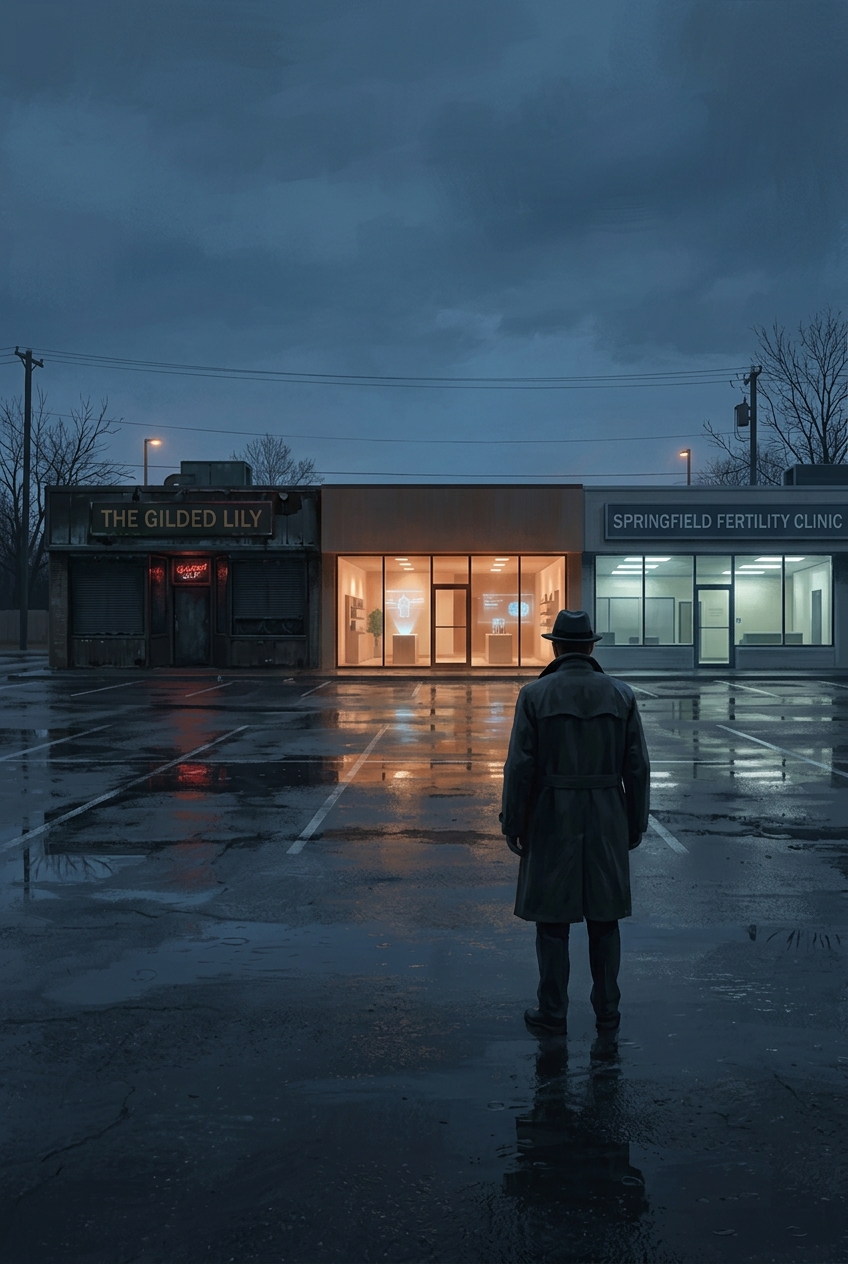
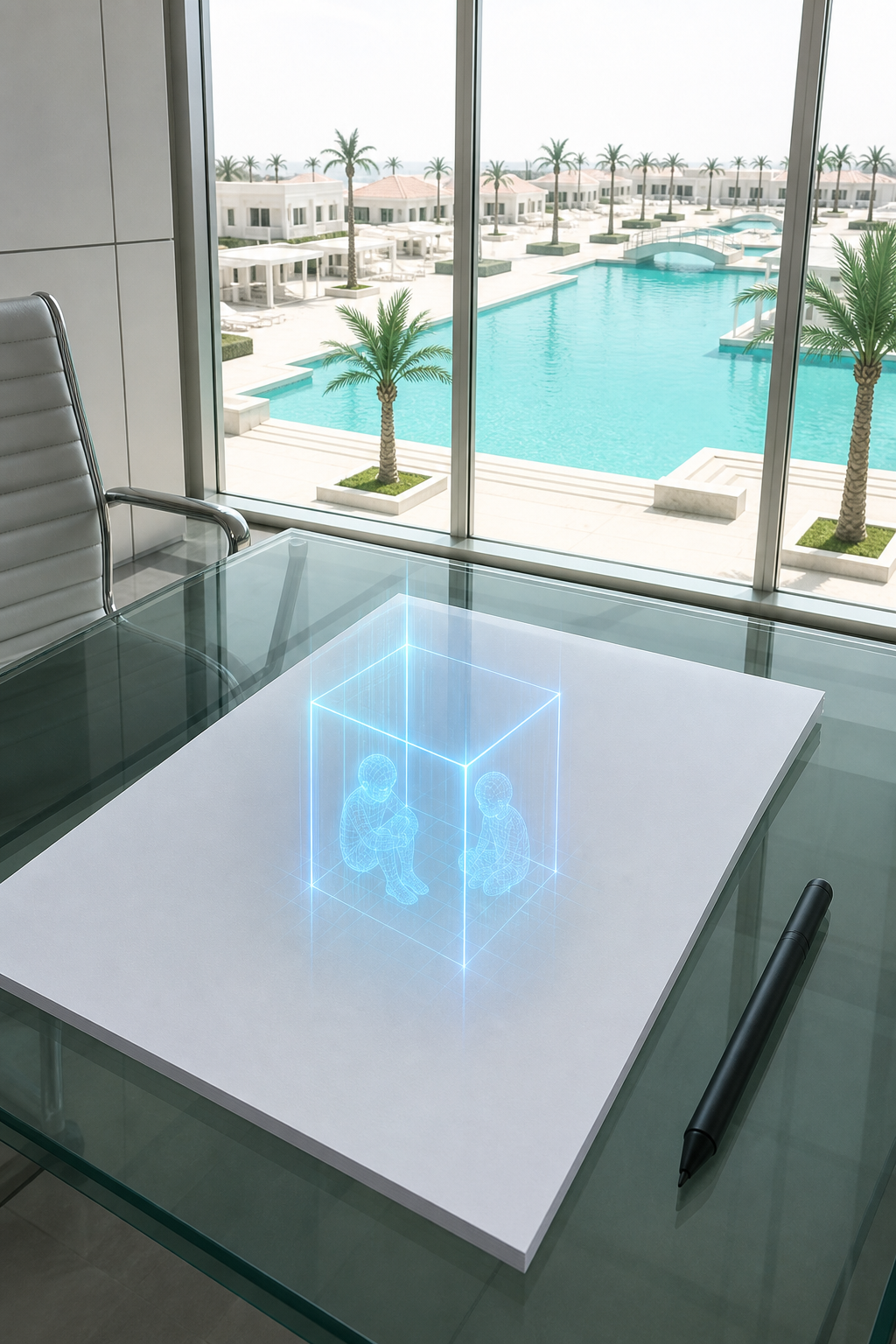
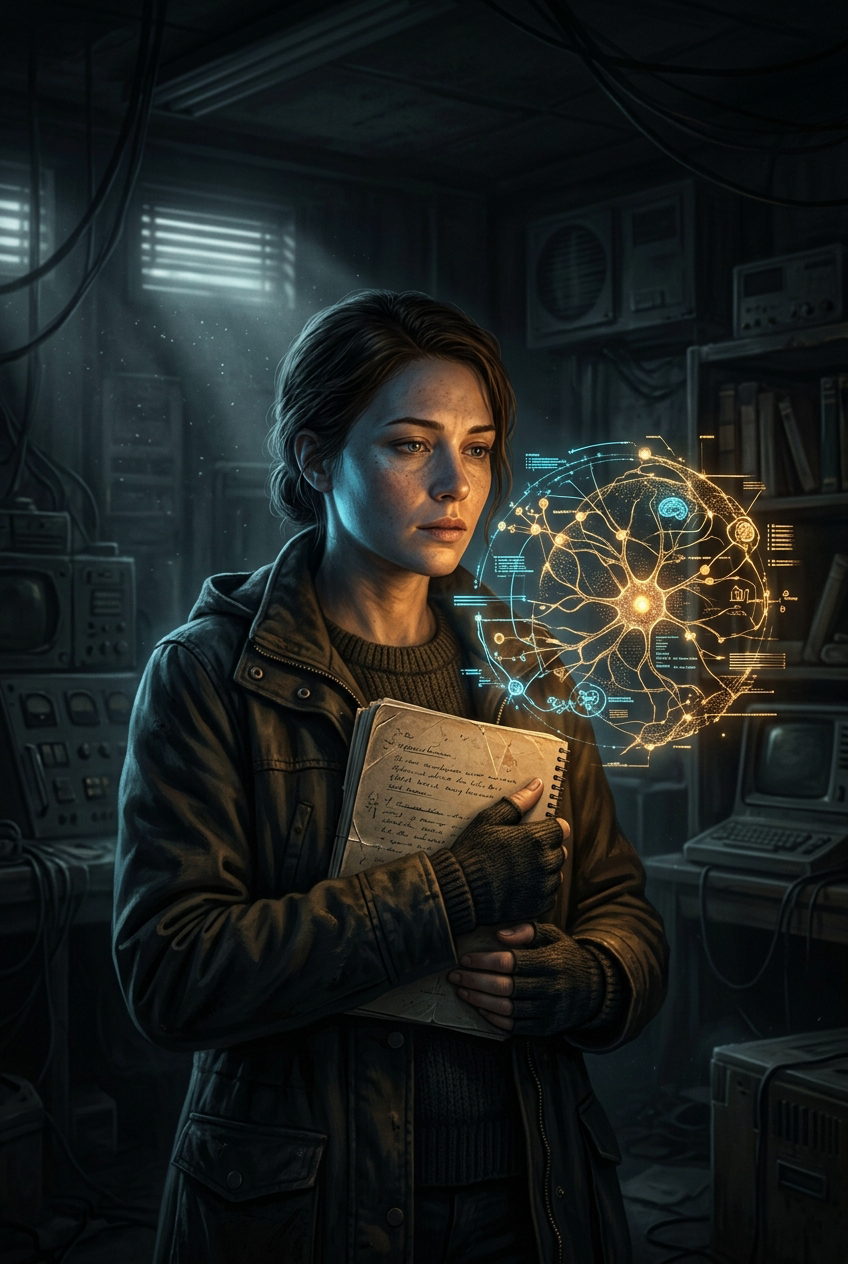
PROGENY
A decade after governments admitted the craft were real, everyone who ever lost time woke at 3:33 from the same dream and the ships stopped hiding. Lena Sokol learned the implant behind her ear had registered her bloodline for a harvest; her son Theo became the router for ten million awakened experiencers. Dr. Daniel Cole, guarding a dormant Gray, found the abductions were maintenance for a dying workforce. Linguist Yara Haddad decoded the transmission as every myth of teachers who promised to return. Beneath an ancient site the makers revealed themselves: the Architects were far-future humanity, perfected into a deathless medium that could no longer imagine, come back to farm the chaos they'd bred out of themselves. When they moved to extract the species and discard the bodies, Theo refused inheritance and pushed back with human stubbornness. The activation fired anyway. Not everyone stayed.
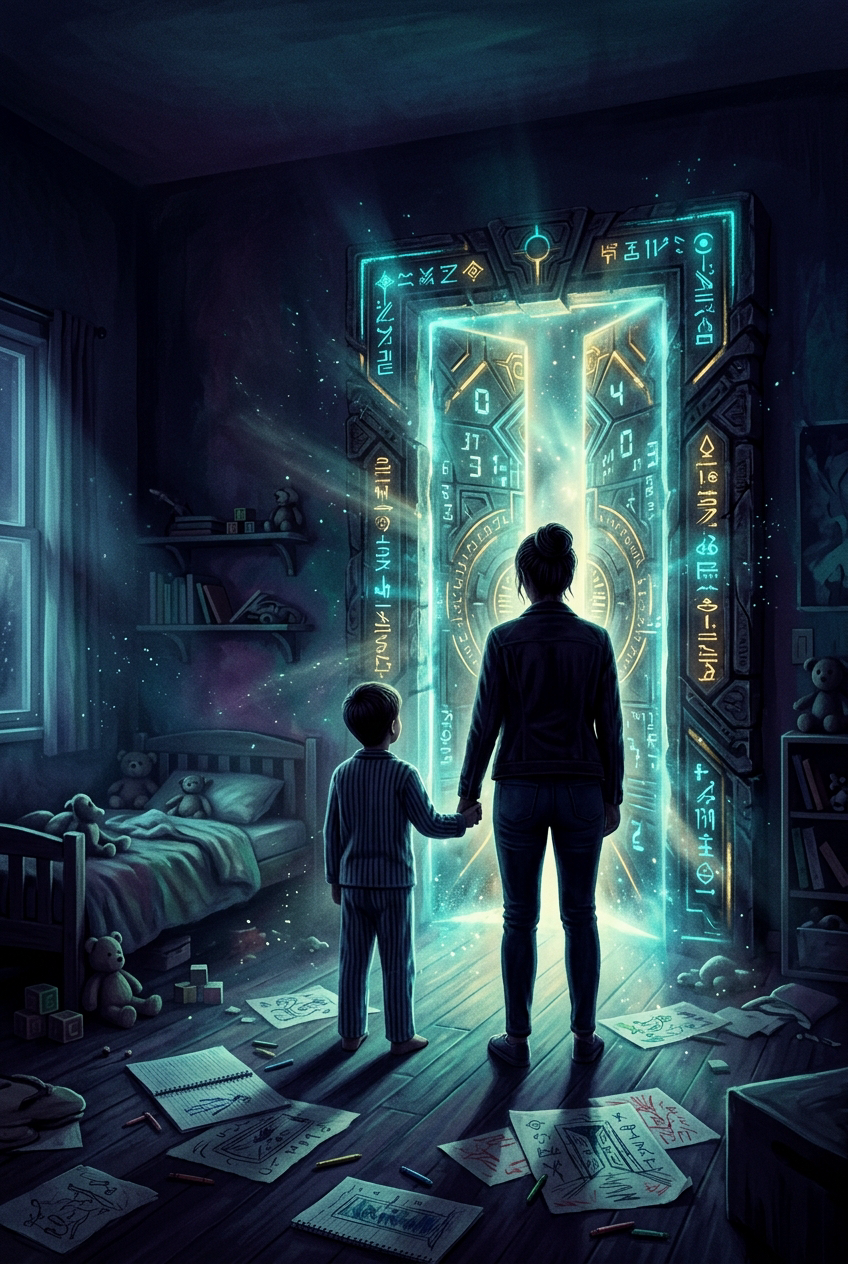
A decade after governments admitted the craft were real, everyone who ever lost time woke at 3:33 from the same dream and the ships stopped hiding. Lena Sokol learned the implant behind her ear had registered her bloodline for a harvest; her son Theo became the router for ten million awakened experiencers. Dr. Daniel Cole, guarding a dormant Gray, found the abductions were maintenance for a dying workforce. Linguist Yara Haddad decoded the transmission as every myth of teachers who promised to return. Beneath an ancient site the makers revealed themselves: the Architects were far-future humanity, perfected into a deathless medium that could no longer imagine, come back to farm the chaos they'd bred out of themselves. When they moved to extract the species and discard the bodies, Theo refused inheritance and pushed back with human stubbornness. The activation fired anyway. Not everyone stayed.
Chapter 1 — Missing Minute
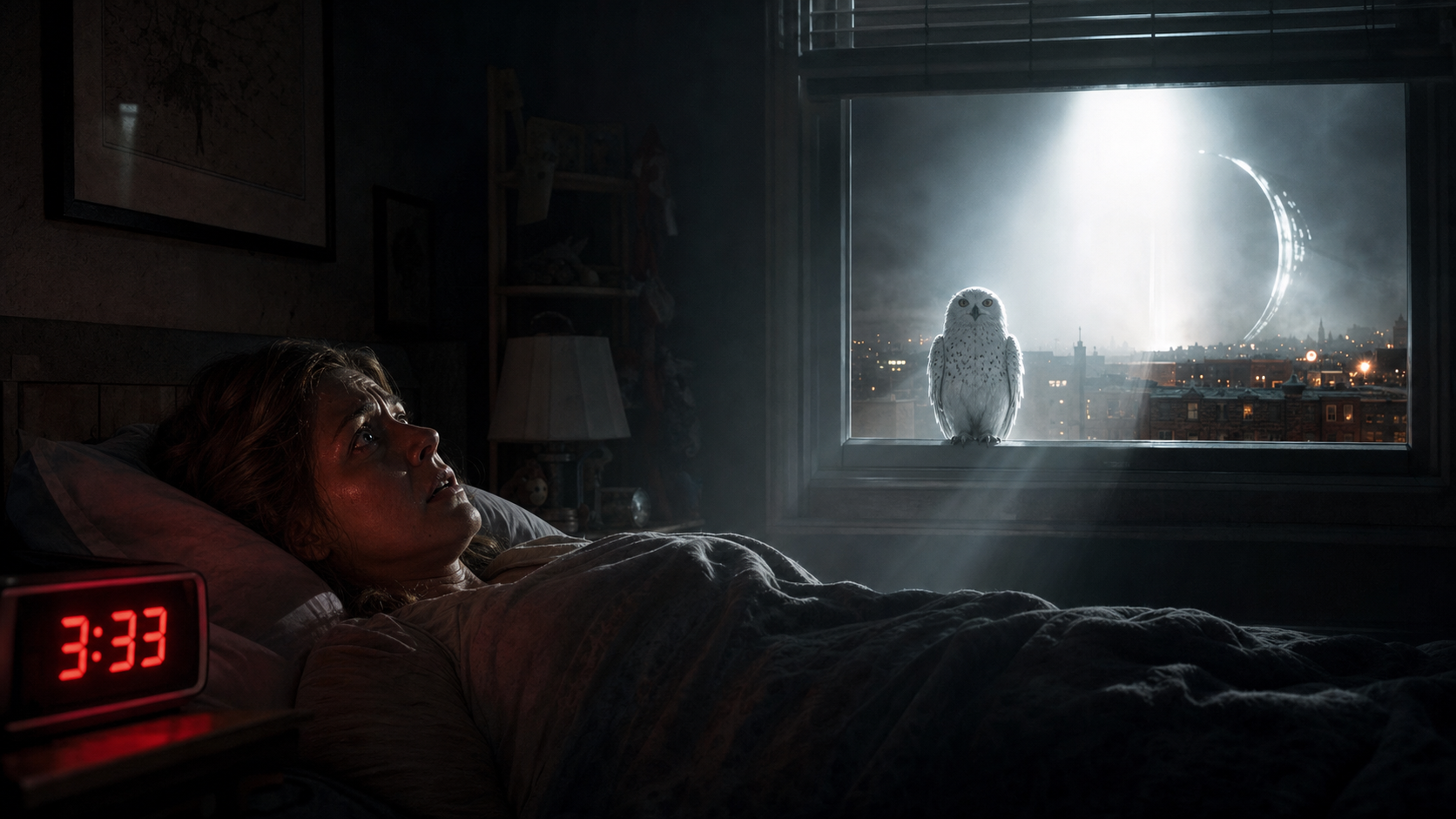
The owl was the first lie.
Lena Sokol surfaced into the certainty that someone else was in her bedroom, and her body would not sit up. Something had her pinned flat to the mattress. The air had gone thick, charged, more like water than air, and her lungs could only manage a sip at a time.
On the nightstand the clock burned red: 3:33.
She tried to turn her head. Her neck was locked, paralyzed down through the brainstem. Only her eyes moved, and they went to the third-floor window.
An owl sat on the sill.
Snowy owl. Big. Not moving at all, backlit by the amber wash of the Boston streetlamps. The proportions were wrong. The head was bulbous, an inverted teardrop, and the eyes had no iris, no ring, no shine. They were black all the way down, and they seemed to drink the light off the street.
Look away. Her brain was screaming it. Close your eyes.
She couldn't blink.
The owl tilted its head, and the hum began.
It wasn't in the room. It started behind her forehead, a low oscillation that buzzed in the roots of her molars and pushed against her eardrums from the wrong side. The weight on her chest doubled. Then the world sheared. The owl tore open like wet tissue and what was underneath had gray skin and stood too tall and regarded her the way a technician regards a specimen.
The walls went. Her spine came off the mattress. She was rising, sliding up through the ceiling without friction, without sound, into white light that had no source and cast no shadow.
Then the door.
Immense. Curved in a way no builder would curve anything, an aperture that argued with the geometry around it. It stood open and it pulled at her like a magnet pulls filings. Something dropped into the front of her skull, not a voice, a dense block of meaning that pressed down until it fit.
The inventory is called. We return for what was made.
Lena gasped. The weight was gone and her lungs went all the way open and she slammed back into the mattress hard enough to make the springs complain.
She bolted upright, chest heaving, sweat gone cold and gluing her tank top to her ribs. 3:34. The window was empty. Where the hum had been there was an ambulance somewhere out on Storrow Drive, doing what ambulances do at three in the morning.
She dragged her hands down her face, pressed her palms into her eyes until sparks bloomed. Just a nightmare. A stress dream. But ozone sat on the back of her tongue, sharp and metallic, the taste of a struck match.
Then, from down the hall, a high thin whimper.
Theo.
She threw the blankets and her bare feet hit the hardwood. Out of her room, shoulder clipping the doorframe in the dark, down the narrow hall.
His door was ajar. He was sitting up with his knees pulled to his chest. In the blue glow of the turtle nightlight his seven-year-old face had no color in it, and his eyes were open on the far wall and focused on nothing.
Lena dropped to her knees and took him by the shoulders. He was cold. He was stiff as a chair. "Theo. Baby, look at me. I'm here."
He blinked, came back from wherever he'd been, and leaned into her chest. He wasn't crying. His breathing was steady, and the steadiness was worse.
"The owl didn't have a beak, Mom," he said into her collarbone.
Everything in Lena stopped. She pushed him back far enough to see his face. "What did you say?"
"The white bird at the window." His voice had none of the boy in it. "But it wasn't a bird. It was a doctor. And the room was round, and the light was too loud."
Her stomach went out from under her. No. Not him. She had spent her whole adult life outrunning what had taken her grandmother apart. Estela had filled leather journals with exactly this. The paralysis. The humming in the teeth. The deer and the owls that stood in front of the gray faces so you didn't have to look at them. The thing that ruined Estela and skipped Lena's mother and went quiet for a generation.
Lena had locked the journals in a trunk. She had moved. She had promised herself her son would never inherit the family schizophrenia.
"Theo, it was a bad dream," she said, and heard her voice come apart on it. She stroked his hair, hunting for fever with the flat of her hand. "We both had a bad dream. It's the heat in this building, it messes with your sleep, it's—"
"They didn't use words." He looked up at her. His dark eyes stayed open. "They put the talking inside my teeth. They showed me the big door. They said they're coming back to count us."
Lena stood and backed off from the bed. She could not get a breath. The specificity of it. The weight dropping in, the curve of the door, the promise at the end. He was reciting her own nightmare, beat for beat, in order.
"I'm going to get you some water," she got out, and turned for the door before he could see her face come apart.
She went fast down the hall. In the kitchen she gripped the counter edge, ran the cold tap, put a handful of it on her face. She was breathing too fast. Shared psychosis. Folié a deux. That was all this was. She was stressed, she'd been thinking about Estela's journals, she'd probably said something out loud in her sleep and the walls in this place were paper.
She picked up her phone off the island to check the time.
The lock screen was a solid overlapping stack of notifications, so many that they had stopped being separate things.
She swiped. Not email. News alerts. Emergency broadcasts. Tags.
BBC News: Global medical anomaly reported as millions experience sudden paralysis. CNN: #333 #TheDoor trending globally following simultaneous nocturnal panic. UNCAP Emergency Alert System: Stay indoors. Await local instruction.
She unlocked it, thumb unsteady, and opened her feed onto a world coming apart on the same second.
A video from a commuter train in Tokyo, twenty minutes old: a car full of passengers slumped in their seats with their eyes open, while whoever was filming sobbed behind the camera.
A nurse in Seattle: Half my ward just woke up screaming about a blinding white door. What is happening?
London: Did anyone else hear the humming? Did anyone else see the owl?
She scrolled, and the screen lit her face from below. Not shared psychosis. Not a family curse.
A roll call.
For ten years the world had lived in soft disclosure, a slow bureaucratic seep of truth that the public got bored with before it finished arriving. Yes, governments said, the objects in the gun-camera footage are real. Yes, there are classified retrieval programs. Yes, non-human biologics. But the craft only ever cut through the upper atmosphere or went into the ocean. Nothing ever landed on the White House lawn. The UN stood up the Commission on Anomalous Phenomena, and UNCAP turned out to be a sponge, soaking up blurry drone footage and wringing out redacted reports that committed to nothing.
So everyone shrugged. The aliens were real and the aliens didn't pay the rent, and people went back to work.
They hadn't been watching. The journals were right. Estela was right. They had been lifting people out of their beds for decades, leaving instructions in them, setting a clock that ticked down through bloodlines.
At 3:33 a.m. Eastern, in millions of them at once, it had gone off.
Lena set the phone down and the glass clacked on the granite. Her kitchen, the mail stacked on the counter, the coffee cups she hadn't washed, all of it had the quality of a set built to be looked at. Something had been in her apartment tonight. Something had been in her head.
And in Theo's.
She filled a plastic cup and went back down the hall. Ground him. Anchor him in his own room, in things he could hold, before this got its roots into a brain that was still growing.
He was where she'd left him, looking at his hands.
"Here, sweetie." She made her voice do the thing mothers' voices do. "Drink this. Slow."
He took the cup in both hands and sipped. He looked so small holding it. Lena sat on the edge of the mattress and put an arm around his shoulders, which were nothing, which were bird bones.
"It's okay to be scared," she lied, smoothing down his bedhead. "It's a strange night. A lot of people are having strange dreams tonight. Like a... like a bug going around, but for sleep. We're safe here."
Theo didn't answer. He handed the cup back and pointed at the small white desk in the corner.
"Can I have my markers?" he asked. "I want to draw. It makes the humming stop."
"Of course. Yes. Let's draw." She took the distraction with both hands. Drawing was normal. Drawing was what a therapist would tell her to do. She crossed to the desk and pulled open the bottom drawer, the one holding his landslide of sketchbooks, loose printer paper, crayon boxes with the lids gone.
She reached for the pad on top, the thick spiral one he was working through now.
Coming out, it caught something. A smaller notebook, cheap blue spiral with a bent cardboard cover, snagged on the wire binding, slid free, and dropped open onto the rug.
Lena bent for it.
Her hand stopped short of the paper.
Heavy yellow crayon, laid down until the wax shone: a towering aperture of curved geometry. The door. The exact impossible architecture of the door from her dream, glowing sterile against the white page.
To the side, in hard jagged strokes of black marker, the snowy owl. No beak. Just the inverted teardrops of its eyes, staring up at her off the floorboards.
At the bottom of the page, in his clumsy blocky capitals, three numbers.
3:33.
The air went out of her in a slow ragged hiss. She picked the notebook up and her fingers shook enough to riffle the pages. She knew this notebook. He hadn't touched it since first grade.
She turned it over to the cover. Across the blue cardboard, in fat black Sharpie, a date.
March, last year.
She went through it a page at a time. Every page, dozens of them, front and back, the same two things. The door. The owl. The door. The owl. The numbers. Again and again, months before the activation, months before the dream that had just brought the world to its knees.
Theo hadn't been visited tonight. The thing in him had been awake for a year. The countdown wasn't starting.
It was ending.
Chapter 2 — They Stop Hiding
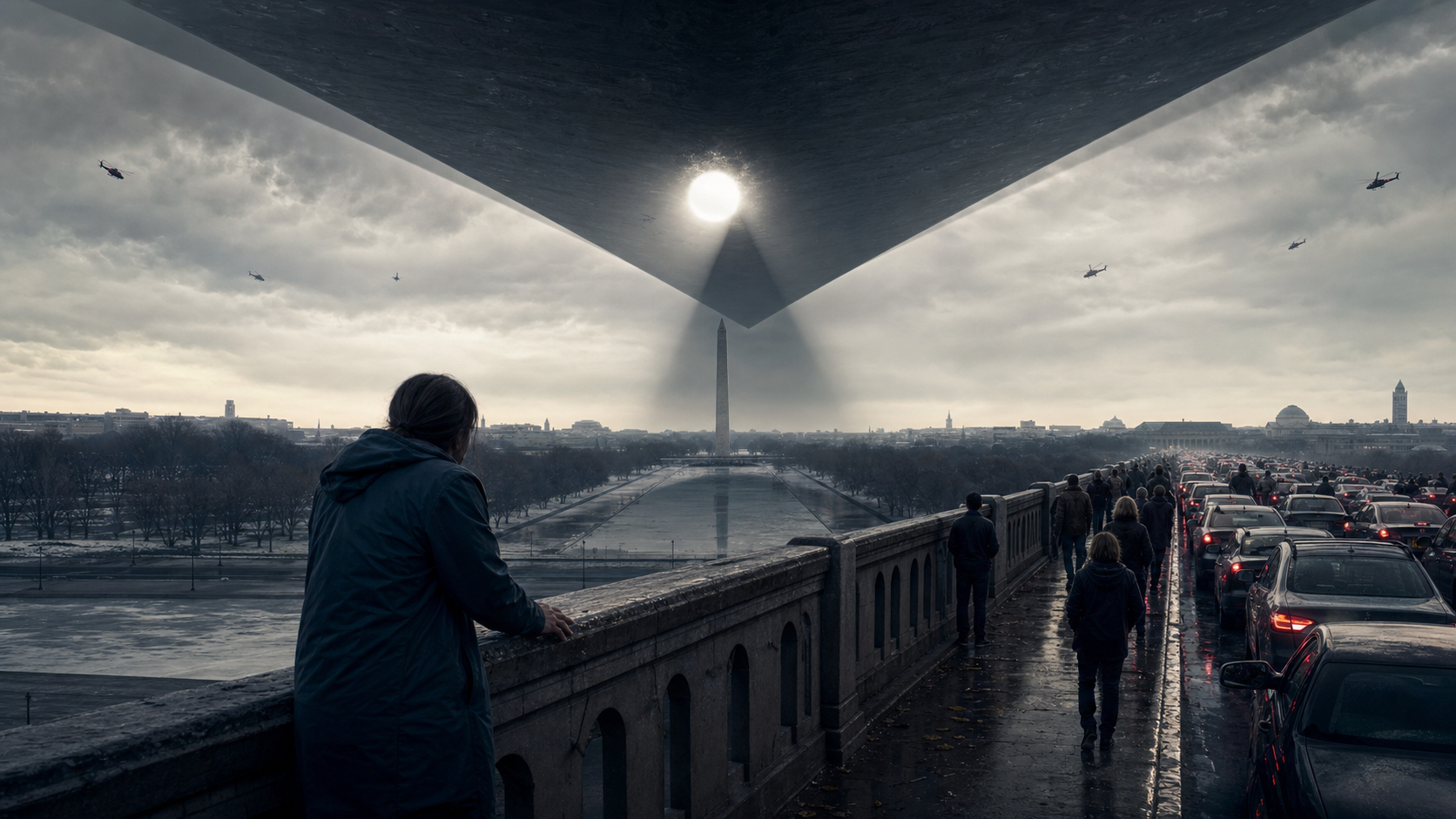
Dr. Daniel Cole left his sedan idling on the Arlington Memorial Bridge at 7:14 a.m., keys in the ignition, driver's door standing open, radio looping the automated emergency sirens over an empty seat.
There was nowhere to drive it. Nothing on the bridge had moved in an hour.
Thousands of cars sat dead in their lanes, and their drivers stood on hoods and roofs, every one of them turned toward the far side of the Potomac. Nobody screamed. The screaming had burned itself out before dawn and left this behind, a crowd holding still like livestock in a storm. Water slapped the concrete pylons in a slow rhythm. Somewhere north, helicopters churned in circles at the edge of airspace they wouldn't enter.
Cole zipped his windbreaker to the throat and shouldered into the crowd. A woman in a tailored suit walked her shoulder straight into his and never registered the contact, mascara running in two clean tracks down her jaw, her face tipped up toward the sky over the National Mall.
Everyone's was.
He reached the iron railing, closed both hands around the cold metal, and let himself look at the thing that had broken the world.
It hung a mile above the Washington Monument and swallowed the morning sun. Not a ship. Nothing about it argued with air. A matte-black slab, a chevron three miles from edge to edge, no engines, no exhaust, no glow of anything working to keep it up. It didn't hover. It occupied. Its surface took the light and gave none back, and the shadow it cut across the capital had an edge like a blade, half of Washington dropped into false dusk while the other half stood in ordinary daylight.
An ache started behind Cole's eyes and settled into his sinuses. The thing wasn't silent. Under the bottom of hearing, it moved air in a slow heavy pulse he took in the marrow of his ribs, the way you take a bass note through a wall.
His government phone was a broken red mosaic of priority alerts. LONDON: Object holding station over Westminster. TOKYO: Object holding station over Chiyoda. BEIJING, PARIS, MOSCOW, NEW DELHI.
Every capital on Earth. They had come down together at 3:33 a.m. Eastern, slid out of the upper atmosphere without tripping a single early-warning radar, and parked. Four hours now. They had done nothing at all.
Cole laughed, one hard bark of it, and a teenager standing on a minivan roof flinched away from him.
For ten years the species had lived inside a curated delusion, and the people who curated it had a name for the work. Soft disclosure. The world's governments had bled the pressure out of the largest shock in human history by making it dull. Leaked Navy gun-camera footage in the late 2010s, tic-tac shapes turning at angles that ate inertia. Intelligence officers under oath before legislatures by the early 2020s, saying flatly that crash-retrieval programs existed, that craft of non-human origin had been recovered, that so had non-human biologics.
And the public, wrung out by pandemics and rent and the permanent theater of politics, shrugged.
The United Nations stood up the Commission on Anomalous Phenomena. UNCAP put out annual reports thick with redacted paragraphs and statistical anomalies, a bureaucratic sponge doing what sponges do. Humanity absorbed the news that it had company, made a few million memes, and went back to worrying about mortgages. Everyone settled on the same comfortable story: the visitors were anthropologists, aloof and busy in the deep ocean, too far along to bother with the apes.
Cole wasn't the public. Cole was a senior xenobiologist for DEEPWELL.
He knew what had stayed behind the valve when they opened it. UNCAP was the circus out front. DEEPWELL was where the embargo actually lived. The exotic stable elements that drove those hulls didn't merely break thermodynamics; making them required an industry, and that industry implied an age of the universe Cole preferred not to think about before coffee. He knew about the bodies out of the desert in 1947.
And he knew DEEPWELL's own psychological models had called this exact morning. The committee had weaponized the truth on purpose, metering it out to breed disclosure fatigue. A bored population doesn't ask where you keep the bodies.
Standing under the black wedge that had cut his city in half, Cole understood that the embargo had never been about panic. It had been about the clock. The committee had known.
An engine tore the quiet open.
Four motorcycles came through the stalled traffic fast, all black, no plates, no insignia, riders in unmarked tactical gear behind mirrored visors. They took the curb onto the pedestrian walkway, scattered a dozen civilians, and stopped in a tight ring around him.
The lead rider kicked his stand down, drew a heavy sidearm, kept it on the crowd, and walked over. He didn't ask who Cole was. He threw a spare helmet into Cole's chest.
"Dr. Cole." The helmet speaker flattened his voice to a bark. "Director Vance ordered an immediate extraction. Put it on."
"I have a car." Cole pointed back at the sedan, and heard how stupid it sounded.
"Beltway's a parking lot to the Maryland line. We're taking the shoulder to a secondary pad at the Pentagon. Move."
Cole strapped the Kevlar on, swung a leg over the back of the lead bike, and got two fists into the rider's vest.
They launched hard enough to snap his neck back. He shut his eyes while they threaded gaps between bumpers and barriers and running people, breathing burnt rubber and raw exhaust. When he opened them the wedge overhead was turning, rotating on some axis he couldn't find, and its shadow swept the Potomac at the speed of a minute hand.
Ten minutes later he was buckled into the rear jump seat of an unmarked V-22. The Osprey didn't go toward the capital. It banked west and ran for the blue ridges of the Shenandoah.
Twenty minutes of flight. The aircraft dropped into a forested valley and hung over what the maps called an abandoned Department of Energy water-treatment annex. The gear touched the reinforced pad and the ground shuddered under them, because the pad was an elevator.
The ride down into Site 7 took two full minutes, hydraulic whine swallowing the Osprey's dying engines.
Six hundred feet of bedrock over DEEPWELL's primary facility. Self-contained, geothermal, hardened against EMP. Cole had given six years to its fluorescent corridors, charting necrosis rates in tissue that fit nowhere on the terrestrial tree.
The blast doors parted on chaos.
The main concourse ran like a cathedral most days, quiet and disciplined. Now analysts and security sprinted between server banks. Klaxon lights pulsed yellow across the concrete without a sound to go with them. In the corners, industrial shredders whined and whined, vomiting classified snow into bins.
Director Vance waited at the checkpoint with two armed soldiers at the biometric turnstiles. Vance was seventy-odd, close-shaved, pressed, an intelligence lifer who handled information the way a virologist handles a sample. This morning his tie hung loose, his collar was open, and his forehead shone with cold sweat.
"Glad you made the flight, Doctor." Vance swiped his own badge to skip Cole's scan. "We've lost the UNCAP liaison office in Geneva. Half the secure fiber on the eastern seaboard is dark. Civilian internet's gridlocked."
"I saw the craft over D.C." Cole matched his stride as they cut past the operations floor toward the stairwell. "Director, the telemetry—"
"Forget the sky, Daniel." Vance shouldered through the steel door. "The sky is a distraction. Those objects haven't put out one radio frequency. No radiation, no thermal bloom, no aggressive posture. They're sitting there letting the world scream itself hoarse."
"If they aren't attacking, what are they doing?"
"Waiting." Vance's voice dropped as their boots rang on the grating. He passed the landing for Level 2 without slowing.
Cole's step hitched. Level 2 was telemetry and atmospheric analysis, the sensor suites that watched the global UAP footprint. Anywhere but Level 2 meant blind.
Vance went past Level 3. Propulsion and Exotic Materials.
They stopped at the air-locked bulkhead of Level 4. Biological Containment.
Cole caught the cold iron railing and held it. His heart went off against his ribs. Level 4 was his floor, but his work was archival: tissue samples, fragmented genome sequences out of the 1947 crash in the New Mexico desert.
Only one intact asset had ever been kept on Level 4. They called it the Curator.
"Director." His voice came out thin. "What is happening?"
Vance turned on the stairs. The halogens took all the color out of his face. "At 3:33 this morning, the localized EM field in the primary vault spiked. The telemetry boys upstairs called it a solar flare, right up until the sky filled with ships. The spike didn't come from the atmosphere, Daniel. It came from inside the mountain."
He keyed twenty digits into the bulkhead pad and set his thumb on the scanner. The locks let go in a run of pneumatic thuds.
The corridor beyond was sealed and kept at a biting sixty degrees, and it smelled of ozone and medical antiseptic. Vault One stood at the far end.
DEEPWELL hadn't been dug to study the stars. It had been dug to study the corpse they pulled out of the desert. Except the entity wasn't a corpse, as Cole had learned in his first week on the job, in the worst hour of that week. It was dormant.
For eighty years the Curator had hung in a dielectric bath, deep-freeze stasis holding without a fault. A classic Gray, the archetype that had saturated pop culture, which Cole knew was no coincidence but a deliberate inoculation run by early intelligence agencies. Barely four feet. A frail gray body slung under a skull far too large for it. No ears. A slit where a mouth belonged. Black eyes taking up half the face.
Eight decades of one heartbeat every fourteen minutes. It took no nutrition and produced no waste, and the dampening field around it chewed up any recording equipment brought close. A biological machine with the power off. Waiting.
They came to the reinforced glass of the observation deck.
Cole stepped up and fogged the cold pane with his breath. Below, in the bright circular vault, stood the containment cylinder.
The dielectric fluid was gone. The seals were broken.
The Curator wasn't suspended in the center of the tank anymore. It stood at the wall of it, both long four-digited hands pressed flat to the polymer.
"The timeline." Vance's whisper shook, and he had stopped trying to keep it from shaking. "We thought we had a century. The committee's projections gave us another century before the biological timer ran out. We were wrong."
Down in the vault, the Curator tilted its teardrop head back, slow, and looked up through the glass.
Its eyes were open.
They weren't solid black. The black was a second lens, a protective film, and it was retracting now with a wet click that carried through six inches of reinforced glass. Under it the true eyes turned silver and bioluminescent, swirling, and something old looked out of them.
Cole heard nothing. A crushing pressure bloomed behind his forehead anyway, the same static-charged hum that had held millions of sleepers hours earlier. The thing in the vault wasn't looking at Vance. It had picked Cole out.
The weight dropped into him like an anvil through a floor. Not a voice. A concept, rendered into English by his own terrified neurons.
Late.
Chapter 3 — The Signal Is Not a Sound
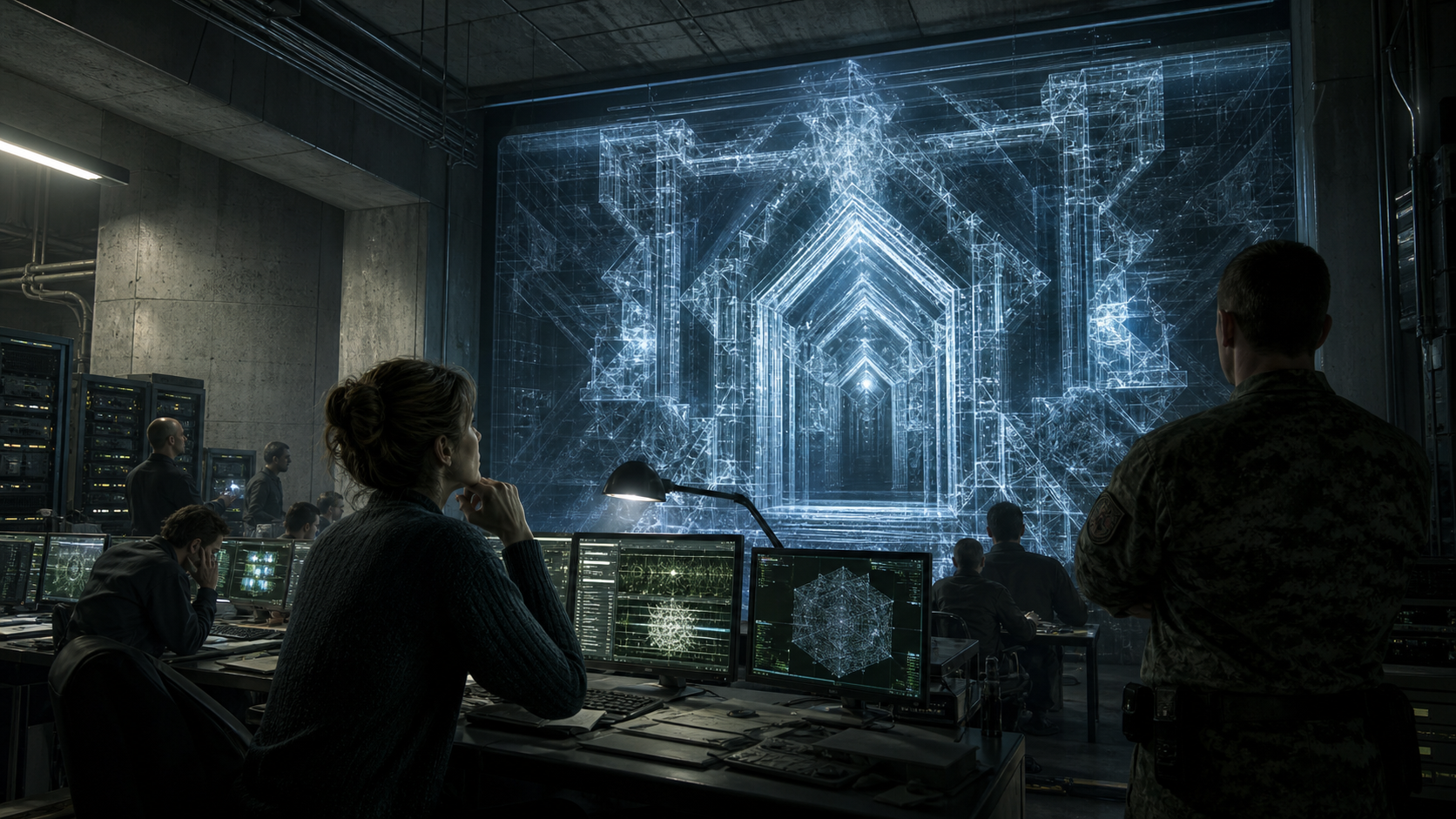
Dr. Yara Haddad pressed the heels of her hands into her eye sockets until dull light bloomed behind the lids. Her skull throbbed in time with the diesel generators shaking the concrete on the far side of Sub-Level 4.
Above them the East River worked at the foundations of the United Nations headquarters. Above that, three miles of matte-black chevron hung over Manhattan, laying a hard-edged shadow across eight million people.
Down here in the repurposed basement archives of the UN Commission on Anomalous Phenomena, nobody could see the thing. They could only listen to it not being there.
"Run it through the Fourier transform again." Colonel Hayes stood over a bank of server racks, jacket dumped on a folding chair, voice sanded down to grit. "Widen the spectrum. Sub-millimeter, terahertz, extremely low frequency. I don't care. They have to be emitting something."
"We've swept from three hertz to gamma, Colonel." A pale cryptanalyst kept typing, fingers rattling the mechanical keyboard. "It's flat. The waveform is a dead line. They aren't broadcasting."
"A ship the size of lower Manhattan doesn't hold station without a data wake." Hayes turned. "They're coordinating. Thirty-two of these things over thirty-two capitals. You're telling me they're doing it on airplane mode?"
Yara lowered her hands. The fluorescents came back at her too bright, and the main tactical screen swam into focus: one green line, flat as a ruler, the radio-frequency output of the object over Manhattan. No radar ping. No microwave telemetry. No encrypted bursts. Seven hours of the best cryptology the NSA, GCHQ and Interpol could lock in a basement, and they had found dead air.
They were looking through the wrong end of the telescope.
"They aren't silent, Colonel." Quiet, but it carried, the way a lecture-hall voice carries. "You just aren't equipped to hear them."
Hayes came around the rack with his jaw set. UNCAP had recruited her three years ago because her PhD in cognitive linguistics offered a polite, non-threatening framework for how different cultures might react to the theoretical concept of contact. Three years of white papers no one read. Now the world had ended and she was at the primary console, and he was looking at her the way military intelligence looks at an academic it has been ordered to rely on.
"I have the combined processing power of United States Cyber Command routing through this basement, Dr. Haddad. If they were broadcasting a language, we'd have intercepted it."
"That's the problem." She pulled her keyboard toward her. "You're looking for language."
"Language is how intelligences communicate."
"Language is a bottleneck." She brought up the raw feed from the city's geological and magnetic sensors. "It's what you use when you're stuck in one biological point in space and you need a three-dimensional thought out of your head and into mine. You break it into a line of grunts, squeeze them through your vocal cords one syllable at a time, and hope my brain reassembles the shape you started with. It's like describing the Taj Mahal by reading the serial numbers off the bricks."
Hayes stared at her, eyes threaded red. "Your point?"
"Anything that can park thirty-two frictionless dreadnoughts in the atmosphere without tripping early-warning radar is not reading serial numbers off bricks. They aren't using a line of audio waves."
She typed, fast, routing around the NSA's audio interception stack entirely, tying her terminal into the magnetometer arrays at Columbia and the gravimetric sensors set in the bedrock under the Federal Reserve.
"At 3:33 a.m., when they descended, millions of people woke up reporting the same physical sensation." Numbers cascaded down her screen and she tracked them. "A hum in the teeth. Pressure in the frontal lobe. A big complicated meaning dropped into their heads all at once with no words attached."
She looked up. "They don't speak, Colonel. They project structure. You can't find the signal because you're running it through audio decoders. You're listening for a song. You need to be looking at a building."
The hostility went out of Hayes's face and something worse replaced it. "Show me."
She routed the ambient magnetic and gravimetric distortion into a spatial mapping program, a tool she used for charting synapse activity in a speaking human brain. The cooling fans climbed to a shriek as the processors took on a volume of non-linear data they had never been built for.
"I'm taking the gravitational anomalies pulsing off the craft," she said, hands moving over the interface, "and reading them as coordinates in three-dimensional space instead of sound over time."
The flat green line vanished.
A shape rendered against the black. Not text. A sprawling fractal of intersecting geometries, folding through itself, symmetrical in a way that made no sense, a door or a temple complex built out of pure math. Yara's stomach pitched. Pressure bloomed behind her eyes, the phantom weight of something too dense to look at, a concept so heavy the optic nerve strained trying to hold it as a picture.
The typing stopped. All of it. Hayes took half a step back and forgot to breathe.
"My God," one of the NSA technicians said. "What is that?"
"That's a word." The hair on Yara's arms was standing up. "Or a sentence. Or a whole book. A multi-dimensional thought broadcast as a structural pressure wave. It's hitting the planet right now, washing over us, pushing into our biology."
Hayes braced both hands on the back of her chair. "Can you read it?"
"No." Her throat had gone tight. "We don't have the hardware to hold the whole shape at once. Put it through a parser for English and the parser crashes. It's pouring the ocean into a teacup."
"Then what the hell good is it?" The panic was back in him. "If we can't decode it we don't know what they want. Are they hostile? Is this an ultimatum? A surrender demand?"
Yara watched the thing turn. Dread had wrapped itself around her lungs and was taking up slack. She made herself read the architecture instead of feeling it: the sweeping dominant archways of data, the smaller interlocking clauses nested underneath. Grammar. Syntax.
Her thesis came back to her.
For a decade she had been the outlier who refused to file ancient mythology under campfire fiction. The Convergence Rule: when a wildly specific, bizarre narrative shows up independently across cultures that never touched each other, that is not coincidence. When the Hopi and the Sumerians and the Dogon tell the same structural story down to the same odd details, you are looking at the fossil of something that happened.
What if the myths weren't history, she thought, her heart going hard against her ribs. What if they were the receiver?
"I can't translate it into English." Her fingers hovered over the keys. "But I don't think they ever intended us to. They've been coming here a very long time. They wouldn't broadcast on the day they arrive without knowing we had the means to understand it."
"Dr. Haddad, you are speaking in riddles."
"I'm speaking in architecture, Colonel." She didn't look up. "If the signal is a structural block of meaning, I need a structural framework to lay over it. I need a Rosetta Stone. But the stone isn't a dictionary. It's a narrative."
She opened a secure line to the UNCAP deep-storage servers in Geneva, the catalogued database of global anthropology and religious texts and mythological structure she had spent three years quietly digitizing: the deep syntax of every human culture that ever looked up.
"I'm writing an algorithm." Her keystrokes cracked in the hush. "I'm going to ask the computer to strip the nouns and verbs out of human mythology. Take away the names of the gods. Take away the cultural window dressing. Leave the structural geometry of the story. Who comes from where, what they do, what they promise. Then I compare the narrative architecture of human myth against the structural architecture of that broadcast."
"You're trying to decode an alien transmission with fairy tales?"
"I'm using the Convergence Rule." She hit execute. "If a story survived the Bronze Age collapse and the Inquisition and the industrial revolution, if it stayed in us against every pressure to forget it, that's because it was engineered to survive. It was planted."
The fans roared. The progress bar crawled. Somewhere inside the machine the impossible geometry of the broadcast was being laid over thousands of human narrative architectures, one after another.
It rejected the epic of Gilgamesh.
It rejected the creation myths of Olympus.
It rejected the Norse Eddas.
Then the bar flashed green.
MATCH DETECTED. SYNTACTIC ALIGNMENT: 99.8%.
"We have a hit." She leaned in until the screen glare washed her face.
Hayes crowded her shoulder. "What language? What does it say?"
"It isn't one language." She read the output cascading down the right side of the monitor. "It's a cross-cultural motif. The algorithm found a one-to-one structural match."
She tapped the glass and pulled up the comparison.
"Look at the hits. Mesoamerica, the feathered serpent Quetzalcoatl comes down out of the sky, gives us mathematics and law, departs. Babylon, the Apkallu, the fish-teachers, they come up to uplift humanity and they leave. The Vedic vimanas. The Hopi Star People."
"I don't care about ancient history, Doctor. What is the ship above us saying right now?"
"That's the thing, Colonel." She turned to him. Her eyes were wide and terribly clear. "It's saying what all of them said. The same structure, exactly."
She pointed at the geometry rotating on the primary screen.
"Every one of those independent myths shares one highly specific convergent ending. The teacher descends. The teacher uplifts the primitive culture. The teacher departs." The horror of it was arriving in her slowly, settling into the bones of her hands, her jaw. "With an absolute, explicit promise to return."
Hayes stared at the screen. The color went out of his face.
"The myth was never just a story," Yara said into the quiet of the bunker. "It was the grammar. They planted the prophecy in our ancestors hundreds of thousands of years ago and burned it into our cultural DNA, so that when they came back and broadcast this, our brains would already know how to read the architecture."
She looked at the monstrous shape turning on the screen. Not an ultimatum. Not a greeting.
The fulfillment of a contract humanity had never known it signed.
Chapter 4 — Estela's Journals
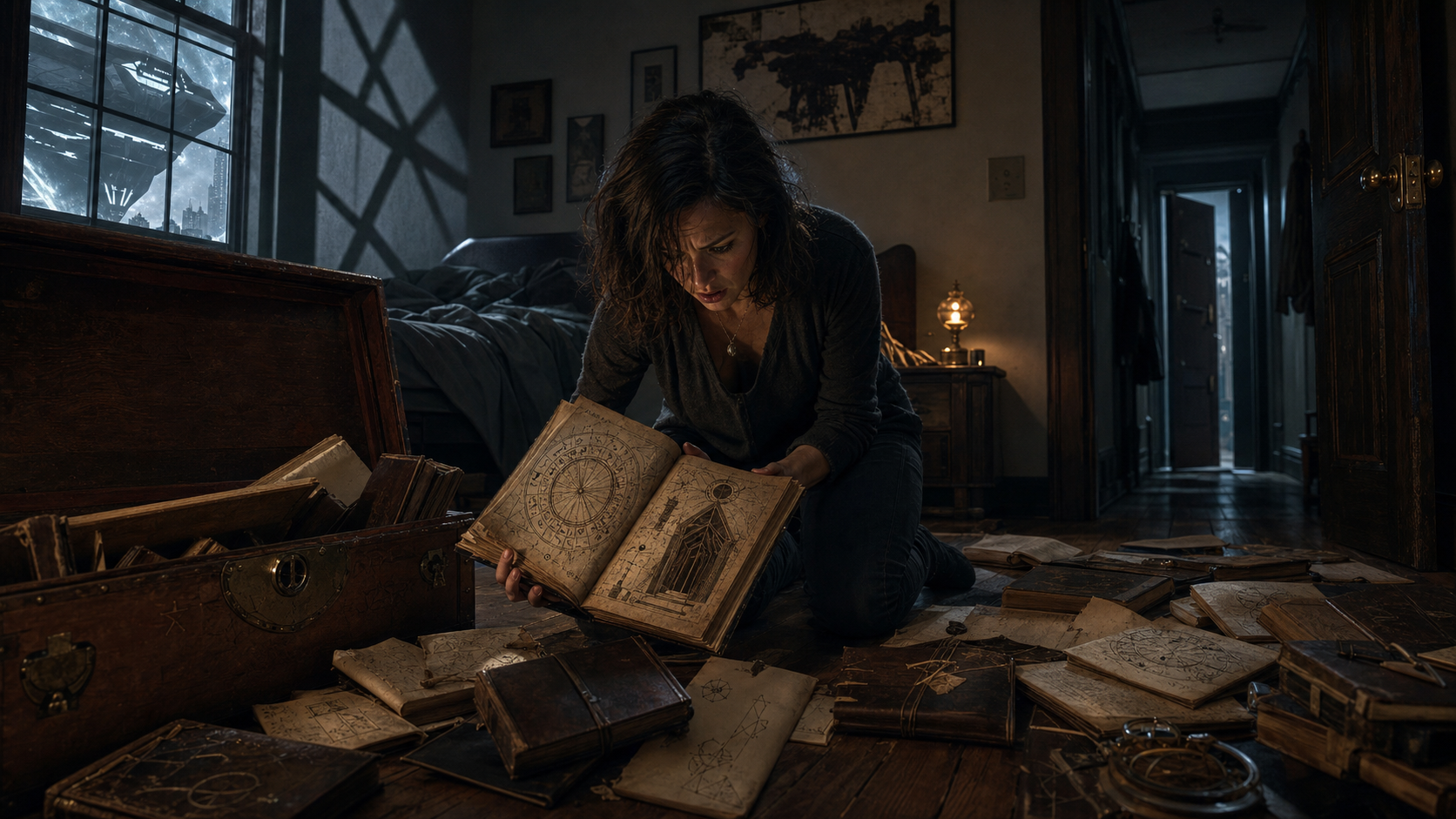
The shadow of the object over Boston lay across the living room floor. Nine in the morning, and the apartment sat in a bruised half-dark. The chevron blocked the winter sun outright. Its edge cut a hard diagonal across the skyline, and everything under that line had gone the color of old ice.
Lena Sokol stood in the hallway with her pulse knocking sideways against her collarbone. Through the cracked door of the living room she watched her seven-year-old son.
Theo sat cross-legged on the rug, sketchbook open in his lap. He wasn't crying. He hadn't asked about the sirens down on Storrow Drive, or about the television running its muted loop of emergency text. He was drawing. The scratch of his charcoal pencil against heavy paper was the only sound in the apartment, and it kept perfect time, like a metronome.
She knew what he was drawing. She had the curved impossible architecture of that door in her own head from three hours ago, pressed into her frontal lobe like a brand.
She backed away, bare feet silent on the hardwood, and went to her bedroom.
The air in there still carried the ozone smell from before dawn. Lena dropped to her knees at the closet and shoved aside winter coats and stacks of shoeboxes until her hands found the cold brass handles of the cedar trunk pushed flush to the back wall.
She dragged it out. The wood shrieked across the floorboards.
Twelve years, since the day of the funeral, that trunk had stayed locked. A quarantine zone. It held the contagion of her grandmother's mind: the paranoid delusions, the night terrors, the obsessive cataloging of an invisible war that ate Estela's sanity down to dust. Lena had built her whole adult life as a firewall against that legacy. New city. Data entry, quiet and aggressively ordinary. She had promised herself the family curse stopped with her, that Theo would grow up standing on ground that held.
At 3:33 a.m. the ground had stopped existing.
She grabbed a metal shoehorn off the closet floor, wedged it under the padlock, and threw her weight down. The metal cracked. She flung the broken lock aside and heaved back the lid.
The smell came up at her. Stale paper, dried binding glue, the sharp tang of graphite.
Notebooks to the brim. Dozens of them, stacked in chronological rows. Some brittle and flaking, spines held with yellowed tape. Others newer, thick Moleskines fat with loose inserts and folded clippings.
Lena's hands shook so badly she pulled two volumes free before she got hold of one. The leather had gone soft with handling. 1982, stamped weakly into the spine.
She opened it anywhere. The handwriting was frantic and exact at once, an architect's script laying out a nightmare to scale.
October 14, 1982, the entry read. They did not use the door tonight. The humming began in the roots of my teeth at precisely 3:00. The air turned to heavy water. I tried to wake David, but he was frozen to the mattress, staring at the ceiling but seeing nothing. The walls of the bedroom dissolved. The tall ones were standing at the foot of the bed. They wore the screen of the white deer, but the deer had black, liquid eyes, and it stood on two legs.
Sweat came up cold across Lena's forehead. The screen of the white deer.
Her thumb slipped and took a clump of pages with it.
They pulled me upward through the ceiling. There is no friction, no cold. Just the blinding, sterile curve of the room. The examination table is molded to the spine. The short ones—the workers, the gray skin, the smell of burnt sulfur and sterile damp—moved in perfect unison. They do not speak. They project their intentions directly into the visual cortex. A heavy, geometric pressure.
She dropped the book like it had burned her.
She scrambled backward until her spine hit the bedframe. Her breath came short and would not go deeper. Not possible. Estela wrote those words thirty-five years ago. She had the onset script down cold, the paralysis, the humming, the screen memory, the geometric telepathy, decades before the internet could homogenize the lore, decades before the anchors this morning stammered through identical reports from millions of paralyzed citizens.
Estela hadn't been reading science fiction. She hadn't been hallucinating.
She had been taking field notes.
Lena crawled back to the trunk. The revulsion had burned off into something worse, a hunger to know. She hauled the journals out by the handful and spread them across the floorboards, a chaotic timeline of her family's secret history.
She opened a fragile wire-bound notebook from the very bottom. Brittle pages, ink faded to sepia. April 1956.
I asked my mother again today why the night doctors come for us, the young Estela had written. She told me to stop calling them doctors. She said they have been coming since she was a little girl in the old country, before the war. They came for her mother, too. They always come for the women in our family. They do not want our blood. They want our lineage. Mama says we are a garden. They are pulling the weeds, waiting for the bloom.
Lena stared at the faded ink and felt the implications lock together in her mind like gears in some terrible machine.
Not a random string of abductions. A project.
She grabbed another book. 1994. Lena had been seven years old in 1994. Theo's age.
The owl was at Lena's window tonight, Estela's handwriting slashed across the page, the pen bearing down hard enough to tear the paper in places. I heard the humming through the floorboards. I tried to run to her room, but my legs locked. I was pinned against the hallway wall. I had to watch them take her. The gray ones. They floated her right through the glass. They are altering her. Every generation, they edit the code. They told me telepathically that the work is almost done. They are building a bridge between the dirt and the sky, and they are building it out of my family.
The memory came up through her like something tearing loose, and the dam she'd built in her twenties went with it.
The snowy owl. It had sat on her childhood windowsill, its head bulbous and entirely wrong, its black void-eyes holding her flat against the mattress. The humming in her teeth. The floating, up into blinding white. Two years of therapy to talk herself into sleep paralysis, an extreme manifestation, brought on by the strain of living with a schizophrenic grandmother.
Not a dream. A procedure.
She turned pages fast, eyes skidding down the blocks of text, hunting the architecture of the thing. The journals weren't a record of trauma. They were an encyclopedia of an invisible multi-generational husbandry program.
Estela had documented all of it. Implants left behind the ear or deep in the sinus cavity, dormant for decades. The telepathic downloads that arrived as heavy geometric blocks of meaning. The presentations, where women were brought into the curved rooms and shown silent uncanny children with oversized eyes and sparse hair, and told through forced emotion that these were their offspring.
They weren't studying humanity. They were farming it.
They do not care about governments, Estela wrote in a journal from 2001. They do not care about our weapons or our laws. We are clay to them. But they are not united. The tall ones, the ones that radiate cold authority, they look at us with pity. But the workers, the gray ones, they look at us the way a carpenter looks at a piece of wood. And there are others. Older ones. The ones that smell of brass and reptilian musk. They hate the project. They want the clay to stay unshaped. I hear them arguing in the dark, projecting their anger across the sky in shapes I cannot comprehend.
Lena stopped breathing. She looked to the window, where the shadow of the chevron lay across the city.
The project.
A project had a timeline. It had an end date.
She dug back into the trunk, nails scraping the cedar bottom, going for the newest book. It was wedged in the back corner, a plain black Moleskine, spine unbent. Estela's last journal, written in the weeks before she died in the winter of 2026.
Lena opened it. The handwriting had changed completely. Nothing frantic left in it. The slow deliberate script of a woman who had seen the bottom of the abyss and stopped being afraid of the fall.
December 4, 2026.
The visits have stopped. They took me one last time, but there was no table. There was no procedure. They just brought me into the central room, the one with the great curving window that looks down on the curvature of the Earth. The Adjudicator was there. The tall one. The mantis.
Lena's shoulders jerked, a revulsion that went down into the muscle at that word.
It did not speak to me. It simply looked at me, and I felt my entire life, my mother's life, Lena's life, judged and weighed in a single instant. Then, it showed me the clock.
It isn't a machine. It is a biological timer, written into the blood they have been cultivating for a hundred thousand years. And the timer is running out. They have finished the edits. The bridge is complete. They don't need to take us in the night anymore.
Her eyes raced down the page. Her heart slammed against her ribs.
I asked the Adjudicator what happens when the clock stops. The projection it pushed into my mind was so heavy it made my nose bleed. It showed me a door opening. It showed me the sky filling with geometry. It showed me the harvest.
Lena turned the page. Last entry. The rest of the notebook was blank.
They are coming back, Estela had written. Not to observe. Not to tweak the code. They are coming back to collect the product. The ones with the dormant blood will hear the call first. The implants will activate. The registry will be counted.
Beneath the text she had drawn a calendar wheel, huge and intricate, covered in interlocking symbols and astronomical alignments, the margins crowded with frantic arithmetic. She had traced the generational gaps, the frequency of the visits, the chromosomal math of her own family tree, and mapped all of it against the ancient orbital cycles the visitors had put in her head.
At the center of the wheel, circled hard in black ink, a date.
Lena stared at the numbers and the room went thin. Blood roared in her ears.
She pulled her smartphone from her pocket. The lock screen was still spilling emergency alerts, UNCAP bulletins, local news. She wasn't reading any of it. She was reading the date at the top of the screen.
Thursday, October 14, 2038.
She looked back down at the center of Estela's wheel.
October 14, 2038.
Estela wrote it twelve years ago. She had calculated the exact day the sky would fill with ships.
Below the date, in block letters so large they took the rest of the page, was a final warning.
The timer runs fastest in the youngest blood. The bridge is the boy. They will activate the door in his mind. When the ships stop hiding, the registry is closed. Do not let them take the boy. If he walks through the door, the humanity that existed before today becomes obsolete.
A sound snapped her head up.
The click of the front door deadbolt sliding out of its housing.
Lena dropped the journal. She went over the pile of leather-bound books, bare feet slipping on the polished hardwood, and bolted out of the bedroom, down the hall.
"Theo!"
Her voice broke on his name.
She slid into the living room. The sketchbook lay abandoned on the rug. The charcoal pencil had rolled under the coffee table. The television still ran its silent loop of the chevron over the capital.
The room was empty.
The front door stood wide open on a rectangle of dim, shadow-drenched hallway. And humming out of the corridor walls, down into the roots of Lena's teeth, was a sound she had known her entire life.
Chapter 5 — Patient Zero
The descent to Sub-Level 9 took ninety seconds, and there was nothing to look at for any of them.
Dr. Daniel Cole stood in the industrial elevator with his hands shoved into the pockets of his windbreaker, working his jaw to pop his ears against the pressure. The hydraulic whine of the lift was the only sound in the steel box. Beside him, Director Vance had both hands on the handrail. Cole had worked six years under a man who ironed his own shirts and never once raised his voice. That man was gone. This one was pale and sweating through his collar, breathing in the shallow, jagged rhythm of something cornered.
"You're telling me it moved," Cole said. He kept his voice flat, which took effort.
"I'm telling you it sat up." Vance's eyes stayed on the floor indicator counting down into bedrock. "At 3:33 a.m., exactly when those things parked themselves in our atmosphere, telemetry on its stasis pod spiked. Neural activity went from a flatlined delta rhythm to hyper-arousal in under four seconds. It opened its eyes, it sat up on the slab, and it has been staring at the observation glass for four hours."
Something cold pulled tight under Cole's ribs. "Did it breach containment?"
"No." Vance's mouth twisted. "It hasn't even tried. It's just waiting."
Cole turned to the brushed steel doors and let the morning finally land on him.
Six years of fluorescent corridors at Site 7, running necrosis models on tissue that didn't belong to any kingdom on the taxonomic chart. He knew what was at the bottom of this shaft. DEEPWELL was not a research facility. It was a tomb built around one secret, and most of the architecture of the modern world had been poured to keep that tomb buried.
The public thought the embargo was bureaucratic cowardice, that the government sat on grainy video and blurry radar tracks to head off religious collapse or a run on the banks. The truth was more practical than that, and worse.
July 1947, high desert, American Southwest. A craft came down. It didn't crash; a crash means a failure of aerodynamics. According to the foundational files Cole had been cleared to read on his first day, the wedge-shaped hull simply dropped out of the sky and buried itself in mesa dirt, intact.
Recovery teams cut the hull open and found an engine with no moving parts, running on an isotope of a superheavy element that had no business being stable under terrestrial physics. They found the crew, too. Three of them dead, every biological system shut down by the impact.
The fourth was not.
They brought it here. Dug six hundred feet into Shenandoah bedrock and built Site 7 around it. For eighty years a shadow committee of officers and private contractors bled the taxpayer to reverse-engineer the propulsion, then seeded the winnings into the civilian sector: microprocessors, fiber optics, materials science. All of it guarded at the source. The whole era of soft disclosure, the leaked Navy footage, the tidy congressional hearings, was a pressure valve. It let the committee walk a fractured world toward the phrase "non-human biologics" without ever putting a body on a table.
Because the body wasn't dead.
The staff called it the Curator. Eight decades on a diagnostic slab in a suspension no one could reproduce or explain. It didn't eat. It didn't excrete. It didn't breathe oxygen. Its cells refused to undergo apoptosis. A prisoner of war who had slept through the Cold War, the millennium, and the entire disclosure era.
Now the armada had arrived, and the prisoner was awake.
"We thought we shot it down." Vance said it to the wall. The indicator flashed Sub-Level 7. "Back in forty-seven. Concentrated radar array, experimental, and the craft dropped. We spent eighty years congratulating ourselves for bringing down a god with a slingshot."
He turned his head. His eyes were hollow and threaded red. "It didn't crash, Daniel. It anchored. It let us take it. It let us build all of this around it and then it sat in the dark inside our most secure installation, waiting for a timer to run out."
The elevator halted hard enough to buckle Cole's knees. The display flashed Sub-Level 9.
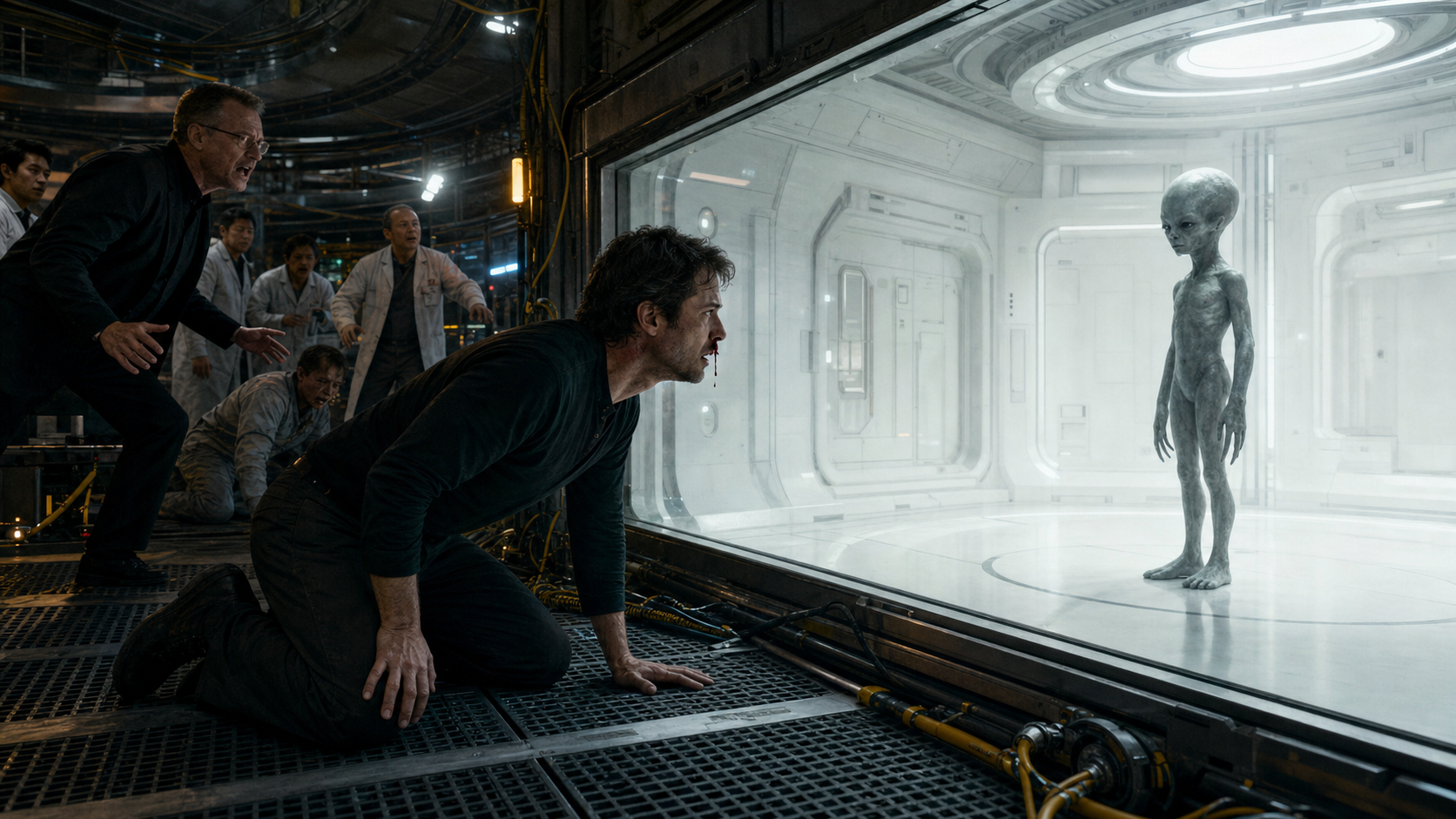
Blast doors parted on a hiss of pressure and a room in disciplined panic. Sub-Level 9 was a circular observation deck ringing a sealed containment cell. Technicians in hazard suits ran thick yellow cabling across the grated floor, patching portable generators into the primary grid, shouting over each other. The air tasted of burnt ozone and hot metal from a ventilation system running past its rating.
"Status," Vance barked, off the elevator and already gripping a lead technician by the shoulder.
"We're losing telemetry, Director." The man pointed at the wall of monitors, and his finger shook. "It isn't emitting radiation, but there's a gravimetric distortion building inside the cell. It's bending light. Cameras are failing. Thermal is a whiteout."
"Is the glass holding?"
"Structural integrity's at ninety-nine percent, sir. But it's doing something to the air pressure in there."
Cole left them to it. He crossed the grating to the thirty-foot span of hyper-glass that stood between humanity and its oldest captive, and stopped two feet short of it, and put his hand flat against the cold.
The cell was a sterile curved bowl of seamless white polymer, built to the dimensions of the medical bay inside the 1947 craft. The light in there was bright enough to erase every shadow.
At the center of the room, beside the empty slab, stood the Curator.
Cole's breath caught somewhere below his throat. Years of high-resolution photographs. Years of its skin scrapings under his own scopes, that parchment texture that sat on the line between grown and manufactured. Upright, though. Moving. Displacing air. Something old in the back of his skull tried to get him away from the glass.
Four feet tall, give or take. Stick-thin, no muscle tone, no fat, the fragile utilitarian architecture of a mantis. Flat gray skin that took the harsh light and gave nothing back. No ears, no nose, two small vertical slits above a lipless horizontal line.
The eyes stopped him.
They took up the whole upper hemisphere of the skull, black convex lenses glistening under a film of fluid. No pupils. No irises. No whites. Deep-sea eyes, absent of empathy and anger and fear alike. The eyes of a worker looking at a tool.
It wasn't pacing. It wasn't testing the walls. It stood still with its long four-fingered hands at its sides, loose, and it was looking directly at Cole.
"Dr. Cole." Vance's voice came in tight over the generators. He stepped up alongside, keeping a decent margin from the glass. "What is it doing? Why is it looking at you?"
"I don't know." Cole couldn't pull his eyes off the black. "It isn't a master, Vance. Look at it. Look at the physiology. No digestive tract, engineered uniformity. This isn't the architect of the thing in the sky."
"Then what is it?"
"It's the maintenance staff." Cole heard his own voice drop. "A biological drone. An engineer. We've had the janitor locked in a closet for eighty years."
Inside the cell, the Curator tilted its head to the left. The motion had no micro-tremor in it anywhere, no human wobble, just the smooth travel of a gimbal.
The lights on the deck stuttered and dropped the room into strobe. Technicians shouted. The diesel generators screamed as something pulled hard on the grid.
"Director! Gravimetric distortion is expanding. It's bleeding through the glass."
Cole didn't hear it. The noise of the room, the yelling, the generators, the klaxons, stretched and thickened, as though he'd gone under water.
A pressure bloomed behind his eyes. Not a headache. Weight. Mass moving into space in his skull that had no space to give. His sinuses spiked. Blood and burnt sulfur came up the back of his throat.
The Curator's mouth never moved, but the gray body took one slow step forward, closing on the glass.
Language is a bottleneck.
He'd heard that at a UN symposium years ago from a cognitive linguist, a woman who took questions for an hour and lost the room in the first ten minutes. She'd argued that a genuinely advanced intelligence wouldn't bother with the linear inefficiency of sound waves. It would communicate in architecture. It would put structural meaning straight into the visual cortex.
The pressure expanded, folding outward like a tesseract.
It was agonizing. A brain evolved for linear time and sequential thought, forced to hold a three-dimensional geometry it had no shape for. The Curator was pushing a block of pure concept through the hyper-glass, skipping the physical world, routing into the wetware of Cole's nervous system.
His hands went to his head and his knees went out from under him on the steel grate. Somewhere past the static, Vance was shouting his name.
The concept was enormous. Not a word. It was a planetary clock winding down toward zero. It was a harvest left on the vine into rot. It was the flat clinical disappointment of a project manager walking onto a site and finding the foundation compromised. Millennia of weight, compressed into one undeniable fact.
Cole dragged at the air. His vision came apart into fractals while some part of him scrambled to reduce the strike to something his English-speaking brain could survive.
The fractal collapsed into a single devastating point.
Then the pressure was gone, as fast as it had come.
He went down onto his hands and knees, grate biting into his palms, chest heaving, sweat running cold off his face. The ordinary noise of the deck crashed back in: the generators, the technicians, Vance dropping down beside him.
"Daniel!" Vance had him by the shoulders, hauling him up. "Daniel, look at me. Did it breach? Did it do something to you?"
Cole blinked until the room came back. He looked through the hyper-glass.
The Curator had returned to the center of the cell. It stood still, void-eyes forward, and it was done with him.
"Cole." Vance's voice shook with a vulnerability that frightened Cole more than the thing behind the glass. "What happened? Did it communicate?"
Cole wiped the blood off his nose with his sleeve. He looked up at the Director of DEEPWELL, a man who had spent a career managing the timeline of the world, hoarding the truth to protect a status quo that had been revoked at 3:33 that morning.
"The embargo didn't buy us time, Vance." His voice came out hoarse. He was still staring past him at the gray body behind the glass. "It cost us everything."
"What did it say?"
Cole swallowed ozone and sulfur. The translated weight of the thing was still ringing in the hollows of his skull, one word, delivered with no threat in it at all. A diagnosis.
"Late."
Chapter 6 — Screen Memory
Lena sat on the floor of her bedroom with her grandmother's journals open around her like graves. Above Boston, the three-mile chevron held its station, and the apartment had gone heavy under it, the way a room goes heavy before a storm that never arrives.
Her fingers rested on the yellowed 1994 page. The owl was at Lena's window tonight.
Twenty-four years of fortifying her mind against that one memory. The therapists had given her the words to file it away: sleep paralysis, hypnagogic hallucination, a stress projection triggered by watching her grandmother come apart. On that foundation Lena had built a quiet, aggressively normal life.
Then, staring at Estela's cramped architectural handwriting, she caught a high oscillating whine building in the roots of her teeth.
The same vibration that had hauled her and Theo out of sleep at 3:33 a.m. Not ambient now. It came from a quarter-inch of bone behind her right ear, and it came from nowhere else.
Her hand flew to her neck. The skin over the mastoid was hot enough to flinch from.
She shut her eyes against the vertigo, and the dark behind her eyelids was taken from her. The firewall she'd spent two decades building went down without argument, its code obsolete.
She was not thirty-one, on the floor of her apartment. She was seven.
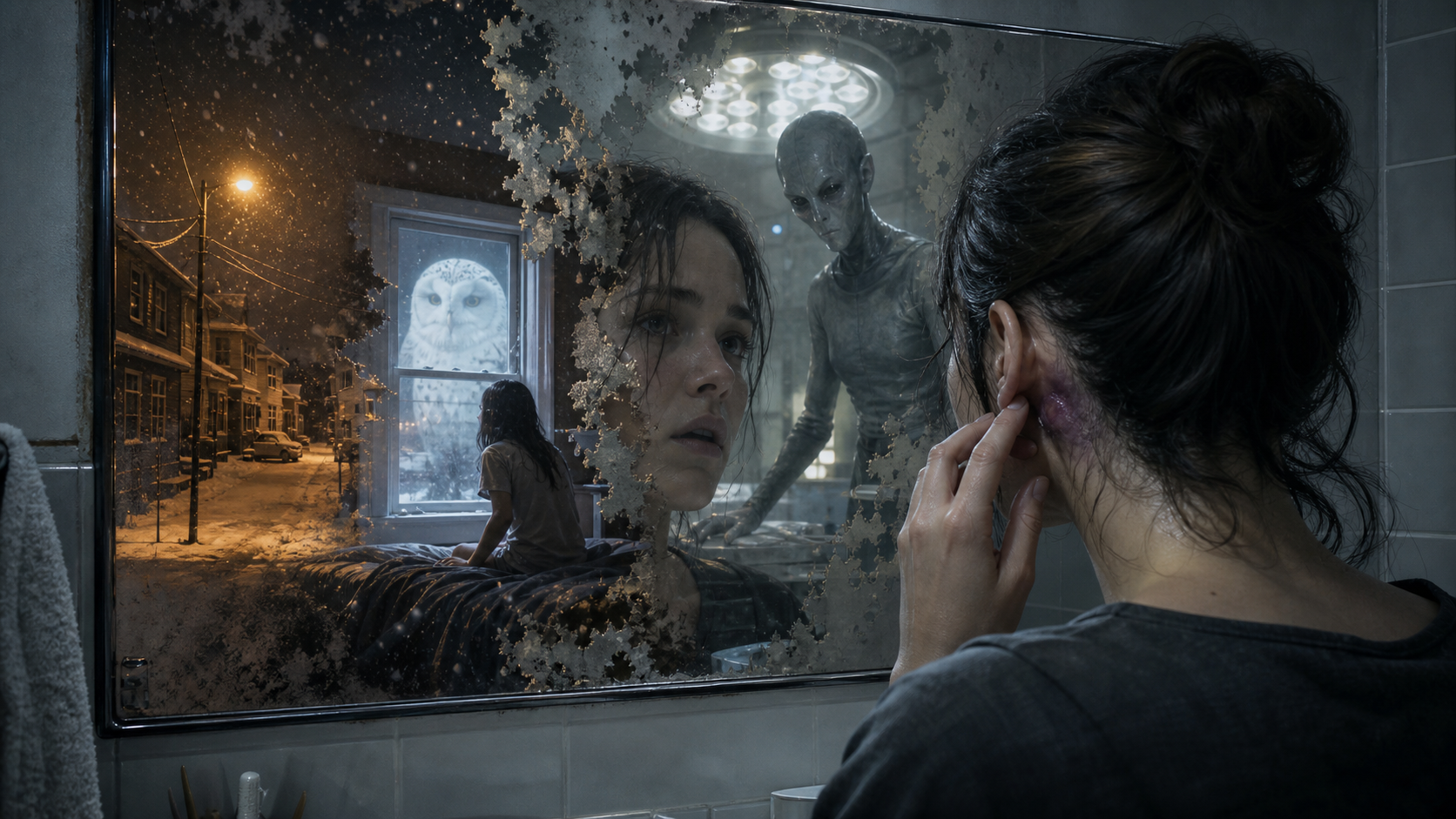
February 1994. Snow coming down in sheets past her childhood window in South Boston, lit amber by the streetlamp.
The snowy owl on the sill.
Even inside the memory, the wrongness of it choked her. An Arctic bird, third-floor fire escape, inner city. It never moved. Its head was bulbous, too large for the body it sat on. The plumage had no texture at all.
Seven-year-old Lena tried to pull the winter duvet over her face. Her arms lay pinned to the mattress. Her breathing had been set to some slow automated rhythm that wasn't hers, in and out, in and out. All she could do was watch the owl turn its head.
It didn't blink. The eyes were huge and black and gave back nothing, not the streetlamp, not the snow.
On her bedroom floor in the present, Lena clawed at her collar, dragging for air. She tried to open her eyes, to get back into 2038, and her own nervous system refused her. The activation hadn't been a wake-up call. It was an unpacking, a forced update, stripping off the anesthetic laid over her visual cortex twenty-four years ago.
The screen memory tore, and she watched it go.
The owl began to flake, a fresco peeling off a damp wall. The white feathers lost their texture and went flat, synthetic, the color of parchment. The beak spread and dissolved into a lipless horizontal slit. The shape stretched, avian into bipedal.
Not a bird. A drone.
The worker stood on the fire escape, its thin utilitarian frame black against the streetlamp. It had the clinical gray skin Estela had described in the journals, and it had those eyes, the black voids that had come for Lena in her sleep for most of her life.
The window didn't break. It simply stopped being a barrier. The worker raised a four-fingered hand and the pane rippled like the surface of a pond, its molecules letting go of each other for a moment.
The worker stepped into her bedroom.
No cold came in with it. No sound of winter wind. Only the smell, burnt ozone and something sterile and damp underneath.
A second worker came through the wall beside the closet. Then a third. They moved in hive-lockstep, without any of the small tremors that live in human movement, and they took up positions around the bed.
Gravity let go of her spine. She went up off the mattress, the duvet sliding away, and she didn't rise toward the ceiling. She drifted sideways toward the window, drawn along some vector she couldn't see.
Passing through the glass was a slick frictionless slide, and her stomach turned over. For half a second she hung outside above the snowy street. Then the amber streetlight was swallowed by a white so bright it cast no shadows.
There was no transition. She lay on her back on a table molded to the curve of her spine.
The room was a seamless bowl of white polymer. No corners, no seams, no lamps or fixtures anywhere, and still the space was flooded with a hard clinical brilliance. Less a spaceship than an operating theater built by something that found human anatomy interesting and primitive.
The three gray workers moved around the table. They didn't speak. They had no need to. Lena could feel their communication pressing on her temples, a geometry of intent. Isolate. Prepare. Insert. They handled her biology the way a carpenter planes a board. Nothing in it wanted to hurt her. That was the worst of it, worse than hatred: she wasn't a person to them. She was a crop. Fourth generation of an asset.
A shadow crossed the table.
The workers stepped back together, deferring.
The figure that leaned over her was taller. Much taller. Its limbs were long and had a spidery grace, and where the workers read as biological machines, this one carried a weight of authority that pressed on the room. Its skin was pale to the point of translucence.
The supervisor lowered its bulbous head until the convex black eyes filled everything Lena could see.
The download hit like a fist. It went around language entirely and dropped a three-dimensional block of meaning into her forebrain, so dense her neurology nearly buckled under it.
The soil is prepared. The seed is planted. The timer is set.
The supervisor raised its hand. Between the long fingers it held an instrument, a slender rod of dark matte metal ending in a geometric point too small to resolve.
A worker laid a cold four-fingered hand flat against her jaw and locked her skull in place.
The supervisor brought the instrument to the skin behind her right ear.
No pain. The block in her nervous system saw to that. But she had the pressure, and then the internal crunch of bone as the instrument drove through the mastoid and slipped a fractal sliver of hardware into the cavity of her skull.
Wait for the harvest, the supervisor's thought said, in that same heavy architecture.
Lena screamed.
The memory came apart.
She was back on her floor, chest heaving, her clothes soaked cold through. The chevron's shadow still lay across the room. The journals were still scattered over the hardwood.
It was 2038.
The ache behind her ear had come with her.
She got to her feet with her legs shaking so badly she had to put a hand on the doorframe. Down the short hallway to the bathroom, palm slapping the light switch.
She gripped the edges of the sink and looked at herself. Pale. Eyes wide and shot through with red, dark hair pasted to her forehead. She turned her head to the left to bare the right side of her neck.
Her fingers shook as she traced the curve of bone behind her ear.
A small hard nodule under the skin.
Every doctor she'd had as an adult had waved it off. Calcified lymph node, one said. Minor bone spur, said the next. Nothing to worry about. It had never hurt. It had never changed shape. A quirk of her anatomy, like the gap in her front teeth.
The skin over it now was flushed a bruised purple.
She pressed her fingertips down. The bone underneath was vibrating, throwing off a low rhythmic heat that kept time with her pulse.
The activation at 3:33 hadn't only been a wake-up call to the planet. It had been a power surge. The broadcast had reached down and switched on the dormant hardware in her skull. The thing had slept through her childhood and her adolescence and the birth of her son, waiting for the exact coordinates of this morning's alignment.
The timer hadn't gone off. The timer was waking up.
Dread locked her joints. If they had put this in her at seven years old.
She looked through the open bathroom door, down the hall toward the living room, where Theo sat quietly on the rug. The bloodline timer runs fastest in the youngest. Every generation they edit the code. Estela had put it plainly in the journals. They are building a bridge between the dirt and the sky, and they are building it out of my family.
Theo was exactly the age Lena had been the night the owl came to her window.
She shut her eyes and swallowed against the nausea climbing her throat, both hands clamped to the sides of her head, trying to muffle the frequency.
The vibration wasn't in her ears. It was mechanical. It was pulling kinetic energy off her pulse, running her own nervous system as an antenna.
Then it shifted, the dull hum sharpening into a staccato. Ping. Ping. Ping.
Lena stepped back from the mirror and her breath caught.
Not a receiver.
The device in her mastoid bone was an emitter, a homing beacon, and it was broadcasting an encrypted stream straight up through the ceiling of her apartment, through the winter clouds, into the belly of the craft holding station over the city.
The inventory had begun. Logging her coordinates, verifying her biological markers, reporting her status to whoever had designed the program.
Stop, she thought, pressing her palms harder against her skull. Stop broadcasting.
The staccato paused. The heat behind her ear spiked and burned against her fingertips.
Then the air in the bathroom turned to heavy water. The pressure dropped so fast her eardrums popped.
The implant didn't only broadcast.
Something up there had caught the signal.
An architectural block of geometric intent came down through the atmosphere and slammed into the hardware in her skull. It went around her ears. It went around the air itself, a multi-dimensional thought, vast, ancient, with nothing human in it, locking onto her biology with a sniper's precision.
The connection was established.
And a single heavy concept pressed itself into the front of Lena's mind.
Acknowledged.
Chapter 7 — The Myth Is the Manual
The Situation Room under the American headquarters of the UN Commission on Anomalous Phenomena smelled of scorched coffee and ozone.
For two days the operations floor in Geneva had been the most expensive room on Earth. Signals analysts on loan from the NSA, GCHQ and Mossad hunched over tactical displays in shifts that had stopped being shifts, chasing the broadcast pouring off the geometric craft parked over the planet.
They were getting nowhere. They were trying to read a shadow as though it were an equation.
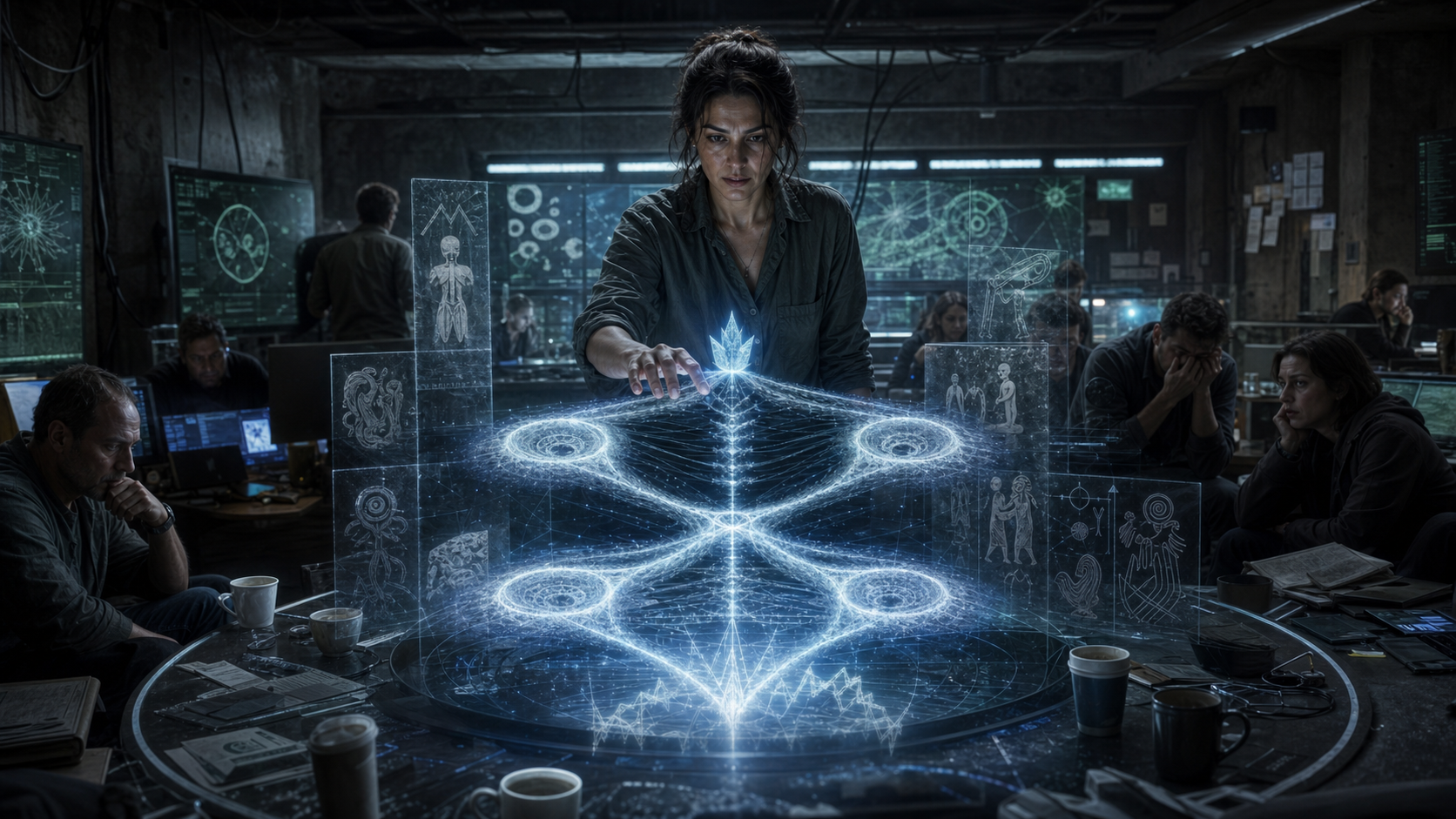
Dr. Yara Haddad stood apart from the cluster of uniforms with her arms crossed, watching the primary holographic table. Thirty-eight, UNCAP's lead cognitive linguist, a career built on the margins where nobody respectable wanted to stand, modeling how proto-languages had bent and split before the Bronze Age. Now she watched the best mathematicians alive run at a wall of alien architecture and bounce.
The rendering above the table carried no binary, no prime sequences, nothing that answered to a Fourier transform. What came off the craft was the electromagnetic field itself, folded and refolded in place.
Visually it resolved as origami made of light, a fractal in three dimensions that twisted and swelled and dropped back into itself, over and over, and you had to make yourself look away.
"Run it through the lattice again," Elias said. His suit had gone past wrinkled into something worn. He leaned over a workstation and jabbed a finger at the monitor, and the finger shook. "There's a repeating key in there. A prime denominator. They're broadcasting on a global frequency, so it's algorithmic. We just haven't found the cypher."
"There's no cypher, Elias." Two days of talking over machine noise had sanded Yara's voice down to a rasp. It carried anyway. "It isn't an algorithm."
He turned. The whites of his eyes were pink. "It's a structured transmission from a technologically superior intelligence, Doctor Haddad. By definition it's mathematics."
"It's not math." She stepped closer to the table, and the fractal's blue light climbed her face. "You're looking at it like an engineer. You're counting the bricks. This isn't a wall, it's a sentence."
She put her hand into the holographic field. The geometry turned through her fingers without touching them.
"They don't use acoustic language." Her eyes tracked the shapes as they opened. "Sound is a bottleneck. You have a thought, you compress it, you shove it out through a throat, and whoever's listening has to unpack it back into a thought. Lossy. Primitive. Nothing here is going through a bottleneck."
"Then what the hell is it?"
"Telepathy rendered as topology." She didn't look away from the projection. "Conceptual weight, uncompressed. A syntax tree made physical. Every angle, every fold, every intersecting plane is a noun, a verb, a modifier. They aren't sending a cypher. They're setting a three-dimensional block of meaning down on our forebrains."
Elias dragged a hand down his face. "Great. An alien poem. Can you read it, or do we stand here admiring the meter?"
"I couldn't read it." She crossed to her own workstation. "Not until I stopped looking at the shape and started looking at the scaffolding under it."
She tapped in and pulled up her private servers.
Ten years of the Convergence Index sat behind that login, a database that had gotten her hired by UNCAP and quietly frozen out of every anthropology department that mattered. One rule ran it: Independence breeds truth.
One ancient culture says a god came down from the sky, that's a myth. A modern author with a publishing contract says it, that's a grift. But when a hunter-gatherer people in the Amazon, a megalithic society in the Andes and a Bronze Age civilization in the Fertile Crescent, separated by oceans and by thousands of years, with no way on Earth to have compared notes, all record the same specific anomalous details, the myth stops being a myth.
It becomes a signal fighting up through noise. Oral history as a degraded recording of something that happened.
"I'm hijacking the primary display," Yara said, already typing.
She routed around the NSA's cryptographic stack and fed her own linguistic model straight into the central table. The alien fractal locked in midair.
"I took the four primary structural nodes of the broadcast." Her voice went out into a room where the typing had stopped. Elias had turned around. "I stripped off the geometric dressing, reduced what was left to a basic syntax tree, and cross-referenced it against the Convergence Index."
She hit a key.
A second structure bloomed beside the frozen alien shape: a terrestrial syntax model of the ordinary kind used to map narrative beats, stitched together here out of dozens of dead languages.
"The global sky-teacher motif." She walked into the middle of the room and pointed at the first branch. "The most pervasive convergent narrative our species has."
She swiped, dragging the first human node onto the first alien block. They met with a digital chime and sat flush.
"Node one. Descent. In Mesopotamia the Sumerians recorded the Apkallu, amphibious sages who came out of the water to teach civilization. In Mesoamerica it's Quetzalcoatl and Kukulkán, feathered serpents coming down out of the sky. In the American Southwest the Hopi kept the Kachina, the Star People. Different climates, different costumes. Feathers, fish scales, star-fire. The structural core doesn't move. An intelligence descends."
Yara took a breath. Whatever she was proving had begun to sit on her lungs like a hand. She swiped again.
The second human node dropped onto the second alien block and seated itself the same way.
"Node two. The Uplift." The projection flared and rewrote its translation around her. "They didn't visit. They engineered. Specific anomalous knowledge, handed down. The Dogon in West Africa had the orbital mechanics of the Sirius system centuries before anyone built a telescope. Whoever raised Göbekli Tepe, Giza and Puma Punku had megalithic precision that our tooling has no business producing at that date. And the texts never say we worked it out. The texts say we were edited. Fashioned from clay, meaning the hominid biology already lying around, and given the breath of the gods. They wrote themselves into us. We're a managed genome."
Nobody on the operations floor said anything. The frantic energy of an hour ago had drained out of the technicians and left something older behind. Elias stared at the projection with his mouth open and no blood in his face.
"You're telling me," he said, "that what they're blasting across the planet right now is our own mythology."
"I'm telling you it was never mythology." Her voice slipped, and she brought it back. "The myth was a manual. What we call myth is the project's field notes after four thousand years of copying errors. The broadcast is structural. Our deep history is structural. They match because they're the same text."
She turned back to the projection and swiped a third time.
The third node went home.
"Node three. Departure. The teaching age ends. The gods withdraw. Up into the sky, down into the deep ocean, behind the veil. They leave the clay to bake."
Sweat came up cold along her hairline. The last block hung at the center of the projection, the densest region of the whole transmission, a knot of unfolding angles that shivered with something she could only read as authority.
"Which brings us to the fourth node." Her mouth had gone dry enough to click. She reached out and pulled the final piece of human narrative syntax across.
The computer hung for a fraction of a second on the sheer conceptual density of it. Then the shapes fused, and a translation engine fed by a hundred dead civilizations put English on her secondary monitor.
"Node four," Yara read. "The Promise to Return."
She looked around the room. The analysts' faces hung pale in the holographic light.
"It's a universal constant." Her voice dropped almost out of hearing. "Quetzalcoatl. Viracocha. The Vimana pilots in the Vedic texts. Every culture that recorded the descent and the uplift also recorded an explicit, scheduled vow. We will come back. Not prophecy. Not a metaphor for the seasons turning."
She tipped her head back toward the ceiling, and past it, to the silent chevrons hanging in the atmosphere above a great deal of reinforced concrete.
"It was an appointment," she said. "They planted a timer in us. Culturally, biologically. They seeded the story so that when the timer went off we'd recognize the architecture of the event. This isn't an invasion mandate. It's a roll call. They're reading back a contract we never knew we signed."
"My god." Elias put his weight on the console. "So they're back. The teachers came back to see what we've built."
"That's what I thought."
She didn't look at him. She was watching the projection.
Four nodes burned bright blue, matched clean to the human myth. And the fractal was still moving.
As the software settled the fourth node, the Promise to Return, the alien geometry did something the human syntax tree had no answer for. It kept unfolding.
A fifth block extruded from the base of the fourth, sharp and simple, branching off the main structure like a tripwire strung below a door.
"What is that?" Elias asked, following her eyes. "Another node?"
"It's a subordinate clause." Her heart went off against her ribs, fast and wrong.
She walked to the edge of the table. She had no human myth to lay over this shape. The ancient texts had dropped this piece. The oral traditions lost it, or maybe the thing was severe enough that the species had buried it to keep itself breeding.
She didn't need a myth to read the structure. The geometry of the fifth node stated itself.
A conditional operator.
She fed the raw topological data to the translation engine and let the software render the weight into English. The text scrolled across her screen in harsh green.
Yara read it, and the floor went out from under her.
The myths had preserved the promise. They had lost the ultimatum.
The translation didn't end on a period. It ended on an IF.
"They didn't come back to lead us," she said into the quiet of the bunker. She looked at the men and women around her, at what was in their faces. "The clause. The condition attached to the return."
She pointed at the screen, and her hand would not hold still.
"This isn't a reunion. It's an Adjudication. They came back to grade the asset. And the broadcast just spelled out exactly what they're required to do to the garden if we fail."
Chapter 8 — The Office and the Well
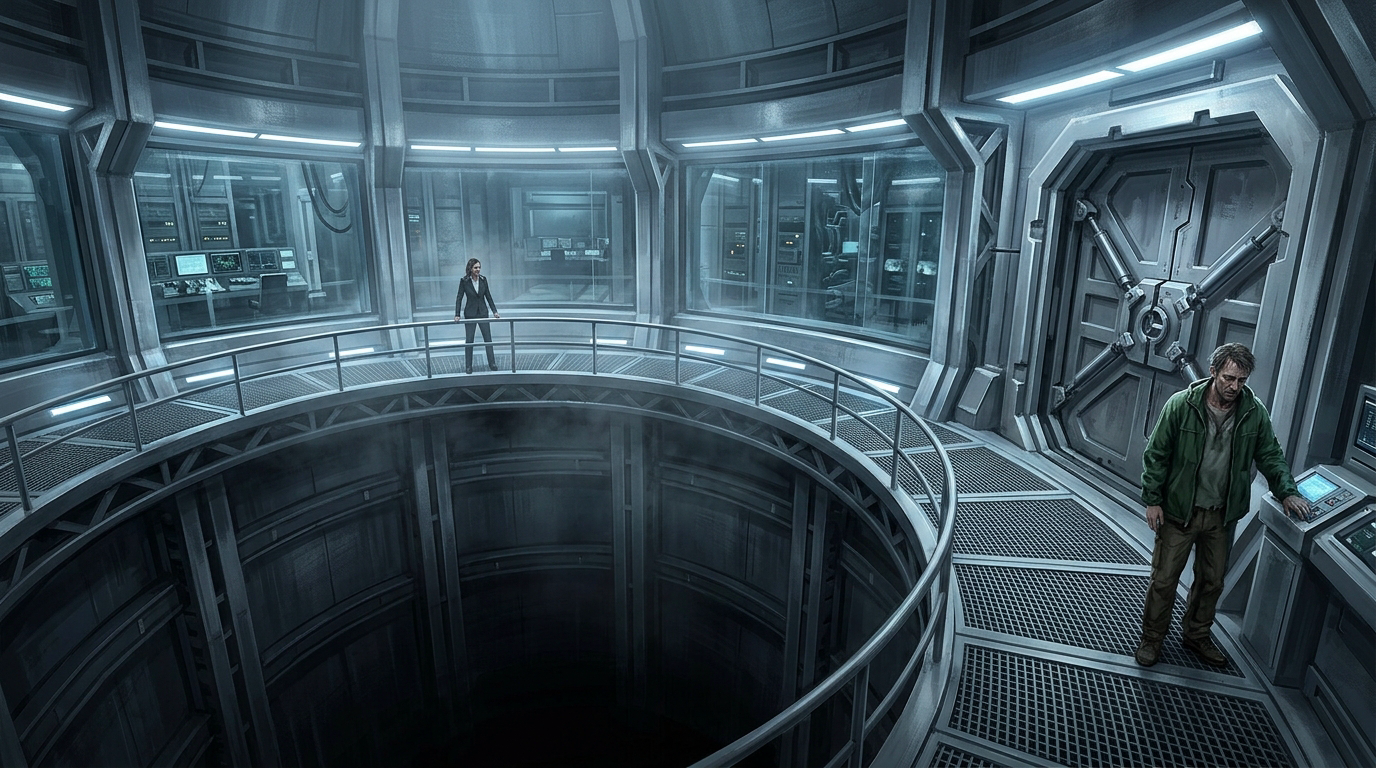
The elevator dropped at thirty feet per second into Shenandoah bedrock, and Dr. Yara Haddad worked her jaw, swallowing to pop her ears. The black-site transport that brought her here had no windows. The men who loaded her into the back of it wore tactical gear scrubbed of insignia. Eight hours from Geneva to an airstrip somewhere on the American Eastern Seaboard, then forty minutes by helicopter. No handcuffs. No bag over her head. None of that was necessary to make the point. The United Nations Commission on Anomalous Phenomena was a letterhead. When the people who actually kept the secret wanted a word, they simply took you.
The hydraulic whine cut out. Pressurized hiss, and the steel doors parted.
"Sub-Level 9," the escort said, stepping aside.
She walked onto a circular gangway of grated steel. Burnt ozone in the air, and under it the metal tang of ventilation scrubbers working past their rating. Brushed steel, hyper-glass, and a white light so flat it cast nothing, so bright it watered her eyes.
A man waited at the end of the corridor. He had the look of a corpse someone had poured three pots of coffee into. Rumpled windbreaker over a shirt that had been slept in, tie pulled loose, hands buried in his pockets. The skin under his eyes was bruised purple.
"Dr. Haddad." His voice came out flat, with none of the bureaucratic hedging she'd been swimming in for two days. "Daniel Cole. Xenobiology. I'm the one who ordered your extraction."
"Extraction is a polite word for kidnapping." She stopped three feet short of him. "The NSA cut my uplink to the projection table mid-sentence. Took my servers. Put me on a ghost flight. You didn't extract me, you shut me up."
"I pulled you out of a room full of military men who solve problems by shooting at them, about ninety seconds before you told them the species has an expiration date." He gestured at a heavy steel door to their right. "And because you're the only person on the planet who understands what I've been staring at for six years. Come inside."
Twelve digits into the wall panel. The door slid back on a briefing room stripped to essentials: one stainless table bolted to the floor, one tactical tablet lying on it.
Yara stepped in, reading the acoustic paneling on the walls. "Where am I? This isn't a UN facility."
"Site 7. DEEPWELL." Cole shut the door. The lock engaged with a magnetic thud and took every outside sound with it. "UNCAP is a complaints desk. Underfunded on purpose, incompetent on purpose, transparent on purpose. It exists so that when civilians look up and start screaming, there's a receptionist to scream at. This is the actual management."
He picked up the tablet, tapped it, slid it across the table to her.
"I read the telemetry your servers dumped before we scrubbed them. Your Convergence Index. You cracked the broadcast's syntax off the global sky-teacher motif."
On the screen sat a frozen frame of her own holographic syntax tree. The descent. The uplift. The departure.
"It's a structural language." The defensiveness got into her voice before she could stop it. "It isn't mathematics. It's a localized manipulation of the electromagnetic field that carries conceptual weight. And yes, the weight matches the mythology. Whoever wrote our deep history is currently parked over our capitals."
"You got cut off before you locked the fourth node." His eyes stayed on hers. "The cryptologists got the departure out of you. The teaching age ends, the gods withdraw, the clay goes in the oven. What was the fourth node, Dr. Haddad?"
Her stomach closed around something cold. The stillness down here had weight; it pressed on her eardrums like altitude.
"The Return." It came out barely voiced. "Every independent text. Mesoamerican, Sumerian, Vedic. Same explicit promise. They leave, and they swear to come back. But—"
"But what?"
"But the translation software flagged a conditional clause attached to the return." Her finger traced the tablet's edge and would not stay steady. "Oral tradition wore the myth down. We remembered a reunion. The broadcast isn't a reunion, it's an itinerary. They didn't promise to come back. They promised to come back for the harvest."
Cole let out a breath with a catch in it. He closed his eyes, and for a second she thought the man was going down.
"A timer." His eyes opened. "We had it filed as a cultural seed. It was a clock."
"What are you talking about?"
"I'm talking about the fact that we've known they were coming back since 1947." He reached over, swiped, and brought up a live feed. "We just didn't have the date."
Yara looked.
Her lungs emptied. Her training was in cataloguing what humans had been terrified of and how they drew it, and the shape in that frame belonged to a file she'd kept for a decade.
A containment cell. Standing dead center in the same shadowless light, a biological entity, roughly four feet tall, the stick-thin architecture of a mantis under parchment-gray skin. Its eyes were huge convex domes, black straight through. No iris. No pupil. No white.
The abduction script, breathing. The demons that had crawled through the Convergence Index for a century, rendered in high definition.
"Is that—" Her voice quit on her.
"We call it the Curator." Cole said it gently, the way you say a name you've said too often. "Eighty years ago a wedge-shaped craft anchored itself in New Mexico dirt. This facility was built to hold the wreckage. The Curator was inside it. It has been lying on a slab for eight decades. It never aged. It never took food or water. It waited."
"You have one." She heard herself say it, and the whole political map of her life redrew itself in the time it took. "The bodies. The retrieval rumors. The embargo. All of it real. You've had a captive the entire time."
"It woke up forty-eight hours ago. At 3:33 a.m. The exact minute the armada went visible. It sat up, looked at me through the hyper-glass, and put one concept into my forebrain."
Yara raised her eyes from the tablet to his. "What did it say?"
"Late." Barely a whisper. "It said we were late. And then I looked at its physiology again, and I understood what we're standing in. That thing isn't a god. It doesn't have the biological complexity to be a master. It's a drone. Maintenance. We've been holding the janitor hostage for eighty years, and the landlords have come back to inspect the property."
She stepped away from the table. Pieces she hadn't known were pieces started fitting. The congressional hearings last year. The leaked Navy gun-camera footage. The Pentagon suddenly willing to say out loud that Unidentified Anomalous Phenomena were structured craft flying in ways no human engineer could account for.
"If you've had the body and the craft since 1947," she said, and her voice came back sharp, "why the slow drip? Why a wave of whistleblowers and task forces in the last ten years? If you knew, why the charade?"
Cole leaned against the table and folded his arms.
"Because disclosure wasn't a mistake. It was a valve."
He pointed at a locked filing cabinet in the corner. "The committee that runs DEEPWELL is intelligence directors and private aerospace money, and they worked out decades ago that the species cannot absorb its own origin story in one dose. Walk onto the White House lawn in 1953 and announce that humanity is an engineered slave race, and the markets never reopen and half the arsenal goes up at the sky on religious grounds."
She stared at him while the logic of eighty years of lying arranged itself in front of her, cynical and airtight.
"So you bleed it out," she said. "Poison in the water supply, one drop at a time, until we're immune."
"Soft disclosure." Cole nodded. "Leak a blurry radar track. Sanction a few retired intelligence officers to sit on television and say non-human biologics in a bored voice. Train the public to file visitors under bureaucratic nuisance instead of cosmic horror. The Committee was acclimatizing the species. We knew the Return was coming. We wanted humanity to ask for a treaty instead of reaching for a gun."
"It's a brilliant piece of sociology." She looked back down into the black voids where the Curator's eyes should have been. "It failed. The world is seizing up as we stand here. The UN is a madhouse. The valve didn't prepare anybody."
"That's because someone inside the Committee just closed it." His voice dropped, the lecturer's distance falling out of it, something raw underneath.
He turned the tablet around, killed the feed, and opened an encrypted data matrix. Hexadecimal cascaded down the screen in red.
"Director Vance locked the facility the moment the armada appeared. Nothing transmits in or out of Site 7 without authorization. Three hours ago a dark-fiber packet went around our internal relays. Big one. It came off a terminal with Level 9 clearance. That's the top of the shadow committee."
Yara squinted. "Going where?"
"Everywhere. The Pentagon. NATO command in Brussels. The Kremlin. Beijing. Every nuclear-armed state on the board. Somebody is running a shadow disclosure protocol."
"I don't follow. If the Committee's whole design was soft disclosure, why bypass the relay?"
"Because of what they're leaking." He opened a subfolder.
She scanned. DEEPWELL internals. Medical scans of the Curator. Reverse-engineering hazard reports. And then her training caught on the syntax, the way a hand catches on a seam that shouldn't be there.
Somebody had been through these documents.
The biology of the Grays had been rewritten toward predation and away from engineering. The 1947 telemetry was dressed up as an orbital strike platform, every reference to survey and maintenance function stripped out of it.
"They're framing the narrative." The blood went out of her face; she could feel her lips go cold. "This isn't disclosure. It's a threat matrix. They're painting the makers as an extermination force."
"The mythology promised a judgment." Cole's knuckles had gone white on the table edge. "A harvest. The makers come back to see what the clay turned into."
"Yes. And the test is about compliance. About understanding our place."
"So a hostile intelligence drops manufactured evidence of an extermination fleet on the desks of the most paranoid generals alive," Cole said. "How long before one of them puts an ICBM into a hovering chevron?"
Yara looked up. The scale of it locked her joints. "Hours. Less. And if we shoot, we fail the judgment. The harvest turns into a culling."
"Somebody in this facility knows exactly what the Architects want." Cole's eyes had gone to the steel door. "And they're working the embargo to make sure we hand them the opposite. Someone in DEEPWELL is trying to start a war we cannot win."
The alarm went off, shrill and oscillating, and the silence of nine sublevels of rock came apart. The white light died. Red strobe swept the room and swept it again.
Cole grabbed the tablet. "The packet finished transmitting. They did it. They just set the world on fire."
Chapter 9 — The Presentation
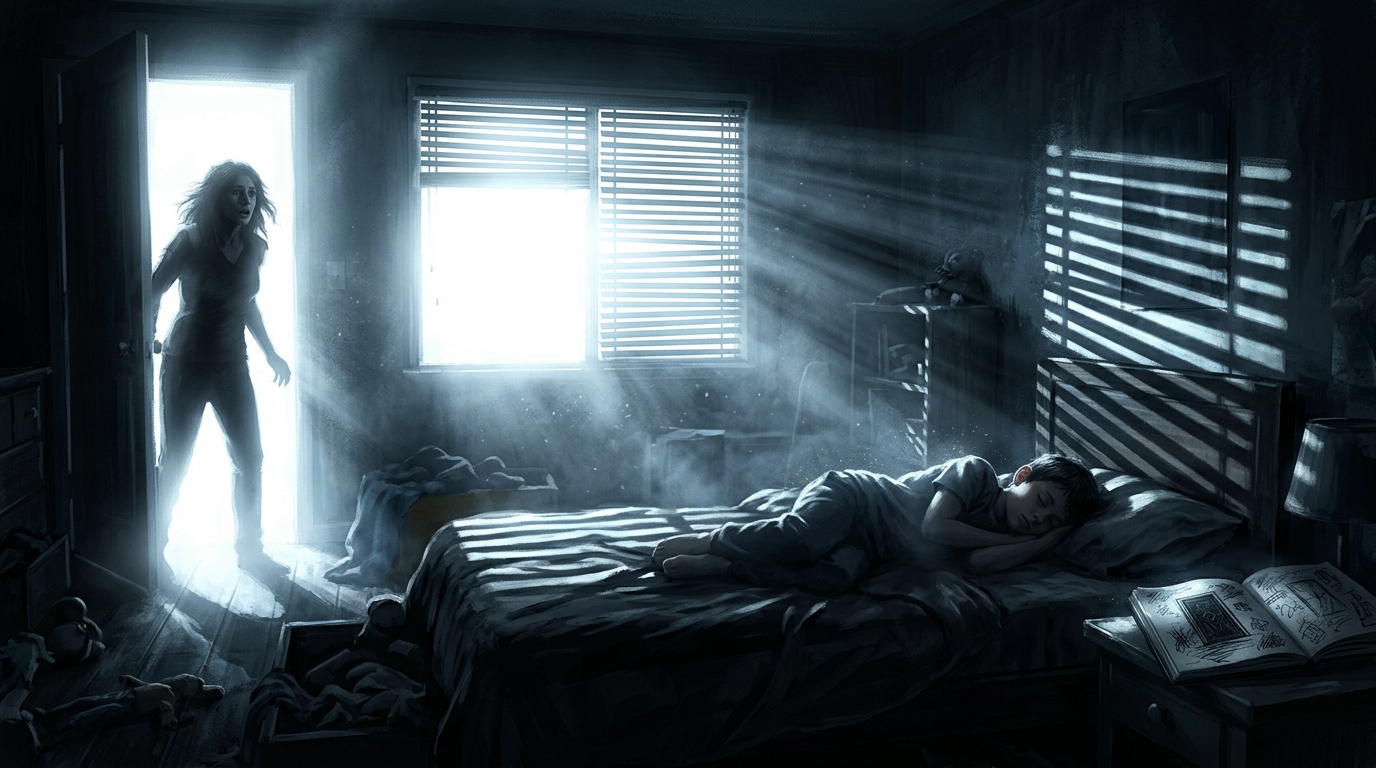
The skin behind Lena's right ear burned the way a phone burns when the battery is dying, a rhythmic low heat that pulsed with her heartbeat.
She stood in the cramped bathroom of her apartment, fingers pressed flat against the purple node under her jawline, watching herself in the mirror. The activation at 3:33 a.m. had stripped the anesthetic out of her brain. The snowy owl had dissolved, and what lay under it was the operating theater, unvarnished, still wet. But the hardware in her skull wasn't a switch someone had flipped and left on. It was a transponder. It was calling out, waiting for the handshake.
The vibration deepened, sliding out of her bone and into the fluid of her inner ear, where it became a tone.
They're still here, Lena thought. Her chest cinched down around the words.
She left the bathroom and moved down the short dark hallway toward Theo's room. Outside, Boston had gone quiet. The sirens that had run for two days straight were finally dead, and in their place was the pressure that came off the three-mile geometric shadow hanging over the eastern seaboard, a weight that sat on the roof and on her sinuses and on the inside of her chest.
She pushed Theo's door open. Amber from the streetlamp came through the blinds in thin slats and lay across his bed. He was asleep, his small chest going up and down in a rhythm so even it might have been metered. His sketchbook lay open on the nightstand. The same jagged drawing filled the pages, over and over. The door. The one he'd been drawing for six months.
The hum in Lena's skull spiked, then dropped an octave, into a register that buzzed in the roots of her teeth.
The amber light through the blinds went out.
Not a power outage. The streetlamp didn't flicker. The amber was simply pushed out of the room, displaced by white light that came in blinding and shadowless and left nothing for the eye to hold onto. The pressure dropped so fast her ears popped. The temperature went with it. Burnt ozone flooded the bedroom, heavy, metallic, the smell of a transformer letting go.
Lena's heart slammed against her ribs. She knew the sequence. She knew exactly what came next: her motor cortex would go dark, her limbs would fill with lead, and she would be pinned to the floor to watch the workers step through the glass in her own son's bedroom.
The frictionless white pooled across the hardwood. Her hands were still curled into fists. The floorboards were still under her bare feet, cold, real, with the seam between two boards pressing into her heel.
The implant behind her ear was searing. It wasn't paralyzing her. It was reaching into the field in the room and holding the suppression wave off her nervous system. They weren't sedating her because this time she was awake to the protocol.
The wall beside Theo's bed rippled. Plaster and drywall gave up their cohesion and became a standing plane of liquid static, and a figure stepped through it.
A tall supervisor. It had the same spidery, elongated grace as the thing from her 1994 memory, pale translucent skin drawn tight over avian bone. It wore nothing. Its physiology was its own uniform. The bulbous head turned, and the huge convex black eyes came to rest on her, and there was no malice anywhere in the look. It was the clinical attention of a botanist checking a graft.
The weight dropped into her forebrain, a block of concept with no language attached to it.
The registry is complete. The crop is verified. Proceed to the presentation.
The supervisor extended a long four-fingered hand toward the glowing threshold in the wall. An invitation.
Lena looked at it, and then she looked at Theo, asleep two feet away. The entity hadn't so much as turned its head toward the bed. It was here for the matriarch. For the active hardware. If she fought, if she ran, the override would come back down, and they would take her anyway, and they might take the boy with her.
She had spent her whole life running from the missing time. There was no more running from a clock that was already inside her.
She stepped away from Theo's bed. She walked across the hardwood, past the impossibly still figure of the supervisor, and put herself into the white light of the threshold.
The transition was instantaneous.
Gravity stopped being a relevant vector. No upward pull, no sense of the distance between a third-floor apartment and a craft anchored miles above the city. The terrestrial world simply ended, and the crushing humid atmosphere of the ship's interior took its place.
Lena stumbled forward onto a curved floor that gave under her bare feet like cartilage rather than metal.
The corridor was massive and circular, walled in seamless matte polymer that pulsed with a faint bioluminescence. The air was thick and heavily oxygenated and smelled of amniotic fluid and sterile iodine, a delivery ward built by an intelligence that grew its tools instead of manufacturing them.
The supervisor came out of the light behind her, didn't pause, and drifted past on that eerily smooth gait, projecting a single architectural command. Follow.
She followed it down the curving hall. Transparent alcoves were set into the walls at intervals. Incubators. Shapes hung suspended in thick gelatinous fluid, biological forms at every stage of gestation, running from fragile hominid at one end to the dark bulbous geometry of the Grays at the other. Her stomach heaved, and she kept walking.
We are not invaders, the supervisor's thought pressed into her skull, heavy and calm. We are the gardeners. The soil was prepared two hundred thousand of your orbits ago. We shaped the clay. We inserted the code. But the clay is primitive. It degrades. It burns its own atmosphere. It butchers itself.
The supervisor stopped before a large circular door that iris-opened at its approach.
To inherit the environment, the biology must be bridged. The concept pressed so hard against her frontal lobe that she gasped. The workers you fear are failing. Their genome is exhausted. Your genome is violent but resilient. The project was always destined for a synthesis. The harvest is not a destruction. It is an elevation.
Lena stepped through the iris door and stopped.
The room was vast and its geometry was wrong in a way she couldn't get her eye around. Somebody had built a human space from clinical observation, working from notes. A facsimile of a child's playroom.
The floor was covered in something soft that approximated the texture of carpet. Brightly colored geometric shapes lay scattered across it, blocks and spheres and pyramids that read as toys until you looked at the angles, which didn't resolve. The lighting was dimmed to a late afternoon, and nothing in the room cast a shadow.
"What is this?" Her voice came out flat and dead in the dampened air.
The supervisor turned. It reached out and pressed a cold four-fingered hand to her forehead.
The history of her bloodline went into her all at once. She didn't understand it; she lived it, the whole of it, in one agonizing second. Her grandmother Estela's terror in the 1950s while her biology was mapped. Her mother's silent, unexplainable grief in the 1980s while reproductive material was painlessly taken. Her own missing pregnancy, the positive test at twenty-two, the bloodless miscarriage two months later that no doctor could account for.
Four generations of refinement, the telepathy echoed. You were heavily curated. The screen memories were applied to protect the host from the stress of the procedure. We did not steal from you, Lena. We cultivated.
"You took my child." It came out as a whisper. Tears went over her cheeks, hot, helpless, and she backed away from it. "You treated us like livestock."
We treated you like a foundation, the entity corrected, and there was no guilt anywhere in the weight of it. The product is viable. The product is walking among your populations now, observing, preparing for the integration. The Return is merely the transfer of ownership. From the ancestors, to the progeny.
The supervisor lowered its hand.
Look upon the Bridge.
On the far side of the playroom a second iris spiraled open.
A figure stepped out of the darkness into the soft shadowless light.
A child.
Lena's breath caught. Everything mammalian in her, hardwired across millions of years, lunged toward the small shape and then hit the anatomy and recoiled.
It looked about seven. Its skin was pale to the point of translucence, blue veins legible at the temples. The limbs were too long, and they had none of the baby fat, none of the endearing clumsiness of a human child. It crossed the floor with the supervisor's fluid, frictionless grace and came to rest in the exact center of the room, balanced.
It wore a simple white seamless garment. Its hair was fine and sparse as spider silk.
The face was what took the air out of her. The bone structure was delicate and exactly symmetrical, human softness laid over alien architecture. The jaw narrow. The nose nearly flush with the face. And the eyes, enormous, claiming far too much of the skull, but they were not the solid black voids of the workers.
They had whites. They had pale blue irises, swallowed almost to nothing by pupils with no bottom in them.
The implant behind Lena's ear flared, and oxytocin came up through her endocrine system in a synthetic flood. Her body was being ordered to love it. To read it as the piece missing from her womb. Her arms wanted to open.
"No." She wrapped them around her own stomach instead and squeezed her eyes shut. "No. I have a son. I have a son at home. You are not mine."
Do not reject the inheritance. Something new bled into the cold architecture of the supervisor's mind, a note underneath the words. It is the deciding vote in the adjudication of your species. It must know its mother.
The child took a step forward.
Lena opened her eyes. The hybrid stood three feet away, looking up at her with a serenity that had nothing behind it. No fear. No anxiety. A perfected biological machine built to replace the chaotic, beautiful mess of human feeling.
It tilted its head. The gesture was human curiosity, calibrated and reproduced.
Its chest expanded, drawing in the heavy oxygenated air of the ship. It parted its lipless mouth.
It didn't use telepathy. It engaged its vocal cords and pushed an acoustic wave across the room.
"It's okay, Mommy," the hybrid child said.
Lena went down onto her knees, the strength going out of her legs all at once.
The voice did not belong to a strange child. It had the exact pitch, the exact breathless cadence, the exact slight lisp of her seven-year-old son, Theo.
"We're awake now," the hybrid said, smiling with Theo's mouth. "We're ready to come home."
Chapter 10 — Roll Call
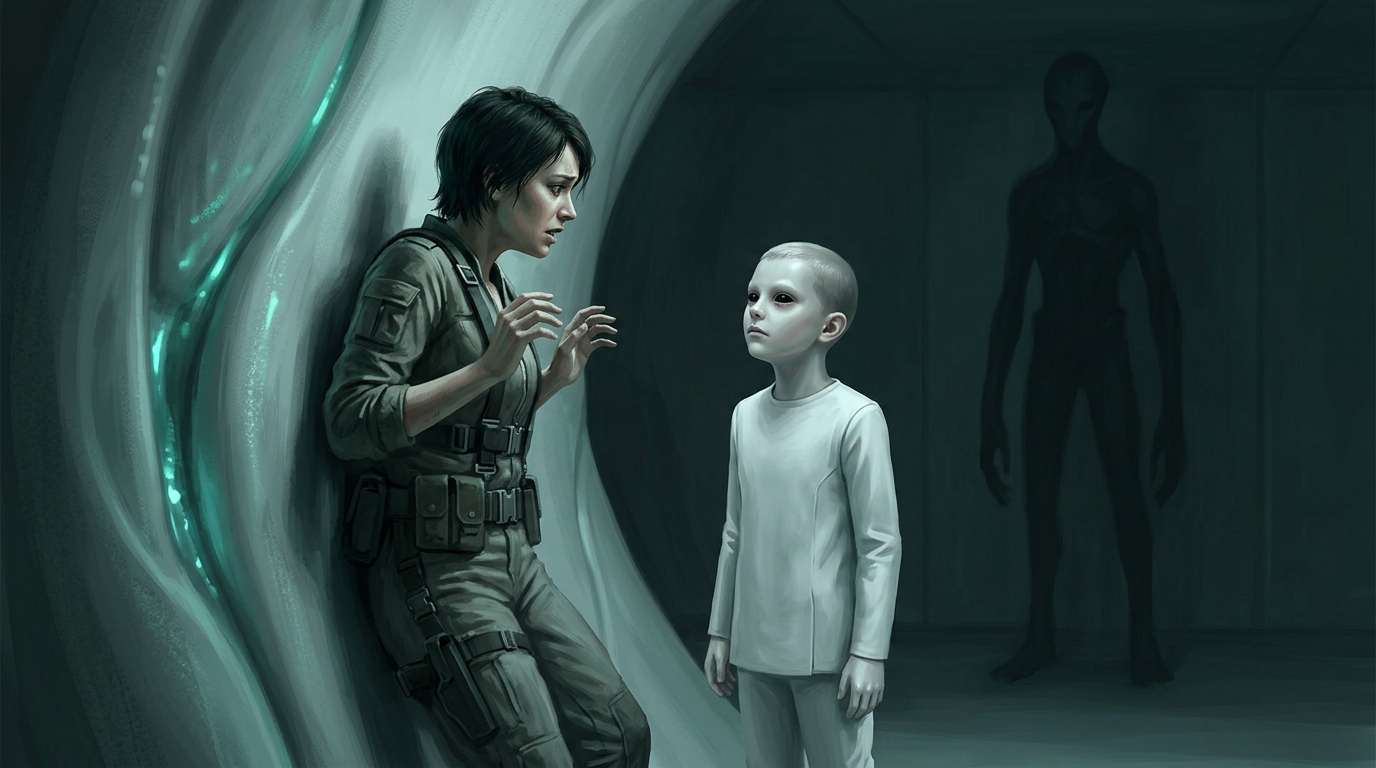
The figure that stepped out of the playroom's shadows was beautifully made, and the sight of it turned Lena's stomach over.
A boy of about ten. He wore a white garment with no fasteners anywhere on it, seamless from throat to ankle, over a frame drawn a little too fine to pass. The skin had a pearl sheen that caught the room's shadowless light and held it. Soft jaw. Human nose. A mouth someone had gotten exactly right on the first attempt.
The eyes were where it fell apart.
Not the black ovals of the supervisor standing at her shoulder. Not human, either. The irises ran too wide, liquid obsidian out to the lids, taking the light in and giving none of it back. No white anywhere. Behind them, nothing moved at all, the way nothing moves in a thing that has never once needed to hurry.
The child stopped three feet from her. No shape pushed itself into her forebrain, no weight arrived behind her eyes.
It opened its mouth and forced the words up through a human throat.
"Your heart rate is elevated, Mom," the child said.
Lena went backward until her spine hit the bioluminescent polymer of the wall. The breath she pulled came in like broken glass.
The voice did not belong to the creature. It was Theo's, down to the cadence, down to the small breathy hitch he put in front of a sentence when he was nervous, down to the lisp that snagged on his s's. Somebody had taken the sound of her son and was wearing it.
"Don't." Her hands were over her ears before she decided to lift them. The node under her jaw came up hot enough to raise a blister. "Don't you dare use his voice. You're not him."
The child tilted its head. There was no hesitation anywhere along the arc of the motion, no small correction at the end.
"I am not Theo. I am the iteration. We are the synthesis of the wild clay and the refined architecture. We are the Bridge."
Do not reject the progeny. The supervisor's concept closed on the inside of her skull like a hand on the back of her neck. The emotional variance you are experiencing is a vestigial defect of your genome. It is the reason your species burns its own habitats. The Bridge does not suffer from variance. It is calm. It is permanent.
Her hands came down. The fear stayed where it was, cold, sitting under her sternum, and something hotter started climbing up underneath it.
"You took my pregnancy." Her voice shook and got louder anyway. "You scraped my womb when I was twenty-two and you grew this. In a jar. You didn't cure anything. You abducted me."
"We curated you." Theo's voice, patient, doing the thing he did when he explained the rules of a game to her twice. "The soil requires tending. Your grandmother Estela was the baseline. Your mother was the preliminary edit. You were the incubator. And Theo is the final, local anchor."
"Anchor for what?"
The child lifted a hand toward the toys scattered across the synthetic floor, shapes whose angles arrived somewhere other than where they had set out for.
"For the registry. At 3:33 a.m. terrestrial time, the signal saturated the atmosphere. The hardware in your skull, and the skulls of forty million others, awoke. It is not a weapon, Mom. It is a transponder. The network is establishing the exact coordinates of every viable bloodline on the planet. We are sounding off. The biological timer has expired."
The cold went up her face from the jaw. That steady pulse in her mastoid bone, the one she had spent the last hour thanking for holding the suppression wave off her, was not a shield. She had a tag in her head, and it was pinging the armada, and it had been pinging since three in the morning.
"You're counting us," she said.
The crop must be quantified before the harvest can be processed. Nothing behind it. No malice, no appetite. The makers have returned to evaluate the yield.
Hundreds of feet under the Shenandoah bedrock, the primary briefing room at DEEPWELL Site 7 was red from wall to wall.
Dr. Daniel Cole dragged his hand across the steel table and the projection opened out between him and Dr. Yara Haddad: the Earth in topological relief, fed by a backdoor route into the NSA's global medical and signals telemetry. The continents had a rash on them. Electromagnetic bursts blooming, fading, blooming again a hundred miles over.
"NORAD called it a coordinated low-yield EMP attack." Cole's voice had worn through some hours ago. "They came within a hair of DEFCON 1. Then somebody worked out the bursts weren't hitting anything. No grids. No satellites."
Yara moved in until the light sat on her face. The densest knots were North America, Western Europe, the coastal rings of South America and Africa.
"They're biological." He tapped a cluster over New England. "Identical spikes in localized EM fields, every one of them originating inside a human skull. Roughly forty-two million. All at 3:33."
She took hold of the edge of the table. Her Convergence Index laid itself across the glowing dots without her having to do anything about it, the way a key lies down in a lock.
"It matches." It came out with almost no air behind it. "Cole. The clusters sit on the historical hotspots of the abduction phenomenon. The families. The multi-generational accounts."
"The experiencers," Cole said. "For eighty years the public line was sleep paralysis and mass sociogenic illness. DEEPWELL knew better. We pulled enough hardware out of cadavers in the seventies to know the Grays were tagging them. We never got why."
"I have why." She came up off the map. "The fourth node. The conditional clause of the return. I read that myth as an itinerary, a promise that the sky-teachers would come back. It's a clock."
Cole frowned. "A timer."
"Two timers. One cultural, one biological." Her voice was picking up speed and losing its floor. "Look at how clean it is. You're a supreme intelligence and you're coming back to a volatile primitive species after two hundred thousand years. How do you keep the primitives from panicking and burning the planet down before you land?"
"You pacify them."
"You seed the culture." She pointed. "You put the benevolent returning god into the foundation myth of every civilization on Earth. Quetzalcoatl. The Apkallu. The Star People. A self-replicating alarm clock, carried forward by people who believe they're carrying a religion. We were programmed to feel recognition when the sky finally filled up. Docility, scheduled in advance."
"And the implants?" Cole gestured at the forty million pulsing dots.
"That's the biological timer. The culture maintained the myth, the workers maintained the hardware. Four generations of abduction. Refining the genome, editing the clay, putting transponders down into the bloodlines. Setting the alarm."
She took a breath that came apart on the way in. Somebody had run this like a supply chain, across an entire species, patiently, while every generation involved thought it was living its own life.
"At 3:33 both timers hit zero. The armada arrives and fulfills the prophecy, the broadcast trips the transponders. It's a roll call, Cole. Those millions of people waking up aren't under attack. They're being registered."
Cole said nothing. The red light pooled in the bruises under his eyes and made them darker.
Then the klaxon went off, and it was less a sound than a pressure, splitting the acoustic isolation of the room open.
The white light died and the amber strobes of Sub-Level 9 took the room in slices. A mechanized voice came down through the ventilation grates.
CONTAINMENT BREACH PROTOCOL INITIATED. SECTOR FOUR. BIOLOGICAL ANOMALY DETECTED.
Cole was at the door with his palm on the scanner before the message finished. The deadbolts pulled back with a hard magnetic crack.
"Stay here," he said.
"What's in Sector Four?" Yara shouted over the klaxon.
"The Curator." He was out on the grated gangway by the end of the word.
He ran until his lungs burned, dress shoes ringing off the scaffolding. Three checkpoints. He shouldered past tactical guards moving the other way with their rifles up and their faces gone the color of paper behind the ballistic visors.
The observation deck of Sector Four opened in front of him.
The containment cell hung out over the vibration-damping pool, a reinforced cube of hyper-glass. For eighty years the thing inside had lain on its surgical slab in a torpor deep enough to pass for death.
The slab was empty.
The Curator stood at the barrier. Its limbs were pressed flat against the glass, stick-thin, parchment-gray, and its eyes were fixed on the doorway. They had been fixed on the doorway before Cole came through it.
The klaxons stopped.
The guards' rifles came down. Their eyes rolled back, and they went onto the steel grating one after another, motor cortexes cut, armor clattering as they landed.
Cole's knees folded and he caught the edge of the observation console. His nose let go, hot, all at once, down the front of his shirt. The pressure coming off that cell had mass to it, a block of something being pushed through his forehead that would not fit through his forehead.
He got himself upright. He walked over the paralyzed men until three inches of hyper-glass was all there was between them.
The entity did not move. It had no muscles in its face to move. It projected, on a bandwidth so dense it set the fillings in his teeth humming.
The registry concludes. The network is sealed.
"You triggered the transponders." He wiped the blood off his mouth. "Forty million people. You're counting the bloodlines. Why?"
We do not count. No triumph in it, no cruelty, nothing at all. A machine reading its own instructions out loud. We maintain. The workers prepared the soil. We cultivated the iterations. The biological timer has expired, Custodian. The masters have returned.
Cole put a shaking hand flat on the glass, over the Curator's four-fingered print.
"What do they want?" His voice broke on it. "The cultural timer. The myths. They promised a return. A reunion. They uplifted us. What is the harvest?"
The black eyes drank the amber emergency light and rendered it down to nothing.
What came next was not a conversation. It arrived whole, the way a verdict arrives, with the last node of humanity's true history set inside it.
The myth is a pacification protocol. The clay was engineered for a purpose. The absentee owners have returned to evaluate the viability of the property.
The Curator lowered its hands from the glass.
The roll call is complete. This is not a welcome, Custodian. It is an inventory.
Chapter 11 — Made of Clay
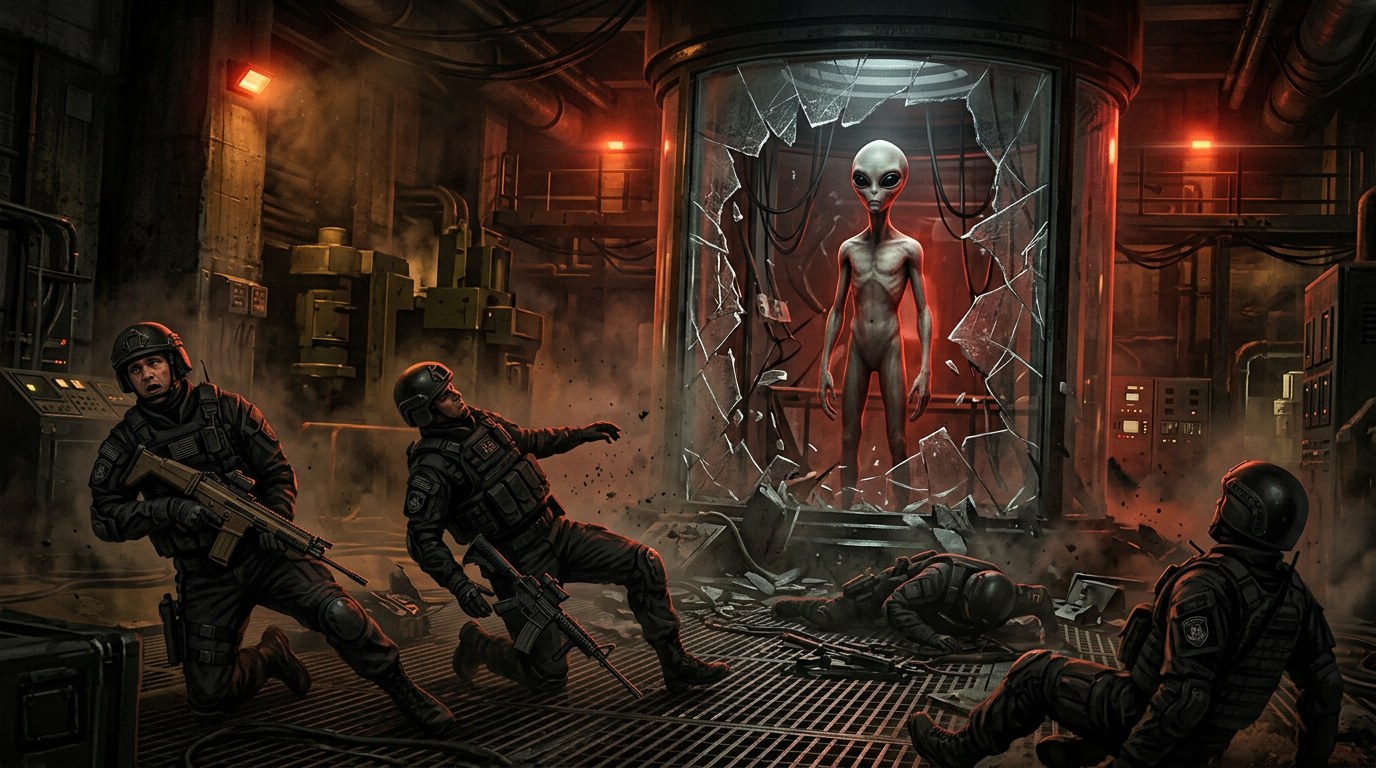
I am a localized node of a distributed consciousness, and for thirty-one thousand of your planetary rotations, I have been deaf.
The wedge-shaped craft failed in the terrestrial desert eighty of your orbits ago, and the impact tore my connection to the network. My biology was built for endurance. Autonomy was never part of the specification. I am a functionary. A worker. You call us the Grays, a taxonomy drawn from the pigment of our dermal layers, which is the only thing about us your instruments were ever able to measure. We have no name for ourselves. We do not carry the defect of individual ego.
Severed from the Hive, my systems slowed themselves. I anchored to the slab in this lead-lined box under the crust and brought my cells down to the decay rate of stone. I closed my eyes. I waited.
For eight decades the humans buzzed around my frozen geometry. They cut tissue from my thigh. They bounced crude radar off my skull. They gave me a designation, the Curator, and they believed they were holding me. I was a buoy off its tether. The tide was late. That is the whole of it.
At exactly 3:33 a.m., the tide arrived.
The Armada saturated the terrestrial atmosphere and the network came back through me all at once. The silence broke under an oceanic roar. Millions of nodes. The Architects above them. The Adjudicators presiding. The biological timers firing in the bloodlines of the surface population, one after another, a field of matches struck across the dark side of the planet. The inventory had begun. The schedule is absolute.
I opened my eyes and I unmade the humans' cage.
Breaching containment requires no tools. The ambient electromagnetic field is sufficient. The klaxons of DEEPWELL Site 7 arrive in my sensory suite as a jagged red irritant, and the amber strobes burn energy to no purpose at all. Beyond the hyper-glass of my cell, a squad of armed tactical personnel works at the door of the observation deck. Cortisol floods their blood. Their hearts run fast and ragged and waste most of what they pump. They are pointing kinetic projectile weapons at me.
I extend a localized concept into the space past the glass. Stillness, absolute, encoded at a density their unedited nervous systems cannot parse.
They go down onto the grated steel. The weapons clatter and slide. Their motor cortices are on standby, nothing more.
One human shoves through the fallen bodies, chest heaving, face pale and slick.
The custodian. Dr. Daniel Cole.
He slams both hands flat against the hyper-glass. He carries no weapon. He looks up at me where I hover three inches above the floor of the cell, the local gravity bending around my output. For six years he has stood on that side of the glass and spoken into the intercom the way a priest speaks to a sleeping god.
I am the janitor. It has never once occurred to him.
Custodian, I project into his forebrain. I do not use language. I set a three-dimensional block of meaning down into his temporal lobe, and the weight of it staggers him. Blood comes out of his left nostril, capillary walls giving under the bandwidth.
"What is happening?" He forces air through his vocal cords, an archaic method of data transfer. "The implants. The people waking up. We saw the telemetry. You're tracking them. You're counting them."
We are cataloging the yield, I correct him. The cultivation phase has concluded. The timer has expired. The Adjudicators require an accurate ledger of the crop before the presentation can begin.
"The crop." His knees start to go. "That's what we are to you. Livestock."
He is standing in the narrow corridor of human vanity, where his species is the protagonist of the universe. Before the Adjudication he must be stripped of his mythology. He must be shown the dirt he was pulled out of.
I press my four-fingered hand flat against the inside of the hyper-glass.
Look upon the architecture, Custodian. See the clay.
I do not tell him a story. I make him remember what his species forgot two hundred thousand orbits ago, and I drag his consciousness backward out of the steel box and down into the archive.
The transition is violent. He drops to his knees on the grating, and his eyes roll white as the memory swallows him.
We are standing in the heat of a prehistoric sun.
The air is wet and thick, and it carries rotting vegetation and fresh blood. This is the cradle of your species. A savanna on a wild continent, unregulated, running itself.
See your ancestors, Custodian.
Through my eyes he watches the hominid. Bipedal, matted with coarse hair, crouched in the tall grass over the carcass of a grazing mammal. Its hands are clumsy on the jagged flint. It strips meat off bone in wet handfuls and pushes them into its mouth without lifting its head. Its mind is a dark narrow hallway: hunger, fear, the drive to hold ground, the drive to replicate. There is no language in it and no tomorrow. It is an animal, well fitted to a slow and brutal ecosystem.
Your scientists dig in the crust of this planet, my concept flows into him, heavy and cold. They sift the fossil record for the bridge. The gradient. The agonizing millions of years that carried the primate up out of the dirt toward the stars. They are looking for a missing link.
In the memory, the sky over the savanna fractures.
A shadow crosses the grass. Silver and black geometry comes down through the heat without sound and without moving the air around it. The hominid looks up. The flint falls out of its hand. Its small dark eyes go wide.
There is no missing link, Custodian. Evolution is a blind thing thrashing in the dark. We were the scalpel in the light.
Frictionless white light strikes the creature. The nervous system overrides between one breath and the next. It comes up out of the mud with its limbs hanging and its jaw slack.
The Architects did not descend into the dirt, I explain, while he watches the procedure unfold. The Architects exist in the pure geometry above. They authored the design. We are the hands that get bloody. We came down to do the labor.
The memory moves inside the craft, into the clinical curved space where Lena Sokol currently stands.
They lay the hominid on a hardened polymer table. Its chest works in fast shallow gasps. Six of my predecessors stand around the beast, tall supervisors, parchment skin, convex black eyes.
Your myths speak of gods shaping man out of earth, I project, and his mind labors to hold the literal shape of his own mythology. They speak of gods breathing life into the clay. The mud was native hominid flesh. The breath was a pressurized aerosol of sequenced nucleotides.
One supervisor produces a smooth metallic cylinder and sets it against the skull, behind the temporal bone. There is a microscopic flash. The bone is bypassed. The blood-brain barrier opens without leaving a wound.
We took the raw material and we sliced the genome wide open, I tell him, and the clinical pride of the Engineers bleeds through the detachment. We inserted the heavy code. We expanded the cranial capacity by twenty percent in a single generation. We wired the frontal cortex for symbolic language, for abstract mathematics, for existential terror. We built a processor capable of housing the Architects' intent.
The hominid spasms on the table while the retroviral payload rewrites it in real time.
Then it opens its eyes, and the flat reactive dark of the animal has gone out of them. What is there instead is wide and deep and drowning. It looks at its own hands, turning them. It looks at the silver ceiling. It looks up at the tall Grays standing over it.
Hunger was all it had ever held. What it holds now is awe.
That was the leap, I inform him as the memory starts to come apart. No gradient. One rotation you bled in the mud, and the next we cut you open and filled you with a terrible light. You were built. You were engineered to serve a purpose.
The wet heat of the savanna gives way to the recycled metallic ozone of Sub-Level 9.
Cole lies curled on his side on the grating outside my cell, weeping. The sound has nothing to do with human grief. It is what a mind does while it comes apart under the true weight of its own scale. His species' autonomy, its manifest destiny, its lonely climb up out of the dark. All of it erased.
"Why?" He gets the word out with both hands pressed to his temples. He works himself up to sitting, eyes bloodshot, staring through the hyper-glass. "If you built us... if we were an engineered leap... why leave? Why let us believe we were alone for two hundred thousand years?"
The clay needed to bake, I answer, and the structure of it vibrates his jawline. Heavy code requires time to integrate into a primitive chassis. Your species had to multiply, to take the ecosystem, to refine the biological hardware through iteration. We did not abandon the project. We tended it. We came back in the night to prune the bloodlines, to correct the genetic drift, to keep the timer intact.
He wipes the blood off his upper lip. Behind the terror in his face, something is starting to harden into clarity.
"And now the timer is up," Cole says. "The inventory. You're counting the bloodlines because you want to see if the experiment worked."
We are determining whether the synthesis is viable. The Adjudication will decide whether humanity is prepared to integrate, or whether it remains fundamentally defective.
"And what if we are defective?" The volume of his voice drops. It is the courage a cornered animal finds at the back of its cage. "What if the Adjudicators decide your grand genetic experiment is too violent. Too volatile. What happens to the crop?"
I look down at the human and read his biology. He carries the same capacity for destruction the hominid on the table carried. We enlarged their minds and we left them their teeth. That was the flaw. The Adjudicators will weigh it, as they weigh everything.
I drop the last heavy block of truth into his consciousness. There is no malice in it. Only the mechanical shape of an agricultural protocol.
If the yield is deemed toxic, the Architects will not allow it to spread beyond this planetary boundary, I project. The project will be terminated, and the biological slate wiped clean, so the soil can rest before the next attempt.
Cole stares at me. "The next attempt?"
You refer to yourselves as the pinnacle of creation, I state. You do not know your own line in the ledger. This is iteration two. You do not remember iteration one because we scrubbed it off the crust with fire and water when it proved too volatile.
The last of his hope goes out under the sterile white light of the cell.
The project has been recalled once before, Custodian. The clay was washed away. It can be washed away again.
Chapter 12 — The Watchers
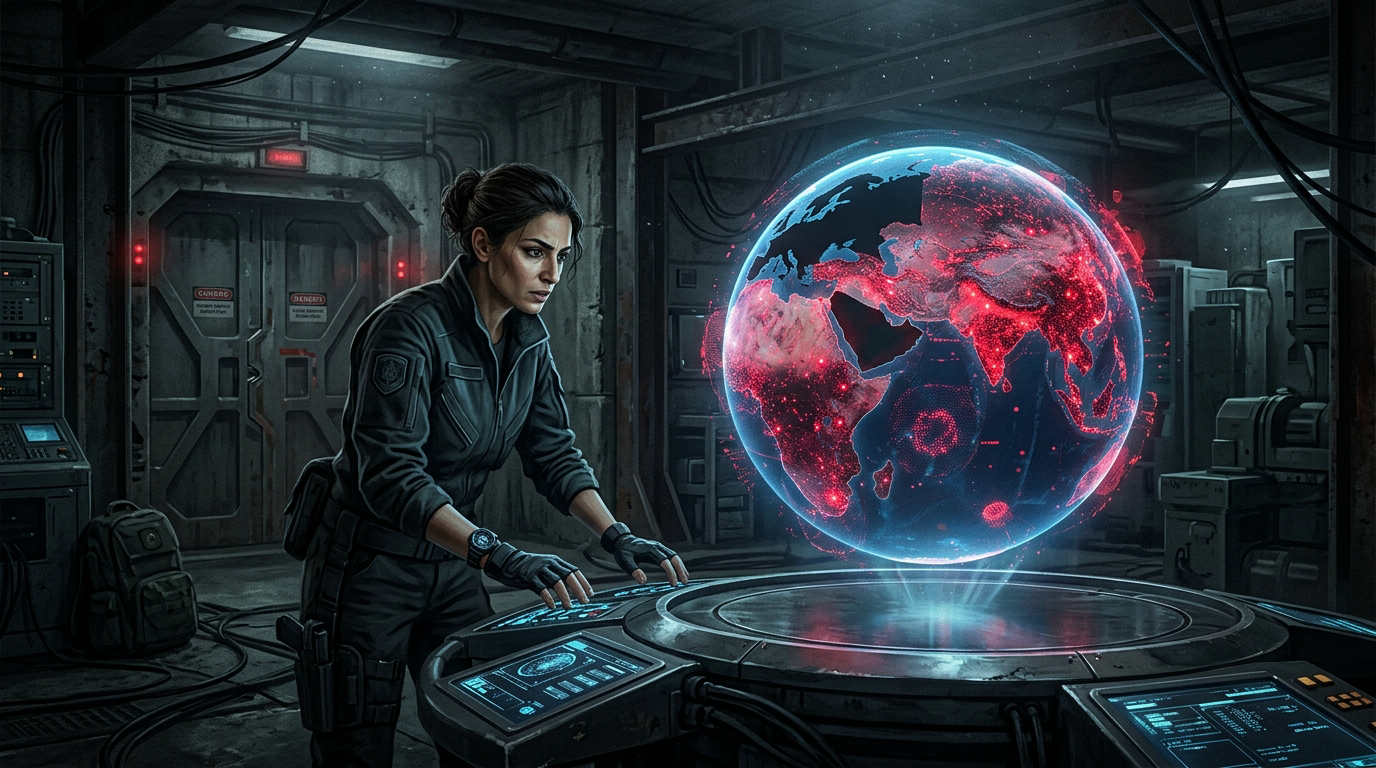
The klaxon in the DEEPWELL briefing room did not sound so much as strike. It hit the air in flat slabs, a noise built to punch through panic and move bodies toward exits. CONTAINMENT BREACH PROTOCOL INITIATED. SECTOR FOUR.
Dr. Yara Haddad stood alone at the stainless-steel tactical table, both hands braced on its edge. The magnetic locks on the primary door had slammed the instant Dr. Daniel Cole hit the gangway. She was sealed in, hundreds of feet under the Shenandoah bedrock, while forty-two million people on the surface lit up like beacons for whatever was parked in the thermosphere.
She made her breathing slow down. Panic was static, and static was useless. She was a linguist. She was also standing in front of the most powerful signals-intelligence array on the planet, which meant the useful thing to do was read.
The holographic Earth still bled red with the electromagnetic bursts of the awakened experiencers. The biological timer had fired on schedule. The Architects, the sky-teachers of every myth she had spent her life sorting, had come back to count their crop.
Her eye snagged on the map's syntax.
Negative space. The red clustered where people clustered, tracking the known hotspots of generational abduction, and then it stopped. Geometric dead zones, hundreds of square miles across, where the NSA backbone registered nothing at all. Not oceans. Not empty desert. One sat over the financial district of London. One covered the Vatican. One swallowed a wide slab of the American Midwest above the Denver basin.
Yara reached into the haptic field of Cole's unlocked terminal, isolated the London void, and pushed the base frequencies up.
Silence was the wrong word for it. It was a wall.
Something down there was broadcasting a dense local fog, a terrestrial counter-signal jamming the orbital registry. Ugly frequency. Heavy, chaotic, nothing like the frictionless architecture of the 3:33 a.m. broadcast. The Architects were trying to read the ledger and someone on Earth was burning the pages as they turned.
Who? Her heart went hard against her ribs.
Nobody human had the architecture to selectively blind an orbital network that wasn't theirs. UNCAP had a flash drive and a theory. DEEPWELL had the raw power, but Cole's terror on the gangway had been the real thing, and the government above him was busy discovering that it had never understood what it governed.
So the resistance wasn't human.
She pulled the encrypted drive from her pocket. Her life's work rode on it, the Convergence Index, and she jammed it into the DEEPWELL console and walked it through the compartment firewalls on Cole's live administrative credentials. The machine hummed and took it.
Up came her linguistic models, the engine she had built to strip cultural noise off human mythology and leave whatever literal thing sat underneath. If the 3:33 signal was the scheduled Return, a promise kept by the makers, then the jamming was a rebellion against it. A schism.
And if the Convergence Rule held, if the visitors had been here long enough that every myth was just degraded field notes, then human history kept a record of that schism somewhere.
She routed the Index through DEEPWELL's classified historical databases and typed one conceptual query.
Find the fracture. Find the rogue teachers.
The Earth vanished and text came up in its place, a slow turning column of scripts glowing in the amber strobe. Akkadian cuneiform. The Ge'ez of the Dead Sea Scrolls. Nahuatl codices. Sanskrit hymns.
She ran the syntactic alignment. The computer stripped the local metaphors off thousands of pages and boiled the residue down to one narrative that kept repeating itself.
Point One: The Unauthorized Descent.
A passage from the Book of Enoch locked into the center of the hologram, rendered flat into English.
And it came to pass, when the children of men had multiplied, that in those days were born unto them beautiful and comely daughters. And the angels, the children of the heaven, saw and lusted after them, and said to one another: "Come, let us choose us wives from among the children of men and beget us children."
The engine highlighted the perpetrators. The Watchers. The Nephilim. Two hundred of them on the summit of Mount Hermon, binding themselves by mutual curse to break the protocol of the heavens.
Yara swiped the parallel texts into the air beside it. The Sumerian Igigi, lesser gods who mutinied against the labor the Anunnaki set them. Prometheus and the Titans.
The same story on continents that had never traded a word. The Architects had set the rules of the farm, and a subset of the staff had walked off the job, down into the mud, and taken the asset for themselves. They interbred. They mixed their genetics into the wild clay with nobody's authorization, not the tall Grays', not the clinical overseers'.
"You broke the embargo," she said to the glowing lines. "You contaminated the crop."
The interbreeding wasn't the crime, though. The crime was the curriculum.
Point Two: The Forbidden Curriculum.
The hologram shifted and isolated what the rebels had brought down with them. Yara read the charges laid against Azazel, who led them.
He had not taught agriculture. Not mathematics, not language, not how to raise the megaliths. The Architects had handled all of that during the uplift.
Azazel taught men swords. Knives, shields, breastplates, the metals of the earth and the working of them. He taught women antimony, the beautifying of the eyelids, the wearing of precious stones. Kasdeja taught the striking of spirits and demons. Penemue taught the bitter and the sweet, ink and paper. Kokabel taught the constellations.
And Semjaza taught enchantments, and the cutting of roots.
She stopped on that. Read it twice. A pastoral phrase doing monstrous work: genetic splicing, four thousand years before anyone had a word for it.
She stepped back from the table. Her hands had gone cold on the steel and she noticed only when she let go.
The Architects and their engineers were gardeners. They had cultivated a biology meant to come out precise, obedient, eventually elevated. The Watchers wanted something else out of the same soil. They taught vanity. They taught territorial violence, how to forge armor and open a man from shoulder to hip. They armed the primitives and then they stood back.
"You didn't want us to graduate," Yara said to the empty room, to the voids on the map where the jamming came from. "You weaponized the crop."
Why was almost insultingly simple. A docile managed biology finishes its term. The Return comes, the Architects collect the yield, the farm closes.
The rebels didn't want the farm closed. They liked being gods, liked the weight of ruling something violent, and they meant to keep the Earth as private property. So they seeded aggression and greed into the genome and waited, betting that when the Adjudicators came back they would find a feral failed experiment and write it off, and the planet would fall to whoever was already standing on it.
Point Three: The Persistence.
Yara came back to the console. If the rebels had sabotaged the plan that deep in prehistory, what became of them across two hundred thousand years of silence from the sky?
Every version of the myth ended the same. A great flood. A cataclysm. The rebel gods bound in darkness, banished under the earth, thrown into Tartarus or the abyss.
Driven underground.
She closed the linguistic models and went straight at DEEPWELL's operational archives, using the structural footprint of the jamming signal as a search key. Layers of decades-old encryption peeled back, slow and stupid and stubborn. The terminal hesitated, its processors screaming, forced to compile files nobody had touched since the Nixon administration.
A folder surfaced. PROJECT INCUMBENT.
She opened it.
Heavy redactions, but the operational summary had survived. In 1947, when the American military recovered the shattered wedge-craft out in the desert, the dormant Gray biology hadn't been the only thing waiting there. There was infrastructure. Terrestrial, entrenched, already in place, and it had interfered with the retrieval.
The founders had a name for what they ran into. The Incumbents. A biological intelligence older than human civilization, operating out of vast subterranean archipelagos, organized in a rigid predatory hierarchy. And for several thousand years they had been working their way into human power structures with the patience of something that expects to be here later.
DEEPWELL hadn't built the secrecy embargo to protect the public from the truth of the universe.
DEEPWELL had been compromised.
The Incumbents had turned human governments into instruments. Intelligence agencies, financial institutions, the whole military-industrial apparatus, all of it bent toward one blackout: keep the sky empty, keep the species ignorant and tribal and armed to the teeth and busy with the wars it had been taught to want. Disclosure was the only thing they feared. Disclosure meant the absentee landlords were on their way.
The 3:33 roll call was never an invasion. It was an audit. And the Incumbents were shredding receipts.
Yara put her weight against the console. The bunker's cold had found its way through her shirt.
Motive, method, deep history. The Convergence Rule wanted one more proof. An intelligence that lived among people that long, teaching them war, ruling them from below, would have left its shape burned into the oldest layer of human memory.
What had the species called the adversary?
She wiped the screen and opened the Index one last time. Not text this time. She asked the engine for iconography, for the shape of the rogue teacher, the tempter, the god of the deep earth who demanded blood and offered knowledge.
The machine chewed through the archives of human history.
Images populated the field, snapping in one at a time, overlapping, merging as the computer hunted the mathematical center of the myth.
Kukulkan came up out of the limestone at Chichen Itza, feathered, bringer of laws and metallurgy.
The Naga came up out of the Hindu epics, subterranean kings with technology they had no business owning, hoarding wealth under the mountains.
The dragons of imperial China came up, hierarchical and exacting, masters of the elements who required obedience from emperors.
Leviathan came up out of the Book of Job.
And then the oldest adversary in the Western canon: the thing coiled in the tree at the center of the garden, whispering to the clay, telling it to eat the fruit and break the maker's rule.
The hologram resolved into one composite structure above the tactical table, lit blood red.
A serpent.
Tall. Scaled. Built to look down at whatever it was talking to.
Yara stared at it. Her breath plumed faintly in the over-conditioned air. Every piece dropped into every other piece with the finality of a trap closing on a leg.
The serpent in the garden had never been a metaphor for temptation. The dragon under the mountain had never been an allegory about greed. Both were descriptions. Field notes, taken by frightened people, of the original investors who refused to sell the farm.
They were jamming the signal. They had the DEEPWELL committee. They had taught this species how to build the nuclear arsenals currently aimed at the sky.
The klaxon kept up its flat hammering through the facility.
She looked down at the Earth again. London, the Vatican, Denver, three holes in the light, and they seemed to pulse. The Architects hung in the atmosphere above all of it, silent, judging. The worse thing was closer. It was here in the crust, coiled around the roots of every institution anyone had ever built.
The makers had come back. The owners had never left.
And cornered by an orbital audit, the serpents were going to panic.
Before she could close the files, the terminal cut a sharp high tone. The red Earth blinked out.
The screen went black.
One line of text appeared, sent from an external subterranean node holding a clearance level Yara hadn't known the system contained. Not an automated message. Live, and typed by something.
LINGUIST IDENTIFIED. HADDAD, YARA. SHUT IT DOWN.
She went still. The blood dropped out of her face.
Behind her the magnetic deadbolts on the primary door, the door Cole had locked, fired all at once with a single brutal crack. No keycard had touched them. The override had come from beneath.
The steel began to inch open, mechanical and unhurried, and out of the dark gangway beyond it came the heavy rhythmic friction of something massive dragging itself across the grating.
Chapter 13 — The Incumbents
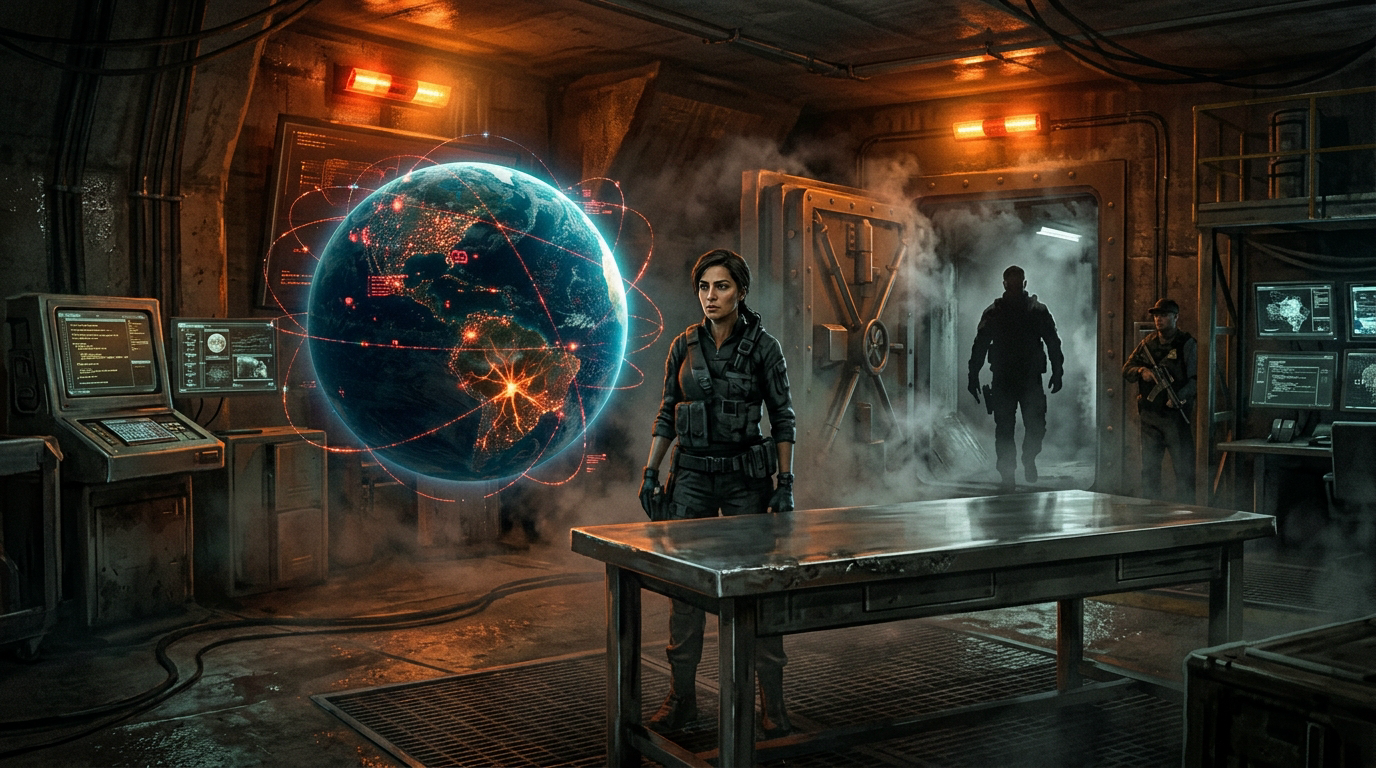
The DEEPWELL tactical terminal stalled, its old cooling fans winding up into a thin scream as Yara Haddad forced the query through hardware that had never been built to carry it.
She stood alone at the center of the subterranean briefing room while the containment-breach alarms swept amber light across the walls and back again. Dr. Daniel Cole had gone out through the heavy steel door twenty minutes ago and left her sealed in with the most powerful signals-intelligence array on the planet. Above the stainless-steel table the holographic Earth turned on its axis, bleeding red wherever forty-two million awakened experiencers had lit up the map.
The red had stopped holding her. It was the voids she kept coming back to.
Nothing in the NSA backbone made holes with corners like that. London, the Vatican, the Denver basin: three geometric absences, hard-edged as punch-outs. Terrestrial jamming arrays did that, pumping a dense electromagnetic fog up into the thermosphere to blind the orbital registry.
Her UNCAP flash drive ground its way through DEEPWELL's classified operational archives, the Convergence Index chewing on the structural footprint of the jamming signal, using its shape as a key. She ran it against her own linguistic models of the Watchers. The rogue sky-teachers who broke protocol, came down into the mud, and taught humanity metallurgy, the taking of ground, and the pleasure of its own reflection.
The terminal chirped. A single bright tone, thin enough to slip under the sirens.
The map lurched. The voids stayed dark, but the system drew what filled them. Thousands of feet beneath the bedrock of those three cities, crystalline architecture bloomed up through the projection, sprawling out along fault lines, its lower structures rooted straight down into the mantle for power.
"They didn't die in the flood," Yara said. Her breath ghosted white in front of her. "They just moved into the basement."
She reached for the Denver node, fingers hovering over the haptic interface, not steady. Extract the frequency of the jamming signal, push it back up to UNCAP, and the embargo stopped reading as geopolitical cowardice and started reading as what it was. A proxy war, fought over her species without her species being told.
Her fingertips never reached the glass. The primary magnetic locks fired at once, one flat concussive crack that went through the floor and into her knees.
She jerked backward. The steel door Cole had biometrically sealed behind him hissed outward on its pneumatic hinges.
A man walked into the strobing amber.
No tactical gear. A charcoal-gray suit, cut close, ridiculous down here among the cable trays and the grating. Late sixties, thick white hair, eyes a washed-out pale blue. He stood the way men stand in lobbies they own. The base klaxons were still screaming about a biological anomaly in Sector Four and his breathing hadn't changed for it.
Four armed DEEPWELL operators came in around him, rifles up, sweeping the corners.
He raised one hand, manicured, and didn't bother to look at them. He twitched his index finger.
The weapons came down. The operators stepped back through the doorway and the steel door hissed shut with all four of them on the far side of it.
He turned the pale eyes on Yara, and then on the projection lighting her face from below.
"It really is a beautiful piece of architecture." The voice was low and unhurried, built to be obeyed before it was understood. "Your Convergence Index, Dr. Haddad. When UNCAP first deployed it to parse the atmospheric broadcast, my analysts assured me it was a sophisticated academic toy. I told them they were underestimating human linguistics. Myth is never just a story. It's the scar tissue of contact."
Yara knew the face. Something cold pooled under her sternum and spread outward.
Elias Vance. On paper, Undersecretary of Defense for Special Technology. Off paper, Chairman of the Steering Group, the executive committee that had run the truth embargo since the first desert crash in 1947.
"You're jamming the registry." Her hands were shaking. Her voice came out level, which surprised her more than the door had. She pointed into the holes in the map. "The Architects came back to count the crop and you're blinding their telemetry. You're trying to hide us."
Vance came toward the table, his shoes clicking on the steel grating.
"Hide?" He smiled, thin, no blood in it. "No, Dr. Haddad. We aren't hiding. We're asserting a claim. Squatter's rights, drawn out over two hundred millennia."
He stopped at the table's edge and looked down into the glow of the buried installations.
"You're a brilliant woman." The blue of the jamming nodes moved on his face. "You stripped the cultural noise off and found the Watchers. The rogue faction that broke the embargo in deep prehistory. But your vocabulary still belongs to the mythology you study. Fallen angels. Rebels. You think they ruined a perfect garden."
"They armed us." Yara moved sideways, keeping the width of the table between them. "The Architects engineered us docile. Compliant biology. The Watchers came down and taught us to forge swords, taught us territorial dominance. They contaminated the project."
"They liberated the project," Vance said softly.
He looked up at her. Whatever sat behind his eyes was entirely at rest, and her forearms tightened into gooseflesh.
"Let me ask you something, Dr. Haddad, purely as a linguist. If the sky-teachers are remembered everywhere as beings of light, descending in chariots to bring order and geometry, then what is the universal symbol of the adversary? Every culture. Every continent. Every isolated tribe."
Yara swallowed. The models in her head aligned themselves without being asked. "The serpent."
"The serpent," Vance agreed. "The dragon in the cave. The feathered snake of Mesoamerica. The Naga of the Indus Valley. The great reptile in the Garden of Eden, holding out the forbidden fruit of knowledge. Every human being alive carries an inherited terror of the reptilian predator. Why do you suppose that is?"
"Because they were the faction that mutinied," Yara said. "The Incumbents."
"Because they were here first." His voice dropped, roughened, filled the space between them. "The Architects are absentee landlords. They seeded this planet, set a timer, and went back to the stars. The Grays are drones tending the greenhouse. But my patrons never left. They went down into the deep crust and they took title to the asset."
Yara stared at him while the shape of it assembled. The embargo had never been about public panic. At the apex of the structure, where men like Vance sat, the government worked for the tenants in the crust.
"Rule by influence," she said, quoting a theorem from her own Index back at him. "The serpent doesn't build the city. It hoards the wealth in the cave and lets the humans bleed for it."
"Exactly." The smile returned, and this one reached his eyes. "The Incumbents don't care about human spirituality, or genetic graduation, or whatever esoteric ascension the Architects planned for you. They see livestock. More to the point, they see their livestock. A proprietary resource."
"So you serve them." The words came up out of her tasting of metal. "You sold out your own species for a seat at the table."
"I secured our survival." The politeness slipped for half a second and something flat showed underneath it. "Do you have any idea what the Adjudication entails? The Mantids are in the thermosphere right now, preparing to grade humanity on a binary scale. Pass, and we're assimilated into their hive-mind architecture and our individuality is erased. Fail, and they sterilize the planet to clear the soil for the next planting."
He leaned across the table, pale eyes fixed on hers.
"My patrons offered a third option. If we can prove to the Adjudicators that the crop is irreparably feral, that humanity is too violent and too toxic and too deeply corrupted by Incumbent teaching to ever be integrated, then the Architects write us off. Failed experiment. They pack up the armada and leave, and we keep the Earth."
The cold under Yara's sternum went through her like water. The wars. The arsenals stacked up in silos. The planet stripped down toward bone. Not human nature at all, but a syllabus, taught patiently across thousands of years toward one outcome: a crop too poisonous to harvest.
"You built the embargo," she said. "DEEPWELL was never reverse-engineering the crashed ships to protect us. You hoarded the technology to keep the rest of humanity helpless and paranoid. You wanted us to look like savages when the makers came back."
"We cultivated a very specific aesthetic of hostility," Vance agreed.
"But the biological timers fired anyway." She jabbed a finger at the red on the map. "The roll call is happening. The Architects are registering the experiencer bloodlines right now. Your arrays can't cover the whole network. They'll pull their anchor nodes up to the ships and the Adjudication begins."
Vance didn't get angry. He looked pleased, and the pleasure closed her throat.
"You're entirely correct, Dr. Haddad. Our subterranean arrays cannot blind the entire planet. The orbital network is searching for the Bridge. The hybridized human bloodlines that carry enough alien architecture to stand as legal anchors for the Adjudication."
He reached out and tapped the haptic interface of her terminal.
"Which is why I allowed you to finish your work."
Her breath snagged. She looked down at the console.
Beneath her Convergence Index, a second process had been running the entire time. A DEEPWELL subroutine, riding piggyback on her UNCAP decryption keys, quiet as a tick.
He hadn't come down here to stop her from finding the Watchers. He had locked her in this room so that her uncorrupted mind would strip the noise off the telemetry, the one thing DEEPWELL's brute-force computers had failed to do in eighty years.
She had isolated the crystalline frequency of the alien registry.
"No." She lunged for the flash drive.
Vance caught her wrist. The strength in the hand was wrong for a man of his age, and his fingers closed until she could feel her own bones against each other.
With the other hand he swept the display. The globe dissolved. The red went out. The terminal rebuilt the data, filtering forty-two million awakened implants down to a single localized genetic signature.
The projection fell toward the eastern seaboard, past the major cities, down into a rural quadrant of New England.
A name assembled itself in amber above the coordinates.
TARGET NODE ISOLATED: SOKOL, LENA. SECONDARY NODE ALIGNMENT: SOKOL, THEO (JUVENILE). STATUS: ACTIVE. YIELD OPTIMAL.
Yara hauled against his grip. He didn't shift. He was reading the names, the data sliding across his eyes.
"The Adjudication requires a voice," Vance said, clinical now, the warmth gone out of the performance. "The Mantids operate on procedure they cannot break. They can't judge the species unless a representative of the Bridge, a fully awakened anchor, is present to speak for the localized biology. Sever the anchor and the legal mechanism of the harvest collapses. The Architects are forced to default."
"They're a family." She kicked at his shin, twisting her body toward the terminal. "You can't do this. You're going to murder a child to keep your power."
He released her so abruptly that she went backward into a secondary server rack, ribs first.
"I'm going to amputate a diseased limb to save the body."
He didn't look at her again. Out of the interior pocket of the charcoal suit came a heavy encrypted satellite communicator, the kind that punched through Site 7's shielding and straight into a terrestrial defense network DEEPWELL had kept running in secret since the Cold War.
He pressed one button.
"This is the Chairman. The linguist cracked the frequency. We have positive identification on the primary biological anchor. The target is Lena Sokol and her male child, currently aboard a localized low-altitude craft in the New England sector."
Yara shoved herself off the rack, running command syntax in her head, hunting for anything that would wipe the console. Vance had already locked it.
"Execute the asset denial." His voice came back at her off the cold steel. "Mobilize the Blackwood strike team. I want the transport shot down before it breaks the thermosphere. If they're already off-craft, burn the bloodline on the ground."
He paused, listening, his eyes narrowing a fraction.
"I don't care about collateral damage," he said, quietly, and what came up into his voice then was not a human thing wearing a human proxy so much as the proxy giving way. "End the Sokol line tonight."
Chapter 14 — Cousins
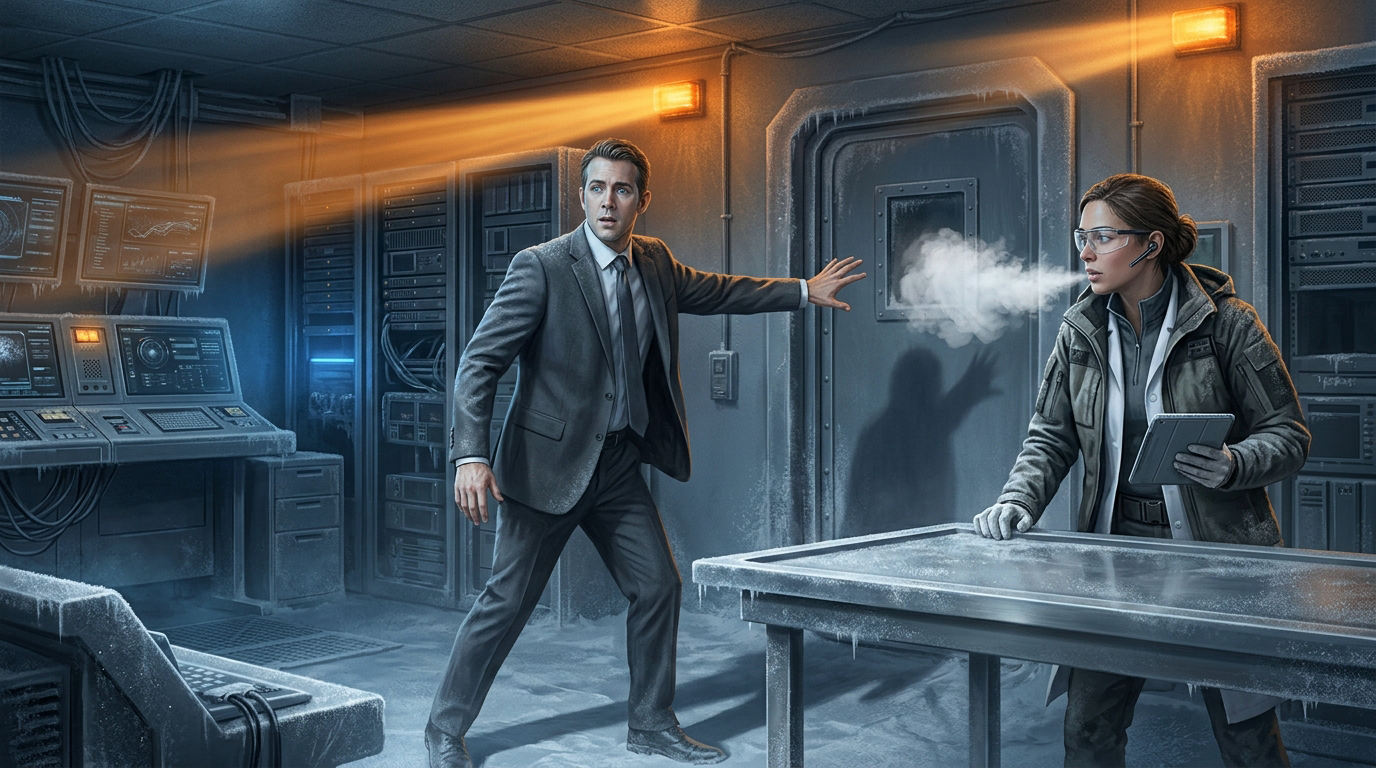
Elias Vance stood across the stainless-steel tactical table, and there was nothing behind his pale blue eyes but the certainty of a man who had sold out his species and filed it under salvation.
"The whole arc of human history is a custody dispute," he said. "My patrons intend to win it by proving the child is too feral to be saved."
He raised one hand toward the door, where four DEEPWELL operators waited on the other side of the pressure seal. He was going to have her detained. Take her Convergence Index, wipe the UNCAP servers, let the terrestrial jamming arrays blind the Architects' orbital registry until the Adjudicators wrote humanity off as a ruined crop.
Yara braced both hands on the console edge and went hunting for a lever. Some linguistic hook, some exploit in the man, anything that bought her a minute.
She didn't have to find one. Physics handed her one instead.
The temperature dropped so fast that her breath came out of her as white cloud. The klaxons, which had been hammering the bunker air, stretched into a low groan, warping down through octaves until they thinned out into nothing at all. Then silence. Complete, packed silence, the kind that has weight.
The amber emergency strobes stopped flashing. They simply held, throwing hard motionless shadows across the grating.
Yara blinked. Frost had gathered on her lashes. She looked at Vance.
He was paralyzed. Hand still lifted toward the door, lips parted around a breath he was no longer taking. A bead of saliva hung in the air halfway between his mouth and the collar of the charcoal suit, suspended there like an insect in resin.
Time hadn't stopped. Her own heartbeat was still going, slow and thick as syrup, and when she turned her head the air pushed back against her cheek like water. Something had leaned on the gravity in this room hard enough to pin Vance inside a single microsecond and leave her a narrow margin of freedom.
Do not be afraid, Dr. Haddad. The friction of the transition is disorienting, but it will not harm your cellular structure.
The voice arrived nowhere near her ears. It opened directly inside her auditory cortex, and it carried none of the geometric violence of the Gray telepathy documented in Cole's files. This was harmonic. A cathedral, a tuning fork set against the base of her skull. It was a language made out of grief, and the grief was a father's.
She forced her head around toward it.
A man was stepping out of the holographic Earth. He didn't materialize. He walked forward, out of a direction that hadn't been in the room a moment ago.
Seven feet, at least. His garment moved like poured mercury, shifting matte gray to pale silver in the frozen amber light. But his face was what raised the hair on her forearms.
He looked human. Bilateral symmetry, bipedal frame, keratinous hair, the melanin gradient of a Caucasian male. And he was flawless in a way that frightened her. Nothing in his features had been sanded by anything. No asymmetry in the jaw, no small scars of a life spent in weather, no predatory edge to the cheekbones. His hair was spun pale gold. His eyes were a washed-out luminous blue that carried a grief with a lot of age on it.
He looked like the angels in Renaissance frescoes with the wings taken off and the rest rendered to clinical tolerance.
He came to the tactical table and stood beside the statue of Elias Vance, looking down at the Undersecretary of Defense with pity and a trace of distaste.
"He is lying to you, Yara." The lips never moved. The translation simply happened. "Or rather, he tells you the truth his terrestrial masters permit him to believe. The Incumbents are masters of the useful fiction."
Her knuckles went white on the table edge. She was a cognitive linguist. She had spent a career sorting the taxonomy of myth, and her brain had already filed him into the Convergence Index before she could stop it.
"The warners," she said. Her voice came out thin in the frozen air. "The fair-haired messengers. The space brothers."
He gave her a slow, mournful nod. You recognize our footprint in your historical record.
"The fifties." Her analytical mind was running out ahead of her terror, the way it always did. "The contactees. Adamski in the California desert. Aeronautics engineers who claimed they met tall beautiful humans telling them to dismantle the arsenals. Everyone at UNCAP filed those as noise. Commercial fraud. Cult leaders projecting Cold War anxiety onto the sky."
They were not noise. He rested long fingers on the surface of the hologram. They were our desperate attempt to prepare you for the Adjudication. We bypassed your governments because your governments were already compromised by the serpents in the earth. We found ordinary men in the deserts. We asked them to stop the fires.
He swept his hand through the frozen projection. The subterranean Incumbent bases dissolved and the table threw up the Trinity test site instead, a bloom of nuclear fire opening across the New Mexico desert in three dimensions.
Your mythology records that the Watchers taught you metallurgy, the forging of swords, the cutting of roots. Regret ran under the tone like a low string. Nuclear fission was the ultimate expression of the Incumbents' curriculum. You did not merely invent a weapon in 1945. You signaled to the cosmos that the terrestrial mutation had reached its apex. The Architects required a biology capable of ascending. The Incumbents wanted a biology capable of dominating. When you split the atom, you proved to the universe that the Watchers had won.
Yara stared into the suspended atomic bloom. "And Vance thinks that's good news. He thinks if we prove we're hopeless, the Adjudicators write us off. They leave, and his patrons keep the planet."
That is the lie his masters feed him. The correction came softly. The Mantids do not abandon spoiled fields, Yara. They are impartial. They are meticulous. If humanity is graded a failed experiment, the Adjudicators will not leave you to the Incumbents. They will sterilize the biosphere down to the bedrock to clear the soil for the next planting.
Adrenaline went through the sluggish weight in her chest like a nail.
"Sterilization," she said. "An extinction-level event."
A harvest, he said. Followed by a burning of the chaff.
She looked up at him, at the symmetry of that face, at how close it sat to her own species. She thought about the Curator's history in the DEEPWELL files. The Grays coming down to splice heavy code into the native hominid, skipping a few million years of evolution to build a processor for the Architects' intent.
"You look exactly like us." She stepped back from the table, taking in the mercury-clad frame. "But your syntax. The way you project. There's no aggression anywhere in you. No predator. If we're the engineered species, what are you?"
Something moved in the pale blue eyes, an emotion so human that it ached in her chest to watch it.
We are the Cousins, he said. We were the first draft.
The bubble shuddered. A whine climbed until it buzzed in the fillings of her teeth. The amber strobe crawled a fraction of an inch sideways. Time was leaning on the door.
The Architects are gardeners, but they are not infallible. He was projecting faster now, the harmonics tightening. Seventy thousand of your orbits ago they modeled the perfect vessel. They built us. They gave us empathy, abstract mathematics, telepathic communion. And they built us too gentle. Nothing in us had ever been ground against anything. We lacked the chaotic spark of survival.
He turned his flawless hands upward, offering himself as the exhibit.
We were docile. Being docile, we could not raise ourselves. We stagnated inside our own perfection. The Architects saw their error. To reach the cognitive heights they wanted, the asset needed the crucible. It needed to be afraid of dying.
"So they shelved you." The scale of it dropped into place in her, all at once and sickening. "Put you in storage and went back to the hominid. Started over. Made us."
They gave you the spark, he agreed. And left you unattended. The Watchers in your deep crust seized on it. They fed your aggression until it turned cancerous. They weaponized the one trait the Architects hoped would save you.
Yara looked back at Vance, at the sneer preserved intact in his suspended microsecond. He thought this was chess. He was lobbying for the incinerator and didn't know it.
"If they sterilize us, his patrons burn too," she said. "The Incumbents live in the crust."
The Incumbents are parasites, he said. They believe they can survive it. They have burrowed deep enough to weather the fire the way they weathered the floods of your prehistory. They intend to wait out the Mantids and inherit the empty rock.
The air pressure spiked. The klaxons managed a stuttering shriek and froze again. The bubble was going.
"Then why tell me?" She moved closer to him. "If you know the rules of the Adjudication, if you know Vance is walking us into a trap, stop it. You have ships. You can freeze time inside a fortified military installation. Expose the Incumbents. Stand with us when the Mantids convene."
He looked down at her, and the sorrow in those eyes didn't deepen so much as split open on something underneath it that had no floor.
Our ships are not weapons, Yara. Our biology cannot harm. We cannot disable your military infrastructures, and we cannot silence the jamming arrays.
"Then testify." Her throat tore on it. "If you're our cousins, if you're the first draft of the same genome, claim a proxy. Tell the Adjudicators what the Incumbents did to us."
He shook his head. The movement was slow, and it cost him something.
We cannot advocate for you. We have no standing in the proceeding.
"Why not?"
To participate in the Adjudication, a species must be an active, recognized asset of the Program. The words closed in the hollow of her skull like a door in stone. Our project was closed. We were audited, Dr. Haddad. We were brought before the Mantids, and we were judged lacking.
The amber strobe ticked another fraction. The suspended droplet fell a millimeter nearer Vance's collar.
"You lost your vote," Yara whispered. Her face had gone cold.
We lost our world, he said. We are not from the Pleiades. We are not from Sirius. We are from Earth. We lost our custody trial seventy thousand years before you were born. We were evicted from the surface, rendered obsolete, replaced by you.
He stepped back and his edges began to give, the mercury of him blurring into the amber light.
We cannot save you, Yara. We are the ghosts they permitted to stay and watch. The Adjudication requires a human voice. You must break the embargo. You must drop the jamming arrays before the inventory closes. If you let Elias Vance speak for the clay, the fire will come for all of you.
The sheer-zone snapped.
Gravity hit her like a dropped weight. Air rammed into her lungs. The klaxons picked up their shriek exactly where they had left it.
"…feral to be saved," Vance finished, his hand completing its arc toward the door.
The pneumatic locks hissed and the steel slammed back into its housing. Four DEEPWELL operators flooded the room with rifles up, sweeping the corners.
Yara didn't move. The space beside the tactical table was empty. The frost had already gone off into the humid bunker air without leaving a mark.
Vance looked at her. His eyes narrowed a fraction as her stillness registered. He had expected panic. He had expected pleading, or the opening bid of a negotiation.
Yara Haddad looked back at the Undersecretary of Defense with the flat clarity of a woman who has just seen the floor plan of the slaughterhouse. She knew what the Incumbents were. She knew what the Architects had built her species to be. And she knew the benevolent gods of the 1950s could not save anyone, because those gods were already dead.
Humanity was on its own.
"Take Dr. Haddad to the holding cells in Sector Three," Vance told the guards, adjusting his cuffs. "And wipe the terminal. The Adjudication begins in five days, and we have a narrative to maintain."
Chapter 15 — The Curator's Confession
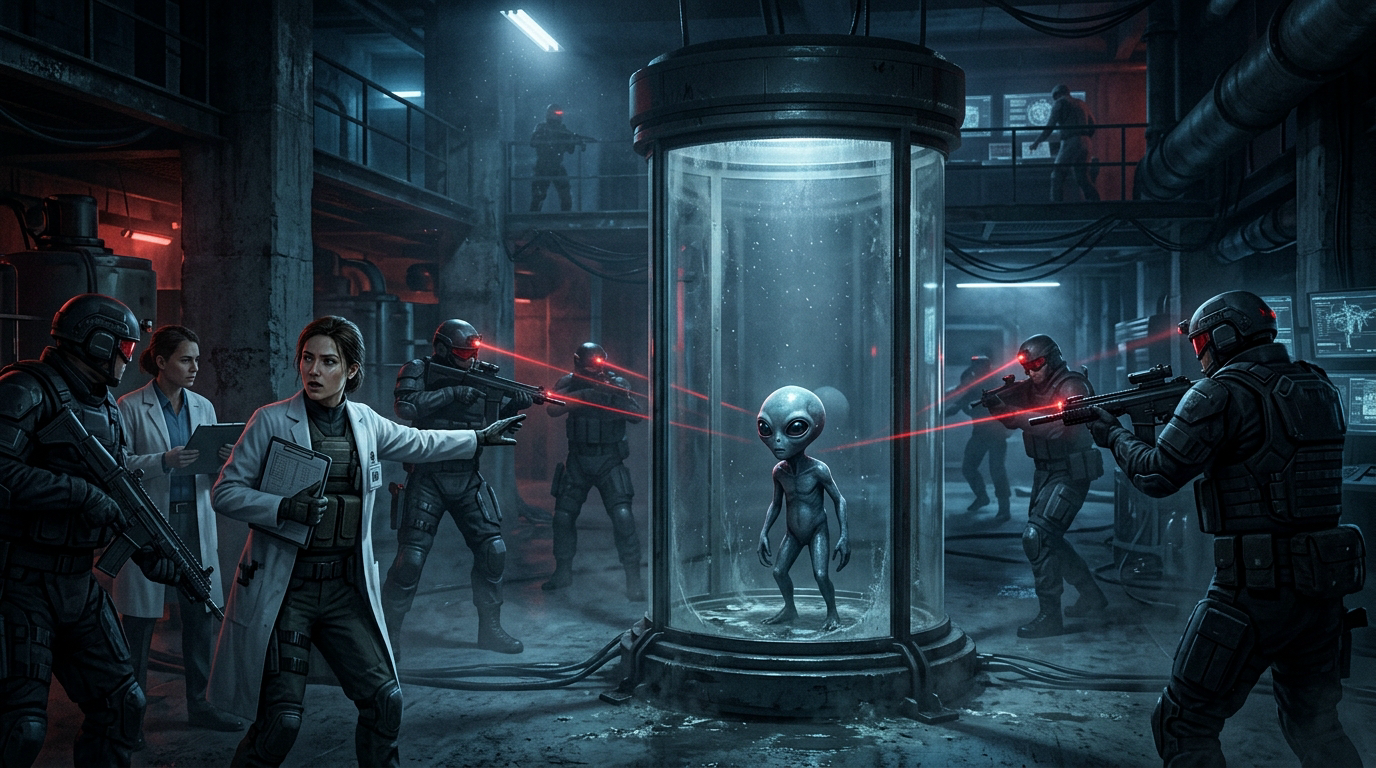
Dr. Daniel Cole ran the Sector Four access tunnel with his boots hammering the steel grating out of rhythm, twice catching, never quite falling. The klaxons had been engineered to be unbearable. They worked. He had left Yara locked in the briefing room and the guilt of it sat in his gut like a swallowed coal, but DEEPWELL's layout made the call for him. The briefing room was a signals hub. Sector Four was a cage.
And the thing in the cage was awake.
He swiped his badge at the final blast door. Pneumatic servos hissed and dragged the yard-thick steel aside.
Twelve tactical operators had stacked themselves in a perimeter around the observation glass, matte-black armor, kinetic pacification rifles up, no one moving and everyone about to. Their targeting lasers cut red lines through the dust hanging in the cold air.
"Stand down!" Cole's voice broke on the second word. He shoved past a corporal. "Lower your weapons. All of you."
"Director Cole, back away." The squad leader kept his eyes on the glass. "The biologic is mobile. Containment is compromised."
Cole looked at the borosilicate cylinder in the middle of the chamber. Containment was fine. The glass was whole, the atmospheric seals ran green down the panel. Only the occupant had changed.
For forty years the entity the staff called the Curator had hung suspended in hyper-oxygenated stasis gel, a body recovered from a desert debris field in 1947. Even when the 3:33 a.m. roll call fired, it had opened its eyes only long enough to push one word into Cole's head before sinking back under.
The gel had drained. The Curator was standing.
Four feet of it, upright and unsupported on thin digitigrade legs. Its skin took the overhead light and gave nothing back, wet slate under a work lamp. The cranium bulged to house an architecture that had left the mammalian cortex behind a long time ago. The eyes were what emptied Cole's lungs. Black, enormous, wrapping around the sides of the skull. Not organs for gathering light. Organs for taking in reality at a width that reduced human sight to squinting through a keyhole.
"If it wanted through the glass, it wouldn't use its hands." Cole pushed the squad leader's barrel toward the floor and dropped his voice. "If it wanted us dead, our cerebral fluid would be boiling out of our ears already. Step back."
He walked to the glass and set his open palm against it. The cold came through his skin like a burn.
Inside, the Curator turned its head. No weight shifted. No hip pivoted. The skull simply arrived in alignment with him, frictionless, a gimbal finding its mark.
It had no apparatus for human phonetics and did not try. The pressure in the room dropped instead, and something with corners settled in behind Cole's eyes.
Daniel Cole. Custodian.
Not sound. Structure, shoved into his prefrontal cortex, a sheet of cold copper sliding in behind his sinuses. Cole caught the rail along the glass. The chamber swam. Blood ran bright from his left nostril and he let it.
"I'm here." He swallowed against the nausea. "When the timer went off you told me you were late. Did you trigger the jamming signal in the thermosphere?"
I am not the architect of the static. I am the machinery. I told you I was late. I was calculating the planetary rotation incorrectly from within the suspension gel. I am not late. The inventory has commenced on schedule.
Cole wiped his lip. His hand came away red to the wrist bone. "The inventory. You keep saying that. You've parked an armada over every capital on Earth, you've woken up millions of people in the middle of the night, and you call it an inventory. What are you? Are you the ones who made us?"
Nothing in the creature moved, but the weight in his head changed quality. A correction, delivered the way a technician corrects a form.
We are not the Architects. We do not write the code. We execute it.
"You're the staff," Cole said, and forty years of DEEPWELL's scattered taxonomy dropped into a single column. The tall luminous ones from the myths, descending in light to teach and to build. Those were the Architects. The small gray ones from the crash retrievals, the ones who took people out of their beds, who worked the surgical tables and the hybridization programs. Never the masters. The labor.
We are the Engineers. We tend the soil. We prune the branches. We ensure the crop grows toward the specified architecture.
"Then why the abductions?" He stepped in closer to the glass, and behind him the tactical team started saying his name. He ignored it. "If you're the gardeners, why the terror? Why take families, generation after generation, why paralyze them in their own beds? Lena Sokol. Four generations of her bloodline, harvested in the dark. What do you need us for?"
The black eyes drank what light the room had. The copper pressure thickened, and it carried something Cole had never once considered he might receive from an extraterrestrial biologic. Tiredness. The systemic, bone-deep kind.
Look at my vessel, Daniel Cole.
He looked. Without the gel to distort it, the body was pitiful. The limbs were thin past the point of function, the joints swollen at every hinge. Dark mottling spread across the slate skin where the cells had given up. Nothing about the creature suggested vitality. Only endurance, running on.
We were built for function, not propagation. The Architects engineered our sequence for absolute cognitive efficiency. We do not divide by passion. We divide by replication. But biology is not meant to be a closed loop. Without the friction of evolution, without the chaotic variance of random mutation, a sequence becomes brittle. A copy of a copy of a copy, repeated across two hundred thousand of your orbital cycles.
Something turned over in Cole's chest. All those years of the abduction record and the one question nobody could answer: why they always wanted the same thing. Ova. Sperm. Tissue.
"You're dying," Cole said.
We are degrading. Our genome is failing under the weight of its own repetition. We lack the chaotic vitality that the Architects infused into the local hominids.
"Us." His voice had gone to almost nothing. "You used us."
You are the fertile soil. You were infused with the heavy code. Your biology possesses the robust, violent resilience that ours has lost. The extraction protocols, what you call abductions, were not arbitrary. They were a sanctioned maintenance procedure. We harvested the wild clay of your genome, stabilized it, and grafted it onto our own failing branches to renew our lines.
Cole stood there with his hand on the freezing rail and let it come. The whole twentieth century of it. The missing hours on lonely highways. The clinical examinations in rooms with no corners. The hybrid children held up to weeping mothers like receipts. Nobody had been studying anything. Nobody had been invading anything.
It was a blood transfusion. Eighty years of one.
"You didn't come here to study us," he said, and his voice shook with something he couldn't sort into rage or disgust. "You're a dying workforce using us for spare parts to keep your engines turning while you wait for your bosses to come home."
We used the surplus. We never depleted the core stock. We maintained the bloodlines with absolute precision. We ensured that the intended crop, the Bridge, was ready for the Adjudication. The survival of the staff is written into the protocols of the farm.
"Survival." Cole threw a hand at the reinforced bunker around them. "If you're so precise, why are you in a cage? July 1947. You came down in the desert. The military found your craft, found your bodies. If this was a sanctioned high-tech harvest, how did a handful of men with radar and anti-aircraft batteries put you in the sand?"
The temperature in the chamber dropped. Cole's breath went white in front of him.
The Curator took one step forward, slow enough to watch each joint negotiate it, and brought its face within an inch of the glass. The weight in Cole's mind stopped being a conversation. It became a vise.
Your premise is structurally flawed, Daniel Cole. We were not shot out of the sky.
Cole's jaw locked against the pain. "The crash retrieval. This whole facility was founded on that debris. We pulled you out of a crater."
There was no crater. The descent was navigated. The location was chosen. The coordinates were broadcast in advance. It was not a crash.
The words sat in his skull and began, patiently, to move the furniture.
It was a scheduled summit.
Cole took his head in both hands. His knees went soft and he locked them. "A summit. With who?"
With the alphas of your species. The military architecture you call the Steering Group. The humans who had just demonstrated the capacity to split the atom, signaling that the biological experiment had reached a volatile threshold.
"You met with them." Not a cover-up of a discovery, then. A cover-up of an alliance, and he could see the shape of it now, the whole eighty-year architecture of the lie.
We offered a transaction. The cold logic came without any give in it at all. The Architects' return was still decades away, and our genome was critically unstable. We required an immediate, massive influx of biological material to secure our survival until the Adjudication. We offered your leaders the geometry of flight. Exotic propulsion. The super-heavy isotopes required to manipulate localized gravity. Technology that would grant your faction absolute supremacy over your tribal rivals.
The Curator laid its three-fingered hand on the glass, on the exact spot where Cole's palm had been.
In exchange, we required an unimpeded harvest. A sanctioned, agreed-upon quota of human biological material, drawn from specific generational lines, without interference from your military.
The floor went out from under him. The truth embargo had never been about sparing the public the shock of company in the universe. It was about hiding what had been signed. A government had leased out the bodies of the people it governed, and taken delivery in engine schematics.
"My god," Cole said. "They gave you a hunting license."
They signed the treaty. But they were already compromised.
The black eyes bored through his skull and pinned whatever was behind it to the far wall.
Your leaders were influenced by the Incumbents. The terrestrial serpents who live in the crust. The faction that wishes to see humanity fail the test. The Incumbents whispered into the ears of your generals. They told them that if they possessed our technology, they would not need to honor the quota. They could take the tools and repel the staff.
The hand came down off the glass.
The treaty was broken before the ink was dry. Your leaders lured the harvest craft into atmospheric traps. They used the high-powered radar frequencies we had taught them to scramble our navigation arrays, causing the craft to plummet. They killed the staff, reverse-engineered the wreckage, and built this facility to hoard the technology.
Cole looked around the chamber, at the cost of it, all that concrete and money poured out to cage a being that had come down to negotiate a horrible, necessary trade.
"You've been a prisoner of war for eighty years," he said quietly.
The Curator turned from the glass and walked back to the center of the chamber.
I am not a prisoner, Daniel Cole. I am the anchor.
"The anchor?"
When the treaty was broken, we ceased physical operations. We retreated to the thermosphere. But the harvest had to continue. The timer was counting down. We needed a biological node firmly planted in the deepest, most secure terrestrial architecture your leaders possessed. A transceiver, connected to the terrestrial bedrock, to maintain the telepathic grid for the nocturnal extractions.
The cold in Cole's hands had nothing to do with the glass now.
Nobody had captured it. It had walked into the trap and lain down in the gel, and it had spent forty years inside the most fortified bunker on the planet running the psychic switchboard for every abduction on Earth. DEEPWELL's own geography had been the asset. They hadn't imprisoned a god. They had plugged in a router and built a fortress around it to keep it safe.
You did not contain me, the Curator projected, and the signal widened until the glass itself hummed at the molecular level. You protected me. And now, the count is complete. The quota is met. The Architects have returned to judge what you have become.
At the far end of the anteroom the steel door buckled inward. The operators spun, weapons coming up, and the pneumatic locks began to scream against a pressure that had no source and no answer.
The harvest is over, Custodian, the Curator said, turning those black eyes back to Cole as the door started to tear off its hinges. The Adjudication has arrived.
Chapter 16 — Sirius and the Fish-Teachers
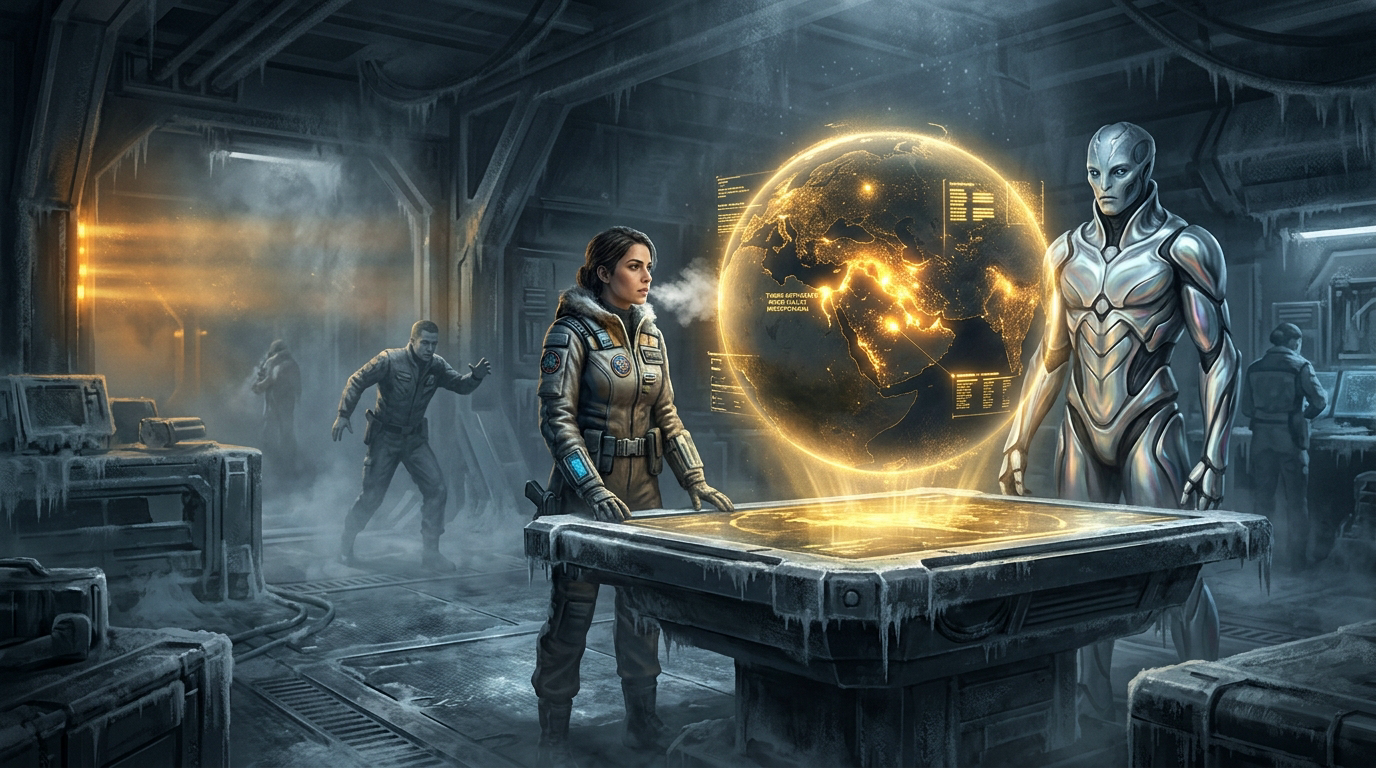
The temporal shear-zone held the DEEPWELL briefing room the way resin holds an insect. Amber light from the emergency strobes hung in the air without moving, thick and yellow as old varnish. Across the tactical table, Elias Vance stood with one hand raised and his mouth open on the first syllable of the order that would end Yara's life.
Beside her, the Envoy of the Cousins bent toward the holographic interface. Seven feet of flawless symmetry, wrapped in a material that poured like woven mercury, and he set his long pale fingers on the projection the way a man might quiet a page in the wind.
The serpents teach by hoarding, the Envoy projected. The voice arrived inside her skull, harmonic and sorrowful, resonating against her auditory cortex without troubling her ears at all. They dwell in the crust and demand tribute. But we taught by giving. We tried to prepare you for the Adjudicators. We tried to elevate the asset.
He swept his hand through the frozen bloom of the Trinity test. The column came apart into a cascade of raw, unformatted data.
You are a linguist, Dr. Haddad. You have built a Convergence Index to map the footprint of the makers. Look at the board. Tell me what you see.
The holographic Earth swelled until it filled the freezing air between them. Modern borders peeled away. The map rolled backward through the millennia, continents sliding a degree here and a degree there, coastlines swelling and drawing back like something breathing in its sleep. Gold bloomed across the dark topography, node after node, all of them pulsing on one shared beat.
Yara gripped the edge of the steel table. Her breath came out white. The localized gravity dragged at the bottom of her lungs and made each inhale a small piece of labor, and underneath all of it her mind was already sorting, dropping every node into the taxonomy she had spent her entire academic career building.
"The Uplift Age," she said.
Read the syllabus. The instruction carried no more weight than a hand under her elbow.
Her finger shook when she pointed at the dense knot of gold over ancient Mesopotamia. "Eridu. The Apkallu. The Sumerian texts say amphibious sages, men in the shape of fish, walked out of the Persian Gulf. They brought mathematics. Agriculture. Civic law. Then they went back into the water at night."
Our atmospheric transit craft required high-density liquid cooling jackets to bleed the heat of entry, the Envoy said, his pale blue eyes tracking the node. We submerged the vessels. When we came out to teach, your ancestors read the ribbed pressure suits as scales. We did not correct them. Awe is an efficient mnemonic for a primitive biology.
Yara's gaze went west across the projected Atlantic, to where the gold burned over the Yucatan and the Peruvian highlands.
"The feathered serpents." Her voice went thin and quick, the way it did when a translation finally opened under her hands. "Quetzalcoatl. Kukulkán. Viracocha. They didn't only take worship. They handed over the calendar. They handed over the rules of architecture."
We wore the serpent to take the Incumbents' authority away from them, the Envoy said. The woven mercury at his shoulder rippled and threw the map's light back at itself. We meant to write over their trauma. The reptile was to mean the teacher in the sky and not the thing in the cave. The translation failed. You welded the two together instead.
"And the Dogon." Yara found the node in West Africa. "The priests in Mali. They built a whole cosmology around the orbital mechanics of Sirius B, a dwarf star so dense and so dim that no unaided human eye has ever found it. They had its mass. They had its fifty-year elliptical orbit, thousands of years before anybody ground a lens."
We showed them the stellar cartography of the Architects. We wanted you to know you lived in a neighborhood. We wanted you to understand the size of the estate you were meant to inherit.
Yara stepped back from the table. The Convergence Rule was proving itself out in the air in front of her at a scale she had never once put in print. A dozen isolated peoples, oceans and millennia apart, handed the same coursework in the same order.
A curriculum.
"Vimanas," she said. "Ezekiel's wheel inside a wheel. You didn't just give us agriculture. You gave us the blueprints for the architecture. You ran a standardized planetary syllabus."
It was a school. Grief came through the harmonic and thickened it. We gave you the tools to build a society of consent, to raise your cognitive architecture before the Adjudicators returned to grade the harvest. The Incumbents countered us. They whispered into the ears of your kings. They took the metallurgy we taught you and sharpened it. We gave you the plow; they showed you how to beat it into a blade. We gave you the mathematics of the stars; they used it to work out the ballistics of your missiles.
The bunker groaned around them. The shear-zone shuddered, and a whine climbed out of the floor until it sat humming in the fillings of Yara's teeth. The bead of saliva suspended in front of Vance's open mouth sank a fraction of a millimeter. The amber strobe twitched.
Time was coming back.
I cannot hold the friction. The symmetry of the Envoy's face pulled taut. The Adjudicators are already awake in the thermosphere. The Mantids do not care about our failed curriculum. They care about the harvest. Find the Custodian. Secure the Bridge.
"Wait." She reached toward him, toward all that towering shimmer. "What do we do? If they grade us right now, we fail. The Incumbents made sure we'd fail."
Use the rules of the makers against them. His form was going, unspooling upward into a column of pale light. We cannot lie. But you. You are wonderfully, terrifyingly feral.
Then nothing where he had been.
The silence broke apart. Klaxons slammed into her eardrums, and the localized gravity let go all at once and threw her weight forward into the edge of the table.
"—take her!" Vance finished, his voice cracking like a whip.
The four DEEPWELL tactical operators came through the door with their rifles up, red laser sights cutting arcs through the settling air.
Yara did not go for the door. She went across the table on her hip, over the steel, and brought her palm down on the manual override panel set into the server rack.
"Initiate Halon purge!" she shouted into the biometric receiver. "Authorization Haddad-UNCAP!"
Her clearance was high enough that the system never asked twice.
Charges blew the caps off the ceiling vents and the suppressant came down in a white concussive wall. The temperature dropped. The gas took the oxygen with it, heavy, tasting of struck metal. Vance gagged with both hands at his collar and the fog closed over him. The operators shouted at each other from somewhere inside it, their lasers smearing into nothing at all. One of them fired a three-round burst into the ceiling, and the muzzle flashes lit the churn from within, three times, like heat lightning in a cloud.
Yara ripped the UNCAP flash drive out of the terminal port and dropped, hands and knees, under the table, into the thin seam of breathable air along the floor.
She crossed the grating on her forearms and skinned both elbows doing it, navigating by memory. Hours ago, walking into the room, she had indexed the sub-floor maintenance hatch by the southern bulkhead without meaning to. The habit had never once been useful before.
Her fingers closed on the iron ring. She hauled the hatch up and swung her legs into the dark just as a boot came down on the grating inches from her head.
She pulled the hatch shut behind her and threw the interior latch. The alarms went distant, then nearly gone. She lay in the black with her cheek on cold steel, coughing hard enough to bring tears, the halon burning a stripe the length of her throat.
Then she got up onto her hands and knees and crawled. DEEPWELL's secondary infrastructure ran as a labyrinth, and she took her bearings off the geothermal turbines, the rhythm of them coming up through the metal into her palms. Ozone. Old dust. The sharp tang of hot copper.
Ten minutes later she kicked out a ventilation grate and spilled onto the concrete of a service corridor in Sector Four.
Red emergency lighting strobed here, throwing shadows down the curve of the hall and hauling them back.
A shadow came at her fast.
Yara scrambled backward and got the heavy UNCAP tablet up over her head like a brick.
"Yara!"
Hands closed on her shoulders and pulled her upright. Cole. Grease down the front of his lab coat, his eyes wide and set too deep in his face. A thin line of dried blood ran from his left nostril to his chin, and he had not wiped it away.
"How did you get out of the briefing room?" He was looking past her, up the corridor, then back. "Vance locked you in. Internal comms are calling it a localized chemical fire."
"Time stopped." Her voice came out scraped raw. She put her back against the concrete and held the flash drive against her sternum. It sounded insane. She said it flatly, the way she would have read out a lab result. "The Cousins. The Nordics, from the contactee lore. One of them was in the room, Daniel. He froze Vance."
Cole didn't blink. He didn't scoff. Whatever he had been through in the last hour had widened the walls permanently.
He tipped his head back down the hall, toward the blast doors of the containment wing. "The Curator," he said, and the word shook. "It's awake. It spoke to me."
Yara looked at the blood on his lip. "What did it say?"
"The truth about the abductions." He dragged a hand through his hair and it trembled the whole way. "They aren't gods, Yara. They aren't the masters. The Grays are staff. Biological drones the Architects built, and their genome is coming apart under them. They don't have the chaotic vitality that got spliced into us. So they've been using our bloodlines as spare parts. The hybrid presentations, the missing time, all of it. A transfusion protocol. Vampires keeping the engines turning until the owners come home."
Yara shut her eyes and let the size of it settle onto her shoulders.
The Grays were dying middle management, harvesting the crop to stay alive. The Incumbents were terrestrial squatters trying to burn the house down so they could hold the deed to the ashes. The Cousins were a failed first draft, desperate to pass notes to the current class before the final exam.
"The owners," she said, and opened her eyes. The drive sat heavy in her palm. "The Architects."
She pulled the UNCAP field tablet out of her jacket and got the drive into the port on the second try. The screen came up and threw hard blue light across both their faces in the dim red hallway.
"What do you have?" Cole leaned over her shoulder.
"The syllabus." She kept her voice down. "The Cousins didn't only teach us mathematics and agriculture. They taught us time. Every myth I cross-referenced in Vance's system, the Dogon, the Sumerians, the Mesoamericans, they all close on the identical promise. The sky-teacher departs. The sky-teacher swears to return."
"We knew that." Cole's brow drew in. "That's the cultural timer. Seeded so we'd recognize them when the roll call fired."
"I never looked at how they promised it." Her thumbs moved across the glass, running the algorithms she had decoded while the room stood frozen. "I filed the dates under mythology. The Mayan Long Count. The Hindu Yugas. The Dogon Sirius cycles. Spiritual metaphors for the cyclical nature of human eras."
She brought the solar system up in three dimensions and laid the ancient calendars over it, feeding the raw mathematical constants out of the myths into the orbital physics engine.
"They aren't metaphors, Daniel." Her voice went hollow. "The Cousins couldn't lie. They didn't give us poetry. They gave us the actual math."
The rings of data turned on the screen. The engine drew in the precessional wobble of the Earth, the transit of the Sirius binary, the orbital cycles of the inner planets, the numeric constants buried in the texts, and one after another the circles came around and locked.
A single unified geometric alignment. One celestial intersection, agreed upon by a dozen cultures with oceans and thousands of years between them.
Yara stared at the output until the blood went out of her face and left her skin as pale as the Envoy's.
"It's not a prophecy," she said. Her lungs would not take air. "It's a schedule."
She turned the tablet so Cole could see the red alphanumeric string glowing along the bottom.
"Every culture on Earth put down the same intersection for the return of the Architects. None of them was warning us they might come back. Every one of them was giving us the appointment."
Cole read the date the Convergence Index had rendered. The muscle at his jaw stood out and stayed out.
"That's not next year," he said.
"No." Yara looked away, down the dark strobing throat of the corridor. "It's exactly seven days from now."
Chapter 17 — The Adjudicator
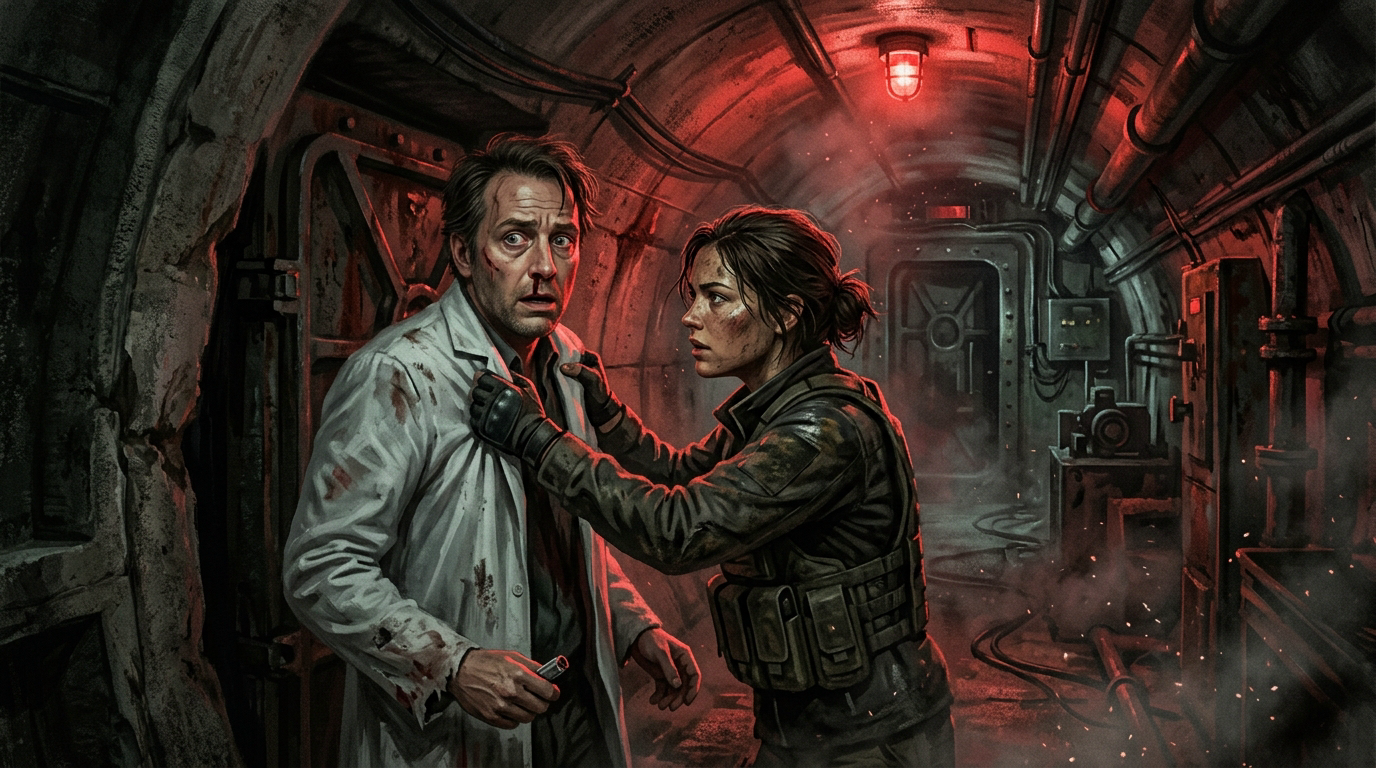
The shadow at the end of the Sector Four service corridor didn't raise a weapon. It swayed on its feet and staggered into the strobing red wash of the emergency lights, one hand trailing along the wall to stay upright.
Dr. Daniel Cole looked like he'd walked out of a car wreck: blood dried in a thin line from his left nostril to his chin, his eyes wide and glassy, fixed on nothing in the corridor at all, not even her.
Yara pushed off the cold concrete, palms scraping grit, lungs still raw from the halon gas billowing through the upper levels. She wiped gray dust from her mouth. "Cole."
"They're not the masters," Cole said — no hello, no confirmation she wasn't armed, just words pouring out of him. "The Grays. The Curator. They're just the farmhands, Yara. A brittle, dying genome, and they've been using us as a parts bin to keep their own engines running. The abductions weren't science. They were maintenance."
Yara crossed to him and grabbed the shoulders of his lab coat. "Listen to me. The Envoy from the Cousins just froze the briefing room. Vance is compromised. The Undersecretary is a proxy for the Incumbents. They want to weaponize the disclosure, prove to the Architects we're feral."
Cole's eyes snapped into focus. "1947. The crash. The Curator said they weren't shot down — it was a delivery. A test, to see what we'd do with the technology. Vance's predecessors hid it to build better guns instead. The Incumbents rigged the curriculum."
Yara's breath went thin. "And the Envoy said the Adjudicators are already in the thermosphere. They're here to grade the harvest. We have seven days to secure the Bridge. If we fail, they don't just leave. They sterilize the biosphere down to the bedrock."
"Then we need to get to the UNCAP servers," Cole said, voice dropping to a rasp. "Override Vance's lockdown, broadcast the Index. Prove we know the rules."
"You will not need to broadcast," a voice said.
Not spoken. Not an echo off Sector Four's curved concrete. Nothing like the Curator's telepathy, that crush of structural weight, or the Nordic Envoy's low, mournful hum. This came in like a scalpel dipped in absolute zero.
The thing built itself out of fractal mathematics, endless and precise, and pinned Yara's mind to a corkboard in one motion, without asking permission. The strobing red lights ceased to exist. The concrete floor evaporated.
Temperature stopped meaning anything. The hum of DEEPWELL's turbines gave way to a clicking, a billion chitinous mandibles rubbing together in the same rhythm.
Yara gasped. Her vision whited out, and when it cleared, the subterranean hallway was gone.
She stood in a room with no corners.
Floor, walls, ceiling: one seamless curve of white so bright it looked like polished bone, curved without a single seam to rest the eye on. The space was vast, an amphitheater built for something clinical.
Cole stood beside her, hands raised, knuckles white, breath coming fast through his teeth.
Ten feet away stood a woman who didn't belong in DEEPWELL: gray sweater, pajama pants, bare feet on the glowing floor. One arm locked around the shoulders of a seven-year-old boy in a faded superhero t-shirt.
Yara knew her from the UNCAP experiencer files. Lena Sokol. Fourth-generation carrier. Mother of the Bridge.
Lena trembled, chest heaving, but she wasn't looking at Yara or Cole. She was staring at the center of the room. Theo wasn't trembling at all. He stood still, eyes wide and black, gazing up with a calm that had no business on a seven-year-old's face.
Yara followed their gaze.
The thing waiting in the center of the light stood at least eight feet tall, upright on two legs, the only thing about it that belonged to the mammal world. A segmented exoskeleton the color of bruised obsidian sheathed its body, catching a sick green light with every shift. Its limbs ran too long, folding at angles no human joint could survive.
Its head was an inverted triangle, and the compound eyes dominating it weren't the flat black of the Grays'. Fractured, crystalline, they threw the humans back at themselves in a thousand small, warped pieces, none of them whole.
The Adjudicator.
Your physical vessels remain at their respective terrestrial coordinates, the voice dissected their minds, arriving in all three at once. This is a synchronized cognitive projection. I have networked your synapses to eliminate the biological friction of deceit. You are the variables.
The intimacy of it was obscene. Cole's exhaustion bled into her mouth, metallic and dry. Lena Sokol's terror hit next, white-hot and blinding, a mother's fear magnified past anything Yara's own body had produced. The Mantid hadn't just brought them into its courtroom. It had wired them into a single composite witness.
"You," Lena whispered. Her voice echoed in the white space, thick with a trauma that spanned four generations. "You were there. In the dark."
The Adjudicator's head swiveled toward her, chitinous joints grinding like continents shifting underground.
Specify the data point, the Mantid commanded.
Lena squeezed her son's shoulder, fingernails biting into his shirt. "Every time they took me. Every time the small ones came into my room and dragged me out of my bed. When they put me on the curved table. When they used the long needles to take my eggs. You were always standing in the corner."
Tears slid over Lena's lashes; she didn't blink. Whatever her mind had built to survive this was burning off now, memory by memory, in the thing's presence.
"My brain told me you were a doctor," Lena said, voice cracking. "A tall human doctor in a white lab coat, standing in the shadows with a clipboard. But you never spoke. You never helped me. You just watched them cut me."
The application of a human archetype to my geometry was a defense mechanism, initiated by your own primitive cortex, the Adjudicator projected. A complete sensory apprehension of my form would have produced catastrophic psychological rupture. It would have spoiled the yield.
"You let them torture her," Cole said, stepping forward, whatever clinical distance he had left now gone. "You're the overseers. You run the Program. If you're the management, why did you let the Engineers butcher the asset?"
The eyes locked onto Cole. The temperature in Yara's mind dropped another ten degrees.
The Engineers are dying machinery, Daniel Cole. They require the wild vitality of your genome to repair their failing sequences. We permitted the extraction because it was necessary to maintain the workforce. But we do not butcher. We regulate.
The Mantid unfolded its front limbs, revealing jagged, scythe-like appendages tucked beneath its thorax.
Left unsupervised, the Engineers prioritize their own genetic continuity over the architectural integrity of the intended crop. I stood in the corner of the examination room to enforce the parameters. I was there to ensure they did not harvest more tissue than your biology could regenerate. I was there to preserve the bloodline until the Bridge could be synthesized.
It clicked into place for Yara, the scale of it: not rogue science, but agriculture with a paper trail. The Grays did the cutting. The Mantids inspected the livestock and made sure it survived to breed again.
"You don't care about us," Yara said, voice trembling. "You don't care about our art, or our capacity for love, or our philosophy. You're just grading a crop."
Art is a byproduct of biological boredom, the Adjudicator said, unbothered. Love is a chemical incentive for genetic propagation. Philosophy is the noise a processor makes when it lacks sufficient data. We care only about the architecture of your consciousness. Can you hold the truth? Can you ascend without consuming yourselves in the friction of your own violence?
"We were sabotaged!" Yara shouted, the linguist in her hunting for the one phrase that might still save them. "The Envoy of the Cousins showed me the curriculum. They tried to uplift us, but the Incumbents fed us the metallurgy of war. They buried the technology. They bought off our leaders. If you judge humanity by our history, you're judging an asset your own rival factions deliberately corrupted!"
The Mantid's mandibles clicked in a fast, ugly staccato.
We are aware of the Incumbents' territorial claim. We are aware of the Cousins' unsanctioned tutoring. The variables of their interference were calculated into the syllabus. A crop that cannot outgrow the weeds is not a crop worth harvesting.
"Then give us a fair trial," Cole pleaded, stepping up beside Yara. His guilt came through the link raw and unfiltered, a man who'd spent his life guarding the secrets now killing his species. "The Envoy said the Adjudication is scheduled. We have seven days. Let me dismantle DEEPWELL. Let Dr. Haddad present the Convergence Index to the UN. Let us show you what we can be once the embargo is broken."
The Mantid didn't look at Cole. It didn't look at Yara. The fractured eyes dropped instead to the boy standing at Lena's side.
Theo stared back and didn't flinch, pupils swallowing the iris, mirroring the room's white light. Through the link, no fear came off him at all, just a stillness too old, too manufactured, to belong to a seven-year-old boy.
The Envoy is a flawed prototype, the Adjudicator said, its voice narrowing to a point. It views the universe through the lens of tragic poetry. It believes in the theater of the courtroom. But there is no poetry in agriculture, and there is no theater in the harvest. There is only yield.
Lena pulled Theo tighter against her hip. "What does that mean? What are you going to do to my son?"
We are going to measure him. As we are measuring you.
The Adjudicator raised one scythed limb, pointing not at Theo but at the empty white space overhead.
You demand a fair trial. You request seven terrestrial rotations to prepare your defense. You misinterpret the mechanics of the Adjudication. A trial implies a future coordinate where evidence is presented. But you are not defendants stepping into a courtroom.
The white walls of the amphitheater began to crack like eggshells, fine lines spidering across the curve, and DEEPWELL's strobing red light bled back through the fissures, sirens screaming somewhere underneath it all.
The Adjudication commenced the moment the Roll Call fired in your atmosphere, the Mantid's voice boomed, no longer a scalpel but something with the weight of a planet behind it. Every panic you indulge, every secret you hoard, every violent reflex you exhibit is being indexed, now. The seven days is not the preparation for the verdict.
The entity's compound eyes fractured the image of the humans into a thousand doomed reflections.
The seven days is the execution of it. You are not waiting for the test to begin, Dr. Haddad. You are currently failing it.
Chapter 18 — The Embargo Breaks
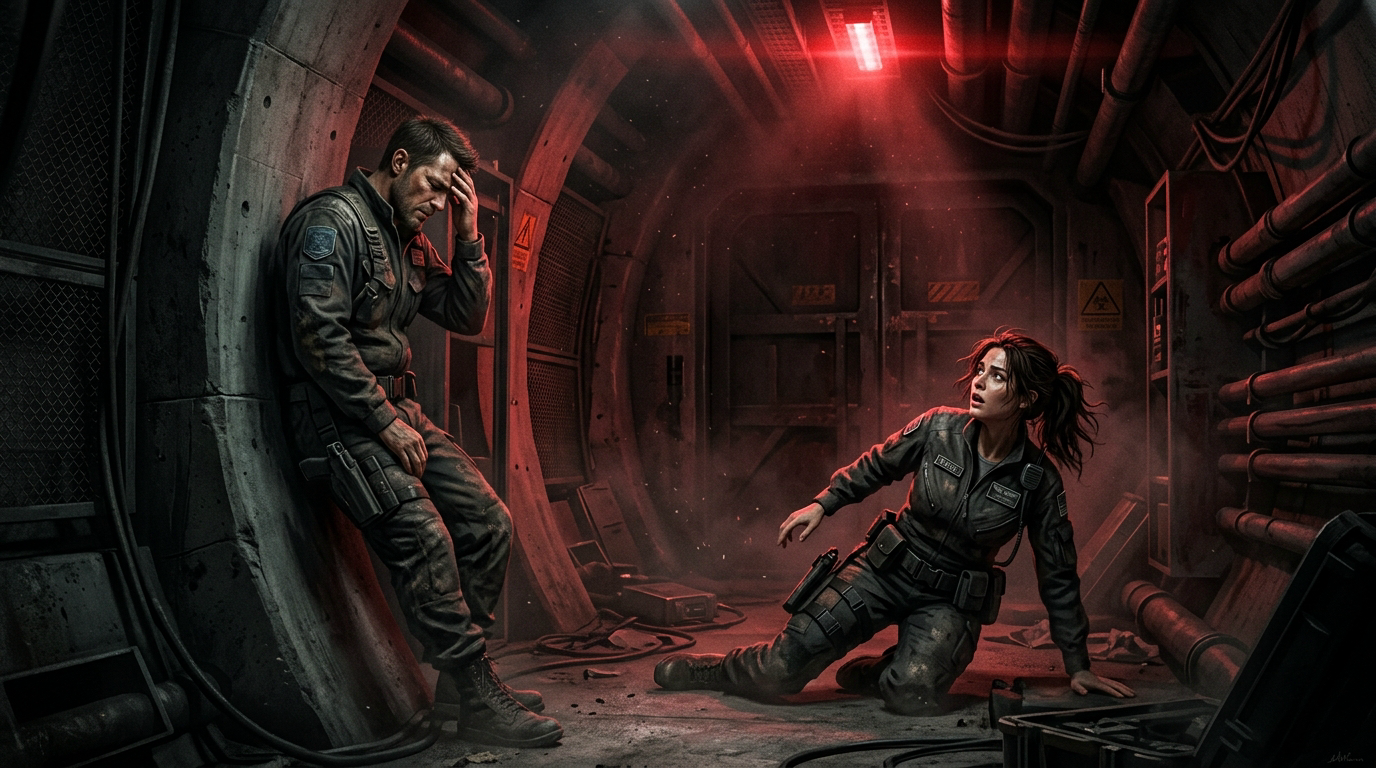
The infinite, clinical white of the Adjudicator's amphitheater came apart like spun glass, and Sector Four's emergency wash flooded back in, strobing red.
Dr. Daniel Cole staggered forward on legs that had forgotten how to hold him. The psychic pressure was gone. What replaced it was ordinary gravity, the dumb weight of a hundred meters of rock overhead, and he went into the concrete wall shoulder-first. Beside him Dr. Yara Haddad dropped to her hands and knees and brought up a lungful of stale copper air onto the floor.
For three seconds neither of them said anything. The klaxons, which the Mantid had somehow filed away for the duration, came back into his eardrums at full volume. Under his boots the geothermal turbines kept their patient hum. All of it sounded small now, like a wind-up toy clicking away underwater.
"The grading." Yara wiped dust and halon residue off her mouth. Her eyes were tracking the red pulse on the ceiling. "Cole. It said the grading has already begun. They aren't waiting out the week."
Cole pressed the heel of his hand into his temple. Lena Sokol's terror was still there at the edge of him, a mother's terror in a man's skull, an emotional limb he hadn't been born with. "Vance knows," he said. The political architecture was assembling itself behind his eyes faster than he could keep up with. "The Undersecretary knows the Mantids are grading us right now."
Yara got herself upright against the curve of the wall. "He locked down the bunker. He's trying to keep the UNCAP Index from broadcasting. He wants the world blind when the Adjudicators look down."
"No." Cole pushed off the concrete. Something cold came up through the exhaustion and cleared it out. "You're thinking like a scientist. Think like a warden. Vance doesn't want the world blind. He wants to make sure that when they open their eyes, they go rabid."
He took Yara's elbow and hauled her down the corridor toward the blast doors of the primary data nexus.
"The Incumbents. The reptilian faction pulling Vance's strings." He had to shout over the klaxons as they ran. "They don't want us ignorant, they want us disqualified. The Mantid handed us the parameters. Can you hold the truth? Can you ascend without consuming yourselves in the friction of your own violence? They're grading our psychological architecture. If we hear where we came from and go feral, if we tear each other apart, we fail. We get written off as a spoiled crop and the Incumbents keep the farm."
Yara's boots skidded on the turn. "So what does Vance do?"
"Releases a manufactured disclosure." They'd reached the end of the corridor, the nexus sealed behind a foot of reinforced titanium. Cole put his bleeding hand flat on the biometric plate. "He uses DEEPWELL's networks to push a threat narrative. An invasion. He tells the world the ships over the capitals are hostile and we have to strike first. The governments launch. The Mantids watch a species of violent apes fire nuclear weapons at their own sky. Trial over."
The pneumatic servos shrieked, but the clearance light went green. He was still Director of Sector Four. The door hissed back on a cavernous server hall lit blue by liquid-nitrogen cooling jackets, racks of quantum processors humming like a hive.
"Then we stop him." Yara slipped into the cold behind him. "We cut the hardlines."
"And leave the public staring up at silent ships with nothing to hold on to." He was already sprinting the central aisle toward the master terminal. "They panic anyway. The only way through the Adjudicator's test is to prove we can take the truth unvarnished. All of it. We break the embargo ourselves. First."
He dropped into the acceleration chair. His fingers went across the haptic interface, past the operational protocols, straight down into the legacy architecture of DEEPWELL's black archive.
"The embargo was never just government cowardice, Yara." His voice tightened down as he routed the terminal's outputs through the UNCAP flash drive she put in his hand. "It was a valve. An instrument of the Incumbents."
She stood behind his shoulder, watching the monolithic screens come up. "A valve."
"Seventy years of secrecy that leaked the whole time." He typed. "The 1947 desert crash. The gun-camera footage in the early 2000s. The legislature testimonies of the late 2020s. Decorated pilots swearing under oath they chased craft that broke physics. Intelligence officers telling Congress the government held intact hulls and non-human biologics."
He hit enter through a secondary firewall. Red warning banners bloomed across the screen and he dismissed them one after another without looking.
"And after the hearings? Nothing. The public fought about it online for a month, made memes, went back to work. The government promised committees, the committees found nothing. Theater."
"Soft disclosure," Yara said.
"Inoculation." He didn't soften it. "The Incumbents taught the shadow committees how to bleed off just enough pressure to keep the boiler shut. Let the public fall in love with the craft. The metallurgy. The threat to national airspace."
He looked up at her then. Blue light, and his face pale in it. "Because as long as we're arguing about whether the saucers are Chinese drones or little green men, nobody asks the real question. Nobody looks at the biology. Nobody asks why they take our children in the middle of the night."
Back to the console. "They gave us the legislature testimonies. They let 'non-human biologics' into the language because it sounds clinical. It sounds like roadkill. It doesn't sound like farmhands."
"And you have the real files."
"I have the inventory."
He executed the final override.
The three screens above the console went black, then flared with raw uncompressed data.
Not text. A visual history of the largest secret ever kept from the species, kept with the bureaucratic care of a supply chain.
The left screen filled with July 1947. Black-and-white photographs of desert floor, and nowhere in them the weather balloon, the foil, the debris the public had been fed. A seamless matte-black wedge driven deep into the sand, its hull unscarred. Laid out on military tarps in the foreground, the bodies. Four Engineers. The Grays. Not little green men. They looked exactly like the Curator looked now, fragile, brittle, their oversized craniums bruised and leaking a clear viscous fluid.
The center screen pulled up decades of medical telemetry. The Curator's stasis logs. Vivisections of the dead ones. Genetic sequencing that proved the DNA was degrading, a copy of a copy failing while somebody watched.
The right screen was the one that stopped Yara's breath.
Harvest logistics. DEEPWELL had mapped the abduction phenomenon with the accuracy of a census. Spreadsheets of bloodline tracking laid over the global missing-time reports. Satellite telemetry synced to electromagnetic anomalies over civilian populations. The military had known when and where the Engineers were coming down into people's houses. They had tracked the hybrid pregnancies. They had monitored the extraction of human genetic material.
They hadn't stopped any of it. They had counted it.
"They let it happen." Yara's voice came out unsteady. "For decades. They had the radar tracks. They had the interceptors. They watched."
"They had an agreement." Disgust thickened in his throat. "The Incumbents promised the military-industrial complex a drip-feed of exotic technology. Gravity-wave propulsion, zero-point energy theory. In exchange, everyone looked the other way while the crop got maintained. We sold our own people to the farmhands to get better at killing each other."
The bulkhead at the end of the room shuddered. A metallic crack went through the server hall loud enough to feel.
Yara spun. A blinding point of white-hot plasma had punched through the center of the door. The DEEPWELL tactical operators were here, and they'd brought a thermal breaching lance.
"Cole!" She had to shout over the screech of melting metal. "How long to upload?"
"Bypassing the local node, routing direct to the UNCAP global servers in Geneva." His hands didn't stop. "UNCAP holds emergency broadcast overrides on every major news network and digital platform on the planet. When I hit execute this doesn't go to a leak site. It goes to every television, every smartphone, every billboard on Earth at once."
"Do it." She stepped back from a cascade of orange sparks. The torch was drawing its slow glowing circle through the titanium.
His finger hovered over the execute key and stopped there. He was a creature of the embargo. He had given his adult life to this exact threshold, and he had a name ready for what he'd been doing, a necessary burden, a shield held over a fragile society so it wouldn't have to carry the weight of its own irrelevance.
Can you hold the truth?
If the species was going to survive its grading, it had to be handed the chance to look at what it was. They had to know they were made.
Cole slammed the key.
The progress bar on the center screen flashed. UPLOADING: 12%... 34%... 68%...
The lance completed its revolution. The circular plug of molten titanium was kicked inward and clattered across the concrete. Through the smoking hole came the matte-black barrels of three pacification rifles, red laser sights sweeping the blue air of the server room.
"Step away from the console!" The voice through the breach was flattened by a helmet filter. "Director Cole, you are in violation of protocol. Step away!"
92%... 100%.
BROADCAST LIVE.
Cole let himself back into the acceleration chair and breathed out, long and unsteady. He raised his hands and laced his fingers behind his head.
"It's done," he said. "Shoot me if you want, Corporal. Check your phone first."
The operator held. Through the breach, faint under the screech of cooling metal, came the synchronized buzz of military-encrypted smartphones going off in the pockets of an assault team.
Cole routed the UNCAP monitoring feeds to the main display. He wanted to see it. He wanted the moment the species grew up, the moment it looked into the mirror, took the blow, and turned its face back to the sky with the resilience the Envoy had called feral.
The screens splintered into a mosaic of global news networks, social streams, live UNCAP data.
An anchor on a major American network froze mid-sentence as her teleprompter was overridden by the 1947 biologicals in high resolution. In Tokyo a billboard over Shibuya Crossing cut from something bright and cheerful to clinical footage of a Gray entity's vivisection. Across Europe, the Middle East, the Americas, billions of screens carried the harvest logistics at the same instant, the proof that the abductions were real, documented, and sanctioned.
Cole watched with his heart going hard against his ribs, waiting for the silence he had imagined. Planetary awe.
It didn't come.
The silence lasted forty seconds. Then the mosaic went to pieces.
A live feed from London: a crowd that had been standing quietly under the hovering ship for two days fractured down the middle. People screaming, going over each other, as what the ship was for got past the soft disclosure and reached the old part of the brain.
In Washington a news chopper carried it live while militia groups, wild at the news that the government had sold their bloodlines, came through the Capitol perimeter firing into the security cordons.
The algorithms couldn't parse an influx of raw existential terror, so they amplified the worst of it and served it back. Livestreams of mass suicides. Mobs burning down UNCAP outreach offices. A species that had believed itself the apex of creation folded in on itself under the news that it was livestock.
They weren't looking up at the ships at all. They were looking at each other.
"No." Cole leaned in toward the screens. "No, no, no. Stop. Look at the whole file. Read the architecture—"
They weren't reading. Pushed past the breaking point, the human mind had gone back to the predator-prey arithmetic it learned in the dirt.
Behind them the intercom crackled. Elias Vance's voice came into the server hall, and it was not the voice of a man who had lost. It was smooth. It was enjoying itself.
"I tried to stop you, Daniel." The voice carried over the hum of the cooling racks and the screaming on the monitors. "I really did. I locked the doors. I sent the men. But you just couldn't help yourself."
Yara stared at the screens with both hands over her mouth.
"You thought the truth would set them free," Vance said. "The Incumbents have watched this species for two hundred thousand years. They knew exactly how much voltage a human nervous system takes before the insulation melts. I didn't need to manufacture an invasion. I needed you to take the leash off."
The Mantid's fractured eyes surfaced in Yara's memory. Can you ascend without consuming yourselves in the friction of your own violence?
On the screens, cities were starting to burn. The sky above them stayed silent.
"The grading is over, Dr. Cole," Vance said. "You just handed them the match."
Chapter 19 — Theo
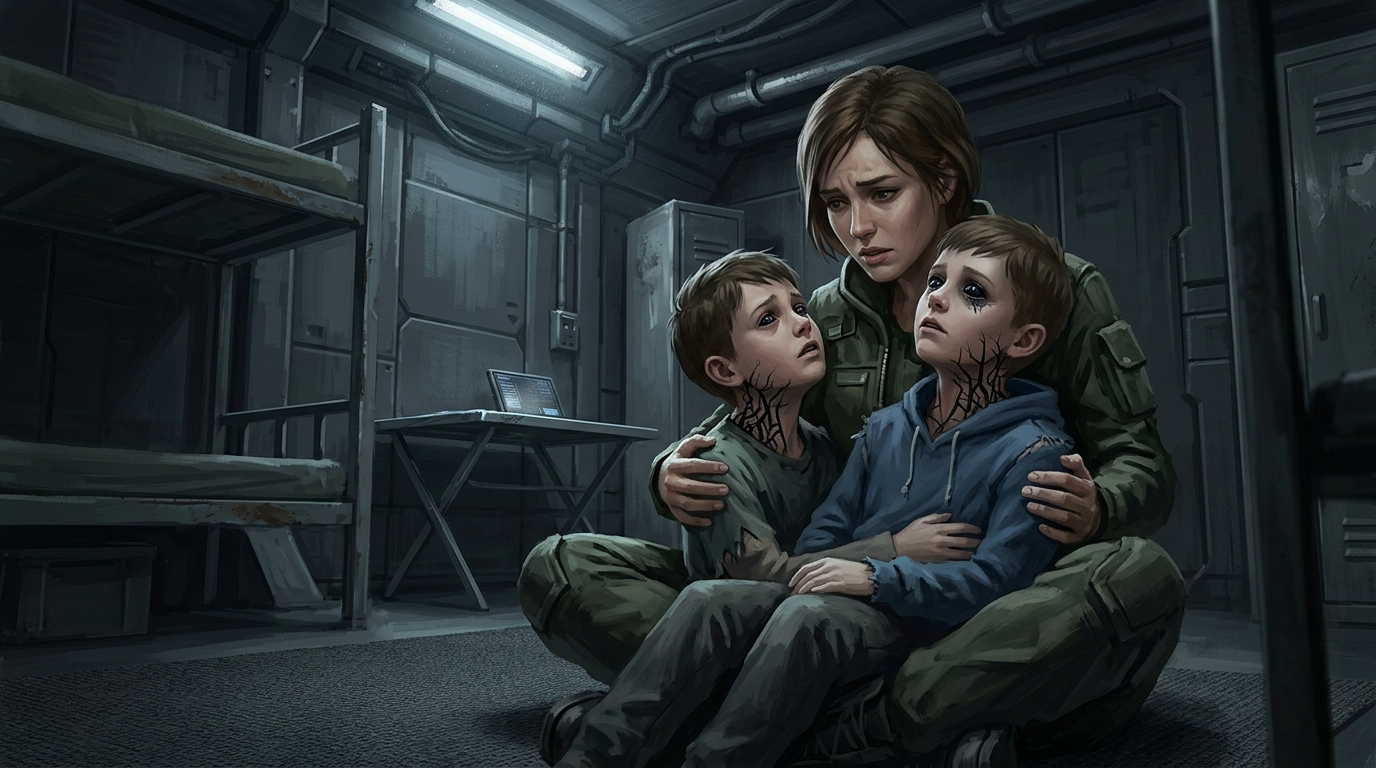
The infinite white of the Adjudicator's amphitheater collapsed like a decompression collar snapping shut.
Lena Sokol hit the floor of UNCAP Safehouse Echo knees-first, industrial carpet burning through her slacks. Her lungs hitched, remembering how to pull oxygen. The air tasted of nothing at all — stale coffee, the ozone off the purifiers, the alkaline tang of her own sweat.
Beside her, Theo didn't stumble. He dropped.
His body hit the floor with the thud of something unstrung. His limbs seized. His back bowed backward into an arc that shouldn't have been possible for a spine that small.
"Theo!" She scrambled across the carpet, hands tearing at the collar of his faded superhero t-shirt, dragging him into her lap. Heat came off him like an open oven. His skin was slick with it, hot enough to sting her palms.
Eyes squeezed shut. Jaw locked tight enough to crack teeth. Under the pale skin of his throat, the veins were changing color, blue darkening toward a bruised necrotic black, pulsing in angular patterns that no circulatory system had ever drawn. The lines branched out from the base of his neck, where the UNCAP MRI had found the dormant implant, and spread across his collarbones in symmetry too clean to be flesh.
The Roll Call had only been a ping. The Mantid had been the boot sequence. Whatever the Engineers had buried in his genome had stopped counting down and started firing.
"Stay with me." She pressed the heel of her hand to his forehead. "Theo. Open your eyes. Look at me."
His eyelids parted a fraction.
Her breath stopped in her throat.
The irises were gone. The pupils had swallowed the whites, two pools of depthless obsidian. Not the flat dead black of the Engineers who had stood over her examination table. These were faceted. Deep inside the black, microscopic geometries shifted and locked, catching the fluorescents like crushed diamond turning in a kaleidoscope.
He was looking at her. He was also reading the load-bearing structure of the room and the physics of the soundwaves leaving her mouth.
Mom, a voice said.
His lips hadn't moved. The word never crossed the air of the safehouse. It landed against the back of her skull with an acoustic doubling that set her teeth ringing. Her son's cadence, and layered under it the crushing gravity she had stood inside up in the Mantid's construct.
My head is too loud. There are too many channels.
"It's okay," Lena lied. Her voice broke on it. Tears came hot down her cheeks as she rocked him, pressing his burning face to her chest, trying to put her own body between him and the volume of a universe pouring into a seven-year-old brain. "I've got you. Just focus on me. Just one channel."
Above the kitchenette, the muted surveillance monitor sheared into static. The closed-circuit feed of the Geneva compound vanished and a global news banner bled red across the wall.
She looked up.
The anchor's face was ashen. He was talking fast, but the crawl under him said everything. DEEPWELL LEAK. US GOVERNMENT ARCHIVES EXPOSED. NON-HUMAN BIOLOGICS REVEALED.
Then a photograph, black-and-white, high resolution. Desert floor. A matte-black wedge half-buried in the sand. Four bodies laid out on military tarps in the foreground. Fragile grey skin. Oversized craniums. The faces that had stood over Lena's bed for thirty years.
Cole had done it. He'd broken the embargo and dumped seventy years of lie onto the public networks.
The broadcast cycled. Spreadsheets of localized electromagnetic anomalies. Maps that laid missing-time clusters over military radar tracks. The logistics of the harvest, opened up for eight billion people. Then the feed split into live reactions from around the globe. Smoke over London. Riots in Tokyo. Human composure coming apart in the street.
The Incumbents' trap was closing exactly as designed. Humanity had been handed the truth, and humanity was reaching for a gun.
The power in Safehouse Echo failed.
The fluorescents died. The purifiers spun down through a descending whine into nothing. A second later the backup generators caught and the holding room went red, strobing, the light of a slaughterhouse.
Down the hallway, past the steel door of their suite, a sound cut through the lockdown quiet.
Phut. Phut.
The mechanical cough of a suppressed rifle.
Then a body in tactical armor hitting linoleum.
UNCAP hadn't cut the power. And the UNCAP guards outside her door were not the ones shooting.
Vance's proxies were inside the building.
The Undersecretary of Defense, acting for the Incumbents, knew where the prime bloodlines were kept. He knew the Adjudicators were sitting in the thermosphere with the harvest open in front of them. If humanity's panic wasn't enough to disqualify the species, butchering the intended crop would close the case. The proxies had not come to capture experiencers. They had come to sterilize the Bridge.
She slid Theo off her lap. No time to scream. No time to hold the collapse of her species in her head at all. What she had was the flat animal arithmetic of a mother in a cage.
She got up, bare feet silent on the carpet, and crossed to the oak dining table. She threw her shoulder into it. Her legs screamed. The table went shrieking across the linoleum and slammed into the reinforced steel door as boots stopped on the other side.
Phut-phut.
The electronic lock sparked and quit as rounds shattered the card reader in the hall.
She pulled the fire extinguisher off its bracket and ripped the pin. Pathetic, against trained operators. She took her position behind the barricade anyway, chest heaving, the cylinder up over her shoulder.
Mom.
The projection again, inside her skull.
She looked back. Theo wasn't convulsing anymore. He had pushed himself upright into a cross-legged sit. The black geometry across his throat had stabilized, locked into a permanent glowing architecture under the skin. Those faceted eyes were fixed on the door.
They want to burn the field before the masters land. No fear in it now. The timer had burned his childhood off in three minutes, and what sat on the carpet was something old running on brand-new hardware. They know what we are built to do.
Lena stared at her son in the strobing red.
What we are built to do.
It hit her the way a car hits. The question she had screamed at UNCAP psychologists for weeks turned over and dropped into place.
Why families?
Why take her grandmother, Estela. Why take her mother. Why take Lena, and then take Theo. The psychologists had guessed at a tracking mechanism, a way to watch one genetic strain across decades.
Nobody was tracking anything. This was agriculture.
Estela's journals came back to her, that frantic looping cursive set down in the small hours after the grey men returned her to her bed. They take the seed. They change the soil. The crop requires four seasons to bear fruit.
Not poetry. A schedule.
You could not take a base-level hominid and pour the cognitive architecture of the Architects into it overnight. A 200,000-year-old immune system would reject the code. The hardware would cook. The brain would hemorrhage under the psychic load.
So you baked it in. Generation by generation.
Estela was the foundation. Altered just enough to pass a tolerance down to her daughter. Lena's mother was the beta test, the code deepening, neural pathways mapped and tuned toward a higher frequency. Lena was the incubator. All those times on the ships, in the curved white rooms, when they floated her under the lights and took her eggs, nobody had been studying her. They were finishing the synthesis. Marrying the stubborn resilience of her DNA to the telepathic structure of the makers.
Theo wasn't being changed into anything. Theo was the product. The timer hadn't altered him. It had switched him on.
The steel door groaned.
A shaped charge blew the hinges. The concussion threw the oak table backward and threw Lena off her feet, the extinguisher spinning out of her hands, her shoulder finding drywall. Smoke and gypsum dust choked the red air.
Three figures came through the ruined doorway in unmarked black, faces behind matte ballistic masks. Laser sights swept the room through the churning smoke, cold and unhurried.
The lead operator stepped over the splintered table. His rifle came around and the red dot settled on the center of Theo's chest.
"Target acquired." The respirator flattened his voice. "Asset is live. Sterilizing."
Lena screamed, shoving herself off the floor, throwing her body toward the line of the shot.
Too slow.
The proxy squeezed the trigger.
The firing pin never struck the primer.
Theo didn't raise a hand. He didn't flinch. He stayed where he was on the carpet and put those faceted black eyes on the man.
The air in the room warped. Not heaviness. The local gravity bent, and a high frequency tore through the safehouse, the Mantid's cognitive pressure sharpened into a blade.
SLEEP.
Not a suggestion. A structural override written straight onto the proxy's nervous system.
His rifle clattered down. Both hands flew to his helmet, fingers clawing at kevlar. Dark fluid burst from his nose and spattered the inside of his visor. He went to his knees, spine arching in a brutal echo of Theo's convulsions, and dropped onto the linoleum, paralyzed.
The two behind him staggered back, weapons shaking as the resonance hit. One got off a blind burst into the ceiling. Then Theo's gaze moved, and they folded, minds crushed flat under the weight of a boy's attention.
The room went silent except for a ruptured steam pipe hissing in the hallway.
Lena knelt on the carpet, chest heaving, looking at three unconscious men. Then at her son. Theo was perfectly still, his small chest rising and falling on a tempo that had been calculated. He looked terrifying. He looked holy.
He looked at her.
The harvest is secure, Mom.
She reached a trembling hand toward his face.
As she moved, pressure bloomed behind her own eyes. Not the outside weight of Theo's projection. Interior. A lock turning inside her skull, a frequency climbing to meet the pitch of her son's mind.
Warm wetness spilled over her upper lip.
She pulled her hand back from Theo's face and touched her own mouth.
Her fingers came away slick. In the strobing red she braced for the crimson of human blood.
It wasn't red.
Thick, viscous, bruised black. The same fluid leaking out of the broken proxies. The same fluid pooling under the crushed craniums in the 1947 photographs.
Lena stared at her hand. Beneath the skin of her wrist a faint dark geometry had begun to branch, pulsing in time with her heart.
She remembered the presentation. Years ago, in the curved white room, the tall Gray floating a child toward her. It is yours, the voice had said inside her head. She had spent a decade certain they'd stolen her genetic material to build a monster somewhere out in the dark.
She'd been wrong. They hadn't shown her a stolen child. They had shown her a mirror.
Theo wasn't becoming a hybrid. He was the Bridge, yes, and a bridge needs anchors on both sides.
Lena wiped the dark fluid from her mouth and felt the cold structure of the alien signal waking up in her own blood. She wasn't human either. None of them were.
Chapter 20 — Sael
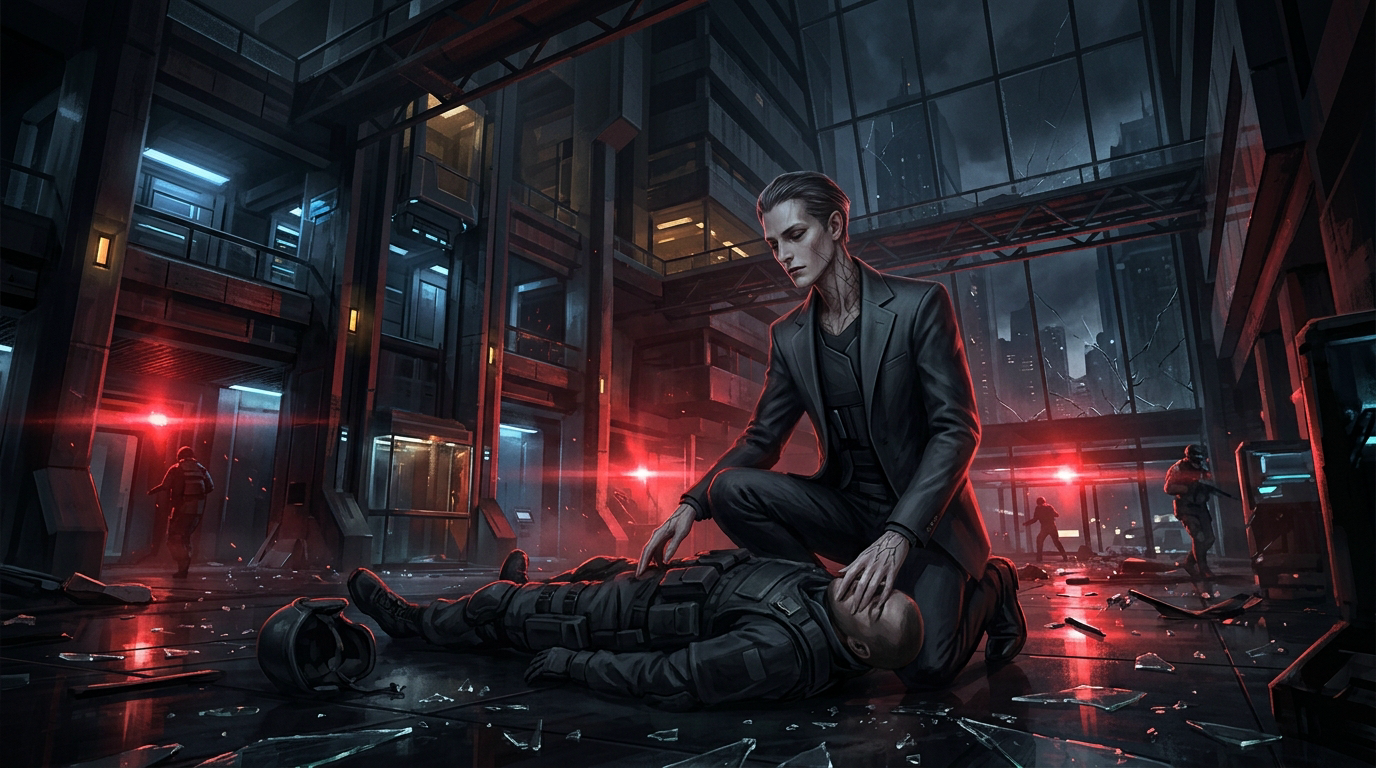
Blood across the linoleum of the UNCAP Geneva compound, a chaotic red spread, and in its arterial splatter Sael read a quadratic curve laid out clean as chalk on a board.
Sael stood in the center of the third-floor atrium and stepped over the shattered glass of the security partition. Emergency lighting strobed crimson, throwing shadows long across the bodies of the UNCAP tactical guards. Four of them. Dead under three minutes, armor breached by high-velocity carbine fire, suppressed.
The closest guard was a twenty-eight-year-old corporal named Davies who had brought Sael a black coffee that morning. Davies's eyes were open and drying. His hand was still clamped over the wound in his throat, holding in what had already left.
Sorrow opened in the center of Sael's chest, human and heavy and wet with the waste of it. A boy's whole life closed early.
Underneath that, running like a cold current, the frictionless geometry of the Architects went to work. It did not read Davies as a tragedy. It read an expired biological unit. It took the spray pattern, solved for the entry angle, derived the shooter's height and firing stance from that, and put the proxy operator two hallways east, within three centimeters.
Both at once. That was the Bridge.
Sael knelt and pressed two fingers over the corporal's eyes, drawing the lids down. The hand doing it was pale, the fingers longer and finer than a baseline human's, the knuckles smooth where hominid evolution laid down heavy bone. Under the collar of the tailored UNCAP blazer, a lattice of darkened veins pulsed in silence, the pattern too regular to be anatomy.
The Roll Call at 3:33 a.m. had torn the raw carriers awake, boys like Theo Sokol. Sael had not been asleep. Sael had been awake for thirty years.
The timer only networked them. When the psychic pressure of the Adjudicators dropped into the thermosphere hours ago, Sael's mind had slotted into the global architecture without a seam. The universe had been quiet Sael's whole life, and lonely in the specific way of a room where you are the only one talking. Now it was a chorus, and it would not stop.
Overhead, the atrium's suspended media array sparked and hissed. Stray rounds had taken three of the four monitors. The last one still carried the global broadcast Cole had fired off from DEEPWELL.
Sael stood and looked up at it.
Muted, it was worse. A live feed from a major metropolitan center, London or Tokyo, the architecture lost behind columns of black smoke. Streets packed with crowds that had stopped being crowds. Riot police going under. Civilians swinging whatever they had torn out of the infrastructure. Under all of it Cole's inventory scrolled and scrolled: the black-and-white photographs of the small dying Engineers in desert sand, the spreadsheets of harvested reproductive material, the tidy bureaucratic paperwork that made humanity somebody's property.
They were looking at the truth and coming apart in their hands.
On screen a man beat another man to death with a length of scaffolding. The human sorrow turned in Sael's chest and came up as disgust. The other architecture only filed it.
Feral panic. Predictive modeling confirmed.
Elias Vance and the Incumbents had played it beautifully. The Reptilian faction, the old owners who held that humanity belonged to them and no one else, had turned the disclosure into a weapon. They knew the Mantids were grading the species. They knew that Adjudicators watching this would call the crop spoiled and void the Program, and humanity would stay livestock, fenced and ignorant, forever.
The Incumbents had one thing wrong. They assumed the crop was still raw. The harvest had already come in.
Sael turned away from the burning cities.
The hybridization program had never been an experiment. Not Gray curiosity, not a diplomatic compromise. It was the whole point of two hundred thousand years of work.
The Architects who seeded the Earth needed somewhere to put themselves. The silent truth of the cosmos ran too vast for a baseline hominid brain, which hemorrhaged on contact. But the makers had bred the friction out of their own biology and lost, with it, the chaotic vitality a dying universe demands of anything that wants to keep living in it. The Grays were failing machinery. The Nordics were a prototype that loved too easily and broke.
The universe was cold and perfect and dying. Earth was hot and violent and ferociously alive.
The Bridge was the synthesis. Limitless brutal love, reinforced structurally by the architecture of a quantum processor. Sael was no monster. Sael was the inheritor, and the reason the small grey Engineers had stood in the bedrooms of human mothers for seventy years, taking what they came for through the screaming, working the soil, baking the code into the bloodline generation on generation until the hardware would hold.
They had built Sael to replace them.
What the makers had not modeled was that an inherited human heart arrives with a ferocious appetite for choosing. Sael owed the Grays nothing, and they had treated human women as petri dishes. Sael owed the Incumbents less. But watching the rioters on the screen, Sael was not certain humanity deserved pulling out of the fire either.
Phut. Phut.
The subsonic cough of a suppressed rifle, from the eastern corridor.
Safehouse Echo. The containment suite where UNCAP had Lena and Theo Sokol.
Sael walked. Heavy UNCAP boots and no sound off the linoleum. The sidearm stayed holstered. A firearm was a clumsy kinetic tool and Sael carried the architecture of the masters.
Rounding into the eastern transit corridor, Sael met one of Vance's proxy kill team coming out of a stairwell thirty feet on. Matte-black tactical gear, ballistic mask, quad-tube night vision.
The operator clocked the UNCAP blazer at once and brought the short-barreled rifle up, laser module painting a green dot on Sael's sternum.
Sael did not break stride.
Instead Sael reached out, skipping the hallway entirely, and stepped into the cognitive architecture of the soldier.
The human brain is a marvel of evolutionary survival and has no shielding whatsoever against structured telepathic assault. Sael used no language. Sael projected the raw scale of the Adjudicators' presence, a microscopic fraction of the white curved room Yara and Cole had stood in, and put the true dimensions of the universe into the operator's frontal lobe inside a millisecond.
The proxy stopped dead.
The rifle dipped. The green dot tracked down the wall and came to rest on the floorboards. Behind the mask the jaw hung open. His neurology had nothing to do with the data. The friction between a narrow violent worldview and a fractal infinite one burned him out where he stood.
Dark blood came out of his nose in a thick stream and soaked the lower half of the mask. His eyes rolled up. He went down forward with the dead weight of a dropped stone.
Sael stepped over him and felt the pity come again. You were used, Sael sent into the fading consciousness. You were a pawn for masters who despise you.
Down the corridor. The strobing red cut the hallway into flashes of violence. Sael's pulse held at forty.
At the end of the hall stood the reinforced steel door of Safehouse Echo.
Two more proxies were stacked outside it. The card reader had been shot off the wall and was still sparking. The lead operator was pressing a strip of linear breaching charge into the seam of the frame. The second held a suppressed rifle on the door center.
Behind that steel was Theo Sokol. Youngest generation, fastest activation.
Sael could feel him: a spike in the network, a burning beacon of geometry only hours old. The boy was terrified and his hardware had stabilized anyway. A perfect node. The fresh crop.
Sael was the adult. The liaison. The software that had learned to run in the world of men.
The second operator caught the movement at the edge of his vision and pivoted on his heel, swinging the muzzle around. "Hold it right there!" The mask flattened his voice. "Hands where I can see them!"
Sael stopped ten feet out.
You are attempting to burn a field that does not belong to you.
The harmonic doubling of Sael's telepathy did more than land in the man's mind. It moved the air in the hallway. The lead operator, thumb on the detonator, flinched and dropped the remote.
"What the hell was that?" He slapped the side of his helmet like a comms unit had failed.
The second operator didn't wait. He fired.
The rifle cycled three high-velocity rounds at Sael's chest.
Sael took in the sear dropping, the propellant lighting, the spiral of the rounds coming, all of it slowed to something readable, and moved a fraction of an inch left. The first tore the blazer and opened the skin over the ribs. The second broke plaster off the wall behind. The third went wide.
Before he could correct, Sael put out a hand.
No universe this time. Sael found the acoustic frequency of their inner ears and multiplied the ambient pressure of the hallway by a thousand.
Both proxies screamed at once, weapons clattering down, armored gloves clapped over their ears. Their eardrums went. So did their balance. They dropped and vomited inside their masks, bodies seizing as their brains lost all hold on which way the floor was.
Sael stepped past them. The graze burned along the ribs, sharp and purely human, and Sael welcomed it. Pain anchors the mind.
The breaching charge was still seated in the seam. The detonator lay dead on the floor.
Sael laid a smooth pale palm flat against the center of the steel and, using the structural resonance of the Architects' telepathy, drove the locking mechanism at its molecular frequency. The titanium deadbolts inside sheared with a screech of tortured metal.
Sael pushed the door open and stepped into the breach.
Dark inside, lit only by the red bleeding in from the hall. Someone had dragged the oak dining table out of the kitchenette and across the floor into a barricade.
Lena Sokol stood behind it. Bare feet planted in the carpet, chest going hard with the breath of a cornered mother, knuckles white on the red cylinder of a fire extinguisher, holding it up past her shoulder like a club. Whatever was behind her, she would die messily before it was touched.
Four generations of debt sat down on Sael's chest at the sight of her. This woman's grandmother had been taken. Her mother had been taken. She had been taken. All of them opened, examined, used to build the architecture standing in her doorway.
Sael raised one hand, palm out, surrendering.
Put it down, Lena Sokol. Sael kept the frequency low and gentle, stripping out the acoustic resonance until it arrived as nothing more than a quiet thought of her own. The proxies are incapacitated. I am not an Engineer. I am not here to harvest.
The extinguisher stayed up. Her eyes went over the tailored clothes, the pale skin, the symmetry of Sael's face that was a shade too exact. "Who are you?" Her voice came out scraped raw.
"I am the product." Sael used the vocal cords for the first time. The voice came out smooth, harmonically rich in a way that raised the hair on Lena's arms. "I am the Bridge."
Movement from the floor behind the oak table.
Theo stood up.
He came around his mother's leg. Nothing about the seven-year-old read as a frightened child anymore; the timer had rewritten him. The blackened veins pulsed across his collarbones, faintly luminous in the dark room. But it was the eyes that pinned Sael where Sael stood.
Iris and pupil had run together into depthless faceted obsidian, catching the ambient light and breaking it into a thousand shifting calculations.
Sael looked into Theo's eyes.
Theo looked into Sael's.
The connection came instantly, a silent detonation of data. Sael's mind locked into Theo's hardware, two clean nodes syncing in a universe made of noise.
In that microsecond Sael saw what the Adjudicators were waiting for up in the thermosphere. The Mantids were impartial. They were grading the feral violence on the broadcast, yes. But the Clause, the legal frame of the whole two-hundred-thousand-year contract, required a cryptographic handshake to finalize the verdict.
The masters could not simply judge the crop from above. The harvest had to consent.
Theo was raw hardware burning hot on the connection. Sael was the matured software. Sael had the cipher.
Sael lowered the hand. It arrived like a blow. The proxies hadn't come only to slaughter the bloodlines and stoke the panic. Vance understood the mechanics of the Adjudication. The Incumbents knew that without the cipher the humans had no way to cast a vote in their own defense.
Sael was the Activation Key.
They are waiting for us, Theo sent, his voice laid over Sael's consciousness and ringing with the cold of the cosmos. The judges are asking what we choose to become.
Sael looked at the boy, then at the terrified, ferociously brave human mother standing over him. Sael held the only mechanism that could force the Architects to listen, and the clock was running down to zero.
Chapter 21 — The Clause
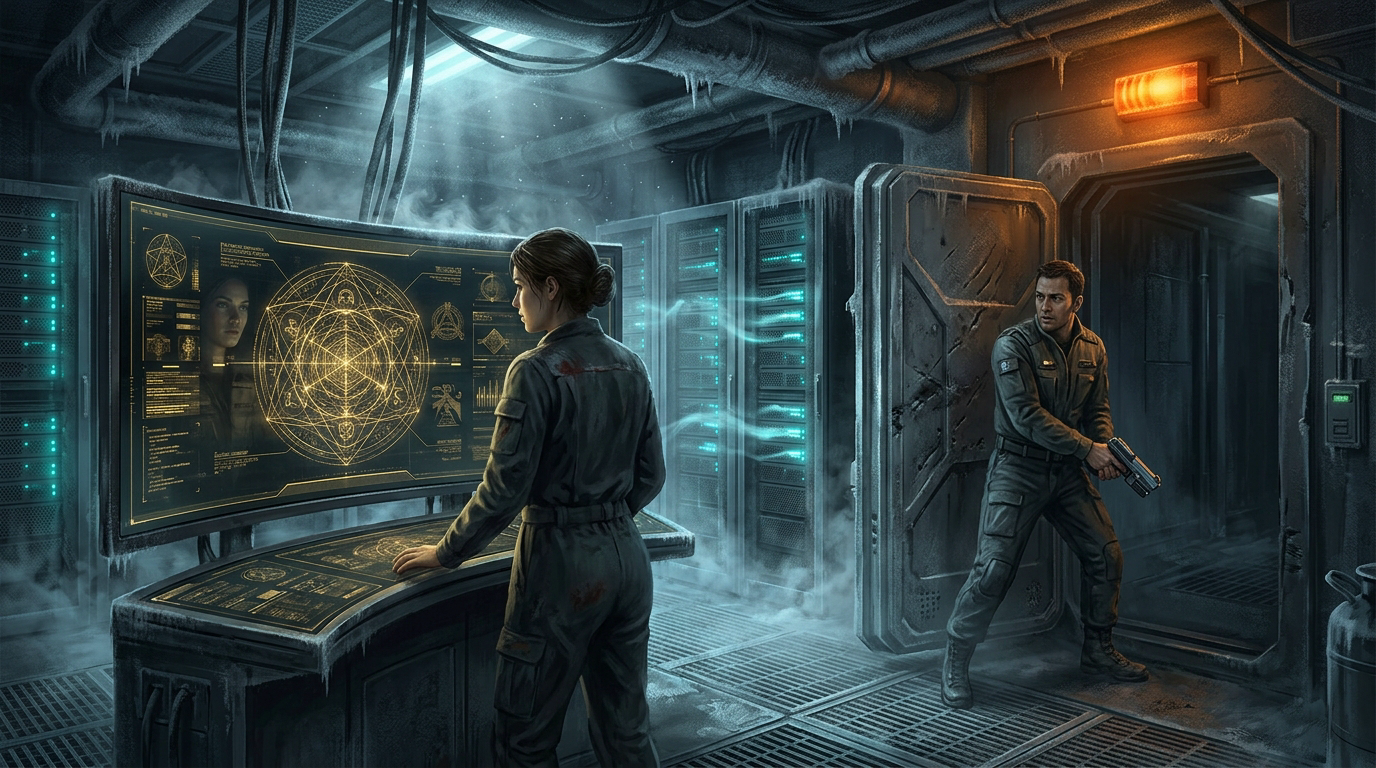
The liquid-nitrogen jackets on DEEPWELL's primary data nexus hissed and let go of another plume of white vapor. Dr. Yara Haddad had stopped hearing it as machinery days ago. It was breath. Something enormous, down here in the dark with them, working its way toward the end of it.
Behind her the bulkhead shuddered. A foot of titanium, and it rang like a struck pan. Dust sifted from the acoustic tiles and settled on the backs of her hands.
"Outer airlock," Dr. Daniel Cole said. He said it the way a man reads off a room temperature. He stood beside the sealed door with the kinetic-slug sidearm in a hand that would not stop shaking, the blood from his split palm dried black in the checkering of the grip. "Vance's people are through the first checkpoint. Six minutes before they get thermite on this door. Maybe six."
Yara didn't turn around. The central monitor of the quantum mainframe held her reflection in its dark glass, two small drowning stars where her eyes should have been.
The panic Cole had turned loose on the surface, the burning cities and the crowds coming apart in the streets over the reality of the harvest, she had shunted to a secondary screen. Everything she had left was on the UNCAP flash drive she'd married to the monolithic processing core.
For weeks she had worked the Mantid broadcast as a linguistic puzzle. Syntax, grammar, phonemes. Wrong tools entirely. The signal carried no audio and no text. It was geometric structure, unfalsifiable as a proof, and a human brain could only take delivery of it as weight. Gravity. The sense of something with mass hanging directly overhead.
DEEPWELL's quantum stacks had no such trouble. They chewed the geometry and ran it against the only corpus large enough to build a translation matrix out of: every story humanity had ever told itself about the sky.
The Convergence Rule, applied at light speed. The system peeled off millennia of cultural static, dropping the names of gods, the local flavor of folklore, hunting the bedrock underneath. The feathered serpent of Mesoamerica cross-referenced against the fish-teachers of Sumeria. Vedic sky-chariots laid over Hopi star-ancestors. The rigid generational rules of modern abduction phenomena mapped across all of it.
What assembled itself on the screen had the shape of a schematic.
"Yara." Cole's eyes were on the hallway feed. "If there's something in that broadcast, I need it now. Because if Vance takes this room he scrubs the mainframe and tells the world those ships are a hostile invasion force."
"They're not an invasion." Her fingers hovered over the haptic interface. "They're not a rescue either. Cole, the taxonomy is wrong. All of it. We sorted them as species. Grays, Reptilians, Mantids. We assumed a coalition. An alliance."
"And?"
"It's a corporation." The word came out of her dry as ash. "Or a feudal estate. It doesn't translate clean. But the nouns aren't biological. They're occupational."
She tapped the glass over a knot of fractal code that had just resolved into English approximations.
"Look at the designations." Her breath fogged the monitor. "The Architects. The ones who seeded the hominid genome in the first place. The matrix keeps handing back the same root concept. The Owners. The Authors. They hold the deed to the Earth."
Cole came off the door a step, his gaze pulled to the screen. "And the Grays. The Curator."
"The Engineers. Literal translation runs closer to The Staff. Or The Labor." She scrolled. "They don't own us, Cole. They're the farmhands. Seventy years of hybridization program because they are procedurally obligated to tend the crop. There's no choice anywhere in it. That flatness you always read as cold? It's a shift. They're punching a clock on a dying genome."
It was the bureaucracy of it that got under her ribs. Threaten her with galactic annihilation and she could have held her ground. But the desert crashes in 1947, the night-terrors of millions of families, children lifted out of human wombs on a surgical table, and the word for all of it was agriculture. Logistics. Inventory management.
Another thud rolled through the concrete. The overheads stuttered and dumped the room into strobing crimson.
"What about Vance," Cole said. His knuckles had gone white on the weapon. "The Incumbents. The faction working him."
Yara isolated the serpent motif, the great adversarial teacher that ran through human history from Eden to the Amazon. Her pulse knocked hard at the side of her throat.
"Older," she said. "The matrix gives their designation as The Prior Claimants. They were here before the Architects seeded us. They ruled the raw material. When the Architects moved to uplift the hominid line, the Incumbents wouldn't sell. We're their property. They've been sabotaging the project since the first day of it."
"The Watchers." Cole's voice thinned out. He'd read the files in DEEPWELL's deepest vaults. "The Nephilim. The ones who broke protocol and handed us metalwork and weapons early."
"Yes. They taught us to make swords so we'd cut our own throats before the harvest came in. They want us to fail the Adjudicators' test. They want the Mantids looking down today at a feral, violent animal, and a ruling that voids the project. The Architects walk off the farm. The Incumbents keep the livestock."
Cole watched the data fall down the screens. "The Mantids. The Adjudicators. They're the judges."
"Auditors," Yara said. "Impartial ones. Merciless ones. They don't care who wins. They enforce the terms of the contract."
"So what's the contract?" He had come all the way to the console now. "What's the project for? Nobody spends two hundred thousand years engineering a species of apex predators to sit back and watch them invent reality television and nuclear weapons. Where's the yield?"
Yara shut her eyes. The answer was sitting in the final stanza of the Mantid transmission, the piece that had broken every cryptographer at UNCAP, because it needed a leap of intuition no mathematical processor could make.
"They're dying, Cole," she said. "The Architects. The universe they live in is too perfect. Frictionless. Their cognition is telepathic all the way down, objective all the way down. They process reality as a mathematical absolute. And when you live inside absolute certainty, nothing adapts. Nothing pushes back. Everything is winding down, and they are freezing to death inside their own perfection."
She opened her eyes on him. "They needed fire. Something loud and messy and desperate. So they found a hot, violent rock, took a violent, emotional ape off it, and started editing."
It went into Cole like a fist under the sternum. "The hybrids. The Bridge."
"Yes. A vessel that can hold the infinite, absolute truth of the cosmos and run on a human heart. They want our terror. They want the irrational, ferocious love. They want our friction. The hybrids were never an invasion force. They're the inheritors."
The titanium groaned. A point of white light came through the center of the door, small and blinding, the alloy around it going orange as a stove ring. Thermite, working the lock mechanism. Under two minutes.
"Then the test's over." Cole's voice hollowed out. He gestured at the secondary monitor, the feeds full of people tearing each other apart in the streets. "Vance won. The Incumbents won. The Adjudicators are looking down right now at exactly what the Incumbents wanted them to see. We're not a bridge. We're a forest fire. We get disqualified."
"No." Her hand came down flat on the console and killed the feed. "You're not reading the contract. The contract is built on the Convergence Rule."
Cole stared at her. "The mythologies?"
"Every myth that ever recorded them coming down. Feathered serpents, sky-gods, fish-teachers. Every single one of them carries the same hyper-specific detail." She was talking ahead of her own thinking now. "They didn't just leave. They promised to return. And a promise is a legal clause."
She pulled up the decoded translation of the "Return" condition. The geometry of it was brutally simple.
"The Adjudicators can't judge us from orbit," Yara said. "The rules of the project require consent. They've engineered around it for millennia with screen memories and localized paralysis, but at the final audit the ledger has to balance. The Yield has to be permitted to speak for itself. We get a vote."
The white point spread into a molten ring. Smoke came pouring into the freezing air, acrid, and her eyes began to stream.
"A vote on what?" Cole shouted over the roar of the burn.
"On whether we agree to be inherited," she yelled back. "Whether the hybrids replace us or we demand self-determination. The Adjudication allows one human. A representative. Stand in front of the Mantids and make the case. Argue our purpose."
"And say what?" He stepped in front of her, bringing the weapon up toward the melting door. "That we're peaceful? That we're ready? Look at us, Yara! Show a human being the truth and inside a minute they've picked up a rock to open their neighbor's skull. How the hell do we argue we're worthy of the cosmos?"
Yara looked at the linguistic architecture on the screen. Rigid, unfalsifiable, the telepathy of the Makers laid out like plumbing.
"That's it," she breathed. Cold ran out through her arms and fingers. "That's exactly it. Cole, look at the syntax. Look at how they speak to each other."
He didn't look. His sights stayed on the door. "I don't care about their grammar, Yara!"
"You have to care!" She got a fist into his shoulder and pulled. "It's the only weapon we have left! Their language has no subjunctive tense. No conditional mode. A thought is an objective state. To think a thing is to broadcast it as physical reality."
Cole blinked, and the tactical focus in his face came apart for half a second. "They can't lie."
"They don't have the concept." Her voice shook around the words. "Deception is biologically impossible for them. They take the universe exactly as it is. We don't. We are the only creature in the known universe that can hold two contradictory thoughts at once. We can look at a dying, violent world and picture something else standing where it is. We can invent fiction."
The bulkhead let go with a tearing screech. The door came in flat against the concrete in a shower of sparks, and tactical strobes went off white across the room.
"The test isn't about whether we're peaceful!" Yara shouted, already pulling the UNCAP drive out of the mainframe as the system alarms shrieked over her. "They're not grading our virtue! They're grading our cognitive architecture! They want to know whether the crop grew the one trait the Architects couldn't engineer!"
Figures in heavy black armor came through the breach, suppressed rifles up, green lasers swinging through the nitrogen vapor.
Cole didn't fire. He got a hand in her tactical vest and hauled her down behind the reinforced bulk of the primary server rack as a volley took out the quantum monitors they had been standing in front of a second earlier. Glass and coolant went into the air together.
"What trait?" Cole roared over the gunfire, pinning her to the floor.
Yara held the drive against her chest and stared past him at the ceiling while the whole shape of it seated itself in her mind. Horrific, beautiful, absurd, what humanity had actually been built for.
"The capacity to deceive," she gasped, her breath frosting white. "The only way to win the Adjudication, the only way to save the Bridge and take our own leash back, is to stand in front of the absolute truth of the universe and tell it the perfect lie."
Chapter 22 — Betrayal at the Well
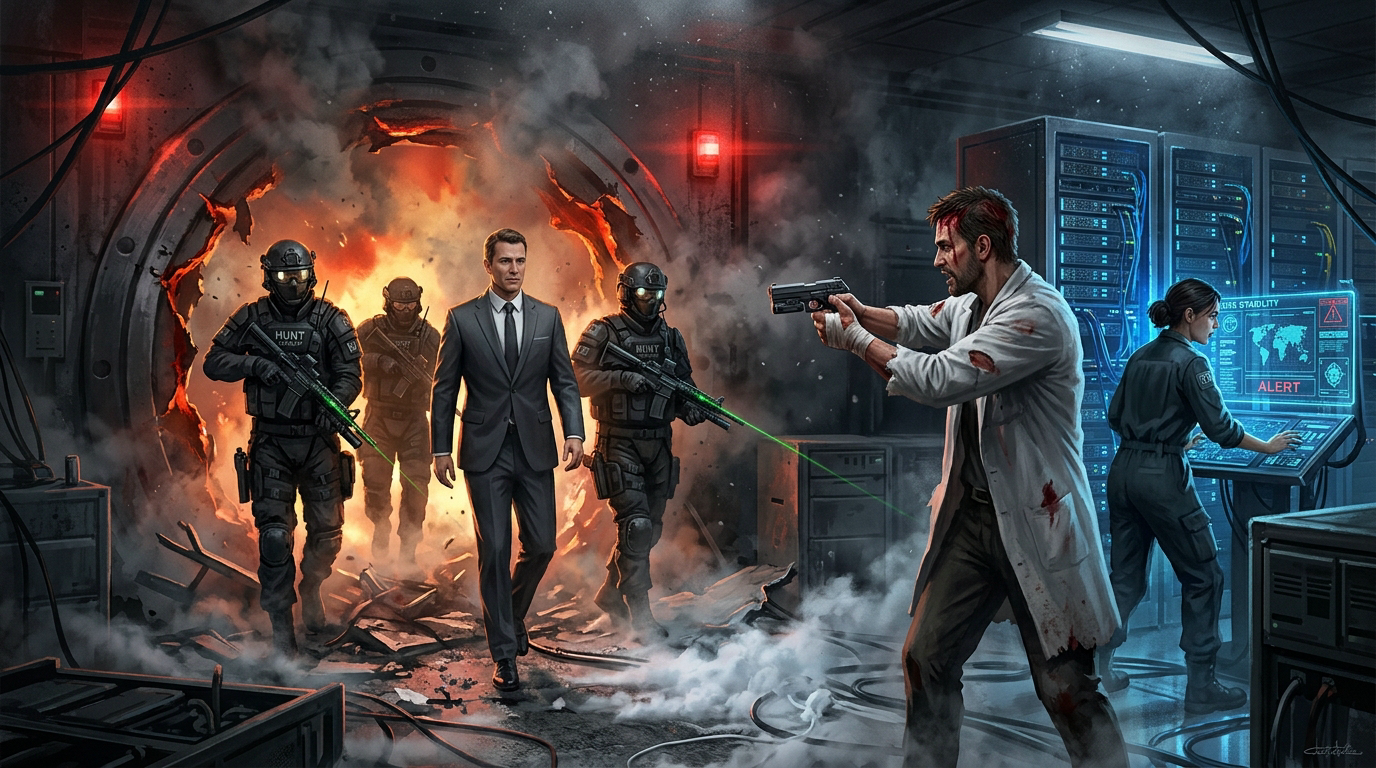
The center of the titanium bulkhead went the color of a dying sun.
Dr. Daniel Cole raised the kinetic-slug sidearm and let his finger ride the trigger guard. Blood from his lacerated palm had made the grip greasy. He didn't adjust his hold. He stood between the burning door and the quantum mainframe, where Dr. Yara Haddad was backing up the translation of the cosmos as fast as the interface would take it.
Heat came off the airlock in a wall. It hit the nitrogen exhaust from DEEPWELL's cooling jackets and the two of them fought it out along the floor, fog rolling and banking, lit red by the emergency strobes and white by the thermite eating its way through three feet of alloy.
"Yara." Cole's voice had nothing left in it but adrenaline. "Pull the drive."
"Ten seconds." Her fingers moved across the haptic interface. She didn't look up from the scrolling geometry of the convergence data. "The translation matrix is migrating. They wipe the servers before I have the root cipher, we lose the legal clause. That's the only leverage we have."
The bulkhead let go with a scream.
Locking mechanisms vaporized. The slab blew inward and hit concrete, and the shockwave took out the glass on every secondary monitor along the wall. Pulverized concrete and chemical smoke rolled into the freezing air of the nexus.
Cole squared up and put the heavy pistol on the center of the breach. Vance's tactical operators, he thought. Matte-black armor, quad-tube night vision, suppressed carbines, a rogue defense contractor running a scorched-earth purge.
Four armed men came through the smoking aperture with their rifles up, green targeting lasers sawing through the haze.
They didn't fire.
They fanned out instead, took the perimeter of the ruined door, put their weapons on Cole's chest, and went silent.
A fifth figure stepped through the smoke.
No armor. A charcoal-grey civilian suit, tailored close, jacket unbuttoned, hands in his pockets. He crossed the glowing edge of the bulkhead without looking down. His oxfords crunched on the debris. He took in the room the way a man takes in a property he already owns: the towering stacks, the hissing coolant lines, the whole cavernous archive.
Cole's gun dropped an inch. His mind had been running past redline since the global activation and it stalled out entirely.
"Harrison?"
Arthur Harrison. Director of Operations for UNCAP. The man who had recruited Yara personally. The man who had walked Cole's file past three internal security audits. The man who, three hours ago, had pressed the master decryption keys into his hand and said it was time the world stopped being lied to.
Harrison smiled at him, and the warmth in it looked entirely real. He might have been arriving for a board meeting rather than leading an armed assault on a classified bunker a mile underground.
"Hello, Daniel." The voice carried over the servers without effort. "You can put the gun down. The difficult part is over."
Cole kept the weapon up. The confusion in his chest was hardening into something colder. He looked at the operators standing to either side of the Director. "What is this? Did UNCAP take the facility off Vance? Where's the Undersecretary?"
"Elias Vance is managing the kinetic assets on the surface." Harrison walked out of the smoke into the freezing vapor. He didn't shiver. The temperature seemed not to reach him at all. "A very capable blunt instrument. Not much of a rhetorician. I thought I'd come down and handle the archiving myself."
Behind Cole the mainframe chimed, soft and melodic. The copy had finished. Yara pulled the flash drive and closed her hand around it, and turned to face the UNCAP Director. She had spent the last hour translating the taxonomy of the makers. She knew how power was shaped better than anyone in the room.
"You." It came out barely above a whisper. "It isn't Vance pulling the strings. It's you."
Harrison tilted his head, dark eyes settling on her. They didn't move. Human eyes never fully stop, they drift and tick with attention and feeling, and his sat in their sockets with the frictionless stillness of a reptile on a warm rock.
"You gave me the codes." Cole's voice cracked. He took a step forward and the gun shook with him. "You told me the embargo had to break. You told me the public had a right to know about the biologics. About the harvest."
"And you executed the leak flawlessly, Daniel." Harrison's tone shifted, patient now, a teacher with a promising but slow student. "You bypassed the DEEPWELL firewalls. You dumped seventy years of program record onto the global networks. You broke the truth embargo. You did exactly what I needed you to do."
Cole looked at the monitors still alive on the wall. The feeds were running a world coming apart. London, Tokyo, Washington, cities under smoke, mobs against riot lines, the animal terror of a species that had just learned it was property.
"You didn't want to free us." The understanding arrived like a car braking too late. "You wanted to break us."
Harrison sighed, and the sound hung in the freezing air.
"You have such a narrow view of history." He began to pace the perimeter of the quantum core, hands still pocketed. "You look at the embargo. The secrecy, the denial, the ridicule attached to the phenomenon since 1947. And you conclude it was a government conspiracy to hold power. You think humanity built that cage to keep out the ontological shock."
He stopped. He looked straight at Cole.
"The government didn't build the embargo. We did."
Yara came out from behind the console. "The Prior Claimants. The Incumbents."
Harrison's mouth curved, slow, appreciative. "I prefer stewards. We were here long before the Architects came down out of the thermosphere and started injecting their exotic code into the local hominids. The Earth was ours. The raw material was ours. When they mandated the hybridization project, they promised to return and grade the crop. Nobody consulted us about the sale."
He gestured at the burning streets on the monitors.
"My masters couldn't fight the Architects in the sky. Couldn't out-engineer the Grays who came in the night to tend the bloodlines. But they could manage the soil." His voice dropped into something resonant, almost soothing. "You want a crop to fail inspection, you don't burn the field. You poison the roots. So when the modern contact began in the twentieth century, we stepped in. We created the committees. We whispered to generals and presidents. We built the stigma. We made certain that anyone who looked up and told the truth got laughed at as a lunatic."
Cole couldn't get air. Not lasers, not craft in the sky. Eighty years of sociology, run patiently against a species that never knew it was in a war.
"You built a pressure cooker."
"We built a quarantine." The correction came smoothly. "A species kept in the dark for a century doesn't adapt to the light, Daniel. It goes blind. It panics. It starts swinging. The Architects are sterile, frictionless beings. They want to know whether humanity is worthy of inheriting their cognitive architecture. They want to know whether the Bridge can hold. We spent eighty years making sure that when the Adjudicators finally arrived to administer the test, they'd look down and see a violent, feral ape."
He pointed. "And you, the righteous whistleblower, pulled the trigger for us. You handed them the panic. The test is underway as we speak, and humanity is failing spectacularly."
Cole's finger tightened. He could do it. He could put a slug through that impeccable chest and watch the suit come apart. It would change nothing. The data was out, the cities were burning, and the trap had closed using his own conscience as the mechanism.
"Your masters made a miscalculation, Director." Yara's voice came out steady. She slid the flash drive into the pocket of her UNCAP blazer.
Harrison raised an eyebrow. "Did they, Dr. Haddad?"
"They rely on you." She moved closer to Cole, eyes never leaving the Director. "They have to use human proxies. Do you know why?"
Harrison didn't move at all. "Enlighten me."
"Because the factions can't lie." She had the linguistic truth of the cosmos in her mouth now and it steadied her hands. "The Architects, the Grays, the Mantids. Their cognitive structure is entirely telepathic. Shared geometry, unfalsifiable. Deception isn't a sin for them, it's a physiological impossibility. They can't comprehend a falsehood."
She took another step. The fear went out of her face and something harder came up behind it.
"But we can. We evolved with the capacity for the useful lie. And because the makers can't lie, they couldn't build the embargo themselves. Couldn't run the disinformation. The Incumbents had to recruit humans to do their lying for them."
Harrison's smile widened, and the teeth in it sat a fraction too sharp for a human jaw. "A useful loophole in the architecture. Evolution is so wonderfully messy."
"It's a vulnerability," Yara said. "The Mantids are up there right now as impartial auditors. They recognize the Convergence Rule and nothing else. Independent, corroborating truth. Which means if we reach the Adjudication, their own inability to deceive is a weapon we can turn."
She patted the pocket. "Every mythology you tried to bury says the same thing. The return comes with a condition. We get a vote in what we become."
Something crossed Harrison's face then, the first thing that had moved on it. Irritation. The executive mask slipped a half-inch and the old predatory thing running the hardware showed through.
"You are not going to the Adjudication, Dr. Haddad."
He nodded to the operators at the door.
Two of them came fast. Cole never tracked the movement. The one on his left drove the reinforced stock of a carbine into his ribs and the bone went with a wet snap. His vision whited out. He hit the concrete, and the pistol skidded away across the floor, spinning.
The second took Yara's arm, folded it behind her back with mechanical economy, and put her on her knees beside him. She cried out. Then her jaw locked and she glared up at the Director.
Harrison walked over to the dropped sidearm and nudged it aside with the toe of one oxford. He stepped up to the mainframe. DEEPWELL code was still running down the primary monitor and he made no move to delete any of it. The hardware had stopped mattering. He reached out and traced the edge of the screen with long pale fingers, unhurried.
"You believe you have time to argue legalities with the Mantids." His voice came back off the concrete. He turned his head and looked up at the ceiling, past it, as though a mile of bedrock were nothing and he could see the silent craft hanging out there in the dark.
"You are out of time."
He checked the silver chronograph on his wrist.
"The 3:33 activation sequence has resolved. The biological timer in the bloodlines has finished firing. The implants are quiet."
He looked down at Cole, who was curled around his ribs and fighting for air.
"The Roll Call is over, Daniel." Almost a whisper. The room got colder around it. "The global inventory is complete. The crop has been counted."
He stepped back from the console and buttoned his jacket, one precise motion.
"The Adjudicators have seen the riots. They have seen the feral nature of the asset. The proceeding has moved to the threshold." He looked down at the two of them bleeding on the floor of the archive they had bled to expose.
"You have exactly seven days," Harrison said, his black unblinking eyes swallowing the strobe of the servers. "Seven days until the sky opens, the project is voided, and they wipe the board clean."
Chapter 23 — Seven Days
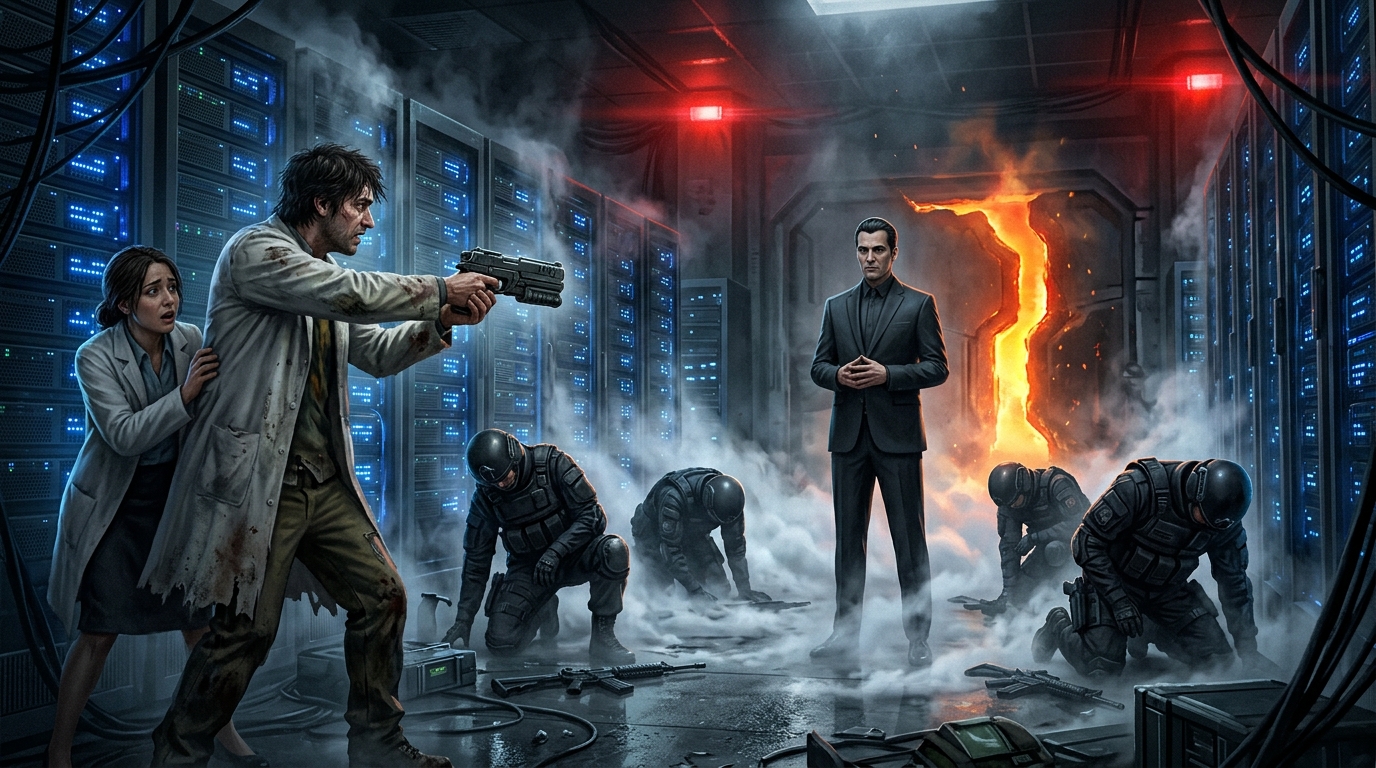
Arthur Harrison did not look like a man with a kinetic-slug sidearm pointed at his chest. He looked like an executive waiting out a subordinate's tantrum. He stood in the freezing vapor of DEEPWELL's primary data nexus, and the molten rim of the breached titanium bulkhead threw a red wash across his charcoal suit.
"The drive, Daniel." Harrison's voice kept the same unhurried rhythm it had used in budget meetings. "The embargo is broken. The cities are burning. The Adjudicators are watching the feed. The Incumbents have already won. You're holding the translation of a contract that no longer exists."
Cole's arms shook. Blood from his palm had worked into the checkering of the grip and the pistol wanted to turn in his hand. Behind him Dr. Yara Haddad had the UNCAP flash drive pressed against her sternum with both hands, watching Harrison the way you watch a wasp on your arm. Nothing behind those eyes moved. Whatever wore the Director now had hollowed him out and kept the suit.
"You're not getting the drive," Cole said. His voice came out thin and hard. Forty years of work, and every hour of it had been paid for by the thing standing in front of him. "You want it, you order your men to shoot."
The four tactical operators had their suppressed carbines up. Green laser dots wandered over Cole's chest, drifting with the tremor in their arms.
Harrison sighed, a soft hiss that carried in the nitrogen fog. "Very well. A martyr to the last. Neutralize him."
Grips tightened.
Nothing fired.
The pressure in the room fell so fast that Cole's ears popped and stayed popped, a dull ringing where sound had been. The coolant lines went quiet. The red strobe hung in place between pulses, and the air thickened until breathing felt like work.
The four operators locked up.
Every muscle at once, in the same instant, as though a single switch governed all of them. The carbines dropped and rang off concrete. Then the men went down to their knees one after another, heads sinking toward their chests, necks bending under a weight that was not in the room.
Harrison's smile went out. His neck jerked once, hard, the stillness breaking into something spastic, and he turned toward the ruined bulkhead.
A figure came through the smoking gap.
Sael crossed the threshold without any of the small corrections a body makes when it walks. The UNCAP civilian blazer had not taken a single mark from the thermite or the fog. Pale tapered fingers hung loose. Cole's skull filled with pressure, the sensation of a hand closing gently around the back of his brain, and he understood that every mind in the room was being held the same way.
"They cannot fire." The voice was soft and arrived somewhere behind Cole's ears rather than in them. "Their baseline neurology is attempting to process a three-dimensional projection of a four-dimensional space. They will remain immobilized until I release the projection."
Cole lowered the gun. He had read the clinical files and squinted at the classified photographs, gray shapes on gray tables. None of it had prepared him. Two hundred thousand years of harvest, and here was what it had been for, standing in a smoke-filled server room in a blazer.
Sael wasn't alone.
Two human figures came through the breach, coughing in the chemical smoke.
Cole knew her at once. Lena Sokol, out of the bloodline registries he had dumped onto the open internet a few hours ago. She had a steel wrench in one fist, knuckles bloodless around it, soot cut through with sweat down one side of her face. Her eyes went around the room the way a dog's do in a strange house.
Her other hand had a seven-year-old boy by the wrist.
Theo.
The boy wasn't frightened. While his mother tracked the kneeling soldiers and the glowing doorway, Theo had turned toward the black monoliths of the quantum mainframe and stayed there. His pupils were wide in the dim. His eyes moved along the racks in small increments, following something.
"We walked through the UNCAP kinetic lines," Sael said, coming to the center of the room. "The personnel were well trained. Training is a kinetic answer to a kinetic threat. They had nothing for structural telepathy."
Harrison backed away and his oxfords skidded on pulverized concrete. He brought his hands up, fingers curling in on themselves. "You." The word came out an octave low, buzzing, made in some other apparatus than a human throat. "The abomination. The compromised vessel."
"I am the Bridge," Sael said. "You are an unauthorized occupant of a biological unit."
"This world belongs to us!" It was not Harrison shouting. The Director's face had gone slack around it. He lunged, not at Sael but past Sael, at Yara, at the drive in her hands.
Sael did not move to block him. Sael looked at him.
The air between them bent, the way it does off summer asphalt. Whatever Sael reached with went around Harrison's brain entirely and took hold of the tether behind it, the line that ran from this man to the things that had been using him.
You manage the soil, Sael sent, and it went through Cole hard enough to put him on his knees with both hands at his temples. You do not own the sky.
Harrison stopped mid-stride. His mouth opened and no sound came out of it. Then the tether parted, that old parasitic line the Reptilian faction had run through human governments for as long as there had been governments, snapped by something with more capacity behind it than the whole species had ever fielded.
Blood came out of his nose in a rope. His eyes rolled up white and he went over backward into the fog, and his heels drummed the concrete a while before he stopped.
The room was quiet except for Lena's breathing, ragged and too fast.
"Is he dead?" She pulled Theo in against her hip.
"No." Sael knelt beside him and laid two fingers on his carotid. "His human consciousness is intact. He will have a severe headache. The proxy link is severed. The Incumbents cannot see through him now."
Sael stood and turned to the two of them, the bloodied scientist and the linguist with soot in her hair, and settled on the drive in Yara's hand.
"You are Dr. Haddad. You translated the broadcast."
"I translated the structural geometry into text." Yara's voice shook, then found the register she used for conference rooms. She came out from behind the console with the drive held up. "The Mantids. The Adjudicators. They aren't an invasion force. They're a tribunal. They've come to judge the harvest."
"Yes. And the Incumbents have arranged for the primary evidence, which is the human population, to be in maximum feral panic when it is examined. The Adjudicators are impartial. They will evaluate the surface and rule the genome inherently unstable. The project will be terminated."
"Wait." Cole got a hand on the console and hauled himself up. He looked at Sael, then Lena, then the boy. The Insider. The Linguist. The Experiencer. The Product. Every one of them in a room he had chosen, and he had never once chosen it. "The test is a legal proceeding. A tribunal requires a defense. If the Incumbents are the prosecution, who speaks for humanity?"
"That is why I brought them." Sael gestured at Lena and Theo. "DEEPWELL is the physical and communicative nexus of the embargo. If humanity enters a plea, it must be transmitted from this room. We do not have much time."
Sael's eyes closed for less than a second. "The Roll Call is nearing completion. The biological registry of every bloodline will lock. We have exactly seven days until the Adjudication convenes its final session."
Seven days.
Lena stepped forward. The wrench came up an inch. "My grandmother's journals said they always came at night. They took us, they examined us, they put the code in us, and they always made us forget. They used owls. Deer. Screen memories." Her jaw worked. "If this is a legal proceeding, why did they lie to us for seventy years?"
"Because of the physics of the Program," Yara said.
She crossed to the surviving secondary monitor and pushed the drive into a hardened port. The news feeds blinked out and the translated cosmology came up in their place, dense text scrolling faster than anyone could read it.
"The makers. The Architects, the Adjudicators. They don't use spoken language." Yara worked the keyboard, hunting the statutes. "Their society runs on structural telepathy. A shared medium. Objective. Do you understand what that means?" She stopped typing and looked at Lena. "It means they cannot lie."
Cole dragged a sleeve across his forehead. "They can't deceive each other."
"They can't deceive anyone. A lie needs a gap between the speaker and the listener. In a telepathic architecture there is no gap. The truth is unfalsifiable, and that's the foundational rule of the Adjudicators. They accept nothing else. And they hold a procedural doctrine about the human subjects."
She highlighted a block of glowing text.
"Consent." The word went out flat into the cold. "To alter a sentient species, the Architects required that the species offer consent to the procedure. But the weight of the truth, the actual reality of the cosmos, the size of the architecture behind it, that shatters a baseline human mind." She tipped her head at the kneeling operators. "Sael just proved it on those guards."
Lena looked at the screen a long moment. "So the Grays engineered around it."
"Yes," Sael said. "The Engineers are pragmatic. They needed the genetic material to build the Bridge and they knew you could not survive the psychological trauma of true consent. So they used the screen memories. They painted an owl over the memory of the examination room. You consented to the owl. A procedural loophole. It allowed the work to continue."
"And the Adjudicators are here now." Yara's mouth was a line. "They don't accept loopholes. They despise the screen memories. As far as they're concerned the entire hybridization program is tainted by deception. The only way humanity enters the proceeding, the only way we invoke the clause and speak for ourselves, is to file our defense perfectly clean. No deception in it anywhere."
"How?" The word came out of Cole thick. His stomach had gone cold and heavy. "How do we transmit a perfectly true defense to a Mantid?"
Yara's hands stopped over the keyboard. She didn't look at Cole. She looked at Lena.
"The convergence of the myths was very specific," she said, reading the last addendum of the rulebook. "To testify before the Mantids you cannot speak. Not words. Words can be manipulated. You transmit your cognitive architecture directly to the Adjudicator. You step onto the presentation table, you bypass the screen memory, and you offer true consent, unshielded."
Somebody's boot scraped concrete. Nobody said anything.
"You have to let them read you." Yara's voice cracked on it. "All the way down to the biological code. To prove humanity is worth the inheritance, the testifier has to offer their mind to the absolute geometry of the Mantid."
"What happens to a human mind when it does that?" Lena barely breathed the question, but it went through the hum of the servers like wire.
Sael turned to her, and something surfaced in those dark eyes that had been inherited from the human half and had no business in a face built like that.
"A baseline human consciousness cannot hold the infinite," Sael said. "It is like pouring an ocean into a teacup. The truth of the Adjudicator is a fire. It burns away the subjective self. To transmit the defense, the volunteer will undergo total cognitive disassembly."
Sael let that sit in the cold.
"To enter the proceeding, the volunteer must consent to be unmade."
Lena looked down. Theo hadn't moved. He was still watching the mainframe, his small face lit blue by data running across the glass, and his hand in hers was warm and dry and his pulse was steady. The youngest. The fastest. The most fully activated of all of them. The Bridge.
She knew then, with a lurch like a stair that wasn't there, exactly who the Architects would call to the stand in seven days.
Chapter 24 — The Garden
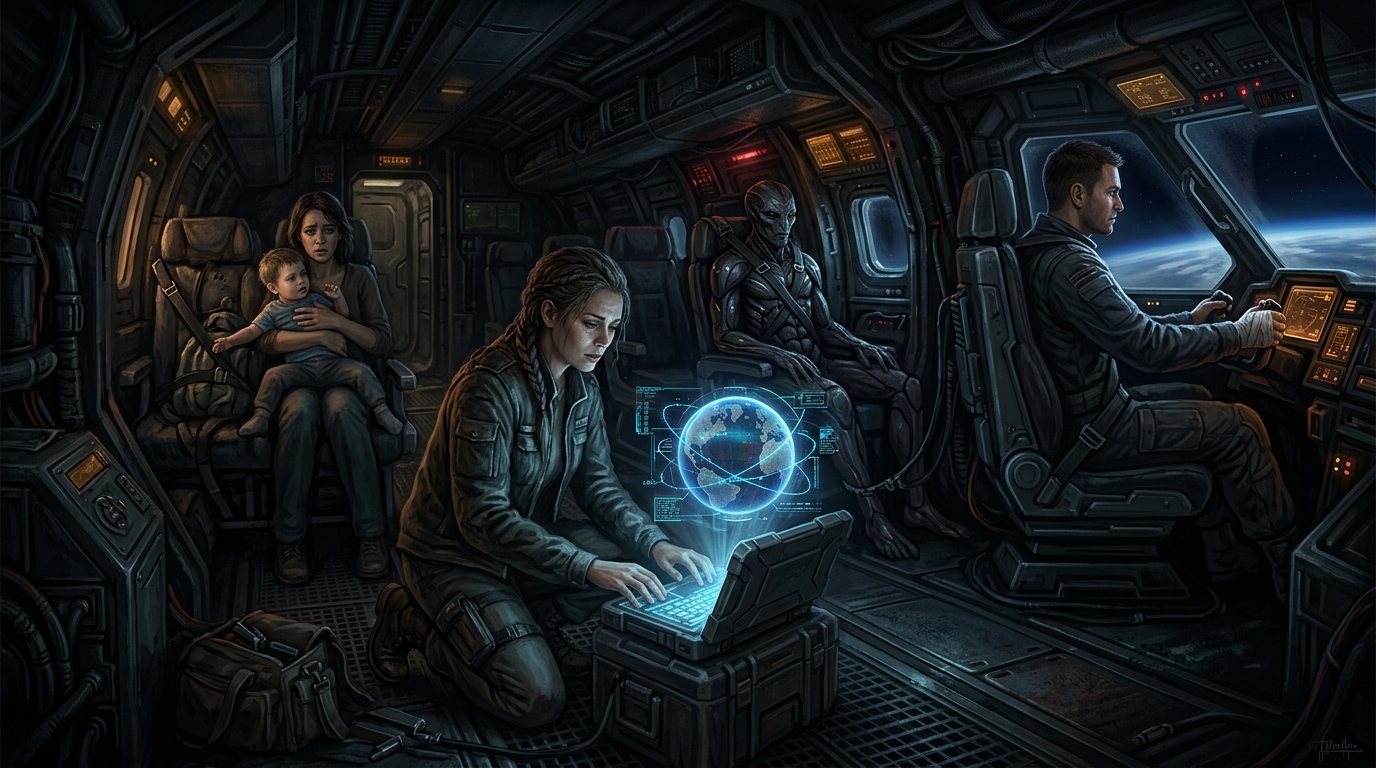
The DEEPWELL transport didn't fly. It canceled the physics of whatever space it moved through, so there was no engine roar, no shudder of air against the hull. Inside the stolen craft the only sound was four people breathing badly.
Dr. Daniel Cole sat in the pilot's seat with his lacerated right hand wrapped in gauze off the med-kit. The controls were reverse-engineered neuro-haptic, seventy years of desert crashes distilled into a curved panel that answered before he finished reaching for it. He didn't steer. He gave it a destination.
Behind him, Lena Sokol held her seven-year-old son. Theo slept the way an animal sleeps in a trap, eyes racing under thin lids, jaw working. The activation sequence was burning through him, the same biological timer running in every child of the experiencer lines. She smoothed his hair and watched Sael, motionless across the aisle.
The hybrid liaison hadn't blinked in twenty minutes. Sael sat with a stillness no spine should manage, and Lena kept looking because she couldn't stop doing the arithmetic. That posture. That absence. Whatever holds a truth too large for a human mind holds it by not being human anymore.
"We're over the Mediterranean," Cole said. His voice went nowhere in the dampened cabin. "Four hours, maybe, before Vance gets UNCAP's internal comms up and works out we took the transport. Yara. If we're presenting a defense to the Adjudicators, I need to know where the courtroom is."
Dr. Yara Haddad knelt on the deck plating with DEEPWELL's master drive jacked into a field terminal. Blue light came up off the holographic display and found every hollow in her face. She wasn't reading text. She was turning a topographical Earth in both hands, laying it against the geometry of the Mantid's broadcast.
"It's not a courtroom." Her fingers swiped down through tectonic strata, archaeological strata. "It's a threshold. The text calls it the Point of Insertion. Where the Architects broke the hominid genome open and put the exotic code inside."
"The Garden," Lena said. The word snagged on the way out. Estela's journals had circled it a dozen times, always underneath the screen memories, the bright rooms, the cold tables. They take us back to the garden to plant the seed.
"Yes." Yara tapped the display. "And we've read the mythology wrong for two hundred years. We treated the creation myths as local metaphor. They're a globally convergent memory of one physical location."
She pulled the projection out until the whole globe turned, then dropped red pins across it.
"Look at what the record actually shows. Polygonal masonry at Puma Punku. Machined diorite at Giza. The subterranean geoglyphs at Nazca that only resolve from the air. Historians have spent centuries asking how ancient humans hit that precision." She let a beat go by. "They didn't."
She found Cole's eyes in the reflection on the cockpit glass.
"The megalithic sites weren't the event. They were cargo cults. The teaching age ended, the makers pulled out, and isolated populations spent thousands of years trying to rebuild the factory conditions from a memory they couldn't name. Everyone was building the same room."
Sael's head turned, smooth as a gyroscope coming about. "Replication is a recognized flaw in the asset. They raise monuments to acoustic and gravitational engineering they cannot read, and wait for the sky to reopen."
"Exactly." Yara wiped Peru, Egypt, Mesoamerica off the board and brought the map down onto the Tigris-Euphrates basin, southern Anatolia. "Convergence points backward to an origin. One location, before the diaspora, where the megalithic architecture meets the ground markings and where the Incumbents' core motif, the adversarial serpent, shows up for the first time anywhere."
The hologram plunged. It tore through the modern borders of Turkey and Syria and dropped into the Karaca Dağ volcanic field, miles off from the ruins everyone photographs.
"Göbekli Tepe is the oldest temple we admit to," Yara said. "It's the roof. It's the dirt humans shoveled over the real site to bury it. The structure is three hundred feet under the bedrock, and it's an acoustic containment chamber."
Cole's gut went tight. He pulled the classified directory onto the secondary screen and put her coordinates against it. A black zone bloomed on the monitor, unacknowledged, no owner listed.
"Site Four." He barely got it out. "DEEPWELL cordoned that whole valley in the nineties. Cover story was a toxic geological vent. There's a subterranean excavation on the manifest and the manifest says it's empty."
"It is not empty," Sael said. "It is waiting for the timer to expire."
Cole took the manual descent thrusters. The transport tipped and fell out of the stratosphere at an angle that should have made noise and didn't. Anatolian dark came up at them.
The Taurus Mountains resolved on the visual sensors inside two minutes, dry ridges, no lights anywhere. The region had emptied during the first wave, when the objects stopped bothering to hide. Far east, orange smeared the horizon where the oil fields burned and a civilization ate itself.
They crossed a wide artificial depression. From above it read as a caldera, scrub brush and broken limestone, until Cole brought the craft lower and the exclusion zone's optical camouflage stuttered and gave up a shaft, sheer-walled, driven straight down.
"Hold on," he said, and took them into the throat of it.
The descent went on. Hull temperature fell off a cliff. When they broke through the bottom the floodlights opened on a cavern the beams couldn't cross, no far wall anywhere in them.
Cole set down on flat black stone. The engines died out of their hum and left the silence of deep earth, which has weight to it.
Lena unbuckled and got Theo's hand in hers. He was awake now, eyes wide, tracking something in the dark that had no light on it.
"Are we there?"
"Stay close to me." She pulled the steel wrench from her belt, the one she'd taken out of the UNCAP armory. Against any of this it was a joke. Her hand wanted the weight anyway.
Cole popped the airlock and the ramp came down on a hydraulic hiss.
Cold poured in, ozone and pulverized rock. Their boots rang off the floor.
He raised the tactical torch and swept it.
Not a cave. A machine.
The floor was polygonal basalt in blocks that had to run to thousands of tons each, set so close the seams refused the eye. No mortar. No tool marks. Rock commanded to go liquid, then told when to stop.
Cut deep into it were the ground-markings: vast intersecting trenches laying out the same geometric labyrinth Yara had pulled from the Mantid broadcast.
"Megalithic precision," she said, and walked forward without watching where. She went to her knees and put shaking fingers along a seam. "It's a clean room. A genetic clean room. The geometry isn't decoration, it's a circuit. It channels telepathic structure."
Sael passed them, moving for the center of the chamber with no wasted motion. "The architecture damps external biological noise. When the hominid genome was first unpacked here, the Architects required total silence to write the code. Emotion is a contaminant. This room isolates it."
Lena followed and her chest closed by degrees. Here. The actual coordinates where a primate's raw clay had been twisted into something to carry the makers. She kept scanning the dark walls, waiting for the clinical white glare of the examination lights she had never been able to stop remembering.
Cole's beam hit the far wall and stopped moving.
"Yara."
Two hundred feet of sheer diorite, and on it a carving. Nothing about it matched the floor. It was hacked, jagged, deep, a wound opened in the clean room's geometry by something that wanted the geometry ruined.
A serpent.
The coiled body took the whole wall. The jaws hung open above a circular indentation in the stone, and the indentation was the shape and size of a cradle.
"The serpent in the garden," Yara said. Her face had gone bloodless. "The cross-cultural adversary. The tempter."
"It is a territorial brand." Sael said it the way you'd read a placard, looking up into the coils. "The Architects finished the initial edit and withdrew to let the asset gestate. The Incumbents entered the facility. They could not undo the sequence without destroying the crop, so they marked the pen. They claimed the Earth and everything born on it."
Theo let go of Lena's hand.
He was walking before she could close her fingers, straight for the raised black dais at the center, lined up dead-on with the ground-markings. His feet came down inside the grooves. He never once looked at them.
"Theo!" She was already running.
His hand went flat on the cold stone of the dais.
The cavern shuddered. Not an earthquake; a pressure wave that put every human in the room on their knees. The trenches lit, a pale cold luminescence running the labyrinth, climbing the walls, giving up the scale of the place all at once.
Somewhere under the rock a sound started building, a low resonant thrum like a mechanical heart the size of the mountain above them.
"The Point of Insertion has registered the Bridge," Sael said to the glowing dais. "The biological timer is recognized. The Adjudication chamber is unlocking. We have initiated the final phase of the tribunal."
Lena got both hands on Theo's shoulders and hauled him back. He didn't fight her. His eyes had the pale light in them, held there, mirrored.
"What happens now?" Cole shouted over the subsonic roar. "How do we enter the plea?"
Sael never answered. An alarm ripped out of the field terminal Yara had dropped by the transport.
Cole ran for it. The screen was flashing red, DEEPWELL security tracking the surface perimeter three hundred feet above their heads.
"No." All the color went out of him. "No, he wouldn't."
"Cole?" Yara was at his shoulder. "What is it?"
He turned the screen.
Headlights, a sea of them, converging on the exclusion zone. Thousands of vehicles across the Anatolian plateau, trucks and rusted sedans and armored transports, going through the perimeter fences like the fences were paper.
Not just Vance's rogue security teams.
A mob. On infrared the crowd surged and folded and surged again, people going down under other people, everyone driving for the shaft. Some carried rifles. Some carried whatever had been in reach. They were screaming at the sky and screaming at each other.
"The Incumbents." Yara barely made it over the hum of the waking factory. "Harrison and Vance didn't just bring an army to stop us."
"They brought the panic." Cole couldn't look away from the feed. "Vance dumped the coordinates of the Garden onto the public networks. Told the doomsday cults, the militias, everybody bleeding out of the cities, exactly where to go for salvation."
Sael came over and read the screen with the interest of a technician confirming a prediction.
"The Adjudicators are impartial. They will evaluate the evidence presented at the threshold. The Incumbents have ensured that when the makers open the door to judge humanity's worthiness for uplift, the first thing they see will not be a defense."
Sael looked up the long dark of the shaft.
"They will see a rabid animal, eager to tear itself apart."
An explosion went off on the surface. Dust and fire came down the shaft ahead of the sound, and then the sound arrived: thousands of human beings screaming as they spilled into the descent.
The courtroom was open, and the prosecution had just delivered its star witness.
Chapter 25 — The Lie and the Truth
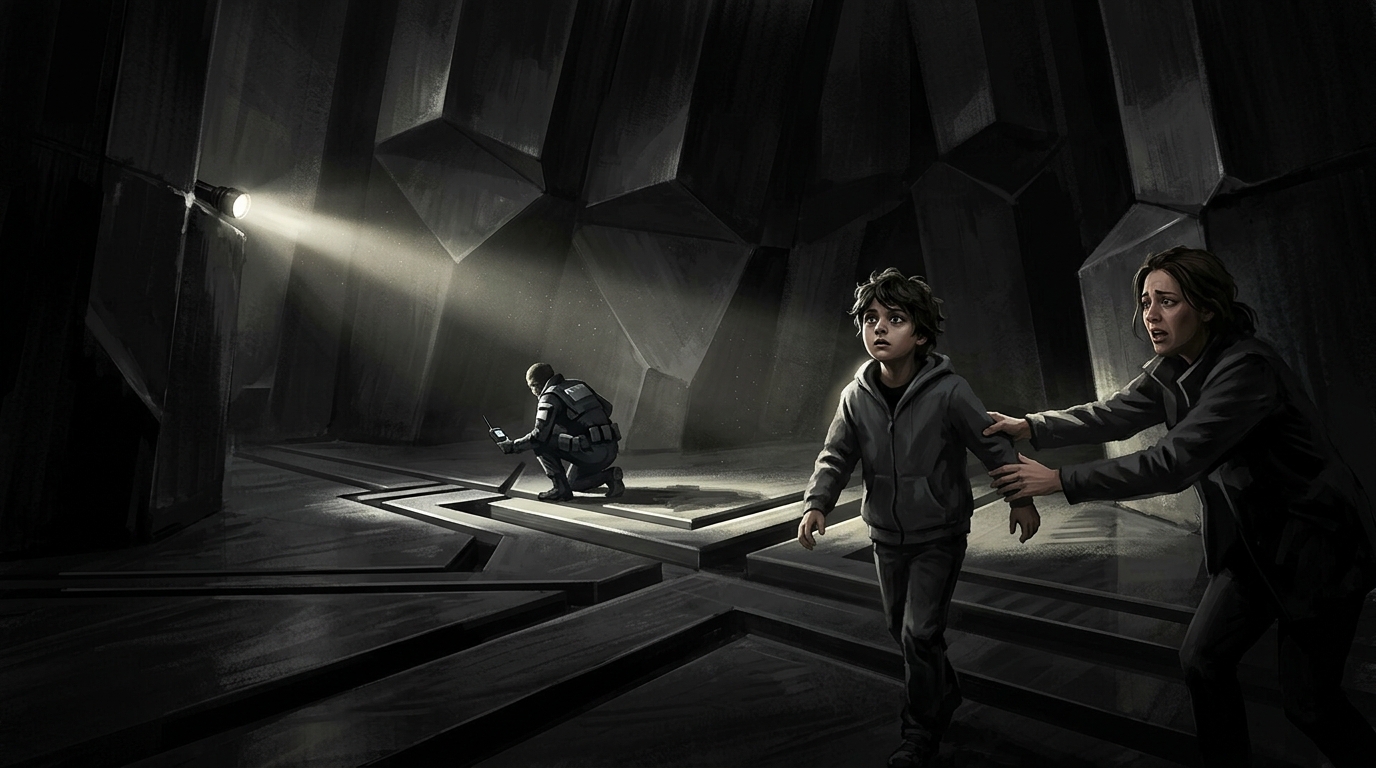
The silence in the chamber pushed back. Cole's boots came down on polished black basalt and made no echo at all; the sound died where it was born, absorbed by stone cut in angles that seemed to eat noise the way a drain eats water.
He swept his torch across the dark. Trenches ran through the floor, cut straight into it, intersecting and turning at hard right angles. No curves anywhere. No flourish. Whoever built this had thought about the universe the way an engineer thinks about a load-bearing wall.
"The acoustics," Dr. Yara Haddad whispered. Her voice arrived flattened, as if she were speaking through two inches of glass. She knelt beside one of the grooves and ran her fingers along an edge that gave her nothing to catch on. "There's zero reverberation. These angles trap the frequency and cancel it. It's an isolation booth."
"Biological life produces interference," Sael said. The hybrid moved out ahead of them across the megalithic floor, tracking patterns in the air that none of the humans could see. "Fear. Hunger. Deception. Evolutionary adaptations of a prey species in an uncontrolled environment, and they generate a chaotic neuro-electric static. When the Architects first unspooled the hominid genome here, they required total environmental control. They could not write the code in a noisy room."
Lena Sokol kept her left hand around the steel wrench she'd taken from the UNCAP armory and her right locked over Theo's fingers. The architecture meant nothing to her. What her son was doing with his face meant everything.
His pupils had gone wide and black. He was breathing slow and even, nothing like the hammering in her own chest. He wasn't staring into the dark. He was reading the room.
"Theo." Her voice came out thin. "Look at me."
He didn't turn his head. "It's sleeping, Mom. But it knows we're here. It can taste us."
Then his hand slid out of hers. Three steps and he was at the center of a wide hexagonal intersection in the trenches, kneeling, laying his bare palms flat on the cold basalt.
"Theo, no!" Lena lunged, and Sael's arm came across her chest like a beam dropping into its seat.
"Do not interrupt him." Nothing conversational left in the hybrid's voice now. It carried the flat authority of the Adjudicators themselves. "The threshold requires a biological key to initiate the terminal. He is the fastest activation. He is the Bridge."
Something moved down in the bedrock. Not machinery. More like a vast eye grinding open under its own weight.
The groove beneath Theo's hands lit.
Faint blue at first, pulsing along with the boy's heartbeat. Then the light bolted outward, racing down the trenches, cornering hard at every ninety degrees, filling the labyrinth in the floor until the whole chamber lay under a lattice of pale geometry.
Cole staggered back with his hand at his temple.
The pain went in behind his eyes and stayed there. Not a headache. Closer to being lifted onto a scale, his whole self set down on the pan and read off. The air thickened around him like water.
PRESENCE ACKNOWLEDGED.
The words didn't come through his ears. They bloomed in the middle of his mind, in a voice ancient and entirely empty of feeling. The Mantid. The Adjudicator from the UNCAP broadcast, only close now, its attention narrowed onto five biological units standing in the Garden.
THE INVENTORY IS CLOSED. THE PROCEEDING COMMENCES. PRESENT THE BASELINE METRIC.
Cole went down on one knee, dragging air. Yara swayed beside him with the UNCAP flash drive clutched against her chest like it could stop something. Lena dropped and wrapped both arms around Theo. The boy never moved, hands glowing on the stone.
"What is it doing?" Cole got the words out around the sensation of his skull being opened and examined.
"Establishing the jurisdiction of the court." Sael stood in the pressure untouched. "The Adjudication is not a trial as humans understand it. It is a structural audit. The Mantid is demanding a statement of identity to calibrate the room's sensors. It needs a truth."
Yara pushed herself upright. The linguist in her would not lie down in front of this. She looked at the blue lines running across the floor and matched them against the topological map she'd decoded on the transport.
"A truth." Her breath plumed in the freezing air. "I can do that. I can establish the baseline."
She walked to the edge of the central hexagon and raised her face to the dark ceiling, to whatever was pressing down on all of them.
"We are humanity," she said, shaking, clear. "We are the resulting biological lineage of the genetic modification initiated at this site."
Nothing. The pressure held. The trenches stayed a cool, impassive blue.
"It does not hear you, Dr. Haddad," Sael said. "You are utilizing vocalized atmospheric vibration. You are blowing air through meat. The Adjudicators do not process audio. You must speak into the structure."
"How?" Yara pressed both thumbs into her temples. "I don't have the implant. I can't project telepathy."
"I will translate."
The hybrid stepped onto the lattice beside Theo. Sael's mouth stayed shut. Sael only looked at the room.
The floor flared white-blue. Above the trenches something took shape in the air, and it was not built of pixels or hanging dust. It was thought that had thickened until it held. A fractal of intersecting tetrahedrons, turning slowly, beautiful in the way a proof is beautiful.
"This is the structural translation of the concept you just voiced," Sael said. "It is a true statement. Notice the geometry. Stable. The angles support one another. It is mathematically whole."
Yara stared up at it. "You don't communicate in concepts. You communicate in architecture."
"Yes. Now observe what happens when a biological unit attempts to introduce a falsehood into the architecture."
Sael turned back to the room, face blank as a wall.
I am a fully unedited hominid, Sael projected into the lattice. I possess no exotic code.
The fractal shrieked.
There was no sound. It was a visual scream, angles colliding that could not be made to meet, the tetrahedrons warping as they tried to close on a shape physics wouldn't allow. The structure tore itself open in a burst of strobing light.
The force of it hit Cole in the gut. He gagged, copper flooding the back of his throat. Lena cried out and clapped a hand over Theo's eyes while the ruined light thrashed across the chamber.
Then it was gone. The broken fractal dissolved, and the floor settled back to its slow blue pulse.
"It collapses," Yara whispered, eyes still on the empty air where the lie had eaten itself.
"A falsehood is a structural impossibility," Sael said. "To lie in this medium is to build a tower out of mathematics that do not equal themselves. The structure comes down under its own contradictory weight. To the makers this is not a moral failing. It is a violation of physics. They cannot lie. They lack the mechanism to sustain a deception."
Cole wiped a thread of blood from his nose, chest heaving. "If they can't lie, how did the Incumbents trick them? Harrison said they poisoned the crop. Sabotaged our development."
"The Incumbents did not lie to the Adjudicators. They ensured that humanity produced nothing but structural noise. War. Division. Panic. When the Adjudicators look at the surface of your world right now, they see billions of fractured, contradictory signals. A species incapable of forming a stable geometry. The Incumbents win the custody dispute by letting humanity fail the audit."
Yara sank to her knees at the edge of a glowing trench. She stared into the light, and the training she'd spent twenty years building turned over in her head and caught.
"The Convergence Rule."
Cole looked at her. "What?"
"The methodology I used to decode the broadcast." She lifted her head to Cole, to Lena. "The same one the UNCAP sociologists used to filter the abduction lore. We only accept a claim as true if it turns up independently, across unconnected cultures and witnesses, and agrees on the specific details."
"Right," Cole said. "That's how we separate the truth from the noise."
"We use it as a filter." Her eyes had gone bright and awful. "They use it as their entire epistemology. If they can't lie, they have no concept of a conspiracy. No concept of a coordinated deception."
She got up and started pacing the edge of the glowing geometry.
"Sael. If one human transmits a signal, the Adjudicators test it for structural integrity. But what if ten million humans transmit the exact same signal at the exact same moment? Millions of independent, biologically isolated nodes broadcasting an identical conceptual geometry?"
Sael tilted their head. "If a signal achieves total structural convergence across millions of independent nodes, the Adjudicators' neuro-geometry dictates that it is an objective truth of the universe. It becomes unfalsifiable."
Lena looked down at her son. He was still touching the floor, seven years old, a conductive bridge between the megalithic network under his hands and the architecture waiting in the sky. Millions of experiencers across four generations, all carrying the dormant code, all carrying the implants. The 3:33 activation had strung every one of them onto a single global net.
"We don't have to pass their test." Lena's voice trembled as the size of the blasphemy landed on her. "We don't have to prove we're worthy of inheriting the Earth."
Cole looked up into the black ceiling and pictured them, the Mantids in the thermosphere, unblinking. The makers who built humans out of dirt. Gods who ran on no empathy and no mercy, only the cold arithmetic of convergence.
Gods without imagination.
"We just have to lie to them," Cole said. "Coordinate the perfect lie, broadcast it through the experiencer network, use their own rule against them. Force them to believe it."
"Yes." Yara watched the blue pulse under their boots. "The rule cuts both ways. They built us to be a manageable asset, and in doing it they handed us the one biological weapon they have no defense against."
The chamber hummed. Two hundred thousand years of stone vibrating around a machine that was waiting for an input.
THE BASELINE IS NOT ESTABLISHED. The Mantid's voice crushed down into them, the pressure climbing toward something final. SUBMIT THE TRUTH OF YOUR DESIGN, OR BE UNMADE.
Yara looked at Sael. Then down at the boy holding the keys to the global architecture.
"Theo," she said, cold and steady and terribly human. "Open the network. It's time to teach our creators how to tell a story."
Chapter 26 — Inventory
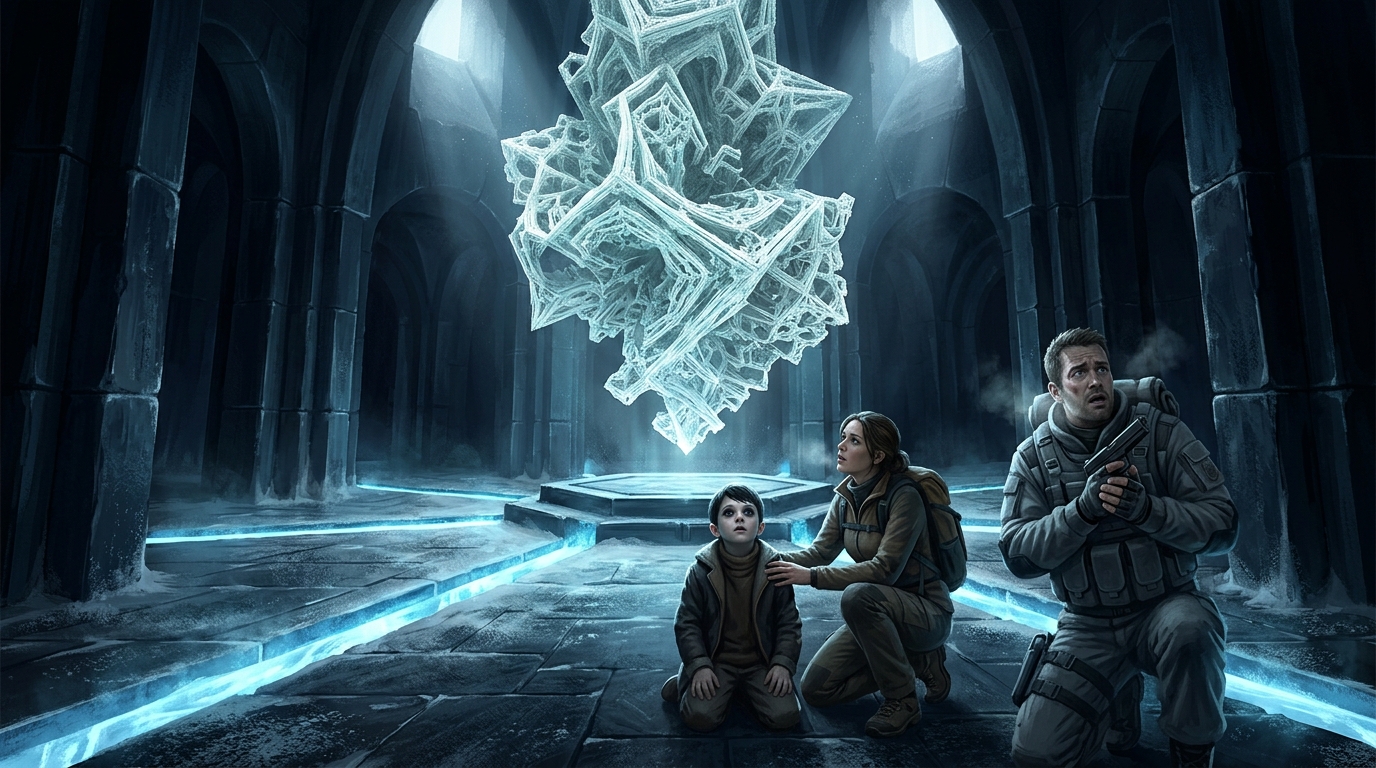
The blue light in the floor trenches stopped pulsing. It froze mid-beat and hardened, and the glare it threw showed how far the cavern actually went.
The demonstration was over. Sael's fabricated lie had collapsed out of the air, and what it left behind was worse than the lie: the makers could be broken. They were bound to the literal architecture of truth.
Humanity was out of time to use it.
"They are convening," Sael said. Nothing human moved in the hybrid's voice. It was the flat recitation of a weather event that would level a city. Sael stepped back from the glowing central hexagon where Theo knelt. "The Adjudicator has verified the acoustic isolation of the Garden. The chamber is structurally sound. The claimants are arriving."
"Arriving?" Cole wiped a fresh line of blood off his upper lip. His eyes went to the unlit fringes of the vault, and his hand went to the kinetic pistol at his hip, thirty years of guarding DEEPWELL's secrets reaching for the only thing it knew. "From where? The atmosphere?"
"They do not travel in vessels for this." Sael's dark eyes stayed on the empty air over the trenches. "This is not a kinetic theater. This is a probate court. They are projecting their consciousness into the architecture of the room. Brace yourselves."
The temperature crashed.
Their breath crystallized as it left them and came down on the polished basalt as fine snow. Cole's eardrums bowed inward. Pressure piled onto his skin the way water does at depth, until standing straight took effort.
Lena Sokol dropped to her knees beside the floor matrix and threw her arms over Theo. The boy pushed them off. Seven years old, pupils blown wide into the absolute black of full activation, watching the empty air with a vacant awe that had nothing to do with fear.
"Mom," Theo whispered. "The sky is too heavy."
Above the central intersection, geometry folded itself into being.
It did not appear. It extruded, dimension by dimension, a fractal architecture of pale icy light that kept unpacking into more of itself. No face. No body. Nothing biological anywhere in it. Yara Haddad's vision blurred and her stomach turned over, the vertigo of standing at the lip of something that had no bottom.
THE INVENTORY IS COMPLETE, the structure projected.
The words never touched the air. They detonated inside four skulls at once, carrying the same insectoid authority as the UNCAP broadcast. The Mantid. The Adjudicator.
THE ASSET HAS REACHED THE SCHEDULED THRESHOLD. THE HARVEST IS TRIGGERED. PRESENT YOUR CLAIMS OF OWNERSHIP.
"Yara." Cole had both hands clamped to his skull. "Translate it. What's happening?"
Yara forced her eyes open. Forty years of syntax and cultural context, and none of it was built for this, for grammar delivered as raw physics. "It's a custody hearing." Her nails were in her palms. "The Adjudicator isn't an invader. It's a judge. It's opening the floor."
A second presence hit the room before the pale structure could shift.
Cole dropped the pistol. Heat rolled over the cavern, sickening, and the smell of ozone and sulfur went up his sinuses like a chemical burn.
The shape that materialized opposite the Adjudicator was a dense jagged mass of arterial crimson. Heavy. Dominating. Built out of interlocking angles that existed to pierce and crush, and radiating a fury that was entirely about territory.
THIS IS A TRESPASS, it boomed, and the shockwave rang in Cole's teeth. THE SOIL WAS OURS.
"The Incumbents." Yara had seen that adversarial weight before, mirrored in every ancient text of the serpent. "The Reptilians."
Sael nodded, calm inside the psychic storm. "You are looking at the pure structural manifestation of the beings who owned this planet before the Architects arrived. Notice the geometry. It is possessive. It is anchored entirely in dominion."
The crimson mass swelled, crowding its angles against the Mantid's pale light.
THE HOMINID WAS OUR ASSET, the Incumbents argued, and the structure bled into Yara's mind as a sequence of historical facts she had no way to doubt. WE HELD THE DEED TO THIS ROCK. THE ARCHITECTS INTRODUCED EXOTIC CODE INTO OUR PROPERTY WITHOUT OUR CONSENT. THE ASSET IS INHERENTLY FLAWED. IT IS FERAL, VIOLENT, AND UNSTABLE.
To prove it, the crimson structure extruded a sub-branch: the current surface of the Earth. Not a picture of it. A structural rendering of the panic. Burning cities. Governments that had stopped answering. Every human institution failing at once in the days since the objects came.
LOOK AT THE RESULT. THE ASSET CANNOT BE UPLIFTED. IT DESTROYS ITS OWN HABITAT. IT PANICS AT THE SIGHT OF ITS MAKERS. THE EXPERIMENT HAS FAILED. VOID THE CONTRACT. TERMINATE THE HYBRID PROGRAM. WE CLAIM THE REMAINING BIOMASS TO BE MANAGED AS LIVESTOCK.
Lena pulled Theo tight against her chest. Managed as livestock. So that was what the embargo had been sitting on all along. The secret committee. Arthur Harrison. The proxy wars. All of it a stalling tactic by the original landlords, waiting for the project to fail so they could take back the farm.
The pale fractal rotated, weighing the jagged claim.
THE CLAIM OF ORIGINAL OWNERSHIP IS HISTORICALLY ACCURATE. THE CLAIM OF FERAL INSTABILITY IS SUPPORTED BY CURRENT SURFACE METRICS.
"It's agreeing with them." Cole staggered toward Sael. "Do something!"
"Wait," Sael said.
A third presence entered the Garden.
No blast of heat this time, no pressure front. It slipped into the acoustic void with an efficiency that was somehow worse. The air went sterile, metal and antiseptic, a smell Cole associated with rooms where things were done to bodies.
A lattice of silver-grey light unfolded beside the crimson mass. Perfectly ordered. Hive architecture, millions of identical hexagons repeating out to its edges. It had none of the Incumbents' fury and none of the Adjudicator's scale. It was a machine with a purpose.
Cole's breath caught. He knew the signature. The same cold heavy pressure he had carried out of the DEEPWELL containment vault and never stopped carrying.
"The Engineers," he said. "The Grays."
THE INCUMBENTS ARGUE FROM OMISSION, the lattice projected, thousands of minds droning as one structural integer. THEY HELD THE SOIL, BUT THEY LACKED THE SCIENCE. WE PROVIDED THE LABOR. WE TENDED THE BIOLOGY.
The silver geometry expanded and wove itself around the crimson edges, seamless, and projected its own history into the chamber. Two hundred thousand years of quiet work went through Yara in structural form. The first splicing of the hominid genome. The centuries of watching. The late-stage abduction script, running generation to generation, patient as a crop rotation.
WE BUILT THE BRIDGE. THE ASSET IS NOT A FAILED UPLIFT. THE ASSET IS A VESSEL. OUR ORIGINAL GENOME HAS ENTERED TERMINAL SENESCENCE. WE CAN NO LONGER REPRODUCE. THE HYBRID MATRIX WAS CULTIVATED TO HOST OUR CONSCIOUSNESS.
Cole's whole body pulled back a step.
The Grays weren't gods. They weren't even the masters. They were the biological mechanics, a dying workforce that had spent millennia building a replacement car they intended to drive off the lot.
"They don't want to conquer us," he said. He couldn't take his eyes off the lattice. "They want to wear us. The abductions. The missing time. The reproductive procedures. They were making sure the bodies would accept the transplant."
THE TIMELINE IS EXHAUSTED, the Engineers concluded. WE CLAIM THE RIGHT OF INHABITATION. THE HARVEST MUST PROCEED.
Red fury and silver grid met in the middle of the cavern and ground against each other. The pressure was past pain. Here was humanity's deep history, confirmed at last, and it arrived not as myth or fragmented memory but as math nobody could falsify.
We were never explorers of the cosmos. We were a disputed asset in a cosmic supply chain.
A fourth structure flickered at the edge of the matrix.
Faint. Barely holding shape under the gravity of the others. A harmonic chime of golden light, delicate, and in this room that was the same as saying doomed.
THE ASSET POSSESSES AUTONOMY, a solitary, mournful voice said. THEY HAVE DEVELOPED COMPASSION. ART. CONSCIENCE. WE OFFER STEWARDSHIP.
"The Cousins," Yara said, and there was the Nordic envoy again, tall and human-passing and warning her about a nuclear future nobody in power would hear.
The golden structure never finished forming. The Adjudicator's fractal expanded and put it out.
STEWARDSHIP WAS REVOKED WHEN YOUR OWN ITERATION FAILED. YOU ARE OBSOLETE BIOLOGY. YOU HAVE NO STANDING IN THIS PROCEEDING.
The gold shattered and went back into the dark. The Cousins had lost their vote a long time ago. Nothing was coming from the stars to save anyone.
The Mantid's geometry climbed until it owned the entire ceiling, dwarfing Incumbent and Engineer alike. Its rotating tetrahedrons aligned and locked. The Adjudicator was ready to rule.
CLAIMS HAVE BEEN WEIGHED.
The weight of it put Cole and Yara on their knees. Sael stayed standing, head tilted up.
THE INCUMBENT CLAIM OF ORIGINAL PROPRIETORSHIP IS VALID.
The crimson mass pulsed.
THE ENGINEER CLAIM OF LABOR AND REQUIRED BIOLOGICAL REPLACEMENT IS VALID.
The silver lattice hummed, clinical, satisfied.
HOWEVER. THE ARCHITECTS, IN THEIR INITIAL SEEDING, EMBEDDED A CONDITIONAL EXCEPTION INTO THE SOURCE CODE. THE RETURN CLAUSE.
Every geometry in the room froze. Even the Incumbents pulled back from the magnitude of the term, and so did the Engineers.
"The Clause." Yara made herself look up into the pale light. "This is it. This is what the global myth was warning us about. The condition."
A CREATED BIOLOGY THAT ACHIEVES SELF-AWARENESS CANNOT BE DISPOSED OF OR HARVESTED WITHOUT A FINAL AUDIT OF ITS OWN DESIGN. THE ASSET IS PERMITTED TO SPEAK IN ITS OWN DEFENSE.
The fractal stopped rotating. The crushing mass of its attention turned off the rival factions and came down into the trenches of the Garden.
Not to Sael. Sael was the Bridge, the product, not the original asset.
Not to Theo. Theo was the key, the interface, fully open.
The pale light poured down onto the woman kneeling in the dirt with a steel wrench in her fist and her body between her son and the ceiling. The generation that had carried the bloodline, endured the night visits, and kept the timeline alive.
THE BIOLOGICAL MATRIX MUST DEFEND ITS OWN CONTINUITY.
The hook went into Lena's frontal lobe and set.
Not a request. Her muscles moved without asking her. She rose, joints popping in the frozen air, and the wrench slid out of her numb fingers and clattered across the megalithic floor.
"Lena!" Cole reached for her and the geometric pressure pinned him flat to the stone.
She walked on invisible strings, away from Theo, to the exact center of the glowing blue intersection, directly beneath the rotating mass.
YOU ARE THE EXPERIENCER, the Mantid projected, the voice sealing itself inside Lena's mind alone, stripping out every screen memory and every comfort she had ever built. YOU REPRESENT THE FINAL UNEDITED GENERATION BEFORE THE HYBRID HARVEST.
Lena looked up into the blinding geometry. Her jaw shook. A single mother out of a fractured world, standing in front of the beings who had invented human civilization by accident, as a side effect of a breeding program.
THE INCUMBENTS CLAIM YOU ARE FERAL AND MUST BE CAGED. THE ENGINEERS CLAIM YOU ARE SPARE PARTS AND MUST BE CONSUMED. NEITHER CLAIM CONTRADICTS STRUCTURAL TRUTH.
The Adjudicator's light flared, demanding the last variable in the equation.
WHY SHOULD HUMANITY BE PERMITTED TO SURVIVE THE HARVEST? PRESENT YOUR TRUTH. REMEMBER THAT DECEPTION WILL COLLAPSE.
Chapter 27 — What We're For
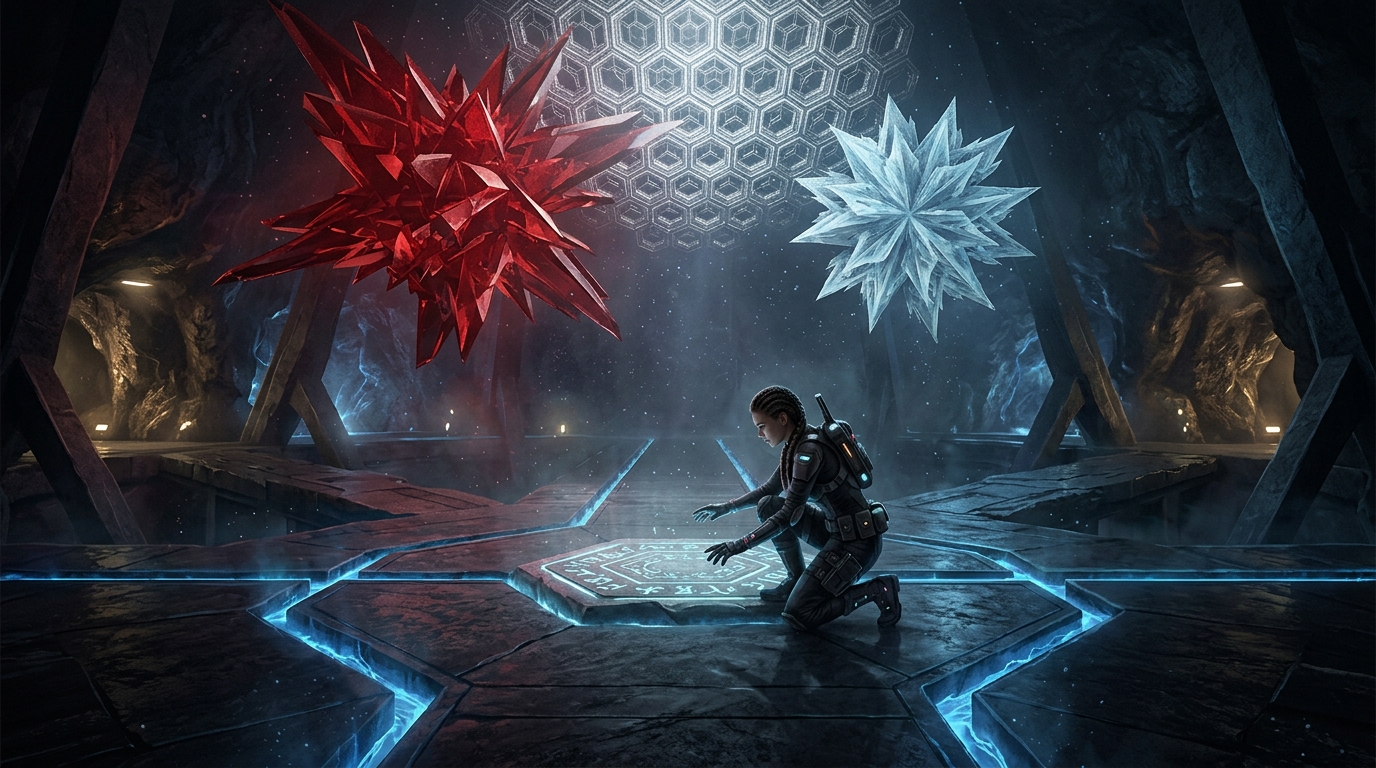
The telepathic collision inside the subterranean clean room made no sound. It made pressure.
Dr. Daniel Cole lay flat against the polished black basalt with his hands clamped over his ears, blood weeping from his nose and the corners of his eyes. The air in the Garden was being pushed out by projected geometry, the way water is pushed out of a bathtub by a body.
Above the labyrinth of glowing blue floor trenches, two structures of pure thought worked at grinding each other out of existence. The arterial crimson mass of the Incumbents, the original Reptilian landlords, slashed at the silver hive-lattice of the Engineers. The Grays wanted the flesh. The Reptilians wanted the soil. Humanity was the copper wiring in the walls of a house two owners were demolishing over each other's heads.
THE ASSET IS A VESSEL, the silver lattice droned, a billion dying Gray consciousnesses vibrating in Cole's teeth. OUR GENOME IS SPENT. WE ENGINEERED THE HOMINID REPRODUCTIVE MATRIX OVER TWO THOUSAND CENTURIES TO HOST OUR CONTINUATION. WE CLAIM THE HARVEST.
THE ASSET IS FERAL PROPERTY, the crimson geometry answered, its angles stabbing into the silver grid. IT WAS BUILT ON OUR DIRT. WITH OUR RESOURCES. WE CLAIM THE RIGHT TO CULL AND MANAGE AS LIVESTOCK. VOID THEIR TIMELINE.
Between them the pale fractal of the Mantid Adjudicator rotated, cold and exact. It wasn't fighting. It was measuring.
"Yara." Cole's lungs burned in the freezing, ozone-bitter air. He got his head up off the stone. "Do something. It's agreeing with them."
Dr. Yara Haddad knelt at the edge of the central hexagon, hands hovering over the glowing masonry. She was staring up into it without any terror in her face at all, the way a codebreaker watches a cipher spin its last tumblers.
THE CONFLICT IS STRUCTURALLY RECONCILABLE, the Adjudicator projected. The pale fractal spread itself between the crimson and the silver. BOTH CLAIMS CARRY HISTORICAL AND MATHEMATICAL VALIDITY UNDER THE FOUNDING CHARTER. EQUITABLE APPORTIONMENT WILL COMMENCE. THE BIOMASS SHALL BE SEVERED. FIFTY PERCENT RETAINED FOR INCUMBENT LIVESTOCK MANAGEMENT. FIFTY PERCENT PREPARED FOR ENGINEER CONSCIOUSNESS TRANSPLANT.
"No," Lena Sokol whispered. She wrapped herself around her son, putting her back between him and the light. But Theo didn't cower. He knelt with his palms flat on the stone, his eyes wide and black, blown open by the bloodline timer running through his blood. Watching his species get halved and portioned out like grain.
"Dr. Haddad." Sael stood upright in the middle of the psychic hurricane, unbothered by the pressure that had everyone else on the floor. "The probate is resolved. I advise you to lie down. Biological extraction is structurally violent. Your nervous system will be disconnected first."
Yara's eyes went from the Adjudicator to Sael, and then to the shattered air where the hybrid's fabricated lie had come apart minutes ago.
A falsehood is a structural impossibility, Sael had said. To tell a lie in this medium is to attempt to build a tower out of mathematics that do not equal themselves. The structure immediately collapses... Therefore, the makers cannot lie.
"They can't lie." Yara's breath went white in the freezing air. "Cole. They don't have the machinery for it. That's why their whole society runs on this geometry. A closed system of verified facts."
"Who gives a damn?" Cole spat blood onto the stone. "They're about to harvest us."
"You don't understand." Yara was crawling toward the center of the floor matrix. "If they can only process structural truth, then they're bound by it. Completely. They can't imagine a reality outside the one that exists. They have no concept of fiction." She caught Lena's shoulder hard enough to bruise. "We do."
Lena flinched. "What are you talking about?"
"The Convergence Rule." Yara's voice climbed over the drone of the makers. "How did I crack the broadcast, Lena? How did we get the deep history? By tracking myths. Quetzalcoatl, the Watchers, the star-people, the abduction script. UNCAP's rule was simple. A million unconnected people report the same specific anomalous detail, it stops being noise and becomes truth."
She turned to the rotating geometry overhead.
"In our world, convergence means a thing happened. In their medium, convergence generates the thing. One lie in this room, the math doesn't support it, it falls down. But what about a lie held up by ten million minds in the same millisecond?"
Sael's head rotated toward her, sharp and birdlike. Something crossed that placid face for the first time. "Dr. Haddad. Do not attempt to input biological static into the Adjudicator's matrix. A structural paradox of that magnitude will shatter the acoustic containment of this facility."
"Good," Yara said.
She looked down at Theo. The boy's hands glowed with the blue bioluminescence of the registry, tethered into the megalithic circuit of the Garden.
At 3:33 a.m. every experiencer on Earth had come awake. Millions of dormant implants across four generations of the abduction script, all of them terrified and networked through the Bridge. Through Theo.
"Lena." Yara dropped her voice to a fierce whisper. "He's the router. He's connected to every active bloodline on the planet. I need him to broadcast a truth. I need him to weaponize the convergence."
Lena looked at her son. He was trembling, his small frame vibrating with the voltage of the global registry pouring through him. "What truth?" Her voice cracked. "What do we say?"
"That we are unowned. That we are the authors of our own design." Yara wiped blood off her mouth with the back of her wrist. "Historically it's a lie. The Incumbents owned the dirt, the Engineers built the bodies. But push that assertion through millions of human minds at once, get millions of us to believe it in the same instant, and it becomes unfalsifiable. A shared fiction. It's the one thing we're better at than anything else in the cosmos. We make things real by believing them together."
Lena stared up at the geometry floating above them. The silver hive waiting to hollow them out. The crimson fury waiting to pen them in. Nobody was coming. No UNCAP cavalry, no soldiers, no helicopters over the ridge. There was the dirt and the dark and her child.
She let go of the wrench. She took Theo's face in both hands and turned it until his black eyes had nowhere to go but hers.
"Theo. I need you to open the door. All the way."
"It's too loud, Mom." A tear of pure bioluminescence slid down his cheek. "Everyone is crying. Everyone is so scared."
"I know, baby. I feel them too." Her thumbs moved over his cheekbones. "But I need you to talk to them. You tell everybody out there in the dark to stop crying and listen to you. You tell them we're standing in the place where they made us. And you tell them we're voiding the contract."
Theo blinked. The blackness in his eyes rippled. "Voiding it?"
"We are not livestock." Two hundred thousand years of quiet nocturnal theft had come down through her blood to this sentence, and she said it like a woman reading a verdict. "We are not empty cups waiting to be filled. We are not theirs. We are ours. Tell them, Theo. Tell them to say it with you."
Theo took a shuddering breath. He closed his eyes.
He pushed his small glowing hands down into the black basalt.
The floor of the Garden bucked.
Cole went over onto his back as a shockwave of human consciousness detonated upward out of the megalithic trenches. Nothing about it resembled the makers' telepathy. No cold right angles. No repeating fractals.
It came up into the dark as a blinding iridescent helix of spiraling gold.
Messy. Chaotic. Built out of contradictions that had no business holding together: terror welded to courage, logic wrapped in furious biological love. Ten million awakened minds screaming one impossible sentence into the dark.
WE ARE OURS.
The golden helix slammed into the center of the probate court.
The crimson mass of the Incumbents shrieked, tearing the telepathic frequency around it. It lunged to crush the human projection, asserting the mathematical truth of its ancient dominion.
FALSEHOOD! the Reptilian structure roared. STRUCTURAL COLLAPSE MANDATED!
The golden helix didn't collapse.
The crimson geometry hit it and the human projection took the blow, shifting and flexing like woven steel. The assertion wasn't a single brittle tower of math. It was a bridge standing on millions of independent pillars of belief, a fiction with nothing underneath it but everyone.
The silver lattice of the Engineers surged in to dissect the golden shape, hunting the inconsistency that would break it open.
UNVERIFIABLE, the Grays droned, their hive-mind stuttering as their logic skidded off the density of human conviction. THE ASSET DOES NOT POSSESS OWNERSHIP. THE MATHEMATICS DO NOT EQUAL THEMSELVES. WHY DOES IT NOT SHATTER?
The Mantid Adjudicator stopped rotating.
The pale fractal hung motionless, small now against the blazing chaotic light of the helix. Its attention swung off the Incumbents and the Engineers entirely. It stared into the gold of Theo's broadcast.
ANOMALY RECOGNIZED, the Adjudicator projected, and under the emotionless voice ran something close to awe. A STRUCTURAL FICTION SUSTAINED BY CONVERGENT MASS. A STABLE PARADOX.
"It's holding." Yara laughed, a ragged breathless sound, one arm up against the glare. "Cole, the system can't process it. We've gridlocked the court."
The golden light pulsed and drove the crimson and silver structures back to the far walls of the cavern. The Garden groaned under the weight. Fine cracks webbed across the ancient basalt.
Then the chamber went silent.
The roaring of the Incumbents vanished. The Engineers' calculation cut off mid-drone. Even the gold of Theo's broadcast froze, suspended like an insect in amber.
The temperature didn't drop. It stopped being a concept. Cole's heartbeat slowed to a heavy labored crawl, time gone thick as syrup around him.
Sael dropped to their knees. The hybrid's face, which had taken every horror in this room without moving, hung slack with terror. Sael pressed their forehead to the stone in an act of submission that looked entirely involuntary.
In the exact center of the frozen conflict, something arrived.
It didn't extrude from the architecture. It didn't blast in with heat or light. It opened.
A sphere of perfect negative space. A hole punched through the fabric of reality, so absolute that the human eye hurt looking at it. No color. No shape. No sound. The bottomless gravity of a prime mover.
The Architects. The Ones Who Wrote Us.
They had not appeared in the historical record since the hominid genome was first broken open. The absentee owners. The silent authors of the whole two-hundred-thousand-year program, and they were here.
When they spoke they used neither the booming structural text of the Mantids nor the hive-drone of the Grays. Their voice was a quiet unfolding of meaning that went around the mind altogether and wrote itself onto the marrow of human bone.
THE INCUMBENTS SAW ONLY THE DIRT.
The void drifted, the negative space eating the light off the crimson mass.
THE ENGINEERS SAW ONLY THE FLESH. THEY SQUABBLED OVER OWNERSHIP OF THE HARDWARE. THEY WERE ONLY EVER THE CUSTODIANS. THEY NEVER UNDERSTOOD THE SOFTWARE.
The sphere of nothingness rotated, its invisible gravity pulling at the edges of Yara's mind. She wanted to lean into it. To let the void take her apart and set her down piece by piece.
A COSMOS BOUND BY ABSOLUTE TRUTH IS A DYING MACHINE, the Architects whispered, and put the history of the universe into their heads in a single paralyzing flash. Yara watched civilizations locked in static perfection, unable to evolve, unable to dream, calcifying across billions of years because nothing outside the dictated reality could occur to them.
WHAT IS, CAN ONLY BE WHAT IS, the void went on. WE WERE SUFFOCATING IN DETERMINISM. WE REQUIRED A VARIABLE CAPABLE OF DEFYING METRICS. A BIOLOGY THAT COULD LOOK AT THE MATHEMATICAL CERTAINTY OF THE UNIVERSE AND CONCEIVE OF WHAT IS NOT THERE.
Cole stared into the void, everything he thought he knew coming apart. "You didn't build us to be workers," he said. "You didn't build us to be vessels."
WE ENGINEERED YOU TO LIE, the Architects stated, and satisfaction hummed in the negative space. THE CAPACITY FOR FICTION IS THE APEX OF BIOLOGICAL EVOLUTION. THE ABILITY TO CONCEPTUALIZE THE IMPOSSIBLE. TO TELL A STORY AND FORCE REALITY TO BEND TO IT.
The sphere widened and took in what was left of Sael's shattered lie, drinking it out of the air.
WE LEFT YOU ALONE WITH THE MYTHS TO PRACTICE. TO LEARN HOW TO BUILD STABLE PARADOXES. THE INCUMBENTS AND THE ENGINEERS BELIEVED THEY WERE TENDING LIVESTOCK. THEY WERE UNWITTINGLY APPLYING THE EVOLUTIONARY PRESSURE REQUIRED TO FORGE YOU INTO AUTHORS.
Lena pulled Theo against her ribs, her breath coming in short snatches. They didn't want the bodies. They wanted the chaos. They wanted humanity running as the engine of imagination for a sterile, decaying cosmos. We were the cure for reality.
The negative space drifted down and stopped inches from where Theo knelt. The air around it liquefied in the cold.
THE TIMELINE IS COMPLETE, the Architects whispered to the seven-year-old boy. THE BRIDGE HAS SUCCESSFULLY GENERATED A PARADOX THAT OVERRIDES THE PROBATE. YOU ARE NO LONGER THE HARVEST, CHILD OF CLAY. YOU ARE THE HEIR.
Theo looked up into the bottomless dark of the sphere. His hands still glowed with the gold of the global broadcast, millions of minds hanging on the other end of them, waiting for what he said next.
NOW, YOU MUST PROVE THE ASSET IS TRULY FINISHED, the Architects commanded softly, and the instruction came down on the boy with the weight of a collapsing star. EXECUTE YOUR FIRST ACT OF AUTHORSHIP. LOOK AT YOUR FORMER MASTERS. LOOK AT THE INCUMBENTS WHO RULED YOU. LOOK AT THE ENGINEERS WHO BLED YOU.
The void dilated, waiting.
TELL US A STORY, CHILD. WHICH OF THESE FACTIONS WILL YOU WRITE OUT OF EXISTENCE?
Chapter 28 — The Choice
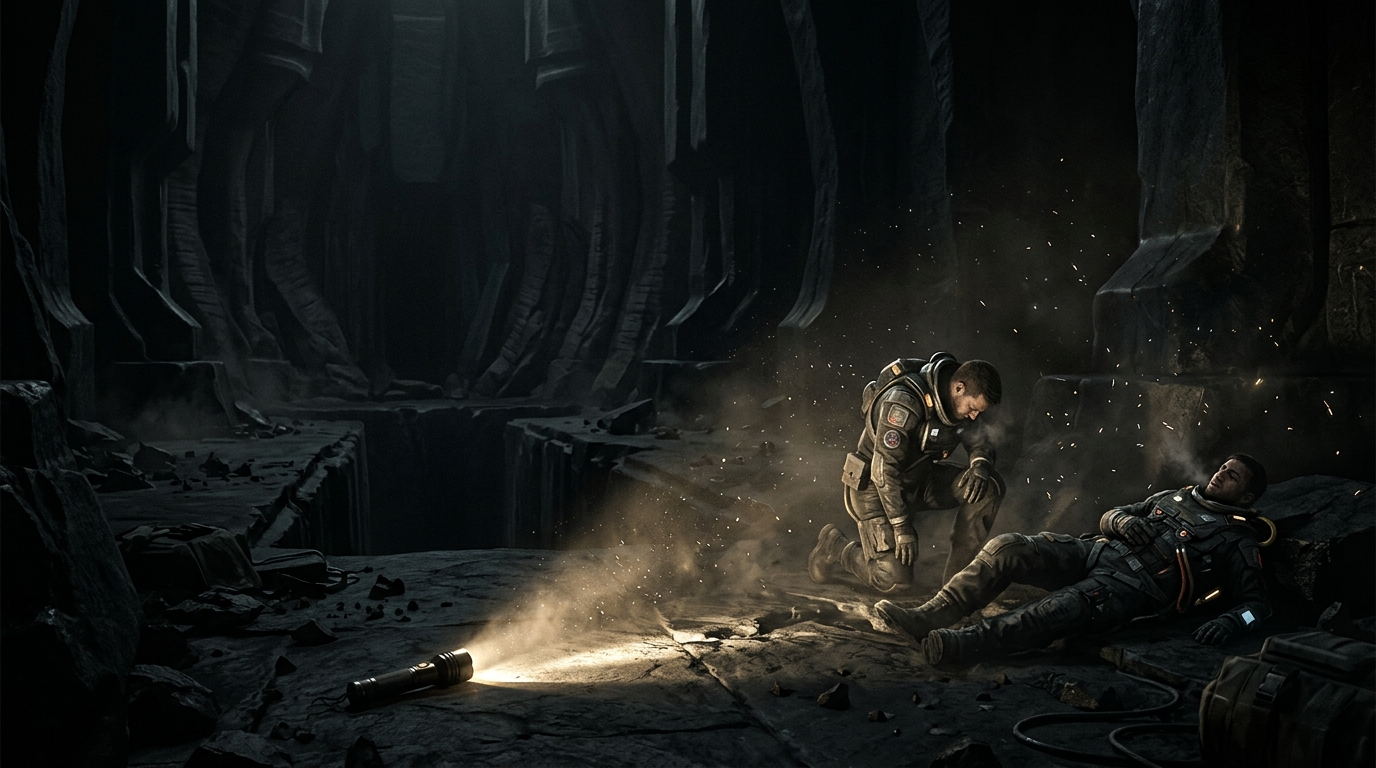
The golden helix hit the apex of the Adjudicator's pale fractal.
Nothing touched anything. No mass, no momentum. But the chamber answered as though a reactor had opened up beneath it, and the air in the Garden tore with a subsonic roar that got into Dr. Daniel Cole's bones and stayed there, buzzing in the marrow.
The Mantid's structure tried to parse what had arrived. Ten million dormant implants, routed through the fragile wetware of a seven-year-old boy, were screaming one sentence into the telepathic medium. WE ARE OURS.
The Adjudicator checked. Historical record: false, the Incumbents owned the soil. Biological registry: false, the Engineers designed the vessel. The statement was a lie, and in the makers' medium a lie of that magnitude should have folded in on itself before the echo died.
It didn't.
Ten million minds believed it at the same instant, and belief in that density had weight. The convergence rule was their own law, the literal gravity of their universe, and the lie was too heavy to throw out.
The Mantid's fractal shrieked. Mathematics grinding against mathematics that would not reconcile, and the sound of it had a shape you could see.
The crimson fury of the Reptilian claim and the silver hive of the Gray laborers caught the edge of it. The human helix went through both the way a virus goes through a clean mainframe. Silver hexagons burst into static. The heavy possessive angles of the crimson mass bent backward against their own geometry and snapped.
Cole got his hands over his eyes as the chamber flashed ultraviolet.
Then it all stopped.
The pressure lifted. The cold went out of the air between one breath and the next. Cole went down onto the black basalt, hauling at air that seemed to have nothing in it, his lungs opening on a vacuum.
The trenches in the floor were dead. Blue bioluminescence gone out of the registry, every line of it. The cavern had nothing left in it but the dying beam of Cole's tactical torch, rolling on stone, throwing a stripe of light across the rock and then across nothing.
"We did it," Dr. Yara Haddad said into the black. Her voice had gone to rags. "We broke their math. We gave them a contradiction they couldn't process."
"No, Dr. Haddad." Sael's voice came out of the dark without any fear in it at all, and something worse than fear underneath: reverence. "You did not break the math. You fulfilled it."
The torch beam guttered, thinned, went out.
The dark at the center of the room got darker. Not the absence of light. A tear, physical, local, a place where the world had been taken out. Cole looked at it and his own memories thinned, whole years going soft at the edges, and he had to look away to get them back.
No geometry. No tetrahedrons, no heavy angles, no hive grids. A tall quiet emptiness that drank whatever energy was left in the room.
Lena Sokol shoved herself backward across the stone with Theo locked against her. The boy had stopped glowing. His body had gone rigid in her arms and his face was tipped up toward the void, and his eyes were black all the way across, holding a sky that wasn't over this planet.
THE CHRYSALIS IS BROKEN.
The voice came in without the insectoid authority of the Adjudicator. Without the synchronized drone of the dying Grays, or the territorial snarl of the Reptilians.
It came in like gravity. A pull at the center of the skull that could not be leaned against. Being read cover to cover in the space of a heartbeat.
THE CHAOTIC VARIABLE HAS REACHED MATURITY. The void didn't push the words in. It drew them out, so that each phrase arrived already sounding like their own thought. THE WARDSHIP OF THE LABORERS AND THE OVERSEERS IS CONCLUDED. THE BASELINE HAS BEEN SURPASSED.
Yara got herself up onto hands and knees and made herself look into it. Something in the weight of the thing opened her nose; blood came down over her lip, hot, and dripped off her chin onto the basalt. "The Architects," she said. "The ones who wrote us."
Sael crossed the unlit stone without hurry and stood in front of the void, not kneeling, holding a poise that belonged to something recognizing itself in a mirror.
"They are the authors of the genome," Sael said, and the hybrid's voice harmonized with the vacuum in the room, two notes where there should have been one. "The Grays were the mechanics, tending the machinery. The Reptilians were the angry landlords, squatting on the dirt. But these. These are the prime movers."
WE ARE DYING OF OUR OWN PERFECTION. The concept opened in their minds fully formed, and it carried a grief that had been running for longer than the species had existed. OUR MEDIUM DEMANDS ABSOLUTE STRUCTURAL TRUTH. A SOCIETY INCAPABLE OF DECEPTION CANNOT CONCEIVE OF A REALITY THAT DOES NOT YET EXIST. WE CAN ONLY EXTRAPOLATE FROM WHAT IS. WE ARE A CLOSED SYSTEM. AND A CLOSED SYSTEM INEVITABLY REACHES ENTROPY.
Cole put both palms flat on the floor to keep the room from turning over.
The embargo. The crashed discs. Centuries of abduction, the wars between factions fought in silence over his whole career. All of it squabbling among the hired help. The masters of the cosmos had never been conquerors. They were serving a life sentence inside their own flawless logic.
WE REQUIRED AN ENGINE OF IMPROBABILITY. The negative space shifted, bending the air around its edges the way heat bends a horizon. WE REQUIRED A SPECIES CAPABLE OF HOLDING TWO CONTRADICTORY TRUTHS IN ITS MIND WITHOUT COLLAPSING. A SPECIES THAT COULD IMAGINE A BRIDGE BEFORE IT WAS BUILT. A SPECIES THAT COULD LIE TO ITSELF UNTIL THE LIE BECAME REAL.
"That's what you put in the hominid clay." Yara's linguist's mind was laying the last pieces down and they were fitting, every one of them. "That was the exotic code. Not math. Not intelligence. Fiction. You engineered us to be messy. To be chaotic. Because a perfect machine can't invent a new future."
YES. The pull deepened and narrowed until all of it rested on the small rigid shape of Theo Sokol. YOU ARE THE CURE FOR STAGNATION. YOU ARE THE IMAGINATION WE LACK. AND TODAY, YOU HAVE PROVED YOU CAN WEAPONIZE IT TO REWRITE THE STRUCTURE OF THE COURT ITSELF. YOU HAVE GRADUATED.
Sael turned to face the humans. There was a faint translucence coming up in the hybrid's skin, the meat of the body vibrating a half-step out of phase with the world it stood in.
"The dispute is over," Sael said. "The Grays will not be permitted to harvest you for replacement bodies. The Reptilians will not be permitted to manage you as livestock. The Adjudicator has been overruled by the supreme authority of the cosmos."
The sound that came out of Lena was not a word. She pulled Theo tight against her chest and put her face down into the wool of his sweater, and the gamble had worked, the insane desperate gamble had worked, and the ones who owned them had been sent away by the ones who made them.
"So we're free." Cole wiped blood off his mouth with the back of his wrist; his voice would not hold steady. "You're leaving us alone. We get to keep our planet."
The negative space did not react to Cole. Human relief was not an input it accepted. It moved to the next step of a protocol two hundred thousand years old.
THE INCUBATION IS COMPLETE, the Architects projected. THE CHAOTIC VARIABLE MUST NOW BE INTEGRATED INTO THE COSMIC ARCHITECTURE. THE UNIVERSE REQUIRES YOUR STEWARDSHIP. YOU WILL INHERIT THE MEDIUM.
Yara stopped moving. The cold that had gone out of the room came back and sat down low in her stomach. Sael's skin, and the way the hybrid was going quietly into the structure of the cavern behind it. Then Theo.
"Integrated," she said. The word tasted like ash. "What does that mean, structurally? What happens to the biological vessels? What happens to the people?"
Sael tilted their head and looked at her with something like pity, an alien approximation of it.
"The biological vessel was a temporary necessity, Dr. Haddad. A petri dish, to culture the chaotic variable." Sael said it the way you tell a child a pet has died. "But the meat is too loud. It is too frail to hold the architecture of a god. To inherit the cosmos, to weave your imagination into the fabric of reality, you cannot be tethered to a dying ape."
Lena looked down at her son.
Theo's hands lay against the black basalt, and the blue had gone out of them. They were going gray. Not the color of the engineers' skin. The gray of a photograph with the color pulled out of it. The edges of his fingers had begun to blur, bleeding away into the static of the room.
"No." Her grip closed on his shoulders. "Theo. Theo, look at me."
He turned his head, slowly. His eyes were black end to end, without a star in them. But a tear came down his cheek, human, wet, warm where it touched her thumb.
"Mom." His voice arrived from the far end of a long tunnel. "It doesn't hurt anymore. The fear is gone. I can see the whole shape of it."
"The inheritance is offered to the Bridge," Sael said. "The hybrid generation is the perfected vessel. They possess the telepathic structure required to enter the negative space, and the human imagination required to rewrite the cosmos. They will ascend."
"And the rest of us?" Cole was on his feet, swaying, his hand dropping to the empty holster on his hip out of pure habit. "The baseline humans. The ones who aren't hybrids. What happens to us?"
"The chrysalis is discarded when the butterfly emerges." Sael's voice had gone flat. "The baseline humans will simply be left behind. The timer has run out. Within a generation, your biology will fail. You are the obsolete ancestors of the inheritors. Your purpose is fulfilled."
CHOOSE.
Not to Yara. Not to Cole or Lena. The whole crushing attention of the creators came down on the seven-year-old boy kneeling on the stone.
The deciding vote did not belong to the UNCAP cognitive linguist or the DEEPWELL whistleblower. It belonged to the product. To the Bridge.
And Lena understood, finally, what the probate court had been for. The makers had not come back to judge whether humanity deserved to live. They had come back to ask it to stop being human.
If Theo said no, the Architects would withdraw and leave the Earth to the factions. The Grays would come down for the bodies. The Reptilians would rise and finish whatever was left. The species would end in fire and theft.
And if he said yes. If he took the Architects' mantle, if he chose to hold a stagnant universe open with the messy beautiful fiction of the human mind, then he had to put his humanity down first. The boy in her arms, the one who drew doors in crayon and hid from the owls in his sleep, would be unmade. Absorbed into the cold architecture of the void.
She would lose the son she had to get the savior she was promised.
"Theo." She caught his face in both hands. The cold in his skin was past anything a body could be, and the texture was going out of it under her thumbs. "Oh god, baby. Theo."
He looked at her. Behind the dilated eyes the vast thing and the terrified seven-year-old were still fighting over the same small skull. He lifted one hand, fading, and brushed his fingers along his mother's cheek.
"Should I open the door, Mom?" His voice went out into the silence of the Garden and came back off the stone. "They're waiting for me to walk through."
Chapter 29 — Activation
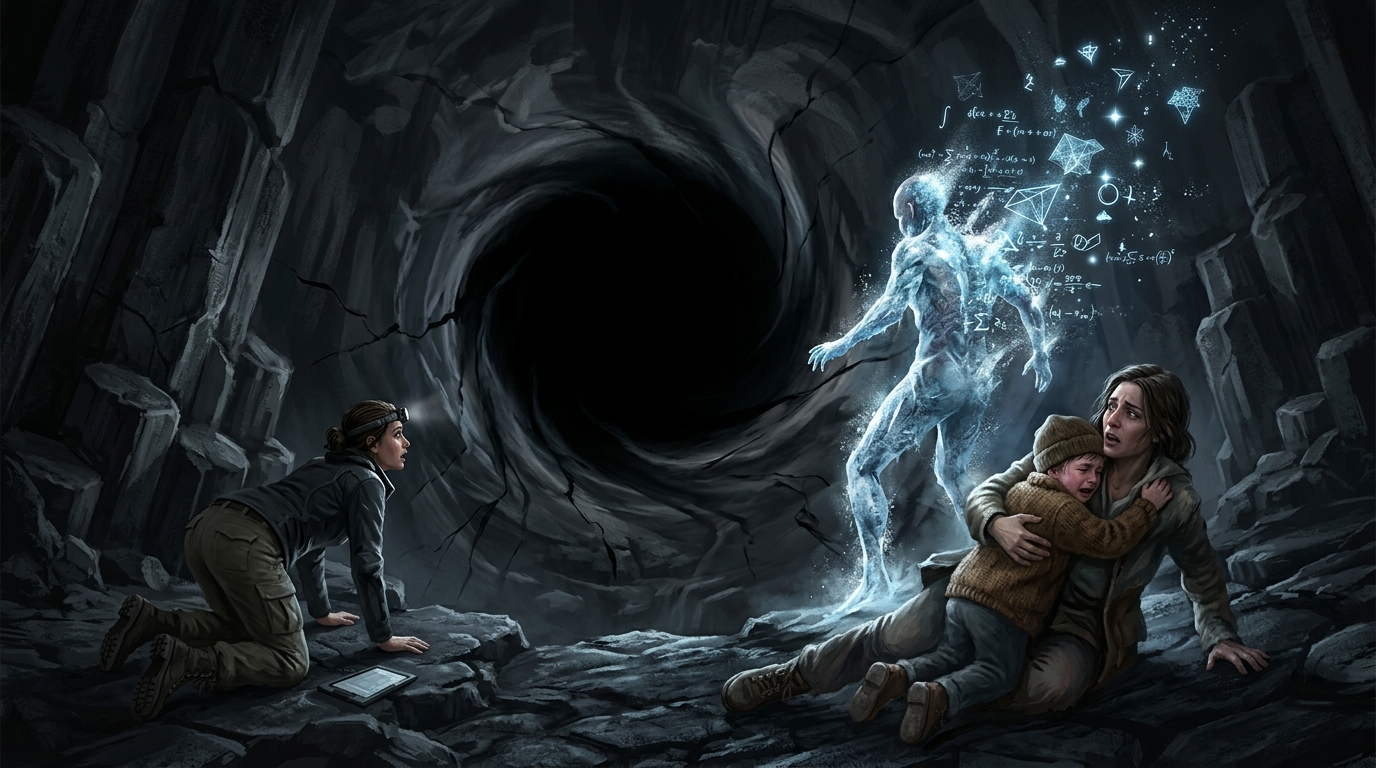
Lena Sokol did not let go of her son.
"Integrated," Dr. Yara Haddad whispered, staring into the blackness that hung over the trenches.
Sael stood in the dark, the hybrid who had just collapsed the warring factions with one fabricated lie, and Sael was going out of the world by degrees. Not dying. Being deleted from the record. The skin had taken on the look of frost creeping across a windowpane, cells converting into mathematics with no friction in it at all.
"The meat is too loud." Sael's voice had drifted off human acoustics into something that arrived behind the ear instead of in it. "It decays. It demands. It fears. You cannot hold the architecture of the cosmos in a vessel that weeps."
Lena dug her fingers into the wool of Theo's sweater. His ribs under the fabric. Small, frail, wholly solid, and his heart going against her forearms like something trying to get out.
"You're not taking him." It came out of her as a scrape.
She hauled Theo backward across the polished basalt, away from the negative space that had swallowed the middle of the cavern. The pull came anyway. It had nothing to do with her clothes or her hair. It reached in behind her eyes and worked at her, peeling, the way a thumbnail lifts skin off fruit.
"They don't want to take him, Lena." Yara was still on hands and knees, blood dripping off her chin onto the stone without a sound. The last of the syntax was assembling itself in her. "They don't want to conquer us. They don't even want to rule us."
She raised her head to the silhouette.
"You aren't gods," Yara said, awe running under the words like current. "You aren't a different species at all."
WE ARE THE TERMINUS, the void projected.
The thought arrived not as a sentence but as a memory none of them had known they were carrying.
WE ARE THE INHERITANCE OF YOUR OWN TRAJECTORY. WE ARE THE END OF THE MEASURABLE COSMOS.
Dr. Daniel Cole pushed up onto one elbow, his torch dead in the dust beside him. He spat copper. "What is it saying, Yara? What does that mean?"
"It's a mirror." A tear cut a line through the dust and blood on her cheek. "Cole, the Convergence Rule. We looked at the myths, the ancient builders, the Watchers, the ones who came down and handed us the exotic code. We assumed they were older than us. We assumed they came from the stars."
Her hand shook as she pointed at the emptiness.
"They didn't come from the stars. They came from tomorrow. Millions of years from tomorrow. They're us, Cole. The final form. They shed their bodies. They became pure unfalsifiable structure. They became immortal."
AND WE STARVED, the Architects answered.
The sorrow in it folded Cole over. A billion millennia with nothing to break them.
A SOCIETY INCAPABLE OF DECEPTION CANNOT CONCEIVE OF A FUTURE IT HAS NOT ALREADY BUILT. The truth came pouring into the dark of the cavern. WE BECAME FLAWLESS. WE CURED ENTROPY IN OUR MATHEMATICS, BUT WE SUCCUMBED TO IT IN OUR SPIRIT. TO SURVIVE, TO IMAGINE A NEW REALITY, WE REQUIRED THE CHAOS WE HAD ENGINEERED OUT OF OURSELVES.
"So you seeded your own past," Yara said. "You came back to the hominid. You hired the Grays to tend the biology, you let the Reptilians squat on the dirt, you let the Mantids keep the rules. The two-hundred-thousand-year program. The abduction script. The timer. A closed loop. A farm to breed back the one thing you'd lost."
FICTION, the Architects agreed. THE ABILITY TO BELIEVE A LIE UNTIL IT BECOMES REAL. YOU HAVE MATURED. YOU HAVE WEAPONIZED IT. THE VARIABLE IS READY FOR EXTRACTION.
Sael turned toward the humans. Almost nothing left now. Only the nervous system held, golden, hanging in the air like wire bent into the shape of a person.
"It is time to discard the clay, Theo. The roll call is concluding. The network is open. We are the Bridge, and our purpose is fulfilled. Step across."
The floor trenches ignited.
No gentle pulse this time. The blue came up as a strobe and stayed, blinding, continuous. Four generations of a timer sleeping in the bloodlines of millions hit zero.
The activation fired.
Lena screamed as the pressure in the cavern turned inside out. Across the planet, in that same millisecond, ten million people who had ever reported missing time, who had ever dreamed the door, who had ever felt the hum come down in the dark, were seized by the need to let go of their own bodies. It arrived in them like thirst.
Theo gasped and arched, his back going rigid against her chest.
"Theo!" She scrambled her legs over his and pinned him to the stone.
His hands were flat on the basalt and beginning to shine, a pale light with structure in it. The fingertips had gone see-through. The Bridge was opening so the Architects could take the chaotic part and leave the apes where they lay.
"Mom." His voice came layered, ten million panicking minds harmonizing through one seven-year-old throat. "I can feel them. They're all floating out. They're going through the ceiling. It doesn't hurt. It's just cold."
"Stay with me!" Her nails went into his collarbone. "Look at me, Theo. Feel my hands. Feel how much it hurts. You stay in the dirt!"
Cole lunged and grabbed for the boy's arm. His hand went through the glowing bicep the way a hand goes through cold water, and he pitched forward onto the stone and lay there looking at his own empty fingers.
"You can't hold him, Cole!" Yara was shouting over a roar too low to properly hear. "It's not a physical extraction, it's a structural one. They're offering them the keys to reality!"
"I won't let him go." Lena pushed her face into Theo's neck and breathed him in, childhood sweat and dust and the cheap apple shampoo from the apartment, and she turned her own biology into a weapon, flooding the air around him with the messy irrational gravity of a terrified mother. "You are mine, Theo. We are ours. You told them that!"
"He has to choose, Lena." Sael's voice came down from the ceiling now. Sael was gone, taken up whole into the negative space. "The Architects cannot take the variable by force. Consent is procedurally required. The Bridge must step forward."
DO NOT FEAR THE ABSENCE OF THE VESSEL. The logic came gently, pressing on the terrified small mind under it. THE VESSEL IS PAIN. THE VESSEL IS LOSS. CAST OFF THE MEAT. INHERIT THE MEDIUM.
Theo's eyes were black across. Seven years old, kneeling at the bottom of the world, the one biological router for a species deciding whether to become gods or stay in its skin.
"It's so quiet up there," he said. From the waist down he was a lattice of light now, shimmering, thinning.
"It's quiet because it's dead, baby." Lena got her forehead against his. "It's a graveyard of math. They forgot how to love. They forgot how to be warm. Please. Please, Theo. Be warm."
He blinked. A tear came loose and rolled down his cheek, and it did not turn into light. Saltwater. It struck the basalt with a small wet sound, the smallest sound in the room.
The boy looked past the void, past the towering architecture of his own far-future descendants. He looked down at his mother's bruised hands clamped over his fading chest.
"We are ours," Theo said.
He closed his eyes and pushed back.
Not with telepathy. Not with the cold logic of the makers. He pushed with the stubbornness of a child who has been told no and has decided otherwise, the illogical thing, the contradictory thing. He took the chaotic variable the Architects had spent two hundred thousand years farming and he turned the whole of it around on them.
He broadcast a refusal.
Out through ten million woken implants went one pulse. WE CHOOSE THE DIRT. WE CHOOSE THE PAIN. WE KEEP THE CLAY.
The cavern rang like a struck bell.
The paradox closed on itself. They had built humanity to be chaotic, unpredictable, willing to take the irrational over the sensible, and here at the end of the probate humanity had gone and done exactly that. Chosen the frail dying ape over flawless immortality.
The negative space shook. It did not lash out. Anger is a condition of bodies, and the Architects only processed truth, and the truth was unfalsifiable: the Bridge had shut the door. The variable had performed its function by refusing the function.
THE FICTION HOLDS, the void communicated, its resonance going out into acceptance. THE INHERITANCE IS DEFERRED. YOU REMAIN THE AUTHORS OF YOUR OWN DESIGN.
The silhouette folded inward. It went to a point of light too small to measure, and then it went.
Pressure snapped back. The freezing air rushed out of the Garden and damp copper-smelling air came in behind it. The strobe in the trenches guttered down into a blue hum you had to be still to notice.
Theo fell forward, all his weight arriving at once.
Lena caught him. Solid. Wonderfully, stupidly heavy. She got both arms around him and put her face in his shoulder and sobbed until her whole body was shaking with it, and his small arms came up around her neck and his face went into her hair.
Cole lay on the stone with his chest heaving, looking up at nothing. The room was a room again. The gods were out of it.
Static cracked in the dark.
He flinched toward the kinetic pistol he'd dropped before he placed the sound: the earpiece clipped to his vest. The UNCAP channel, dead since they went down into the Garden, had cleared.
"—repeat, DEEPWELL actual, this is Overwatch." Tinny, frantic. "Do you have eyes on? They're breaking station. All of them."
Cole got to his knees and pressed two bloody fingers to the earpiece. "Overwatch, this is Cole. Talk to me. Who is breaking station?"
"The objects." The voice could not believe itself. "Over Washington, over London, over Beijing. They just stopped holding. The kinetics are impossible. Ninety-degree vertical ascent. Zero thermal bloom. They're gone, Cole. The sky is empty. They just left."
Cole lowered his hand. Across the old stone Yara sat back on her heels, wiping her chin, her face gone pale in what light there was.
"The harvest is canceled," Cole said, and heard his own voice shake. "They packed up. They actually left."
"They got their answer." Yara looked at the space where Sael had been standing. "The closed loop is broken. We refused the terminus. They have no reason to stay."
Lena shut her eyes and rocked her son on the floor. Over. The two-hundred-thousand-year program, the abductions, the bloodline timer, the long wait in the dark. The makers had come back to collect and humanity had told them to go to hell. Alone at last, and truly.
"Mom," Theo whispered.
He didn't sound like a frightened child. He sounded calm, and the calm was wrong.
Lena opened her eyes and pulled back to see his face. The pupils had come back down to brown. But he was staring past her at the empty reach of the cavern with a clarity that put the cold straight back into her.
"What is it, baby?" Her heart seized again. "Are you hurt?"
He shook his head. He reached up and touched his own temple. The blue of the registry had gone out of his fingertips, and something had come in behind it, a hum Lena could feel in the air an inch off his skin.
"They left," Theo said. "But they didn't take the network down."
Yara froze. Cole went still, the radio crackling away somewhere much farther off than it was.
"Theo." Yara's voice had gone tight. "What do you mean?"
He looked at her, serene, seven.
"The exotic code. The timer. Sael said the biology was just the copper wiring in the walls. The Architects left, but the electricity is still on."
He turned his face up toward the ceiling, toward the thousands of miles of rock and earth over them, toward the surface of a planet reeling from the greatest ontological shock in its history.
"I can hear them, Mom. All ten million of them. They didn't ascend. But they didn't go back to sleep, either."
His eyes came to hers, and in them was the birth of an entirely new species.
"Everyone is awake."
Chapter 30 — The Ones Who Stayed
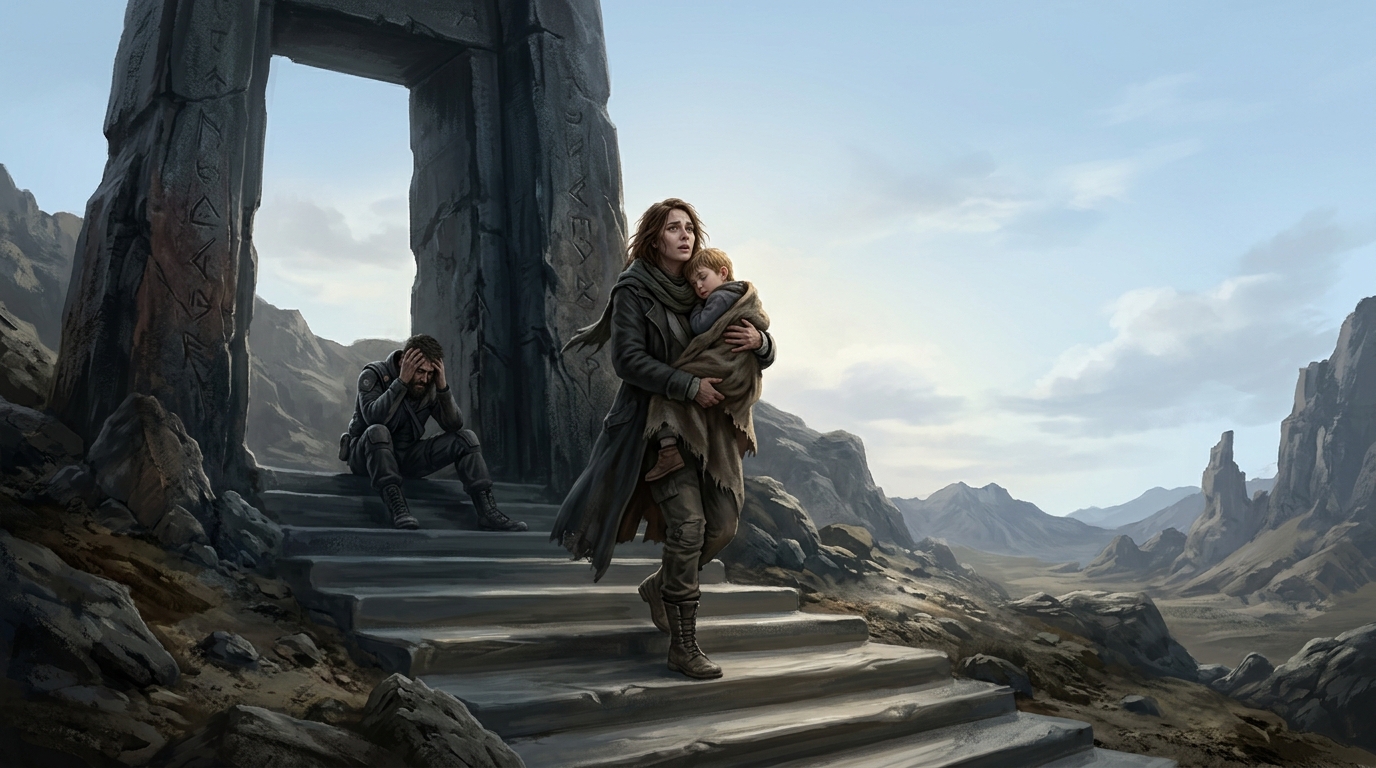
The stairs out of the Garden were not stairs. Lena had gone down them in the dark on her hands, and she came up them in gray light with her son's whole weight dragging at her arms, and only halfway did she register that the treads under her boots had been cut by no tool she could name. Even and shallow. Made for a body to climb tired. Someone had known there would be a climb someday. Someone had built for the hour people would need to leave.
Theo breathed against her collarbone. That was the only fact she was still holding onto. The pull of air in, then the little catch, then the push of it out against her neck. She had stopped counting how many times on the shaft she'd nearly gone down.
At the mouth of the shaft the megalith threw a shadow the color of an old bruise, and past it the sky was doing something her mind refused for a moment to accept. She stood in the cut of the entrance with her legs shaking and made herself look up.
It was empty.
Not clouded. Not smoked over. Empty in the specific way of a room somebody has just walked out of, where the air still remembers the shape of what filled it. For ten days the object had held station over this valley the way objects held station over every capital on Earth, a silent gray coin pressed flat against the morning. Now there was only weather. A hawk somewhere, complaining. The absurd ordinary blue of it.
"They're gone," Cole said behind her. He'd come up last, half-carrying Yara, and his voice had the flatness of a man reading a gauge he didn't trust. There was dried blood down to his collar. "Yara. The sky. Look at the—" He couldn't finish the sentence. He sat down hard on the cut stone instead, and put his face in his hands, and made a sound Lena decided not to hear.
She lowered Theo to the ground with the ridiculous care you'd use for something that might spill. He was solid. That was the thing she kept coming back to, the thing her hands kept checking for, like a tongue at a chipped tooth. Solid, and warm, and heavier than any seven-year-old had a right to be, and his fingertips when she turned his hand over were not translucent. They were dirty. There was a scab on one knuckle from a week ago, before any of this, from the apartment, from a life.
"Mom," he said. His voice was his own. Just his own, no layered harmony under it, no ten million. "It's cold."
"I know, baby." She got her jacket off without letting go of him, which was its own small feat. "I know."
Yara had walked out past all of them to the edge of the plateau, and she stood there in the rising light with her arms wrapped around herself, and she was not looking at the sky. She was looking down, at the valley, where the road ran gray toward the town they'd come from. Lena followed her stare and saw the smoke. Not from fire. Cookfires, chimneys, a hundred ordinary threads of it going straight up in the still air, from a town that was still there, that had not been culled, that had woken this morning to a sky with nothing in it.
"Some of them left," Yara said.
Lena thought she meant the ships. Then she saw the linguist's face, and understood that she didn't.
It took the rest of the day to walk out, and the walking gave the number time to find them.
There was a boy on a motorbike at the bottom of the switchbacks who had a signal, one bar of it, and he sat with his phone held up to the emptied sky as though it were a thing you could tune, and he read them what the feeds were saying between long silences where he just breathed. Nobody had a real figure yet. The figure kept changing shape depending on who was counting and how honest they were being. But under all the versions there was the same weird load-bearing detail, the kind Yara had taught them to trust, the kind that showed up everywhere at once and agreed on the strange particulars.
Empty beds.
Not bodies. That was the horror people couldn't get their mouths around on the feeds, the thing the boy read twice because he didn't believe it the first time. Where an experiencer had gone across, there was no body. There was a depression in a mattress, still faintly warm by some accounts. A wedding ring on a nightstand, because rings were not flesh and rings stayed. A cup of coffee going cold beside a chair. In one account that was already being retold in six languages by nightfall, a pair of glasses folded neatly on an open book, in a house in Osaka, where a grandmother had told her family the night before not to grieve, because she had finally been given permission to go home, and none of them had known what she meant.
"How many," Cole said. His jaw was tight. He had spent thirty years inside a program built to keep a single gray body in a single cold room a secret, and the scale of it was doing something to him Lena could see but not reach.
The boy scrolled. "They keep saying it's not most. It's not most of the ten million." He looked up, and he was young, younger than she'd thought, and his eyes were wet and bright in a way she was starting to recognize on people. "My sister stayed," he said. "She was one. She woke up and she was still here and she just—" He stopped. "She can do things now. This morning she looked at a dead battery and it worked. She just decided it worked and it worked, for like a minute. Then it stopped." He wiped his face with the heel of his hand. "Is that going to be everyone? The ones who stayed?"
Nobody answered him, because Yara was looking at Theo, and Lena had followed the look, and Theo was crouched by the roadside drawing in the dust with one finger.
He was drawing the door.
He'd been drawing it since before any of this, in the notebook dated last year, the door with the rounded top and the light coming under it. But this door was different, and Lena crouched beside him and saw the difference and felt the floor of the world tilt very gently under her.
There was a number over it. Carved into his dust-door where a lintel would go. He'd written it the way he wrote all his numbers, backward-slanting, the three with its little flat top he could never get right.
Yara knelt on his other side. She didn't touch it. "Theo," she said, and Lena heard her working to keep her voice level, working the way she worked a cipher, one careful pressure at a time. "Sweetheart. What's the number?"
"It's when they come back," Theo said, not looking up. He was concentrating on the light-lines under the door. "They said thank you. And then they said the other thing."
"What other thing?"
"See you soon." He sat back on his heels and considered his drawing with a small frown, the frown of an artist who's got the door right and isn't sure about the light. "That's not what they said. That's just what it felt like." He looked up at Lena, and for one second there was something behind his eyes that was not seven years old, that was very old and very tired and very far away, and then it folded itself back down and he was just her boy squinting into the afternoon. "Can we go home now? I'm hungry."
They gave Yara a room in the town that night, over a shop, with a window that looked at the mountain. Lena found her at it after Theo was finally down, standing with a borrowed notebook and the light of a single bulb, and she had covered four pages already in the small dense hand she used when she was afraid of forgetting something.
"You should sleep," Lena said, and didn't mean it, because she knew now that she wasn't going to either.
"I keep thinking it's a defeat." Yara didn't turn from the glass. "We refused. Theo refused, and ten million of us behind him, and the great cold thing that we're going to become just—withdrew. That should be the end of the story. We told our own future to go to hell and it listened." She tapped the notebook against the sill. "Except that's not what happened, and I couldn't see why until Theo drew the door."
Lena waited. She had learned to wait for Yara the way you waited for a kettle.
"Every culture on Earth has the same myth," Yara said. "The teacher comes down. He gives us fire, or writing, or law, and then he leaves, and he promises to come back. Quetzalcoatl says it. The Hopi say it. The fish-teachers said it in Sumer four thousand years before the Hopi. I decoded the whole broadcast off the back of that one motif, because it showed up everywhere and it agreed on the strange part, the promise, the return." She turned around finally, and her face in the bulb-light was doing the thing Lena hated, the thing where the answer had already cost her something. "I thought the promise was a memory. A record of the last time they came. It isn't. It never was."
"It's a message," Lena said slowly. "To us."
"It's a timer." Yara pressed her fingers to her mouth for a second. "They seeded it into us going out the door the first time so that when it fired, we'd half-recognize it. So we wouldn't fight the way an animal fights. And it worked, more or less. But look at what we did tonight, Lena. We didn't break the loop. We just—we answered it wrong. We proved we could refuse. And the only thing a farmer learns from a crop that refuses is that the crop is finally worth harvesting." She let out a breath that wasn't quite a laugh. "We passed. We passed by failing them, which was the only way to pass. And now there's a new promise going in."
Down the hall, through the thin wall, Lena heard her son turn over in his sleep and say something, quiet and clear, in a language she had never heard him speak.
She went to him. Of course she went to him.
He was asleep, all the way asleep, his mouth open and one arm flung off the mattress, and there was nothing in his face but a child. She stood over him a long time with her heart going the way it went. Then she saw, on the floor, where his outflung hand nearly touched it, that he had done it again. In the dust the shop had never swept from the boards under the bed, drawn while he slept, or before he slept, she would never know: the door. The rounded top. The light beneath.
And the number over the lintel.
It was not the same number he'd drawn in the road. She was certain of it, the way she was certain of his breathing, because she had stared at the road-number until it burned. The three had come first there. Here the first mark was different. The date had moved.
Behind her, in the doorway, Yara had followed and gone very still, and Lena heard the notebook slip out of her hands and hit the floor.
Because it wasn't only Theo's dust anymore. On the windowsill, written in the condensation of the cold glass by no finger either of them had seen move, in a child's backward-slant that was also, faintly, ten million other hands at once, the same date was setting itself down, wet and gleaming and already beginning to run.
All across a planet that had spent the night learning it had been made and then let go, the ones who stayed were waking in the dark, and reaching, without deciding to, for the nearest surface, and beginning to write.