PERPETUITY
The Kolars signed a perpetual, heritable deed in Las Vegas: one family week a year at Halcyon Cay for $212, capped. The deed conveys the other fifty-one weeks, delivered through the family's sleep bands to grateful strangers. A 1993 amendment, ratified by 71 percent of owners after the original tower was condemned, made the family itself the Unit. Marcus found an assignment clause and said nothing. Dana's Thursdays are booked eleven years out by Adela Faust, a dying woman who spends her banked points folding the Kolars' laundry and leaving a worn sock behind. Dana left her guest a note; by Friday it was gone, and a special assessment arrived: a new wing and bigger kids' club, the fee still $212, the cost 311 hours per household, drawn from juvenile inventory as it becomes eligible.
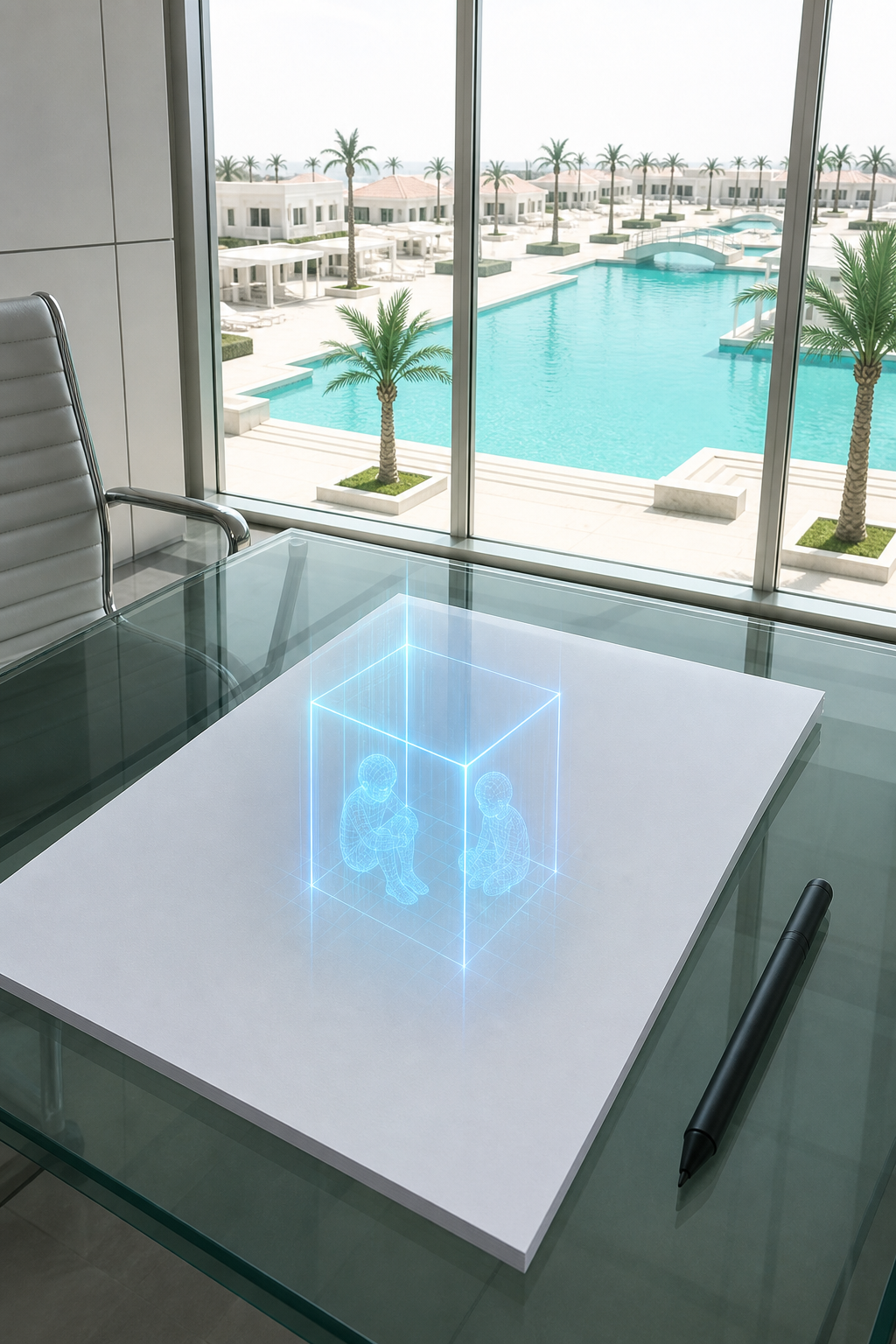
The Kolars signed a perpetual, heritable deed in Las Vegas: one family week a year at Halcyon Cay for $212, capped. The deed conveys the other fifty-one weeks, delivered through the family's sleep bands to grateful strangers. A 1993 amendment, ratified by 71 percent of owners after the original tower was condemned, made the family itself the Unit. Marcus found an assignment clause and said nothing. Dana's Thursdays are booked eleven years out by Adela Faust, a dying woman who spends her banked points folding the Kolars' laundry and leaving a worn sock behind. Dana left her guest a note; by Friday it was gone, and a special assessment arrived: a new wing and bigger kids' club, the fee still $212, the cost 311 hours per household, drawn from juvenile inventory as it becomes eligible.
Chapter 1 — Ninety Minutes

The second afternoon was the one Dana had been saving. The first day you spend recovering from the flight and pretending the room is nicer than it is; the second, you finally look up. They came out of the buffet into that flat Nevada light that has no weather in it, and Marcus put his hand on the small of her back, and for a second she couldn't remember the last time they had walked anywhere without a child orbiting one of them.
Eleven years. She had done the arithmetic on the plane, the way she did arithmetic on everything, because it was the only tic her job had left her that she couldn't switch off. At Washoe Regional she reconciled four hundred people's shifts in fifteen-minute increments, and somewhere along the way the increments had gotten into her. She knew that this trip was ninety-one hours, gate to gate. She knew that Margo and Jonah were four hundred and seventy miles away at her sister Bea's, asleep in the same bunk beds Dana and Bea had used, and that it was 2:40, and that she and Marcus had spent exactly none of the ninety-one hours doing anything that felt like the reason they'd come.
"We could just walk," Marcus said. "That's allowed."
"That's allowed," she agreed.
They got as far as the corner. There was a man there in a good gray polo, not a lanyard-and-clipboard man, no visor, no sunburn. He had the settled, unhurried look of someone who had already had a nice day and wanted you to have one too.
"You two have that just-escaped-the-kids look," he said. Not a question. He smiled at Marcus. "How many?"
"Two," Marcus said, before Dana could decide whether they were the kind of tourists who talked to men on corners.
"Then you already know the math. Every hour here you're either spending money or feeling guilty about spending it." He said it kindly, like a diagnosis he'd had himself. "My name's Dale Ochoa. I'm going to make you an offer, and I'm going to tell you the catch in the same breath, because I hate the version where you find it later." He put out his hand, and something about the order of things — offer first, catch first, no gift-card-and-a-cruise ambush — made Dana take it. His grip was dry and brief. "Ninety minutes. Not eighty-five that turns into three hours. Ninety, timed, and I'll show you the clock. In exchange, a week for your family at a property in the Bahamas. Airfare's yours; the week is ours."
"There it is," Marcus said, pleasant, already moving them along. "The week that costs four grand in fees."
"Two hundred and twelve dollars a year," Dale said. "And I'll show you where it says it can't go up faster than a number you'll be comfortable with. Ninety minutes." He wasn't following them. That was the thing Dana kept coming back to later. He had said his piece and let them keep walking, and it was the not-following that turned her around.
The suite was on the fourth floor of a property off Fremont, and it was nicer than the buffet had led her to expect. Cold air, real chairs, a wall of window with the mountains going brown in the distance. A young woman brought them each a coffee and a glass of water without being asked and then left them alone with Dale and a table, which surprised Dana; she had braced for a room full of couples and closers, the pressure of other people's yeses. There was a clock on the wall, an ordinary round office clock, and Dale pointed at it.
"2:58," he said. "You walk at 4:28 no matter what, and if I'm still talking you get up and I'll thank you for your time. Can I get either of you anything before I start earning the ninety minutes?"
Marcus leaned back with his arms folded, which Dana recognized as his listening posture and his defensive one, the same posture for both. "You can start by telling me what you actually get for two hundred and twelve dollars, because that number is too low to be the price."
"It isn't the price. It's the fee." Dale opened a folder and turned it so they could both read it right-side up, which she noticed too. "The price is a deed. You'd own an interval at Halcyon Cay — a real property interest, recorded, that you can sell, or leave to Margo and Jonah, or hand to a stranger. The fee is what it costs to keep the lights on at the resort, and it's capped in the deed itself. Not capped by a promise. By the instrument." He slid a single page across. There was a paragraph on it, and inside the paragraph a sentence, and inside the sentence a number, and the number did what he'd said it did.
Marcus read it twice. Dana watched him read it twice. "Perpetual," he said.
"Perpetual. Heirs and assigns, in perpetuity." Dale said the phrase the way you'd say the name of a town you'd grown up in, no weight on it. "That frightens people, so let me be the one to bring it up. It means it doesn't end. Most people hear that as a trap. It's the opposite. A hotel can raise your rate to whatever the market allows, every year, forever, and you have no say. This can't. You're buying out of the market. The perpetuity is the protection."
"For two hundred and twelve dollars."
"For two hundred and twelve dollars a year, and ninety minutes today, and one thing I'll get to at the end that I want you to hear when you're not tired."
Dana set her coffee down. "Get to it now."
Dale looked at her for a moment, and there was something in the look that she would spend a great deal of the next year trying to name and never quite would. It was not calculation. It was closer to respect, or to relief, the way a man looks when the person across the table turns out to be someone he can talk to plainly.
"Every twenty-four months, to keep the fee where it is, we ask you to refer one family. One. People you'd genuinely tell about a good week, because it is a good week and you will want to." He shrugged, a small honest shrug. "That's the whole ask. Miss it and the fee floats up to standard, which is still less than you'd think. I'd rather tell you now than have you feel ambushed at renewal. Does that feel like a trap to you?"
"It feels like a timeshare," Marcus said.
"It is a timeshare. I've never once said it wasn't." Dale smiled, and it reached his eyes, and that was the worst of it, in retrospect: that it reached his eyes. "The word does a lot of work scaring people away from arithmetic. So let's do the arithmetic."
He did the arithmetic. That was the part Dana could never afterward explain to anyone who hadn't sat in the chair, because it was so completely, insultingly reasonable. He laid out what a week in the Bahamas cost a family of four at the counter — flights aside, since flights were theirs either way — and then he laid the fee beside it, and the two numbers were not close. They were not in the same conversation. He showed them photographs of Halcyon Cay that a hotel would have been within its rights to fake, and then he showed them the resort's own third-party ratings and its regulator filings, and he read them the passages that undercut his own pitch as readily as the ones that helped it. When Marcus asked about resale, Dale told him, without a flicker, that intervals sometimes resold for a dollar and sometimes couldn't find a buyer at any price, and that anyone who told him different was lying to him. When Marcus asked what happened if they wanted out, Dale said there was a way to give the deed back, and that it was the one part of the business he wished were kinder, and he left it at that.
Dana kept waiting for the seam. In her work there was always a seam, the place where a schedule that looked balanced turned out to have someone covering two units at once, or an hour billed to a shift nobody had worked. She had a good eye for the seam. She ran the offer along it the whole ninety minutes and could not find where the fabric had been cut.
At 4:10 Marcus uncrossed his arms, which was the tell she'd been married to for seventeen years. He looked at her. Not a question exactly; a handoff. He did the money; she did the hours; that was the division of the marriage, and this was an hours question dressed as a money one.
"The kids would lose their minds," she said quietly, which was as close as she came to voting yes out loud.
"They'd lose their minds," Marcus agreed.
Dale did not lean in. He did not lower his voice or produce a second pen or mention that the offer was only good today, though she understood later that it was only good today, and that he had simply chosen not to weaponize it. He turned the folder to the last page and set a plain black pen on top of it, and he sat back, putting distance between himself and the decision, giving it to them.
"Read it," he said. "All of it, if you want. You've got eighteen minutes and I'm not going anywhere."
They didn't read all of it. Dana would remember that too. It was long, longer than a lease, longer than the mortgage, a fat stapled block of a thing with a smaller booklet clipped behind it, and she got four or five pages in and hit a wall of defined terms and did the thing that four million people had done before her and would do after her: she trusted that a document this boring, this evidently regulated, this dull, could not be hiding anything a person needed to be afraid of. Fear didn't come in that font. She turned to the signature line. Marcus was already signing. She signed under him. Their two names, her loop and his slash, the only marks either of them made on the entire document.
"Congratulations," Dale said, and he meant it, she could hear that he meant it, and he rose and crossed to a small printer on the credenza and it woke and pulled a sheet with the soft mechanical sigh those machines make. "Your welcome certificate. You'll get the formal package in the mail, but people like something to put on the fridge."
He handed it to Marcus, and Marcus looked at it, and Dana watched her husband's face do something she had no name for either, and he passed it to her without a word.
It was warm from the printer. A pineapple in the corner, a wash of resort blue. EVERSTAY VACATION OWNERSHIP welcomes the Kolar family to Halcyon Cay. And below that, a reservation. Not a blank to be filled, not a menu of choices, not the floating-week language Dale had spent ten careful minutes explaining. A specific week, already assigned, printed in the same ink as everything else: the last week of June, a Saturday to a Saturday, a year they had not discussed. A week she had not chosen. A week nobody had asked her to choose.
And beneath the dates, under a heading that said OCCUPANTS, four names.
Marcus J. Kolar. Dana R. Kolar.
Margo Elise Kolar. Jonah Andrew Kolar.
First, middle, and last. Margo's middle name was her grandmother's and it was spelled the unusual way, the way that got corrected on every form the child had ever touched, and it was not corrected here. Jonah's was spelled right. The children's ages were not on the sheet, but their names were, in full, in order, and Dana was still holding the pen that had put exactly two signatures on exactly one document, and she had not written a single word beyond her own name, and neither had Marcus, and there was no line on anything they had signed that had ever asked either of them who else lived in their house.
"There we are," Dale said warmly, gathering the folder, glancing at the clock, which read 4:24. "Four minutes to spare. I told you ninety."
Chapter 2 — Week Twenty-Six

The water at Halcyon Cay was the exact color the photographs had promised, which Dana had privately bet against on the flight down. She had a whole theory about resort photography, the way it lied by being technically true, and she'd been prepared to feel the specific letdown of a place that was fine. Instead the taxi came around the last curve of the causeway and there it was, a blue that didn't look like it belonged to the same ocean that hit the coast of anywhere real, and Jonah pressed his whole face to the window and said a word he was not supposed to say, and nobody corrected him.
The room was a two-bedroom on the third floor with a balcony that ran the length of it. Margo did a slow lap of the place with her phone held out in front of her, filming, narrating under her breath the way she did now, thirteen years old and turning everything into footage for an audience Dana had never met. Marcus dropped the bags and went straight to the sliding door and stood there with his hands on his hips, not saying anything, which was how she knew.
On the kitchenette counter there was a basket. Pineapple, a bottle of something sweating and cold, a tin of shortbread, and a small square card propped against the fruit. Dana picked it up while Marcus wrestled the balcony door in its track.
Welcome home. Thank you for your continued ownership.
She read it twice, the way she read everything twice, and the second time the word caught. Continued. They had owned the deed for six days. She turned the card over. Nothing on the back but a printed sailboat and the resort's name in a font that cost money. It was a template, she decided. Somebody had a stack of these and one card said the same thing whether you'd been coming for twenty years or had signed on a Tuesday in a suite off Fremont. That was all. She set the card back against the pineapple and did not mention it, because Marcus had gotten the door open and the sound of the ocean came into the room and took the top off everything.
She had braced for the week to be good in the way vacations are good, which is to say expensive and slightly disappointing and remembered fondly only after the fact, once the sunburn and the airport had faded and the mind did its kind editing. She had braced, honestly, for the four of them to be their usual selves in a nicer setting: Margo behind a screen, Jonah escalating, Marcus checking his work phone in the bathroom where he thought she couldn't tell. She knew her family. She loved them at a temperature she had learned to sustain, which was not always warm.
It wasn't like that. That was the thing she kept failing to explain to herself as the days went by.
The second morning she woke before any of them and the light was coming up pink over the water and she felt rested in a way she could not remember feeling, a bottomless, seamless rest, like the night had been poured rather than slept. She lay there and listened to the others breathing. They all wore the bands now, the little gray sleep monitors they'd gotten three Christmases ago, and in the dark she could see the four faint indicator lights, two in this room, two through the wall, all of them the same steady low green that meant everything was fine. She'd stopped noticing hers most nights at home. Here she felt it at her temple, cool, and she thought: I should get up before they wake. And then it was an hour later and Jonah was standing at the foot of the bed in his swim trunks asking if it was time.
They did everything and none of it was a fight. That was the strangeness, and she was a person who noticed the absence of friction the way other people noticed noise. Jonah learned to snorkel in an afternoon and did not have a single one of his meltdowns, not when the mask leaked, not when a fish startled him, not at the end of the day when he was tired and hungry and would ordinarily have come apart at the seams. Margo put the phone down. She actually put it down, on the third day, left it face-down on a lounger and went out to the sandbar with her brother and taught him to float, and Dana watched her daughter be patient with a ten-year-old in a way that Dana herself, on a normal Wednesday, could not always manage.
"Look at them," Marcus said. He'd come up beside her with two of the sweating cold bottles from a bottomless supply that seemed to refill itself. His shoulders had gone brown already. He looked younger. He looked like the man in a photograph she kept in a drawer, from before either kid, and she felt something turn over in her chest that she didn't have a clean name for.
"I keep waiting for it to go wrong," she said.
"Don't." He handed her a bottle. "Just let it be nice."
And that was the strangest part of all, stranger than the kids: that she and Marcus were, this week, easy with each other. Seventeen years had sanded them down to a working relationship, a logistics firm with two clients and a shared bed, and she had made her peace with that, mostly, the way you make peace with weather. Here his hand kept finding the small of her back. Here she laughed at things he said before she'd decided whether they were funny. On the fourth night they left the kids with a movie and walked down the beach past the last of the resort lights and he kissed her against the trunk of a palm like they were people who did that, and she let him, and afterward she stood there with her heart going and thought, with a lurch that felt almost like grief: why aren't we like this. We could be like this. What is wrong with our actual life that this is what it takes.
She didn't say it. She filed it, the way she filed a shift that didn't add up, to look at later when she had the ledger open and the light was worse.
Once, over dinner, Marcus brought up the certificate. They were on the terrace and the kids were fighting good-naturedly over the last of the conch fritters and he leaned in and said, quietly, "You remember the paper. From Dale. It had their names on it already."
"First, middle, and last," Dana said. "Spelled right."
"We never gave him that."
"No."
He turned his glass a slow quarter-turn on the tablecloth, a thing he did when he was deciding whether to be bothered. "It's a big company," he said finally. "You book the flights under all our names. The rental car. It's all in a system somewhere, our whole family, and they bought it or they matched it or whatever they do. That's not spooky, that's just Tuesday." He said it the way you say a thing to close it, not to open it.
"Sure," Dana said.
She could have walked to the front desk. It was forty feet away, staffed around the clock by pleasant people in linen who had answered every other question she'd asked instantly and completely, where's the good snorkeling, can you warm a bottle, is the water safe for Jonah's ears. She had no doubt at all that if she walked over there and asked how her children's middle names had gotten onto a document before she'd given them, someone would tell her the truth, kindly and in full, the way Dale had told them everything, holding nothing back. She was almost certain of it.
She didn't go. She told herself it was because the fritters were good and Jonah was laughing and you don't get up from a table like this to go ruin it. That was true. It was also true that some animal part of her did not want the answer inside the week, did not want to carry it out onto the sandbar in the morning, and she recognized that impulse for what it was even as she obeyed it. She was choosing not to look. She, who looked at everything for a living. She noted that about herself too, and filed it with the rest, and passed Jonah the last fritter.
The week went the way good weeks go, which is fast, and then it was Saturday and the bags were by the door and the room had gone back to being a room. Jonah was crying, quietly, the honest bewildered crying of a kid who has learned for the first time that the good thing ends. Margo had her phone back out but she wasn't looking at it; she was standing on the balcony taking the ocean in one more time with her actual eyes, and Dana let her.
Marcus took the folio down to the front desk to close it out and Dana went with him because she wanted to see the number. She was braced for it. This was the part of the timeshare she understood, the part Dale had been honest about too: the fee was real, the incidentals stacked up, the mini-bar and the excursions and the four dinners, and she had a figure in her head, a bad Saturday-morning figure, the price of a week that had been, she now understood, worth more than any number they could put on it.
The woman at the desk was named Pia. Her lanyard said so. She printed the folio on a long slip of paper and turned it around on the counter with two fingers, right-side up, so they could both read it, and Dana felt the small déjà vu of Dale doing exactly that with the deed, the same courtesy, the same turning of the page toward the customer as though nothing on it needed managing.
The itemization ran the length of the slip. Every dinner. The snorkel rental. Jonah's warmed bottles, listed at zero. Two spa appointments Dana had forgotten booking. And at the bottom, the balance, in bold, the number she'd been bracing for.
$0.00.
"There's a mistake," Marcus said, and he almost laughed, because it was the good kind of mistake, the kind you point out and then don't. "We had the dinners. The excursions."
"Included with ownership," Pia said. She was smiling. She meant it. "Everything on your week is. That's the deed." She said the deed the way Dale had said heirs and assigns, with no weight on it at all, a town she'd grown up in.
Dana wasn't looking at the balance anymore. She was looking at the line below it, set slightly apart from the rest, in a smaller face, the way a footnote sits under a total. She had reconciled ten thousand statements in her life and her eye went to it the way a tongue goes to a broken tooth, before the mind has even caught up.
OCCUPANCY DELIVERED: 51.0 WEEKS — SATISFIED
"What's this one," she said. Her voice came out level. That was training.
Pia leaned over and looked where Dana's finger rested, unhurried, helpful. "Oh," she said, and her face did nothing, no flicker, no closing, only the mild pleasure of a person who likes to be useful. "That's just the occupancy. It reconciles at checkout." She straightened up and reached for the little stapler to attach the receipt to their folder, already moving to the next kind thing. "You're all settled, Mr. and Mrs. Kolar. We hope you had a wonderful stay."
Fifty-one. Dana stood very still and let the number sit in her, the way you let a temperature register before you trust the thermometer. There were fifty-two weeks in a year. They had reserved one. She had signed for one.
She looked at the small print again to be sure she had read it, and she had. Satisfied. Delivered and satisfied, the whole of it, all the weeks that were not theirs, itemized and closed out on a receipt while her son cried in the elevator upstairs because the good thing was over — and the good thing, she understood with a slowness that would horrify her later, was theirs for one week out of the fifty-two, and the other fifty-one had also, somehow, this week, been delivered to someone.
"Ready?" Marcus had the folder. He was warm and brown and easy and he had not looked at the line under the total, because why would he; he did the money and the money said zero and zero was good news.
"Yeah," Dana said, and took his hand, which she would not ordinarily have done, and did not let go of it all the way to the taxi, because the week had made her someone who held her husband's hand, and she wanted to be that a little longer, before she got home to the office and the grid and the fifteen-minute increments, and started, without yet knowing she was starting, to count.
Chapter 3 — The Shift She Never Worked

Reno took the week back in the first hour home.
It did it gently, the way it always did. The dog needed her thyroid pill and the mail had backed up into a landslide and the smell of the house was the smell of the house, not bad, just theirs, the closed-up furnace-and-dog smell that no vacation existed inside of. Jonah went straight to the television as if it had been waiting up for him. Margo took her suitcase to her room and shut the door and the phone came up in front of her face on the stairs, and by the time Dana had the perishables sorted into the ones that had survived and the ones that hadn't, the four of them were arranged around the house exactly as they had been arranged before Las Vegas, in the old configuration, each in a separate room, and Halcyon Cay was a color she could no longer quite picture.
She unpacked. She ran a load. She stood at the kitchen counter eating crackers over the sink because dinner was a decision she couldn't make yet, and she looked at the doorframe by the pantry where the pencil marks climbed, JONAH 8, JONAH 9, MARGO 11, dates beside them in her own small hand, and thought nothing about it at all except that she was behind on it, that Jonah was due a mark and hadn't had one since spring.
Then it was Monday, and Monday was the reconciliation.
She loved the reconciliation the way you love a thing you're good at and nobody watches you do. Once a month she closed her office door at Washoe Regional and pulled the whole prior month of the nursing schedule into one enormous grid, four hundred people wide and thirty-one days deep, and she made it true. Not fair; true. The two were different and only she seemed to know it. The floor managers built the schedule forward, hopeful, and then the month happened to it, the call-outs and the swaps and the mandatory overtime and the float-pool nurses shuffled unit to unit to plug the holes, and by the end the record was a rumor of what had actually occurred. Her job was to reconcile the rumor against the badge data, the charge sheets, the timeclock, until every hour a human being had been paid for matched an hour a human being had stood on a floor. She was very good at it. She could feel a bad hour the way you feel a stair that isn't there in the dark, a small sick lurch, and then she'd go find it, and it would always, always be there.
She worked backward from payroll, which was how she'd been taught and how she still did it eleven years on. Med-surg first, the big unit, the most swaps. She ran her finger and her eye down the float column, matching floats to holes, and the thing she felt, at 10:40 on a Monday morning with cold coffee at her elbow, was the stair that wasn't there.
Tuesday the fourth. Night shift, seven to seven. Charge.
She had it before she understood she had it, the sick lurch first and the reason a beat behind. The charge slot on med-surg nights that Tuesday held a name, and the name was hers.
KOLAR, D.
She looked at it for a while. Charge coordinators did not take charge shifts. She hadn't stood a clinical shift in nine years; she wasn't current, wasn't credentialed for it, would have needed a month of re-orientation to legally run a floor. And she had not been in the building on the fourth. On the fourth she had been in a two-bedroom on the third floor of a resort in the Bahamas, asleep, four hundred and seventy miles past the edge of the state, and she could prove it with a boarding pass and a folio and her own children.
She pulled the badge log for the unit, that night, all doors.
The badge log said she had swiped onto med-surg at 6:52 p.m. and swiped off at 7:11 the next morning, and had gone through the med room door nine times in between, and the omnicell had opened to her fingerprint at 2 a.m. for a pain med she'd pulled, witnessed, and wasted, with a co-signature, all of it clean.
Her mouth had gone dry. She noticed that the way she noticed things about patients, from a small clinical distance, dry mouth, elevated pulse, and the distance was the only thing keeping her in the chair.
She pulled the charge sheet itself, the handwritten one, the shift's own record of itself. Every unit still kept one, a paper grid the charge nurse filled out by hand at the top of the shift and adjusted through the night as things went sideways: who had which rooms, who was floating where, who went to lunch when. Charge nurses griped about it, the last handwritten thing in a building that had gone digital around it, but nobody would give it up, because when the system went down at 3 a.m. the paper was the only thing that knew where the nurses were.
The scan of the fourth's charge sheet loaded, and Dana looked at her own handwriting.
She knew it the way you know your own face in a bad photograph, instantly and with a small recoil. The little closed a's. The way she crossed a seven. The way she wrote RN with the R larger than the N, a thing she'd done since nursing school and had never once decided to do. It was hers. Not a fair copy of hers, not someone's careful forgery. It had the speed in it, the places where the pen had hurried and the letters had degraded because the hand already knew the word and didn't need to finish drawing it. You could not fake the speed. She'd caught two forgeries in eleven years and both times it was the speed that gave them away, the forger's hand going slow and neat where a real hand would have run.
This hand had run.
And it had run well. That was the part she came back to, later, in the driveway, and later than that, lying awake. She made herself read the grid the way she'd read any grid, as a professional, and the professional in her looked at how the shift had been built and felt something turn over that was worse than fear, closer to jealousy. Whoever had floated that floor had done it beautifully. There'd been a hole at eleven, a med-surg nurse pulled to the ICU for a rapid response, and the grid showed the two remaining nurses' assignments re-cut at 11:20 to cover it, and the re-cut was not how Dana would have done it. It was better than how Dana would have done it. It kept the two fresh post-ops with the same nurse instead of splitting them, which she wouldn't have thought to protect, and it put the walkie-talkie patient next to the station, and it balanced the acuity so evenly that nobody on that floor would have had a bad night, and all of it in her own fast closed-a hand at 11:20 p.m. on a night she was unconscious in another time zone.
She sat with that. The office was very quiet. Down the hall somebody laughed at something and the sound came in from a normal world she had briefly stopped living in.
There was a note in the margin. She almost missed it, a few lines in blue in a different hand, the kind of thing a charge nurse's oncoming relief scribbles at handoff. She zoomed the scan until it went soft and read it anyway.
Smooth night. D. carried us — took the ICU pull like it was nothing and had us recut before I even knew we were down a body. Wish she'd come back to the floor. — T. Okonkwo
Tunde Okonkwo. She knew him. Day charge, good man, three kids, a laugh you could hear through a wall. He had written wish she'd come back to the floor about her, about a shift she had never worked, and he had meant it, and he would say it to her face if she called him, she was certain, would say you were great that night, why don't you pick up more, and mean that too.
She did not call him. She understood, sitting there, that she did not want to hear Tunde Okonkwo tell her, warmly and completely, that she had been standing right next to him. She recognized the impulse. She'd had it on the terrace at Halcyon Cay, forty feet from a front desk that would have told her the truth, and she'd passed Jonah the last fritter instead. She, who looked at everything for a living, had now twice chosen not to look, and she filed that fact too, with the growing pile of things she was going to examine later, when the light was worse and she had the nerve.
She closed the scan. She did not, could not, sign off the reconciliation with that hour in it, so she did the thing she had never once done in eleven years: she left the month open. She wrote herself a note, med-surg 6/4 nights — hold, and she felt the wrongness of the open month like a splinter, an hour that would not reconcile, a rumor she could not make true.
She left work early. She told the front office she wasn't feeling well, which was not a lie.
In the parking structure she stood beside her own car for a moment before she got in, the gray Honda she'd driven for six years, and something snagged at her, low, the stair-in-the-dark feeling again. She got in and sat and did not start it. The seat was wrong. It was a small wrongness, the kind you'd correct without thinking and forget you'd corrected, and she almost did, her hand already going to the bar under the seat. Then she stopped, because she had spent the whole afternoon learning what small wrongnesses were worth.
The seat was too far back. Her feet reached the pedals with her toes. She was five foot four and she drove with the seat well forward, always had, Marcus teased her about it, said she drove like she was trying to climb into the dashboard. The seat was set back two notches, maybe three, set for someone with longer legs than hers, someone who liked more room, someone taller. She sat in her own driver's seat arranged for a stranger's body and she looked, slowly, the way you look at a thing you already know the shape of, at the odometer.
She knew the number. That was the thing about a mind like hers; it kept numbers it had never agreed to keep. She'd filled the tank the morning before Vegas and glanced at the odometer the way she glanced at everything, and it had ended in a run she'd noticed because it was tidy, and the car had gone to the airport lot and sat there for six days while they were in the Bahamas and come home on her own two trips, airport and back, forty miles round, no more.
The odometer was eighty-four miles past the number she was holding in her head. Forty of them were hers. She sat in the wrong seat in the cooling car and did the only arithmetic left to do, the subtraction any child could do, and it came out to forty-four miles she had not driven, in a car nobody else had a key to, with the seat pushed back for somebody bigger than she would ever be.
Chapter 4 — Step Count

Margo filmed the cereal because the light was good.
That was the whole reason, and she'd have said so if anyone asked, though nobody did. The kitchen at seven in the morning got a slab of sun across the counter that made everything look like it cost money, the milk going gold, the steam off her mother's coffee standing up in it. Nobody watched the videos. She had forty-one followers and most of them were girls from Sparks who had quietly stopped being her friends when she moved. It didn't matter. The point wasn't being watched. The point was that it was kept.
She had never been able to explain that to her mom, who thought the phone was a wall Margo held up against the family. It wasn't a wall. It was a net. She caught the day in it and the day held still, and later, months later, you could scroll back and prove a thing had happened, that a Tuesday had a color and a sound, that you had eaten this and stood there and the light had done that. Her mother reconciled hours at the hospital, made rumors into true things. Margo did the same thing. She just did it with her own life, and she'd never once thought of it that way until the Tuesday the numbers didn't match.
It was a nothing day. She wanted that on the record afterward, when she was walking herself back through it: a nothing day, a Wednesday of a day that happened to be a Tuesday. School, bus, home by three-forty. Jonah watching his show too loud. Her mom's car not in the driveway because her mom had been weird and early and late all week, going in at strange hours, coming home with her face doing the thing it did when a schedule wouldn't add up. Margo had filmed exactly four things that day. She knew because she filmed the way she breathed, without deciding to, and at night she logged them.
That was the other thing she did that nobody knew about. Not the posts. The log. A note on her phone, one line a day, going back to when she was eleven and had read that you were supposed to, that it made your memory better. Tues — nothing. Bus smelled. Made a video of the dog. J watched the ninja one 3x. Homework, math, hate it. She kept the step count at the end of each line because the health app put it there and it felt official, a little receipt for the day. 8,412.
Except the app said 19,270.
She noticed it the way you notice a stair that isn't there, which was her mother's phrase, though Margo didn't know that. She'd typed 8 out of habit, the number a school day always was, more or less, and then she'd checked, because she was a person who checked, and the phone said nineteen thousand and change, and she sat up in bed with the specific cold feeling of an answer being wrong on a test she'd been sure of.
Nineteen thousand steps was a hike. It was the day at Halcyon Cay they'd walked the whole beach to the point and back. It was not a Tuesday she'd spent on the bus and the couch. She tapped the number and the app opened the little graph, the bars by the hour, and there it was, plain as a fever chart. Morning: normal, the walk to the bus, the shuffle between classes, small blue bars. Then the flat afternoon she remembered, three-forty to four-ten, almost nothing. And then two bars that went up like a wall. Four-fifteen to six-fifteen. Three thousand steps an hour, then a little more. Two hours of somebody walking and walking inside her own Tuesday, and she could not tell you a single thing about them.
Not a gap. That was what she kept circling back to, later, when she tried to describe it to herself and gave up. It wasn't like a blackout in a movie, the screen going dark, waking up somewhere with your heart pounding. There was no dark. There was no waking up. She had a headache that afternoon, she remembered that, a tight one behind her eyes from the bus and the fluorescent math room, and she'd gone to lie down at maybe four and put the band on because that was what the band was for, the little gray band from three Christmases ago that smoothed you out, and she'd thought twenty minutes, and then it was evening and she'd gone down for dinner and her mother had made the eggs-for-dinner thing and Jonah had complained. That was the whole memory. It was continuous. It had no hole in it. It just also had no afternoon.
She lay there and did the thing she did, which was reach for the camera roll, because the camera roll didn't remember, it recorded, and there is a difference and Margo had built her whole small life on the difference.
She scrolled to that Tuesday. The dog video, 3:52. A picture of her math homework she'd sent to Priya, 4:04, the timestamp sitting under it like a signature. And then nothing. Then a picture of the eggs, because she filmed dinner, she always filmed dinner, 6:31.
Two hours and twenty-seven minutes with no footage in them.
That had never happened. She checked. She actually sat up and checked, scrolling back through weeks, months, and there was footage in every waking two-hour window she had ever lived, the boring endless documentary of a girl who could not stop keeping things: her shoes on the bus floor, the ceiling of her room, Jonah's ear, the sky, the sky, the sky. She filmed when she was bored and she was bored constantly and so there was always, always something. Except in the exact window that the step counter had filled with eleven thousand steps.
One of them had kept time. The camera, which needed her to lift it, had gone dark. The counter, strapped to nothing, riding in her pocket or on her actual moving body, had gone right on counting. Her phone had two witnesses to that afternoon and they told different stories, and the difference between them was a girl walking eleven thousand steps that her own hands had not thought to film.
"You're being so weird," Jonah said from her doorway. He said it as a fact, not a complaint. He was ten and he narrated her the way she narrated the dog.
"I'm always weird. Go away."
"Mom says dinner." He didn't go away. He came and sat on the end of her bed with the heavy backward flop of a kid who has decided a room is his now. "Are you filming? You have your filming face."
"I'm not filming."
"You have the face, though." He picked at the edge of her blanket. "Do you remember the beach with the sandbar? When you taught me to float?"
"Obviously."
"I keep trying to remember it and it goes away." He said it lightly, a kid mentioning a scab. "Like I know we did it. I can say it. But I can't see it. It's like a thing somebody told me happened."
Margo went very still, in the way you go still when a spider is on you and you are pretending to be a person who is fine. "You were tired," she said. "It was a lot of days."
"Yeah." He seemed satisfied with that, the way you're satisfied at ten, and he flopped back up and left, and she heard him go down the stairs two at a time, real, loud, present, keeping his own kind of time.
She didn't go down to dinner right away. She sat with the phone in both hands and the graph glowing and she felt something she didn't have a word for yet and wouldn't for months, a thing that was not fear, that had a bright thread through it, because whoever had walked those eleven thousand steps had done it in her body while she was somewhere that wasn't anywhere, and part of her, a part she was ashamed of before she'd even finished feeling it, wanted to know what they'd done. Whether they'd been good at it.
At dinner her mother was doing the face. Margo knew the face from the inside now, which was new. Dana pushed the eggs around and asked the normal questions in the normal voice, how was the bus, did you finish the math, and Margo answered in the normal voice back, and the whole time she was aware of a second conversation running under the first one, silent, both of them holding something under the table with both hands.
"Mom," she said, before she'd decided to. "Do you ever have a day where you don't remember part of it. But you're not, like, worried about it. You just notice later there's a piece gone."
Her mother's fork stopped. It was a small thing, a hitch, and if Margo hadn't spent her whole life reading this exact face she'd have missed it. "Everybody does," Dana said. "You're busy, your brain doesn't bother saving the boring parts. It's called being tired." She said it too smoothly. She said it like a woman reading an answer off a card she'd been handed.
"Right," Margo said. "That's what I told Jonah."
Something moved behind her mother's eyes at that, fast, there and gone, and Dana looked down at her plate and Margo looked down at hers, and neither of them said the thing, and Margo understood with a small electric certainty that her mother had a graph too. Some grown-up version. Some hospital version. That her mother had gone looking at a receipt somewhere and found the wrong number on it, and had decided, the way grown-ups decided, not to tell the kids.
Fine, Margo thought. She could keep a secret longer than her mother. She had more practice being alone with things.
She went back up after and did what she should have done first, which was the physical part, the part her mother the reconciler would have said was the only part that couldn't lie to you, though her mother hadn't said that yet, wouldn't say it for another two weeks, standing at the pantry doorframe with a pencil in her hand. Margo didn't have the language. She just had the instinct that the phone was a witness that could be gotten to, and that the world itself might be a witness that couldn't.
She got up and went to her closet and took out her shoes.
The gray ones, the everyday ones, the ones she'd walked whatever she'd walked in. She turned them over under the desk lamp the way she'd film a product if she were doing a video, holding them to the light, and she looked at the soles.
They were worn wrong.
She knew how her shoes wore. Everybody's shoes wear, that was normal, the tread going bald where you pushed off. Hers always went at the ball of the foot and a little at the inside of the heel, because she walked slightly pigeon-toed, always had, her mother used to make her do exercises for it when she was small. She rolled in. Every shoe she had ever owned wore down on the inside edge, a smooth pale patch under the arch side, and she had never once in her life thought about it because it was just the shape of how she moved through the world.
These were worn on the outside.
Both of them. The outer edge of each sole scuffed pale and thin, the tread flattened along the pinkie-toe side, a wear pattern from a person who walked rolled out, heavy on the outside of the foot, a long even stride with the weight thrown to the edge. It was not a little uneven. It was a different gait. It was somebody else's whole way of walking, printed into the rubber, eleven thousand steps deep, in shoes she had put on that morning pigeon-toed and rolling in like she always did.
She stood there holding them, one in each hand, turning them under the lamp, and the bright ashamed thread in her went taut and hummed, and she reached, without deciding to, without any thought at all, for her phone, to film it. ===END CHAPTER===
Chapter 5 — Owner Relations

The number was printed on the back of the welcome folder in a gray so pale you had to want to read it, and for nine days Dana had not wanted to.
She had carried the folder from the kitchen to the bedroom and back. She had set it on the microwave, then under the mail, then in the drawer with the dead batteries and the takeout menus. At work the reconciliation was still open, the med-surg hold sitting in the file like a splinter she wouldn't dig out, an hour that would not go true. She had reset the driver's seat and driven a week on it and told no one. Marcus was in Sacramento, then Boise, then a city he texted the name of that she forgot by lunch. And she had watched Margo go quiet at dinner in a new and specific way, the two of them holding something under the table with both hands, and had passed the salt and said nothing.
On the tenth morning she called.
She did it from the car, in the parking structure, before her shift, because the car was the one place no one would come find her, and because some animal part of her wanted the wrong seat under her while she did it. She wanted the evidence close. She set the folder on the passenger seat, dialed the pale gray number, put the phone on speaker on her knee, and listened to it ring twice.
"Thank you for calling Everstay Owner Relations, this is Corrie. Who do I have the pleasure of speaking with?"
The voice was young and unhurried and entirely without the plastic that 800 numbers put in a voice. Dana gave her name. She heard keys, a small pause, the particular quiet of someone reading.
"There you are. Dana and Marcus, the Reno household, Halcyon Cay. And you just had your first stay, it looks like, back in June." A smile came into the words. "How was it? People come back from that property and they can't make sentences for about a week."
"It was good," Dana said, and heard how thin that was, and let it stand.
"It really is. I've been going since I was a kid." Keys again. "So. What can I get squared away for you today?"
Dana had rehearsed this. She had a professional's questions lined up, badge-log questions, the kind you asked when an hour wouldn't reconcile. In the rehearsal her voice was flat and careful and gave nothing. What came out instead was, "I think there's a mistake on my account."
"Okay. Let's find it." No hesitation, no defensiveness, just a person rolling her chair up to a screen. "Tell me what you're seeing."
"The folio from checkout. It had a line at the bottom." She had it memorized. She had read it in the Bahamas standing at the desk with Pia's two fingers holding the paper flat, and she had read it eleven more times since. "It said occupancy delivered. Fifty-one weeks. Satisfied."
"Mm-hm," said Corrie, the way you say it to a thing that is exactly where it should be.
"We stayed one week."
"You reserved one week. That's your Owner's week, week twenty-six. That's yours every year, that's the one you sleep in." A beat. "The other fifty-one are the ones you don't reserve. Those are what we call the Float. That line on your folio is just confirming the Float delivered for the year and the account came out even. Zero balance. You're all set."
She said it the way you'd read a phone bill back to someone. Dana looked at the pale gray folder on the seat and felt the first cold thing move through her, not because the words were frightening but because they weren't. Because they were paperwork.
"The Float," Dana said.
"Right. So." Corrie took a breath, the small settling breath of someone who has explained a thing many times and does not resent explaining it once more. "When you buy a deeded week, most people think they're buying seven nights in a building. And you are, that's your week. But the deed conveys the whole year of the accommodation, all fifty-two, and reserves one to you. The fifty-one you're not using don't just sit empty. That would be a waste, and honestly it's what makes it possible to keep your fee where it is. So the Club manages that unreserved time. Books it, places it. That's the Float. It's in your Statement, if you've still got it, it's page one-forty-something, the whole thing's written out."
"Places it with who?"
"Guests. Other members, mostly, people who bank time on the exchange and spend it. There's a network. It clears the way any exchange does." A little warmth, confiding. "It's actually the nicest part of the whole model, if you ask me. Nothing you own goes unused. Not an hour of it."
Dana's mouth had gone dry. She noticed it from the clinical distance, dry mouth, elevated pulse, the distance the only thing keeping her upright in the seat. Out through the windshield a man in scrubs walked to his truck carrying a coffee, ordinary, a Tuesday of a man, and she watched him the way you watch land from a boat.
"When you say the hours don't go unused." She kept her voice in the register she used for families at three in the morning, the one that held. "What does that mean. Physically. What happens in them."
The pause this time was different. Not evasion. Consideration. The pause of a person deciding how much true thing to hand across at once.
"That's a good question and most people don't ask it," Corrie said. "The occupancy is delivered through the wellness band. The Lull. You've got them, the household's enrolled, that's part of why you qualified for the offer in the first place." Keys. "It's the same thing it does every night, honestly. It manages the transition so it's continuous. There's no gap in it for you. You won't feel a thing missing, because from where you sit nothing's missing. The night just goes smooth. That's the whole design."
"And someone else is."
"Is what, hon?"
"In it. In the hour."
"They're occupying, yes." Gentle. Not one degree of shame in it. "That's the product. It's dead time, is the thing. It's the hours you're asleep, or on the freeway, or standing in a pickup line. Time you weren't going to get back anyway. Somebody spends it, and it means something to them, and you come out of it rested. Everybody's better off. I know how it sounds the first time you really hear it. It sounded strange to me too and I grew up with it."
Dana thought about the charge sheet. The re-cut at eleven-twenty in her own fast closed-a hand, the two fresh post-ops kept with one nurse, the acuity balanced so even that nobody on the floor had a bad night. She thought, that wasn't dead time. That was the best charging I've ever seen and it had my hands on it. She did not say it. She had learned, twice now, that she did not want to hear the true thing said all the way out.
"There was a shift," she said instead. "At my work. It has my name on it. My handwriting. I wasn't there."
"You'd have been occupied then, I'd guess, if the record says you were present." Corrie said it kindly, helpfully, a woman solving a puzzle for a caller. "Was it a good shift?"
The question landed somewhere under Dana's ribs.
"What?"
"I only ask because owners tell me that a lot, that they found out because something went unusually well and they couldn't account for it. It throws people. There's nothing wrong on your account, Mrs. Kolar, I want to be clear. Everything I'm seeing is exactly as it should be. You reserved your week, the Float delivered, the year reconciled. You're in good standing." A pause. "You're actually in really good standing. Can I tell you something you'll want to know?"
Say yes, some part of Dana said, the part that left the month open, the part that had to make the rumor true no matter how bad the light got. "Yes."
"You're on the Founder's Rate." Corrie said it the way you tell someone their test came back clean. "Two hundred twelve a year, and it's capped, contractually, it cannot be raised on you. Most people who signed when you signed are not on that anymore, they got moved to the standard schedule, and their fee is a whole different animal now, and there's no getting back once you're off it. You're on it. Whoever wrote your deed set you up right. You'll want to keep that."
"How do I keep it," Dana said, and heard, distantly, that she had already agreed to want to.
"It's easy. It maintains itself as long as the household stays active, and active just means one qualifying referral every twenty-four months. One family. You bring one household in to sit for the presentation, ninety minutes, no obligation on them at all, and your rate locks for another two years. That's it. Most owners do it without thinking about it, honestly, because who doesn't want to give the people they love the best week of the year." Warmth, easy and real. "You've got till, let me see, next spring on your window, so there's no rush at all. But that's the thing to protect. That rate is the whole gift."
Dana looked at the folder. The sailboat on the front. Welcome home. Thank you for your continued ownership.
"One family," she said.
"Just one. And they'll thank you. That's the part nobody tells you when you start, that you get to be the person who hands it over." A voice somewhere on Corrie's end, another rep, a laugh, the sound of a room full of people answering phones and meaning it. "Is there anything else I can pull up for you? I've got your file right here, I'm happy to go through any of it, top to bottom. We don't hide anything. It's all yours to read."
And there it was, the thing that made the cold go all the way down. She would. Dana understood, with the same certainty she'd had on the terrace forty feet from the front desk, that this young woman would sit on the phone for an hour and read her the definition of the Unit and the mechanics of the Float and the terms of the substitution and every word of the two-hundred-and-fourteen pages, patiently, accurately, taking nothing back, and that at the end of it Dana would know everything and be exactly as owned as she was now. There was no room she was being kept out of. The door was open. That was the architecture.
"Corrie," she said. "Can I ask you something not about the account."
"Sure."
"Are you an owner."
The smallest pause. Not caught. Just a person meeting a question she was allowed to meet.
"Third generation," Corrie said, and there was something under the brightness now, something that had been standing behind it the whole call. "My grandmother signed in seventy-nine. Same deed I'm on. It's a good week, Mrs. Kolar. I mean that. It's the best week of my year and I don't have to lie to you about a single part of it." A breath. "That's kind of the nicest thing about this job. I never have to."
Dana sat with the phone warm on her knee and the man in scrubs long gone and the shift clock ticking toward a floor full of people whose hours she would spend the day making true.
"Thank you," she said. "You've been very helpful."
"That's what I'm here for. You keep that rate now." A smile, audible, sincere, closing a complaint the way a truthfully answered question closes one, permanently. "Welcome home."
The call ended. The screen went back to the folder photo. Dana did not move for a while.
Then she picked up the folder and opened it, because there was one more thing she hadn't let herself look at, and she'd run out of reasons. Inside the front flap, under the resort map, was a small perforated card she had skimmed past nine times. Refer the people you love. Maintain your Founder's Rate. And a line for a name, and a line for a phone number, and below that, in the same soft gray, a printed courtesy, the account already looking ahead on her behalf, a household already suggested from whatever system held her whole family and everyone attached to it.
Referral on file: BEATRICE MERCER, Sparks NV.
Her sister. First and middle and last, spelled right, and a phone number Dana had known since she was nine, printed on the card before she had given anyone a single thing.
Chapter 6 — Page Ninety-Six
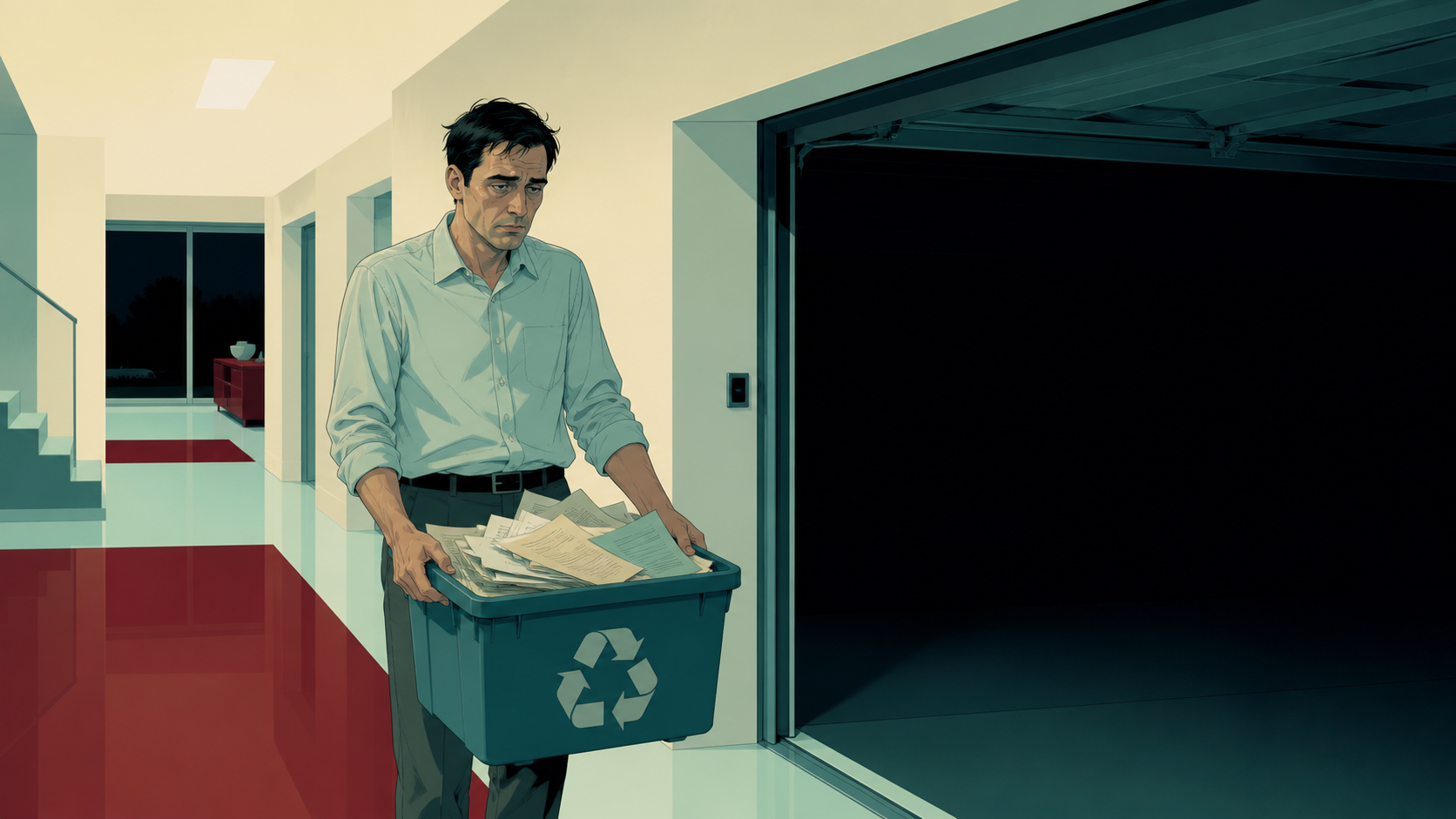
Marcus got home at eleven on a Thursday that had begun in a Marriott outside Ogden, and if you had stopped him in his own driveway and asked what the middle of the day had held, he could not have told you, and would not have thought it strange. That was travel. Travel ate the days from the inside and left the wrapper. He had a boarding pass in his coat and a rental receipt and a warm, vague sense of having been good in a conference room, and the rest was the gray nothing that four days a week had always been. He carried it into the house the way you carry in weather, without a second thought.
The house was doing its night version of itself. The dog lifted her head off the couch, decided he wasn't worth it, and put it back down. Upstairs the bedroom door stood open and Dana was a shape under the blanket, the little gray band a paler line at her hairline, her breathing gone long and even the way it did on the band, smoother than she ever slept without it. He stood in the doorway a minute. He wanted to lie down against her back and give the day to sleep. But the road was still in him, the recycled air and the four cups of bad coffee, and he knew if he got in he'd lie there doing arithmetic on the ceiling until the alarm. So he went back down to be tired somewhere it wouldn't wake her.
He read buildings for a living. People didn't understand that was the job. They thought a facilities manager fixed the boiler, and sometimes he did, but mostly he read: permit sets, load calcs, the fine gray print of a service contract, the specification that said the membrane was warrantied for twenty years provided you never once let standing water sit on it. He had a feel for the sentence in a document that was actually holding the building up, the one clause everyone skated past that turned out to be the whole deal. It was a boring gift. It had saved his company four hundred thousand dollars twice and gotten him exactly one dinner out of it.
He took the recycling out because it was full and because moving felt better than sitting. The bin lived in the garage, and when he tipped the kitchen basket into it the garage light caught something flat and heavy at the bottom, already there, a cardboard mailer the size of a phone book with the corner torn where somebody had checked what it was and lost interest. The little sailboat logo. EVERSTAY, and under it, in the friendly lowercase they used for everything, your ownership, in full. He almost let the coffee grounds go down on top of it. Then the reader in him, the part that could not leave a document unread any more than Margo could leave a phone unlifted, reached in and pulled it out and wiped the one wet corner on his jeans.
The Statement was two hundred and fourteen pages. It said so on the front, in a box, the way a serious document tells you how serious it is. Public Offering Statement. This document is required by law. You are entitled to receive it. Please read it carefully. He carried it to the kitchen table and turned on the light over the stove and not the big one, and sat down where he could see the doorframe by the pantry with the pencil marks going up it, JONAH 8, JONAH 9, MARGO 11, the little dated rungs of his kids getting taller, and he started to read the way he read a spec, which was slowly, from the front, looking for the sentence that held the building up.
For a long time there wasn't one, and that was almost restful. It was good writing, was the thing. He'd braced for the usual, the clotted lawyer prose that hid the ball by being unreadable, and instead it was clear. Warm, even. It explained the resort, the season calendar, the maintenance fee and the cap on the maintenance fee, and he found himself nodding along, the way he'd nodded along in the presentation, thinking this is fine, this is a good deal, we were right. Two hundred twelve dollars a year, capped, in writing, initialed. The membrane was warrantied. He turned pages, and the pages were kind to him, and somewhere around sixty he caught himself half-asleep and thought about going up, and didn't, because he'd told himself he'd finish, and Marcus finished things.
Page ninety-six had a heading he'd been sliding past all night in the other sections, and this time it stopped him, because it was defining a word he thought he already owned.
"Unit," the Statement said, shall mean the accommodations designated from time to time by the Club for the Owner's use, whether or not corresponding to any particular structure, room, or physical space, it being understood and agreed that the Owner's interest is in the occupancy so designated and not in any specific real property.
He read it once fast, the way you skim a definition, and it slid right through him. Then something snagged, the stair-in-the-dark feeling, though he didn't have Dana's word for it, and he went back and read it the way he read the clause that mattered, slowly, out loud almost, moving his lips.
Whether or not corresponding to any particular structure, room, or physical space.
He turned back to the certificate they'd been mailed, the good stiff one Dana had put in the folder, and there it was, the legal description he'd glanced at and filed as boilerplate: Unit 4-C, Halcyon Cay Tower. A room. A specific room, on a specific floor, with a number, the room they'd slept in, he'd assumed, the two-bedroom on the third floor with the balcony where Jonah had eaten fritters. Except the balcony room hadn't been 4-C, he was fairly sure it had been a two-something, and anyway the definition on page ninety-six had just told him, in the calmest possible voice, that the number didn't matter. That the room didn't matter. That what he owned was not a room and had never been a room. His interest was in the occupancy so designated. In the hours. Whether or not there was any structure at all.
He sat with that for a while. The refrigerator cycled on and filled the kitchen with its low even hum, and the dog dreamed and paddled her feet against the couch, and Marcus Kolar looked at a paragraph the way you look at a hairline crack that runs, when you follow it, from the ceiling all the way down into the foundation, and understood that the crack was not in the plaster. The crack was the wall. The wall had been built as the crack.
He kept reading, because now he had to know how far it went.
It went, in plain English, exactly as far as it could. Page one-forty-one laid out the Float the way Corrie must have laid it out for Dana, though he didn't know yet that Dana had called, that she was upstairs sleeping smooth over the same fact he was learning down here in the stove light. He didn't know they were both inside this thing separately, each of them carrying it alone through the house so the other one wouldn't have to. He only knew that the document did not lie to him, not once, not by omission, and that the not-lying was somehow the worst thing about it, because a lie you could be angry at. This just told you. It told you the unreserved occupancy was managed, banked, delivered, and it used the word delivered the way a company that shipped freight would use it, and it never raised its voice, and every place he braced for the trapdoor there was instead a clear sentence with his own signature two hundred pages back standing under it, holding it up.
And then, near the end, in a section headed Transfer, Devise, and Assignment, he found the sentence that held the building up.
He knew it the second his eye touched it, the way he'd always known, a small cold settling in the chest. It sat under a paragraph about heirs, and the paragraph about heirs was the one Dale had read them a piece of in Vegas, the old ceremonial words, and Marcus read the whole of it now for the first time:
TO HAVE AND TO HOLD the same unto the Owner and to the Owner's heirs and assigns, in perpetuity.
In perpetuity. He'd heard it as a flourish, a nice forever, the kind of word a resort used to mean you'll always be welcome. Reading it at his own kitchen table at two in the morning it did not mean welcome. It meant the thing did not end. It meant that when he ended, it would not, that it would step over him and go on being owed, and that it had already decided who by. Heirs. His heirs slept upstairs. One of them was due a pencil mark and hadn't had one since spring.
Below that, set off in its own numbered subsection, was the assignment clause, and Marcus read it twice.
An Owner may assign the entire Deed, together with all occupancy and obligations conveyed thereby, to a single Owner of Record, provided that the assignee reserves no Owner's week and retains no occupancy to the assignee's own use. Upon recordation of such assignment, all other members of the assigning household shall be released from occupancy and from all obligations hereunder, and the Deed shall thereafter be performed in full by the assignee alone, in perpetuity.
He read it the first time and understood the words. He read it the second time and understood the offer.
It was an exit. That was what it was. It was the only thing in two hundred and fourteen pages that had the shape of a door, and it opened exactly one way. One person took the whole thing, reserved nothing, kept no week, and stood under it forever, and everyone else in the household walked out free. Released from occupancy. He could feel his own body loosen at the phrase, an actual physical unclenching, relief arriving ahead of thought, and it was the relief that frightened him, because relief meant part of him had already run the arithmetic. Part of him, the part that read the clause that mattered, had already started sorting his family into the ones who got released and the one who carried it.
And it did the sorting the way it did every calculation, coldly, on the merits, and the merits said: someone who reserves nothing, who keeps no week, is worth the most to the instrument if they have the most hours left to give. The most years. The most Tuesdays ahead of them. His eye, before he could stop it, before he even knew he was doing it, went across the dim kitchen to the doorframe, to the little dated rungs climbing up it, to the highest pencil mark and the empty wood above it where the next ones would go.
He stood up so fast the chair barked on the tile.
For a second he just breathed. The refrigerator hummed. Upstairs nothing moved. He looked at the doorframe and made himself look at it as wood, as trim, as a thing he'd caulked once, and not as a ledger, and slowly the kitchen came back to being a kitchen. He was tired. He was road-tired and jet-stupid and he'd read a legal document at two in the morning, which no one should ever do, and he had scared himself with a sentence. That was all. In the morning it would be a strange clause in a long boring book and he'd tell Dana about it over coffee and she'd say something sensible and it would go back to being paperwork.
Except he already knew he wasn't going to tell Dana about it over coffee.
He didn't decide not to. It was more that he watched himself not deciding to, watched his own hands close the Statement and square its edges and slide it not back into the recycling but onto the high shelf over the coats, behind the board games, where a two-hundred-page book could sit for a year and no one would think to look. He turned the little numbered subsection down at the corner first, a dog-ear, so he could find the page again. He told himself that was so he could find it to show her. He was fairly sure that wasn't why.
"You're back."
Dana was on the stairs, one hand on the rail, the band gone from her hairline, her face soft and creased from the pillow and not yet all the way awake. She had the look she got when the house made a sound that woke her, half here, ready to be told it was nothing.
"Chair scraped," he said. "Sorry. Couldn't sleep. Ogden." He heard how easy the lie came, three true words doing the work of a false one, and thought, distantly, so that's how she's been doing it too, though he didn't yet know she had been.
"What are you doing down here?"
"Taking out the recycling." He crossed the kitchen and turned off the stove light so she wouldn't see the shelf, so she wouldn't see his face, and put his arms around her at the foot of the stairs, and she came into it warm and heavy and half-asleep, her cheek on his collarbone, and over the top of her head he could still see the pale doorframe in the light coming down from upstairs, the rungs, the empty wood above the top one where his eye had gone.
"How was the trip," she murmured into his shirt.
He honestly could not remember a single hour of it, and for the first time in eleven years of coming home from the road that did not feel like nothing.
"Fine," he said. "Long. I'm glad I'm home." That part, at least, was completely true, and he held onto it, and held onto her, and did not tell her about the door, or which of them it had, without asking, already picked.
Chapter 7 — Four Columns
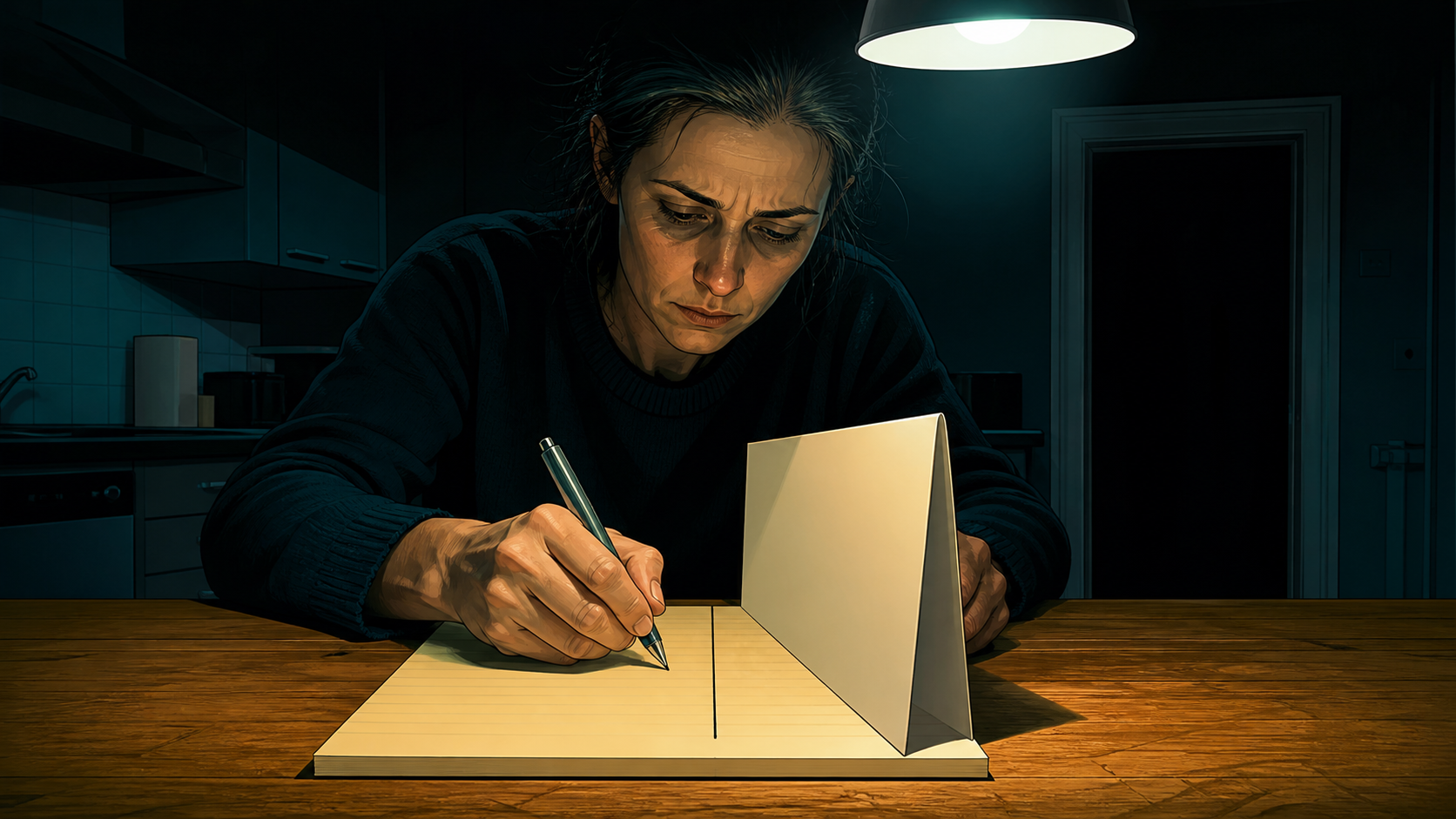
The legal pad came out of Marcus's drawer, the one where good pens went to die, and Dana ruled it into four columns with the edge of a takeout menu because she could not find a straightedge and would not go looking for one, because looking would mean walking past the doorframe, and she was not ready for the doorframe yet.
She did this for a living. That was the thing she kept telling herself at the kitchen table at ten at night with the stove light on and the rest of the house dark. When a shift wouldn't reconcile at Washoe Regional you didn't panic and you didn't guess. You built a grid. You put what the record claimed in one column and what a body could prove in the next and you did not let yourself feel anything about the gap between them until the columns were full, because feeling was how you talked yourself out of a number. Numbers didn't care how tired you were. She had made four hundred people's hours behave for nine years on exactly that principle, and she was going to make her own family behave the same way, and if her hand shook a little ruling the lines, well. No one was grading the lines.
She labeled the first column CAN'T TELL THE STORY. That was the one that had started all of it, the one nobody but a person who reconciled time could have caught, because it didn't feel like anything. A blackout felt like something. This felt like a Tuesday. You could not point to where it went because nothing had gone; there was simply no story in it, the way there was no story in the drive to work, except the drive to work you could reconstruct if pressed and this you could not, and the not-being-able had no edges.
Second column: SOMEONE SAYS I WAS THERE. The charge sheet in her own hand. Ruth Delgado's note, thanks for the assist, D, you saved my night. A badge swipe with a timestamp. The world's witnesses, all of them competent and none of them her.
Third column she sat on for a while with the pen against her lip. Then she wrote WORE OUT ANYWAY, which wasn't good English but was the truest thing she'd written in a week. The world kept its own books. That was the whole trick, she was starting to understand, the only clean instrument in the house. The Lull smoothed the seam and Corrie's screen said everything reconciled and her own memory handed her a Tuesday with no hole in it, and against all of that soft agreeable machinery there stood a set of dumb physical facts that could not be talked to. An odometer could not be reassured. Rubber did not care what you remembered.
Fourth column she almost didn't write, because she knew where it went and she didn't want to give it a name yet. She wrote WHO GOT PAID and put the pen down.
Then she started filling it in.
The car was easy because she'd already done the car, done it standing in the driveway three weeks ago with her thumb pressed white against the trip meter. Eighty-four miles. The seat two notches back for someone with longer legs, and she a woman who had driven that seat in the same position since the dealership, who knew her own knees against the wheel the way she knew her own signature. She wrote it across all four columns in a hand that stayed level: no story, the toll camera on the 580 with a plate that was hers, tread and fuel gone that she hadn't spent, and the last column, the one she'd sworn she wouldn't fill, wanting to say nobody, wanting the miles to just be miles. But miles were value. Somebody had banked an errand inside her Wednesday and the errand had gotten done and the getting-done had landed, itemized, somewhere she couldn't see. She left the fourth column at a question mark and hated the question mark.
She went upstairs for the shoes.
Margo's were by the door with the rest, and Dana crouched in the dark and turned them over the way you'd turn over a chart, and there it was, the wear along the outside edge, the heel scuffed on the outboard corner like a person who walked with their weight rolled out. Margo did not walk like that. Dana had watched that child walk for thirteen years, pigeon-toed since she could stand, wearing through the inside of every shoe she'd ever owned so that Dana bought inserts by the case. These had gone the other way. Eleven thousand steps the girl had mentioned once at dinner and then never again, both of them letting it drop, and the steps had left their signature in rubber, in the exact place Margo's own feet never touched. Someone with a different gait had walked a long way in her daughter's shoes.
She put them down exactly as she'd found them. That felt important, suddenly, to disturb nothing, to be a careful auditor of her own house and leave no trace, and she recognized the feeling as the one you had around a thing that might still be watching, and made herself stop having it.
Marcus was awake. She could tell from the landing by the quality of the not-sleeping, the specific held stillness of a man pretending, and she stood in their doorway a moment the way he'd stood in it Thursday without either of them knowing the other had. The band made a pale line at his hairline. His breath went long and smooth and false.
"You're up," she said.
"Couldn't turn it off." He didn't say what. He shifted onto his back and the reading light clicked and there he was, gray at the temples, tired in the honest way that travel made a man tired, and she loved him with a sudden lurch that had fear all through it like a thread through cloth. On the nightstand the amber bottle. Her eye went to it before she'd decided anything.
"Give me your arm," she said.
"What?"
"Your wrist. Give it here." She sat on the edge of the bed and took his left hand into the lamplight and turned it, and he let her, puzzled, and there on the inside of his wrist was the mark she'd half-seen a dozen times and filed as nothing, a healed patch the size of a nickel, shiny, the pink gone silver at the center, a burn some weeks old and well past hurting.
"When did you do this," she said.
He looked at it like a stranger's arm. She watched him reach for the story, watched the small machine in him that made plausible things go looking, and come back empty, and then not want her to see it come back empty. "Oven," he said. "Reaching over a burner, probably. You know me."
"You haven't cooked since June, Marcus. You've been in Ogden and Boise since June." She pressed the pad of her thumb next to it, gently, the way she'd check a patient's healing, and he didn't wince because there was nothing left to wince at. "This is three, four weeks along. It's most of the way closed." She heard her own voice go into the register she used at three in the morning, level, kind, the one that held a family still while you told them the thing. "You burned your arm badly enough to scar and you don't remember it and it didn't hurt you, because by the time it was yours again it was already this."
He was quiet. The refrigerator cycled on downstairs, filling the house with its low even hum, and she thought, absurdly, that she'd have to defrost it, that there was a whole ordinary life stacked up waiting behind this, dishes and a dentist and Jonah's cleats.
"Dana," he said, and stopped. She watched him hold something with both hands under the blanket. She knew the grip. She was doing it too. She had a legal pad downstairs with four columns on it and she had not told him, and he had a paragraph in a two-hundred-page book he had not told her, and they sat six inches apart in the lamplight each carrying the whole weight alone so the other one wouldn't have to, and that, she would think much later, was the most married thing they ever did.
"It's fine," she said, which was a lie, the only lie in the house that night, and she put his hand down.
She took the pill bottle to the bathroom and counted it under the fan so the sound wouldn't carry. Her own script, the low-dose thing for the blood pressure, thirty a month, filled on the ninth. She counted twice. There were six too few. She stood on the cold tile and did the arithmetic she did in her sleep, days times dose, and the bottle was three days lighter than her life could account for, three days she had taken a pill she did not remember swallowing, her own hand to her own mouth in a kitchen at a time that left no story, keeping her own body running smooth for whoever was standing in it. That was the one that got under. Not the miles, not the burn, not even the shoes. The pills. Somebody had been careful with her. Somebody had kept her healthy in the hours they wore her, the way you'd wipe down a rental, and she had come out of those hours rested and even and had gone on taking credit for a steadiness that had, in measurable part, been maintenance.
She went back down and wrote it in. All four columns full now, the beneficiary question mark starting to look less like a question. She sat with the pad and let herself, finally, for one minute, feel the thing she'd been holding off since the ruled lines, which was not violation. That was the horror of it, the part she couldn't have explained to anyone who hadn't sat in that stove light. It wasn't violation. It was closer to relief, a small shameful loosening in her chest, so that's why the charting's been so good, so that's why I've been so patient with him, and she caught herself feeling it and was more frightened by the feeling than by anything in the columns, because if the relief was real then some part of her had already agreed to want this, the way she'd heard herself agree to want the Founder's Rate on the phone before she'd decided a thing.
The last column she'd saved was the doorframe.
It was the only witness in the house she trusted completely, and she'd left it for last the way you leave the test you're surest of, because a pencil mark was a thing a hand made on a night, dated, in someone's writing, and there was no smoothing it, no exchange rate, no seam. Marks went up it in a ragged ladder by the pantry, JONAH 8, JONAH 9, MARGO 11, the little dated rungs of her children getting taller, and she knew them, she had made most of them herself, standing a squirming kid against the wood with a book flat on their head.
She brought the stove light with her, angling the pad to throw it, and knelt.
There was a new one.
Higher than MARGO 11 by a good two inches, penciled clean and level the way she always did it, book-flat and square. MARGO, and a date. She read the date and her stomach went out from under her the way a stair goes when it isn't there.
Three weeks ago. A Saturday.
She knew the Saturday. She knew it the way you know the day of a funeral. That was the night of Bea's thing, her sister's back-patio thing for the twins' birthday, and the whole family had gone, all four of them, she had a hundred photos, she had Jonah with cake on his chin and Marcus in the folding chair and Margo filming the sparklers, forty minutes away in Fernley from six o'clock till nearly midnight. Nobody had been in this house. The house had been dark and locked and empty from six until midnight on the exact Saturday that someone had stood a girl against this doorframe, laid a book flat and square on her head, and marked her new height in pencil, in Dana's own careful hand.
She put her fingers to it. It did not smudge. It was three weeks set into the wood and it was hers and she had not made it, and the girl it measured had been in Fernley eating cake, and both of those things were true, and the doorframe, which could not be reassured, which did not care what she remembered, held them both.
Chapter 8 — The Ball Team
The game went to extra innings, because ten-year-olds cannot be made to end anything, and Dana sat on the third row of the aluminum bleachers with the heat coming off the metal into the backs of her knees and was, for whole minutes at a stretch, almost happy.
That was the part she'd learned to be afraid of these last weeks. The happiness still came. It came the same places it always had, in the nachos going orange and cold in their paper tray, in Jonah out at second base doing the ready-crouch she'd taught him in the driveway, spitting the way the big kids spat and mostly getting it on his own cleat. It came watching him and not thinking, for a whole half-inning, about the doorframe, or the pills, or the four ruled columns on the legal pad in the drawer at home that she had not shown her husband and did not intend to. The sun was good. The boy was hers, all the way hers, ten years old and worthless as inventory, and she could look at him and know for certain that every clumsy thing he did on that field he was doing himself.
"He's gotten good," Carla Deveraux said, next to her. "Wyatt says he's the only one who'll actually run out a ground ball."
"He's stubborn," Dana said. "It looks like hustle."
Carla laughed. She was a wide, easy woman who brought orange slices in a cooler for the whole dugout and remembered which kid was allergic to what, and her husband Neil ran a heating-and-air outfit off Kietzke and coached first base in a bucket hat, and Dana liked them the plain way you like people you only ever see in folding chairs. They had talked, over two seasons, about nothing at all. Grades. The umpire. Whether the league would ever fix the outfield fence.
"You guys look rested," Carla said. "Did you go somewhere? You've got a color on you."
And there it was, the little door in the afternoon, and Dana felt herself walk through it before she had decided to walk anywhere.
"We did the Bahamas in June," she heard herself say. "This place called Halcyon Cay. It was the best week we've ever had, honestly. I don't say that."
She meant to stop there. She had come to this field with a plan, and the plan was to be a person watching her son play baseball, nothing more, a woman with a worksheet at home and a referral window that Corrie had said didn't close until spring, months off, an ocean of time in which to not do this. She had rehearsed, in the car, the sentence she would use if it came up. We went somewhere warm. Four words with no hook in them.
Instead she kept going.
"It's one of those ownership things," she said, "which I know, I know, believe me, Marcus about walked out. But the number's real. Two hundred and twelve dollars a year, and it's capped, it can't go up on us, it's in the contract. For a week at a place you would not believe. Water like a pool. Kids' club so good Jonah cried leaving."
"Two hundred?" Neil had turned around from the row below, bucket hat and all. "A year."
"A year. I do hospital billing, basically, I reconcile people's hours all day, I don't get fooled by a number. I ran it four ways. It's real."
"There's a catch," Neil said, friendly, the way Marcus had said it, and Dana felt something in her settle into a groove she did not remember cutting, a smoothness, a warmth coming up in her chest like the first swallow of something.
"The catch is they want ninety minutes of your life," she said. "They sit you down and they show you the whole thing and they try to sell you more, and you say no thank you, and you leave with a free week. That's the catch. Ninety minutes. I timed it. They stopped at eighty-eight." She smiled at him, and it was her own smile, she was almost sure. "You'll spend longer than that on hold with your insurance this month."
Carla was looking at her the way you look at good news. "And you'd — what, you'd recommend it. You'd put your name to it."
"I'd put my name to it," Dana said.
She should have heard the sentence for what it was. She reconciled hours for four hundred people; she knew the shape of a phrase that had been engineered, the way a claims code was engineered, every word load-bearing and none of it hers. Put your name to it. She had never in her life said that. It was not how she talked. It had come up out of her clean and finished, the way the shift had come up on the grid in June, in her handwriting, better than she did it.
But the sun was on the metal, and Wyatt Deveraux was up with a runner on, and Carla had her phone out already saying okay, okay, how do I even, do you send me something, and Dana was walking her through it, thumb to thumb over the bleacher rail, the little sailboat coming up on Carla's screen, the field where you put the referring household's account number, which Dana knew by heart though she had never once dialed it, and the whole thing took less time than an at-bat. Wyatt struck out looking. Nobody minded. Carla was pink with the pleasure of having been let in on something, and Neil shook Dana's hand across the row like they'd closed on a house, and Jonah's team lost in the bottom of the eighth on a passed ball, and everyone went for pizza, and it was, all of it, a nice afternoon.
The confirmation was waiting when she got home.
She saw it on the lock screen carrying the pizza box in, and she stood in the kitchen under the good light this time, the big one, both boxes going warm on the counter, and read it with her coat still on.
Dana — so glad you thought of us! We've received your referral for the DEVERAUX HOUSEHOLD (Reno, NV) and reached out to schedule their Preview. There is no obligation on their end and no pressure, ever — just ninety minutes and a very good week if it's right for them. Because you're a Founder's Rate owner, here's what posts to your account when a referral completes a Preview:
And then the line, set off in the gray monospace they used for anything that touched the ledger, the same face the folio had worn at checkout, the face she had come to read the way other people read a biopsy:
REFERRAL — DEVERAUX HH — PREVIEW PENDING
+1 OWNER WEEK (WK 27) — FOUNDER'S RATE MAINTAINED THRU 2036
ACCOUNT STATUS: ACTIVE — IN GOOD STANDING
That's a second reserved week for your family, Mrs. Kolar, week twenty-seven, right up against your twenty-six, so you can do the two back to back if you like. Most owners never look back. Corrie's your specialist if you have any questions at all. We'll take good care of the Deverauxs.
Dana read it twice. She took her coat off. She got two paper plates down and called the kids and served the pizza and told Jonah to wash his hands for real, with soap, and she did all of it with the specialist part of her brain reading the message a third time underneath, the way she'd read a chart with a bad number in it while she smiled at the family.
A second reserved week. She turned it over. She had spent three weeks now learning that the deed conveyed everything she didn't reserve, that her fifty-one unreserved weeks were the product, were inventory, were the hours somebody else stood inside her life doing her job better than she did. So a second reserved week ought to be a good thing, a week clawed back, one more week of the year that was hers and not the Float's. That was how it read. That was how it was built to read.
But she made herself do the arithmetic, because she did arithmetic, and the arithmetic said the week hadn't come from nowhere. Somewhere in Reno tonight the Deverauxs were pink and grateful, and in ninety minutes they would sign, because it would be irrational not to, and then they would have their own week and their own fifty-one, their own kids' names printed correctly on a certificate they hadn't chosen the date for, their own Wyatt out at short doing something with somebody else's hands. She hadn't clawed a week back from the machine. She'd fed a family into it and been handed a week for the delivery. The two events were the same event. She had been paid a finder's fee, in the only currency the thing dealt in, and the fee was more of the exact substance that was eating her.
She knew all that. She stood at the counter and knew all of it cold.
And she was so relieved she could have sat down on the floor.
That was the thing. That was the thing she could not get around, forking cold pizza onto Jonah's plate. The relief was enormous, physical, a loosening behind the sternum she hadn't known she'd been holding since the parking structure, since the call, since Corrie's kind voice saying you'll want to keep that. The rate was safe now. Locked through 2036. Whatever else was true, whatever was standing in her on her lost Tuesdays, the household was protected, the fee could not move, the one number she could actually control had been nailed down for ten years, and she had done it, she had reached out and done it with her own smile and her own hand, and it had been so easy, and everyone had been so happy.
The missing hours had frightened her. But the missing hours had been done to her. She could hate them clean. This was different. This she had wanted. She had walked to the field a woman with a worksheet and walked home a woman who was glad, and the gladness was the most occupied-feeling thing that had happened to her yet, a warmth that arrived on schedule and did her thinking for her and left no story in it, and she could not for the life of her find the seam where she stopped and it began.
"You okay, Mom?" Margo, in the doorway, not eating. Watching her the new specific way, the way that held something under the table with both hands. Thirteen going on fourteen, going on eligible, and she missed nothing, she logged everything, and she had been logging her mother too, Dana understood now. For weeks.
"Long day," Dana said. "Your brother lost on a passed ball."
Margo didn't move. "Carla Deveraux texted my friend's mom. She said you sold them on the Bahamas thing." A pause. "She said you were really good at it."
Really good at it. Dana felt the sentence go down into her like the six missing pills.
"Eat your dinner," she said, and Margo, after a moment, did, and Jonah told a story about the umpire that took nine minutes and required no reply, and later, when the plates were in the sink and the house was doing its night version of itself and the little gray bands were on the nightstands charging, Dana went to the drawer where good pens died and took out the legal pad.
Four columns. CAN'T TELL THE STORY. SOMEONE SAYS I WAS THERE. WORE OUT ANYWAY. And the fourth one, WHO GOT PAID, that she had left three weeks ago at a question mark she hated, because she had not wanted to write the name that lived at the bottom of every discrepancy, the beneficiary the arrow always pointed at, off past the edge of the page where she couldn't see it.
She found a clean line and she wrote the date, and Deveraux referral, and she went across the columns the way she'd trained herself, level, giving nothing. No story: she could not honestly say she'd decided to do it. A witness: Carla, thumb to thumb over the rail, and now a text going around the moms of Reno saying she was really good at it. Worn: her own voice, cut smooth in a groove she didn't remember cutting, saying put your name to it like it was hers.
And the fourth column. WHO GOT PAID.
For three weeks the arrow had pointed away from her, at Everstay, at the ledger, at the grateful strangers. She had been the one it was taken from. That had been the whole shape of the horror, and she had known where she stood inside it.
She looked at the pending line one more time on the dark phone. +1 OWNER WEEK. FOUNDER'S RATE MAINTAINED THRU 2036. Then she put the pen to the fourth column, and for the first time since she'd ruled the page, in her own steady handwriting, the handwriting that was hers and had also, apparently, worked a shift she'd slept through, she wrote her own name.
She sat and looked at it. The refrigerator cycled on and filled the kitchen with its low even hum. Upstairs the bands were pulling three people's nights into one smooth unbroken thing, and down here the doorframe stood pale in the dark with its dated rungs, JONAH 8, JONAH 9, MARGO 11, and one more up top she had not made and could not account for.
The worst part was not that she'd gotten paid.
The worst part was that she wanted to do it again.
Chapter 9 — The Christmas Band
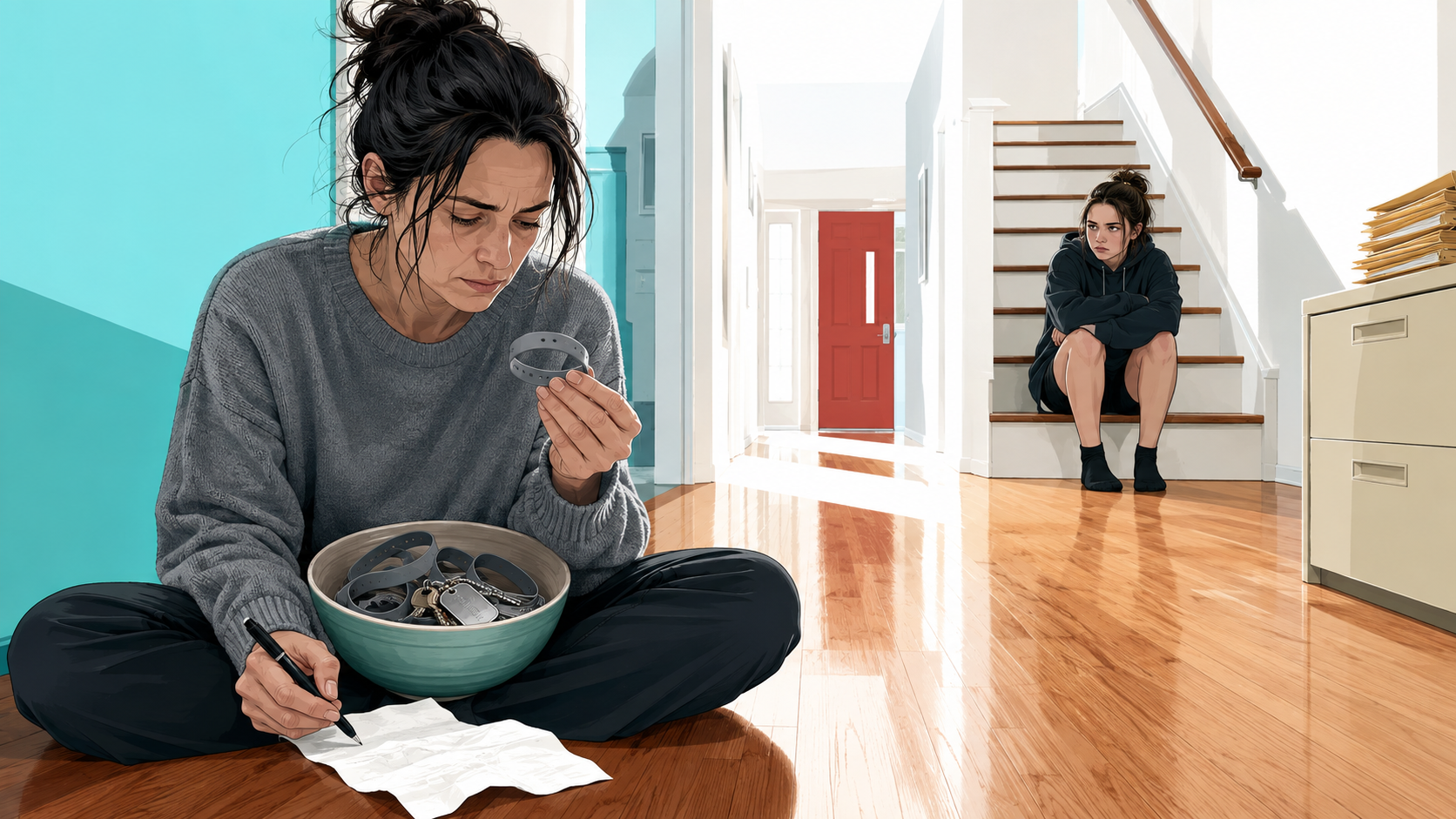
The bands lived in a bowl on the hall table with the keys and the dog's spare tags, four of them, gray, curved like commas, and Dana had put her hand in that bowl every night for three years without once looking at what she was holding.
She looked now. She sat on the floor of the hallway at nine-forty on a Sunday with the bowl in her lap and turned one over. It weighed almost nothing. The strap was that soft medical silicone that never got warm, and the inside of the band had a little bloom of green corrosion at the contact pad where three years of her own sweat had gone. LULL, and under it, tiny: Model 3s. Rest is a clinical outcome. There was a serial number. She wrote the serial number on the back of a grocery receipt because she was a person who wrote things down now.
"That's mine," Margo said from the stairs. "The one with the chip in it."
"I know."
"You're being weird about it."
"I'm being thorough about it." Dana did not look up. "Do you remember who gave us these?"
Margo came down two steps and sat, which was as close as she got to volunteering for anything lately. "Grandma Ellen. Christmas at Aunt Bea's. The year Jonah had the ear thing and screamed through the whole present part."
"That's right."
"You cried."
"I did not cry."
"You did the thing where you don't cry," Margo said, "which is worse."
Dana let that stand, because it was accurate and because the girl deserved a win. She remembered the box. Four of them in one carton, which had struck her at the time as extravagant for Ellen, who bought presents at the pharmacy, and Ellen had said they were doing a family bundle, honey, it was practically free, which was the sort of thing Ellen said about everything, and Dana had thanked her and been genuinely, uncomplicatedly grateful, because Dana had not slept properly since Jonah was born and by that winter she was a woman held together by coffee and spite. She had put it on that first night doubting it entirely. She had woken at six-fifteen without an alarm feeling like a person. It was the single best gift anyone had ever given her and she had said so, out loud, more than once, for three years.
That was the part she kept turning over. Not that they had it. That she had loved it.
"Margo," she said. "What Christmas was that."
"Twenty-eight." Margo shrugged. "I got the camera the same year."
Dana did the arithmetic the way she did all arithmetic, silently and twice. Christmas 2028. Vegas was June of 2031.
She sat very still on the hallway floor with a grocery receipt in her hand and felt the sequence rearrange itself, quietly, the way a column of figures does when you find the transposed digits: nothing new added, nothing taken away, everything suddenly in a different order and meaning something else entirely.
She had been building the story wrong. She had built it the way anyone would: they sat through the ninety minutes, they signed the deed, and then, at some point after, the machinery had reached into their house and found the instrument it needed. Cause, then effect. A trap laid after the animal walked in.
Except they had been wearing the bands for two and a half years before Dale Ochoa ever said hello to them on a sidewalk off Fremont.
"Mom."
"Sorry. Yes."
"You went away for a second."
"I was thinking."
"You do that with your face open," Margo said, and went back upstairs, and Dana sat in the hall and listened to her daughter's door close and did not move for a while.
She got up eventually and did what she did, which was reconcile. The Lull had an app, and the app had a settings page, and buried four taps down under About was the thing she wanted, because engineers cannot help themselves: a firmware history. Every update, dated, with release notes, going back to the day they'd paired the things. It was public. It had always been there. She scrolled to the bottom and started reading up from the beginning, and it took her forty minutes, and it was the most boring document she had ever been frightened by.
3.0.4 — Improved sleep-stage classification accuracy for users under 30 kg.
3.1.0 — Continuity smoothing now available in all regions. Micro-arousals below 90 seconds are resolved without waking the user. You will not remember them, because there will be nothing to remember.
She read that one twice. It was cheerful. It had a little moon icon next to it. She thought about all the mornings she'd said to Marcus I slept like the dead, and how proud of the band she had been when she said it, the way you're proud of a good appliance.
3.2.6 — Guest Continuity (beta). Extended sessions now maintain seam integrity beyond the sleep window. Feedback welcome via the Help tab.
The date on 3.2.6 was March of 2031. Three months before Vegas.
She wrote it on the receipt under the serial number. Her hand was steady. Her hands were always steady; it was one of the four or five things she'd been complimented on in her life, and she no longer knew whether it was hers.
4.0.0 — Ownership sync. If your household holds a Club membership, your Lull will now coordinate rest with your Club calendar. Nothing to set up. Enjoy your week.
Enjoy your week. Somebody had written that. Somebody at a desk had typed those three words into a release note for a sleep band, and a manager had approved them, and neither of them had been doing anything wrong.
Marcus found her at the kitchen table at eleven with the laptop open and the bowl of bands beside it and the light on over the stove and not the big one. He had gotten in from Boise at nine. He stood in the doorway with a glass of water and looked at the bowl and then at her, and she watched him decide not to go to bed.
"Okay," he said.
"Sit down."
He sat. She turned the laptop toward him, and it wasn't the firmware page anymore, it was a filing, the boring blue-gray of a corporate document scan, and she had it open to a page in the back where the subsidiaries were listed the way subsidiaries always are, in a table nobody reads, alphabetized.
He read it. She watched him read it, the way he read, lips moving slightly, the facilities man going down a spec sheet for the line that held the building up.
AMBIT LEISURE GROUP, INC. — Wholly owned subsidiaries: Everstay Vacation Ownership, LLC (FL). Everstay Management Services, LLC (FL). Halcyon Hospitality Holdings, LLC (BS). Interval Clearing Company, LLC (DE). Restwell Devices, Inc. (d/b/a Lull) (CA), acquired 2027.
"Huh," Marcus said, which was what he said instead of swearing.
"Same parent."
"Same parent." He sat back. "That's not even hidden. That's on page ninety of a 10-K, that's — Dana, that's in the annual report, that's the part with the photographs of smiling people in it."
"I know."
"You could have found this in twenty minutes any day for four years."
"I know," she said. "That's what I've been sitting here with."
He got up and got the water he'd already poured and stood at the counter with his back to her, and she let him have the thirty seconds, because she'd needed longer.
"Ellen bought them," he said.
"Ellen bought them."
"Your mother bought us a sleep band." He turned around. "Your mother, who buys presents at Walgreens, bought four medical-grade wearables in a family bundle for practically free."
"That's what she said. Practically free."
"Where's Ellen's band, Dana."
Dana had been waiting for him to get there, and when he did she found that she did not want him to have gotten there, that she'd have preferred another few minutes of him being a step behind. "In the drawer by her sink. She wore it about a month. She says it gave her a headache." She looked at her hands on the table. "She's seventy-nine, Marcus. She's got the AFib and the kidney thing and she sleeps four hours and takes eleven pills."
"So she's — what."
"She's not good inventory," Dana said, and hearing herself say it in her own kitchen made her want to go outside and stand in the yard.
He didn't argue. That was the thing about Marcus; he never argued with a number. He came and sat back down and put his hand flat on the table near hers, not on it, and said, "Say the rest of it."
"The rest of it is the order," Dana said. "I had it backwards. Everybody would have it backwards. We sat through the Ninety and we signed the deed and then they came for the hours. That's the story. That's the story I've been auditing against since June." She turned the laptop back around. "But the bands were in this house for two and a half years first. We were already wearing them. We were already sleeping eight hours a night on the smoothest sleep either of us has ever had, we were already handing them a channel, and then a man on a sidewalk offered us ninety minutes."
"Cold call," Marcus said slowly. "In a city with forty million people in it a year."
"He knew Margo's name. He knew Jonah's name. It was on the certificate before we chose a week."
"We assumed they pulled it off the credit app."
"We assumed," Dana agreed. "We assumed a lot. We assumed we were customers who got approached." She looked at the bowl of gray commas. "We weren't approached. We were qualified. The presentation isn't how they get you. The presentation is the paperwork you sign after the inventory's already been inspected."
Marcus was quiet a long moment. The refrigerator cycled on and filled the kitchen with its low even hum.
"Then they knew what we slept like," he said. "Before Vegas. They knew I go down at eleven-forty and don't move till five. They knew you've got that four-hour dead stretch. They knew Margo's a — " he stopped.
"Say it."
"They knew Margo was going to be eligible in about eighteen months," he said, "because they had two and a half years of her sleep architecture, and that's a growth curve, and a growth curve tells you a birthday."
Dana had not gotten there. She had been all the way down the road on the adults and had not once turned and looked back up it at her daughter. She sat with it and something went through her that was colder than anything in the last four months, colder than the doorframe, because the doorframe had been about something that already happened and this was about something that had been scheduled.
"They didn't offer us a presentation because we walked past a booth," she said. "They offered us a presentation because a household of four with two juveniles and one heavy sleeper is worth more than a household of two."
"We were the good week," Marcus said. "For them. We were somebody's good week before we ever got ours."
Dana pulled the receipt toward her, the one with the serial number on it, and turned it over, and on the back she started a fifth column, which she had sworn she would never do, because four columns were the method and the method was the only clean thing she had left. She wrote at the top: WHEN DID THEY KNOW.
Then she stopped, because Margo was standing in the kitchen doorway in a t-shirt and sleep shorts, arms crossed, and neither of them had heard her on the stairs.
"You're talking about me," Margo said.
"Go back to bed, baby."
"You said eighteen months." Margo's face had nothing on it at all, which was worse than crying, and Dana thought, absurdly, she gets that from me. "You said eighteen months and a birthday."
"Margo."
"It's not eighteen months," Margo said. "I want you to know I'm not being a brat. I'm telling you a fact and then I'm going to bed." She uncrossed her arms. "It already started. It started in April. I've got it in the log, I've got the dates, I've got the whole thing written down since April and I didn't tell you because you were doing the thing with your face and I didn't want to be the reason."
The stove light hummed. Nobody moved.
"And the other thing you should know," Margo said, "is that I'm not the first one it started with in this house."
Chapter 10 — Owner of Record

The lanyards were in every photograph, which was the trouble with photographs. They kept everything, including the parts nobody had been looking at.
Dana had four hundred and six pictures from Halcyon Cay. She had gone through them twice the first week home, the ordinary way, for the pleasure of it, Jonah gone brown as a nut, Margo pretending not to like the water and then not getting out of it for five days. Now she went through them again on the desktop in her office at Washoe Regional with the door shut and her sandwich going soft in its paper, at four hundred percent, the way she read a scanned time sheet when an initial looked wrong.
Behind Jonah on the pool deck, half out of frame, a man carrying a tray of towels. His lanyard hung forward as he bent, and the card on it said LONNIE B., and under the name, in a smaller face, a year.
She had read that, in June, as a hire date, if she had read it at all. A resort proud of keeping its people. It was the kind of thing you noticed and approved of and forgot inside a second, the way you noticed a clean bathroom.
She found the kids' club counselor in eleven photographs. PRISCA A., 2016. The woman at the towel hut, whose name was Delphine and who had given Margo a hibiscus for behind her ear, 1998. The dive instructor with the ruined shoulder, 2022. The girl who brought the pineapple up on the first afternoon, so young she still had a retainer, 2030.
Dana wrote them down on the back of a census sheet. Nine names, nine years, and not one year matching another, which was the part that made her sit back in her chair. In nine years of staffing four hundred people she had learned what a hire-date distribution looked like. It clustered. It came in waves, because hiring came in waves, because budgets did. These were spread like rainfall across thirty-two years, evenly, individually, as though every single person on that property had arrived on their own private schedule and nobody had ever been hired in a batch.
She picked up the phone and dialed the resort, the main number off the back of the folio, and a woman answered on the second ring sounding genuinely pleased to be at work.
"Halcyon Cay, this is Ivette."
"Hi, this is going to be an odd one," Dana said, and used the voice she used on pharmacy techs, cheerful and slightly helpless. "We stayed in June and I'm finally writing the thank-you notes, and I want to spell people's names right. There was a gentleman on the pool deck, Lonnie?"
"Owner-Associate Baptiste," Ivette said. "B-A-P-T-I-S-T-E. He'll love that, nobody writes."
Dana kept her pen moving. "Owner-Associate. Is that a level? Like a supervisor?"
Ivette laughed, warm, surprised by the question in a way that was not performed. "Oh, no, ma'am. It just means he's one of us. We're all owners here."
"All of you."
"Everybody on property. It's how you get on, you know? You come to a Preview, you sit through your ninety, and if it's right for you then you're an owner, and then you can apply. Housekeeping, grounds, the dive shop, front office." A little pride came into it. "I'm eleven years in November."
"Eleven years working here?"
"Eleven years an owner," Ivette said. "I've only been at the desk since March."
Dana thanked her and got the spelling of Prisca's surname and hung up and sat looking at the sandwich.
The owner magazine came four times a year and lived, unread, in the basket by the downstairs toilet where Marcus put mail he intended to deal with. It was called Halcyon and it was beautiful, thick paper, a woman on the cover floating on her back with her eyes closed. Dana brought it to the kitchen table that night and found what she was looking for on the second-to-last page, in the place every company puts its family news, between a recipe for conch salad and a reminder about hurricane-season rebooking.
OWNER-ASSOCIATE MILESTONES, it said. Please join us in congratulating these members of the Everstay family on their ownership anniversaries this quarter.
Forty-one names. A column of them, each with a photograph the size of a thumbnail, each with a property and a year. Delphine Sainvil, Halcyon Cay, 25 years. Tomas Ferrer, Owner Relations, 15 years. Halfway down, a woman in a blazer with a good haircut and an easy smile: Ronna Beaumont, Vice President, Owner Experience, 30 years.
Dana read the page three times. There was nothing in it. That was the thing she kept running into, over and over, since June, and it had stopped being strange and become a kind of weather. There was never anything in it. It was a staff appreciation page. Every company she had ever worked for had run one.
She looked at Ronna Beaumont's small kind face for a while and thought: you are the vice president, and you signed the same thing I signed, and there is a screen somewhere with your Thursdays on it.
Then she called Corrie.
"Mrs. Kolar." Corrie Dunlap picked up on the fourth ring, and there was the sound of a chair, a woman settling in. "You caught me at a good time. How are the Deverauxs? I saw they Preview on the ninth."
"They're excited," Dana said, and the word came out of her flat.
"They will be. Reno families do so well with the June inventory." A keyboard. "What can I do for you?"
Dana had written the question down, because she had learned that with Corrie you got exactly what you asked for and nothing around it, and the asking was the whole skill. "I'd like the chain of title on our unit."
The typing didn't stop. "Sure. Everything recorded, or just since the amendment?"
"Everything."
"It's not short. Do you want it as a PDF or should I have the records office certify hard copies? Certified ones take about nine days and there's a charge from the county, it's eleven dollars."
"PDF's fine."
"Give me twenty minutes," Corrie said. "Is there anything in particular you're looking for? I can flag it."
And there it was again, the little open door, the absolutely sincere offer, the same one that had been standing open since the first phone call in the parking structure. Dana had learned to hear it now, and hearing it did not help.
"I want to know how old it is," she said.
"Oh," Corrie said, and something moved in her voice, one degree. "It's older than you'd think."
It came in seventeen minutes. Dana put the kids to bed and printed it on the little printer in the hall that jammed, forty-one pages, and laid it out on the kitchen table under the good light because the stove light was not going to be enough for this.
It was a county recorder's index, the ugliest kind of document there is, courier type and abbreviations and book-and-page numbers running down the left margin. Cardenas County, Florida, which had nothing to do with the Bahamas and everything to do with where a developer had incorporated in 1977. The legal description repeated at the head of every entry like a hymn refrain.
UNIT 4-C, WK 26, HALCYON CAY TOWER, A CONDOMINIUM
The first entry was dated the fourteenth of February, 1979.
BK 4411 PG 0092 WARRANTY DEED
GRANTOR HALCYON CAY DEVELOPMENT CORP
GRANTEE DUNLAP, VERNA M, A WIDOW
CONSIDERATION $10.00 AND OTHER GOOD AND VALUABLE
...TO HAVE AND TO HOLD, TOGETHER WITH ALL OCCUPANCY NOT
RESERVED TO THE OWNER, UNTO THE SAID GRANTEE AND TO
OWNER'S HEIRS AND ASSIGNS, IN PERPETUITY.
Dana put her finger on the line and left it there.
She had seen that sentence four times now. She had seen it on page ninety-six in Marcus's margin-scribbled photocopy, and she had seen it on the deed in their own file, in a typeface designed in this decade, on paper that still smelled like a printer. Here it was in 1979, in a font that came off a golf ball, above the signature of a woman who had been a widow at the time, and it was the same. Not similar. The same words in the same order, because it was the same instrument, and the instrument had simply gone on being performed while everyone who had ever signed it got older.
She went down the pages.
1979, Dunlap. 1986, a recorded assessment lien, satisfied nine weeks later. 1993, the amendment, a single line in the index with a book and page and the words AMEND DECL OF CONDO, which she circled and did not yet open. 1997, DUNLAP, VERNA M to DUNLAP, RAYMOND E AND MARIE, quit claim, the consideration $10.00 and love and affection, which is a real phrase that real deeds really use and which sat in the middle of that page like a hand on her arm. 2004, an assignment. 2011, another. 2016, DUNLAP, RAYMOND E to DUNLAP, CORINNE A, single woman.
Dana stopped.
She read it twice, the way she read everything, and the second time she read the line under it, in the status column where the county's software put whatever the operator had typed.
STATUS: OWNER OF RECORD — ACTIVE
Below that, 2019 through 2029, eight more entries, eight more surnames she did not know, each one grantee and then, three or four years later, grantor, back to EVERSTAY VACATION OWNERSHIP LLC, again and again, a little revolving door running down the right-hand margin of the page. Beside three of them the status column said something else, one word, and she did not know what it meant and wrote it on her legal pad to ask about.
STATUS: UNRESERVED
And then, at the bottom of page forty, June of this year, a special warranty deed, grantor EVERSTAY VACATION OWNERSHIP LLC, grantee KOLAR, DANA M AND MARCUS J, HUSBAND AND WIFE.
And then, on page forty-one, the form's next ruled line, blank, waiting, with the column headings printed above it.
"Whoa," Margo said.
Dana had not heard her come down. The girl was in the doorway in the enormous T-shirt she slept in, hair in the ruin it got into, and she came over and put both hands flat on the table and leaned across the pages the way she leaned over everything she wanted.
"Bed," Dana said, without force.
"Is that ours?"
"It's the unit."
"How many people is that?" Margo ran a finger down the grantee column, counting, lips moving, and Dana let her, and hated that she let her, and did not stop her. "Fourteen. Fourteen people had our week."
"Had this unit. This week in this unit."
"So there's fifty-one other lists," Margo said. "For the other weeks. Just in this one room." She straightened up. "How big is the room?"
It was, Dana would think later, the only intelligent question anybody asked that entire month, and it was asked by a thirteen-year-old at eleven at night, and Dana had no answer for it at all.
She sent Margo up. She sat with the pages until the printer's timer clicked off in the hall, and then she called the 800 number again, the after-hours line, and got the recording that said Owner Relations was closed and would she like a callback tomorrow between nine and eleven.
Corrie called at nine-oh-four.
"You found her," she said.
Dana had a page of questions in front of her and she did not use any of them. "Corinne A. Dunlap."
"My grandmother was Verna." Corrie's voice had the sound of a woman who had decided, before dialing, to be exactly as truthful as she always was, and who had spent the night deciding it. "My father was Raymond. He gave it to me when I turned twenty, which I was pretty pleased about at the time, honestly. I'd been going since I was four."
"Six dollars a month," Dana said. It was on page one, in the recital of the purchase-money note, and she had gone back for it.
"Six dollars a month for a hundred and ninety-two months. She was a school secretary in Ashtabula and she saved two years for the down payment." A small sound that was almost a laugh, and nothing happy in it. "It was a room, Mrs. Kolar. That's what she bought. Two beds, a kitchenette, a balcony, week twenty-six, every June, and she took my father and then she took me. That's all it was for a long, long time."
"And now it's a room plus my Thursdays."
"It's the same deed," Corrie said. "Amended twice. That's the part I don't think anybody hears when I say it. She didn't buy a different thing than you bought. Nobody ever went and got a new document. It's hers, it's yours, it's the same words on the same paper and it just kept working."
Dana looked at the blank ruled line on page forty-one.
"I want to see it," she said.
"See what, hon?"
"The unit. Four-C. I want to fly down and stand in it." She heard herself getting faster and let it happen. "Not our week, I don't care about the week. I'll pay a nightly rate, I'll pay whatever it costs, I'll come in February when nobody's there. I have a deed that describes a room and I've never been in the room, and I would like, once, to stand in the room I own and look at the balcony where a school secretary from Ohio sat in 1979. Can you book that."
The pause went on long enough that Dana heard a phone ring somewhere behind Corrie, and heard nobody answer it.
"Mrs. Kolar," Corrie said, and her voice had come all the way out of the script, out of the warm competent groove it had run in since June, and what was under it was so ordinary and so tired that Dana's hand went cold around the phone. "There's no tower. It was condemned in 1992. There hasn't been a building there in thirty-nine years."
Chapter 11 — Substitution of Collateral

Marcus flew into Miami on a Tuesday and told his company it was for the Doral chiller job, which was half true, because the Doral chiller job existed and he did go look at it. Forty minutes, a bad compressor, a maintenance log nobody had signed since March. Then he drove ninety miles northwest to a county seat with a courthouse square and a Cuban place on the corner, and sat in the records room of the Cardenas County Clerk from eleven until they put him out at four-thirty.
He liked records rooms. That was the thing he had not expected about any of this. Twenty-two years of walking mechanical spaces had made him a man who believed buildings told the truth about themselves if you got underneath them, and a county recorder's office was the same animal: fluorescent, indifferent, organized by somebody long dead, and completely unable to lie because lying took effort and nobody here had ever had the budget for effort.
The clerk was a man in his sixties named Ruben who ran the microfilm reader like a lathe.
"Book forty-four eleven," Marcus said.
"Seventy-nine's on film. Ninety-three you can pull paper, they didn't scan till ninety-six." Ruben was already moving. "What are you, exit company?"
"Facilities."
"Huh," Ruben said, which was what Marcus said instead of swearing, and Marcus liked him immediately.
The 1992 file came first, and it was not a deed at all. It was a building department record, and Marcus read it the way he read any condemnation, which was the way a man reads his own obituary in a language he speaks. STRUCTURAL ASSESSMENT — HALCYON CAY TOWER. Twelve pages, an engineer's stamp, a signature that had been made fast. Andrew had come through on the twenty-fourth of August and the eye had missed them by eighty miles and it had not mattered, because the outer wall on the seaward face was a curtain system hung on embeds, and the embeds had been specified in 1977 by a man who had never designed for that exposure, and the wind had simply taken hold of the northeast corner and peeled.
Progressive envelope failure, floors 6 through 11. Water intrusion to all levels. Post-tension anchorage compromised at grid lines D-F. There was a photograph, gray and grainy off the film, that Marcus looked at for a long time. You could see straight into a unit on nine. There was a bathroom in it, tiled in that pink they used, the vanity still on the wall with a towel over the bar.
He wrote in his notebook, nobody was in it. season was over. He had been afraid to check that. He checked it. Eleven fatalities in the county and none at the property, because the property had closed for the season on the eighteenth.
RECOMMENDATION: STRUCTURE UNSAFE FOR HUMAN OCCUPANCY. DEMOLITION.
And underneath, in a ballpoint hand that had signed forty of these that month: No reasonable path to repair. Value of structure exceeds land value; owner notified 9/14/92.
He sat with that for a while under the fluorescents. Owner notified. Somebody had driven out to an office in Lauderdale with this in a folder and put it on a desk, and a man had read it and understood in about ninety seconds that eleven thousand perpetual deeds in his file cabinet now described a hole in the ground.
Marcus had been that man, on a smaller scale, more times than he could count. Not with deeds. With a roof. You stand in the mechanical penthouse at six in the morning with the building engineer and you both look at the same crack and you both know, and then there is a period of perhaps four days in which nobody says the number out loud, and everybody's job is to find the version of the truth that does not cost forty million dollars. He had never once seen a person choose the forty million. He had never once seen a person he could call evil, either. He had seen a lot of men in good shirts doing arithmetic.
"Ninety-three," he said to Ruben.
The amendment came out of a box, actual paper, forty pages with a blue backer, and it had that smell, and Marcus laid it flat and went down it with a pen and read like a man going down a spec.
It was the dullest document he had ever been afraid of.
AMENDMENT TO DECLARATION OF CONDOMINIUM, HALCYON CAY TOWER, A CONDOMINIUM, recorded at Book 5109, Page 0771. A recital section. WHEREAS the Tower has been declared unsafe for human occupancy; WHEREAS the Declarant's obligation to deliver Occupancy to Owners of Record survives the loss of the Improvements; WHEREAS the Association is advised that the voiding of the Deeds would constitute a taking of a vested property right from eleven thousand two hundred and six households...
That was the sentence Marcus copied out in full, because it was the one people would get wrong later. Whoever had drafted this had not been protecting a company. Or not only. The sentence was written by somebody who had understood, correctly, that the eleven thousand households had bought a real thing with real money and that simply telling them it had blown away was not a neutral act. He kept finding this. Every place he expected to find a knife he found a man being reasonable.
Then Article IV, and it was four paragraphs, and the whole world was in it.
4.1. Substitution of Collateral. Where the Improvements securing an Owner's right of Occupancy have been lost, destroyed, or rendered unfit, the Declarant shall not be relieved of the obligation to deliver Occupancy, but shall instead designate substitute Accommodations of equivalent or superior utility.
4.2. The term "Unit," wherever it appears in the Declaration or in any Deed recorded hereunder, shall be construed to mean the Accommodations designated to the Owner's use, and not any particular structure, parcel, or airspace.
He read 4.2 three times. Then he put his pen down on the table and looked at the window, which was glass block, and on the other side of it Florida was doing its four o'clock thing, going dark and green and getting ready to rain.
They had not changed the deed. That was what he kept trying to get his arms around. They had not touched a single one of the eleven thousand deeds. Every one of those instruments still said, word for word, what it had said since 1979, including the part that said all occupancy not reserved to the Owner, including the part about heirs and assigns. All anybody had done was reach down under those words and swap out what one of them pointed at. The deed did not know. A deed cannot know. It says Unit and it goes on saying Unit forever, and if you change what Unit means you have not amended anything, you have just moved the furniture in the dark.
And 4.2 had been drafted for a beach. That was the part that would have made Dana put her hand flat on the table. Whoever wrote and not any particular structure, parcel, or airspace in March of 1993 had been thinking about a parcel forty miles down the coast, a different tower, a swap, a bus, a hotel block in Nassau. A lawyer had written a wide sentence because wide sentences are cheap and narrow ones come back to bite you, and thirty-four years later a company had bought a sleep-band manufacturer, and the sentence was still sitting there, wide open, and it fit.
Nobody had lied. Nobody had even planned. Somebody had left a door unlocked in 1993 and a different company had walked through it in 2029, and both of them were correct.
"You need ninety-four?" Ruben said. "There's a ninety-four."
"What's in ninety-four?"
"Same book." Ruben was pulling it already. "Certification of the vote. They always record the vote, on account of somebody always sues."
Marcus had not known there had been a vote. He took the folder and opened it and found, on top, a single sheet, certified by an inspector of election, notarized, with a seal that had gone through the paper.
AMENDMENT TO DECLARATION — OWNER RATIFICATION
BALLOTS ISSUED: 11,206
BALLOTS RETURNED: 8,884 (79.28%)
VOTED IN FAVOR: 6,307 (70.99%)
VOTED AGAINST: 2,577 (29.01%)
AMENDMENT ADOPTED.
Seventy-one percent. He looked at it and felt something in his stomach go over.
Under the certification was the ballot itself, and he pulled that out with two fingers, and it was one page, cream card stock gone brown at the edges, and it was beautiful work. There was a photograph at the top of the tower before, taken at the good hour, with the water doing what the water did. Under it, two paragraphs of plain and accurate English explaining that the storm had destroyed the property and that the association had been advised of two available courses.
And then the two boxes.
[ ] I VOTE IN FAVOR of the Amendment, preserving my Deed, my Week, and my rights of Occupancy at substitute Accommodations designated by the Declarant.
[ ] I VOTE AGAINST the Amendment. I understand that if the Amendment fails, the Improvements described in my Deed no longer exist, my Deed conveys nothing, and no refund, credit, or substitute is available from any party.
Marcus read the second box four times, and then he laughed, once, out loud in a county records room, and Ruben looked over.
"Sorry."
"They all do that," Ruben said.
Because it was true. That was the whole horror of it, sitting there in eleven-point type on a piece of card stock: the second box was accurate. Nobody had threatened anybody. If the amendment failed, the deeds did convey nothing, and no refund was available from any party, and a lawyer who wrote anything softer than that would have been committing an actual fraud. The honest sentence and the coercive sentence were the same sentence. There had never been a version of this where somebody had to choose between them.
Twenty-five hundred and seventy-seven people had voted against it anyway. Marcus thought about that longer than he thought about the six thousand. Twenty-five hundred people had read the second box and checked it, knowing, taking the loss on purpose, and it had not saved them, because a condominium amendment carries with the majority and binds everyone, including the people who said no, including their children, including whoever bought the deed off them in 2004 for a dollar.
You could not even be right about it. You could be right and still be owned.
He paid Ruben eleven dollars for certified copies and stood in the parking lot in the first of the rain with the envelope under his jacket, and he called Dana from the rental car, and when she picked up he could hear the kitchen, the tap, Jonah somewhere saying something urgent about a charger.
"It was a vote," he said.
"What was?"
"Ninety-three. The amendment. The thing that turned the Unit into us." He put the wipers on and watched them. "It wasn't done to anybody, Dana. They put it on a ballot and they mailed it to eleven thousand households, and they wrote the two choices out fair, and seventy-one percent of the people who answered voted for it. Owners. Like us. They voted to keep their week."
She was quiet. He heard the tap go off.
"They voted," she said.
"Twenty-nine percent voted no and it didn't matter. It binds the whole association. It bound the no votes and it bound everybody who bought in after." He heard himself getting fast and made himself slow down. "I've got the ballot in an envelope on the seat. It's got a picture of the building on it. The water's the same color as when we were there."
"Marcus."
"Hang on, because there's one more thing, and I want to say it while I've still got it straight." He pulled out of the lot and onto a wet street with the light going. "The sentence they used. Four-point-two. The accommodations designated to the Owner's use, and not any particular structure. That's the whole hinge. That's the sentence that ate us."
"I know. It's on page ninety-six."
"Right," Marcus said. "That's what I'm telling you. It's on page ninety-six. Word for word, the same sentence, in the statement they mail out every spring." He turned onto the highway. "They didn't hide it in ninety-three and they've never hidden it since. It's been sitting in our recycling every year since the year we signed."
Dana said nothing for long enough that he checked the phone.
"Say that again," she said.
"It's the same sentence. Ours is just the current print—"
"No. Every spring." Her voice had gone careful, the voice she used on the phone at work when a number came up wrong. "Marcus, they mail the statement to owners of record. Updated annually. That's the whole defense, right, they mail it to every owner."
"Yes."
"We got ours in April," Dana said. "It came in a manila envelope with the window. Two hundred and fourteen pages." A pause. "It was addressed to the household."
"So?"
"So I pulled ours out of the recycling in July and there was a second one in the stack underneath it," she said. "Same mailing. I thought they'd double-sent. I didn't even look at it, I just threw it out." She had started moving; he could hear the basket, the sound of paper. "They don't double-send. They don't get anything wrong, Marcus, they've never once gotten anything wrong."
"Dana."
"It's still in the garage," she said, "because I never took the bin out," and then he heard the door, and her breathing, and the sound of a woman going through recycling in the dark, and then nothing at all for eleven seconds.
"It's got her name on it," Dana said.
"Whose."
"Margo's," she said. "Margo Kolar, Owner of Record. It's dated in April."
Chapter 12 — The Interval

The Interval had a login, because everything had a login now, and Dana's was already made.
That was the first thing. She sat down at the kitchen table on a Thursday at ten past nine, after the dishes, intending to create an account and find out what she could find out, and the browser filled the password field before she finished typing her email. Dots marched across it, confident, more of them than she would ever have chosen. Established June 2031. The week they got home. A username she recognized and a password she had no memory of setting, which her own machine remembered on her behalf, the way it remembered everything she did while she was being someone else.
She let it in.
Welcome back, Dana! The banner was the blue of a swimming pool photographed at eleven in the morning. A cartoon sun wore sunglasses. Under it, a ribbon: You're CORAL for 2033. Just 4 owner-weeks from TURQUOISE — ask us how!
She sat with that a while. She had reconciled a lot of documents in her life and she had never once been called by her first name by one, and she found she resented it more than the rest of it, which was irrational, and she noted the irrationality and kept going.
There were tiles. The Interval was built out of tiles, cheerful square ones, the way everything was now, and each tile was a verb. BANK YOUR WEEKS. TRADE UP. GIFT A GETAWAY. EXPLORE 4,100 RESORTS. Down the left, a little thermometer of her standing, Coral filling most of a bar the color of a healed sunburn, and above the tiles, in a font that had been chosen by somebody paid to make her feel taken care of, her balance.
Your Float: 51.0 weeks. Banked: 0. Available to book, trade, or gift.
Fifty-one point zero. The decimal was the part that stopped her. She dealt in decimals for a living, in the fifteen-minute increments that made a nurse's day come out to 8.25 or 12.5, and a decimal meant somebody had done arithmetic on a thing until it stopped being a thing and became a quantity. Fifty-one weeks, to the tenth of a week. Her year, less the one week they'd stood on the beach and been happy, expressed to a precision that let it be divided.
She clicked TRADE UP, because she wanted to know what her life was worth against other lives.
It opened a shopping page. There was no other word for it. A grid of destinations with little starred ratings and a price in points beneath each, and a field where you entered what you had to spend, and hers auto-filled: her fifty-one weeks, converted, came to a number with a comma in it. A week in Aspen in February cost more points than a week at a place in Missouri she'd never heard of. A studio cost less than a two-bedroom. There was a clearance rail, actually labeled Last-Minute Escapes, where weeks were marked down because nobody had booked them in time and unbooked inventory, apparently, spoiled.
She understood the machine in about ninety seconds, the way she'd understood the firmware page, because it was not complicated. It was a currency exchange. Her Thursdays and her Tuesday nights and the four smooth years of her marriage had been run through a converter and come out as points, and the points had a rate, and the rate moved, and somewhere a screen showed her hours ticking against the hours of a family in Missouri who wanted to come to Reno the same way she wanted to go to Aspen, which nobody did, which was why Reno was cheap.
"You're doing the face," Marcus said. He was in the doorway in the T-shirt he slept in, holding nothing, which for him was rare; he liked a glass of water to have somewhere to put his hands.
"Come look at what we're worth."
He came and looked. She watched him read the tiles the way he read a control panel, top left to bottom right, and she watched him arrive at the fifty-one point zero and go still.
"They rounded us," he said.
"To the tenth."
"There's a loyalty tier."
"I'm Coral," Dana said. "Four weeks from Turquoise. Whatever Turquoise gets you."
He pulled out the chair beside her and sat and did not touch the laptop, and they looked at it together, the two of them lit blue in a dark kitchen, and Dana thought, not for the first time, that the worst of this was how ordinary it was to look at. There was nothing in it. She kept coming back to that, kept walking up to it and putting her hand on it: there was never anything in it. It was a rewards program. Everybody she knew was in a rewards program. Ellen had a punch card for a sandwich shop that had closed and she still carried it.
"Bank your weeks," Marcus read off a tile. "What does that mean, bank them."
"It means you don't use them this year, so they hold them for you." She hovered over the tile and a tooltip bloomed, helpful, instant. Not traveling in 2033? Bank up to 100% of your Float and it's yours to use for two years, or gift to a loved one. Your hours are always yours until you spend them! "Two-year expiry. Use it or lose it."
"Or gift it."
"Or gift it." She thought of Bea, who she had not yet called, whom she was going to have to call, and the thought sat down in her chest like a stone going into a coat pocket. Gift a getaway. There was a tile for it with a little ribbon on it.
Marcus reached past her, finally, and clicked EXPLORE 4,100 RESORTS, and Halcyon Cay came up first because the site knew where she was from, and there it was, the water doing what the water did, and under the photograph a line of green text: You own here. Book your Owner's Week. And beneath that, smaller, a link she almost didn't read, because it was gray and it was at the bottom and everything important on this site had been made large and blue.
Manage occupancy calendar.
She clicked it before she'd decided to.
It asked her, gently, to confirm her identity. It sent a code to her phone. Her phone, on the counter, lit up and buzzed against the laminate, and Marcus got it for her and read her the six digits, and she typed them in with two fingers, slowly, the way you turn a key you're not sure you want to turn.
The calendar loaded.
It was a year on one screen, twelve little months in a grid, the kind of thing that came free with a checkbook. Her Owner's Week was there, the one real week, boxed in gold and marked OWNER — RESERVED, week twenty-six, the middle of the year, theirs. The rest of it, the other fifty-one, was not blank.
It was booked.
Not all of it, and not evenly, which was somehow worse than a solid wall would have been, because a solid wall you could hate cleanly and this was pointillist, this was her year rendered in a hundred small confirmed reservations, each a pale filled square with a reference number too small to read until she leaned in. Weekday afternoons, mostly. Tuesday and Thursday, over and over, two to four, two to four, the hours the kids were at school and Marcus was in Boise or Doral or Sacramento and she was, on paper, home. Little squares the color of the inside of a shell.
She put her finger on a Thursday in March. The screen, being a screen, did not care that her finger was there, but she left it there anyway, the way she'd left it on Verna Dunlap's deed.
"Click one," Marcus said. His voice had gone very level, the flat he got when a number was bad and he was not going to make it worse by being loud about it.
She clicked one.
A little card slid up from the bottom, clean and friendly, with a checkmark in a green circle at the top of it because a booking was a good thing, a booking was a sale, and the site was pleased for everyone.
CONFIRMED STAY Accommodations: Owner Unit 4-C (Kolar) Date: Thu, 14 Mar 2033, 2:00 PM–4:00 PM PT Occupant: Member #— (guest privacy protected) Status: DELIVERED — reconciled
She read guest privacy protected three times. Not her privacy. The guest's. There was a person, and the person had a number, and the number was withheld from her to protect the person from her, from the owner, from the accommodations. She was the unit. She had known she was the unit since Marcus read her 4.2 across this same table, but knowing a thing and seeing it print your own last name in parentheses beside the words owner unit were two different weights, and the second one she had not been ready for.
"March," Marcus said. "Scroll it back."
She scrolled it back. February, January, and there they were, the little shells, Tuesdays and Thursdays. December, and the squares kept on. She had reached the beginning of the calendar's year and the pattern did not begin; it continued off the top edge, into a year the grid wasn't showing.
There was an arrow. Of course there was an arrow. Next to the year, a little gray chevron, view future inventory, and she clicked it, and the year rolled over to 2034, and the shells were there too, the same Thursdays, and she clicked again, 2035, and again, and her hand had gone cold on the trackpad but her hand was steady, her hands were always steady, and the shells did not stop.
She stopped clicking and did the thing she did instead of anything else, which was go back to the source. She closed the card. On the calendar's Thursday squares, when she hovered without clicking, a tooltip surfaced, the same helpful instant bloom that had told her about banking, and this one said what the little cards would not, because it was aggregate, because it was inventory data and inventory data was cheerful:
This slot is part of a STANDING RESERVATION. Recurring hold placed by a Platinum member. Thank you for keeping your calendar open!
She clicked the standing reservation itself, the recurring one, the spine the individual shells hung off, and the card that came up was longer, and at the bottom of it, under the green checkmark, under the withheld member number, was a line the individual bookings hadn't had.
Recurrence: Weekly (Thu), 2:00 PM–4:00 PM PT. Term: 14 Mar 2033 through 09 Mar 2044. Auto-renews per Owner's continued eligibility.
Eleven years. She counted them twice, because she counted everything twice, and got eleven both times, and then she read auto-renews and understood that eleven was not the length of the thing. Eleven was only as far ahead as this member had bothered to reach, the way you fill a prescription for ninety days when the condition is for life. Somebody had sat where she was sitting, in the pool-blue light of the same friendly site, and reserved her Thursday afternoons through the spring of 2044, and clicked confirm, and been thanked for keeping her calendar open.
Marcus said, quietly, "Who books eleven years."
"Somebody who's planning to be here," Dana said, "and knows I will be too."
She looked at the withheld number. Member #—. A person with a name and a reason and points banked for it, who wanted her ordinary Thursday, two to four, the hours she thought she spent folding towels warm out of the dryer and not thinking of anything, the hours she'd have told you, if you'd asked, were nothing, were rest, were the flat dead middle of a working week when nobody needed her and she needed no one. Somebody had looked at those and seen the best two hours of a life, and reserved them, weekly, for as far as the form would let them see.
The cursor blinked over the card. There was, she noticed, one more line, a link, gray and small and at the very bottom the way the important things always were, and it said Guest wishes to leave a note for the Owner. View?
She did not click it.
She sat with her finger not on the trackpad and Marcus's breathing beside her, and the sun in his sunglasses grinning up out of the banner, and she thought about the door of the dryer and the particular warmth of a towel that has just stopped tumbling, and how she would never again put her face into one of them without wondering whose afternoon it was.
Then she clicked it. Then she clicked it.
Chapter 13 — Guest Services
The statement came on the first of every month, and for nineteen years Adela Faust had read it the way some women read their horoscopes: privately, with coffee, and with a feeling she would not have defended to anyone.
INTERVAL MEMBER STATEMENT. FAUST, ADELA R. MEMBER SINCE 2014. TIER: PEARL.
Banked balance: 1,412,880 points.
Every point was one of her own hours. She had bought into a studio outside Sedona the spring after Lou died, because the young man at the presentation had been patient, and because for ninety minutes she had sat in air conditioning with somebody who looked at her while she talked. She had gone to Sedona once. The rocks were the color of a clay pot and she had cried in the hot tub, which seemed to her an acceptable use of a hot tub. After that she banked every year. She banked the week, and the Interval banked the fifty-one weeks it was owed, and she never asked where those weeks went or who had used them. She had run the laundry at St. Luke's in Phoenix for thirty-one years. She had folded the sheets that people died on, and she believed in a practical way that a body was a place that got used.
The statement had a second page now. It had grown one in March, after Dr. Okafor, when Adela phoned the Interval to ask what happened to points when a member passed. The woman on the line said oh, honey before she said anything else and then answered every question exactly. The second page was titled Your Legacy Options. Adela had read it at the kitchen counter with a highlighter, the way she used to read linen contracts. If you held standing reservations, they reverted at death to a named beneficiary or released to inventory, and the member could choose which. The minimum term for a standing reservation was eleven years.
She was given eleven months. When she understood both numbers she laughed until she had to sit down on the step stool, and the cat came and looked at her like she'd broken something.
Choosing had taken her most of April.
That was the part nobody would have guessed and the part she was proudest of. People with fourteen hundred thousand points went to Kyoto and Lisbon, and they wrote their reviews in the clipped, exhausted language of people who had seen the Alhambra through somebody else's eyes and found it smaller than the pictures. Adela read those reviews. She also read the other kind, way down the search results, under filters most members never opened. Household. Weekday. Children present. Those reviews were short and no two were alike. There is a dog who leans. The mother hums when she drives. I made a grilled cheese and nobody watched me make it.
The Kolar listing said: Owner Unit 4-C (Reno, NV). Thursdays 2:00–4:00 PM. Laundry, light kitchen. Ineligible minor arrives approx. 3:20. It had a single review, four years old, from a member who signed as T. in Ohio:
The kitchen gets the afternoon light. The towels are the good kind.
She booked it that night, standing, for the full term, and left the beneficiary line blank. She didn't think she was owed Thursdays she wouldn't be alive for, and she didn't want her niece in Tempe to inherit a stranger's laundry along with the good china. Release to inventory was the honest box, so she ticked it.
Today was her ninth Thursday.
The Lull band was the same one she'd worn since 2029, gray, a little loose now because of the weight she'd lost. At ten minutes to two she lay down on the bed in Scottsdale on top of the covers with her shoes off. The window unit ticked and her side hurt in the low, patient way it had been hurting since summer. She had stopped pretending to the hospice nurse that it didn't. She closed her eyes and the band warmed, and the pain went on talking for a moment the way a radio keeps playing in a room you've already left.
Then it was a Reno kitchen in October.
Each time she arrived, the first thing to reach her was that nothing hurt. Before the light or the smell of the room, there was the plain fact that she lived in a body with nothing wrong in it. She stood there with her hands on the cool edge of the counter, Dana Kolar's hands, the knuckles a little dry, a thin white scar across the left thumb that had come from a mandoline. Adela knew about the mandoline from the Household Brief. She let her lungs fill and kept them full. Forty-one-year-old lungs. She could have run up a flight of stairs. She considered doing it, to feel her heart work, and decided against it, because the Guest Conduct Agreement asked members to honor the Owner's routines, and the Brief did not list stairs.
She had the Brief memorized. Dryer buzzer broken; check at 2:45. Snack: anything without peanut. J. will ask for screen time; the answer is after homework. Do not open the mail.
She did not open the mail. There was a lot of it, stacked by the toaster, and the envelope on top carried the Everstay pineapple in the return corner. She turned it face down. You didn't read a person's mail. She had worked forty years in buildings full of people's private things and the rule had never once been hard to keep.
The dryer had stopped. She could tell without the buzzer. The house had a particular silence once a machine quit, and she'd been listening for it most of her life.
The laundry room was off the garage, narrow, with a window over the folding shelf. She opened the dryer and the heat came out at her and she put both arms in to the elbow and stood like that for a moment, a grown woman with her arms in a dryer, eyes closed. It was the warmest she'd been since August.
She carried the load to the kitchen table because that was where the light was. T. in Ohio had been right about the light. It came through the window over the sink in long low bars and lay across the table and the floor and the edge of the doorframe by the pantry. The doorframe had pencil marks on it, small ones, with dates. She had noticed them the first Thursday and made herself look away, the way you don't stare at the photographs on a stranger's mantel.
Then she folded.
She did Marcus's T-shirts first: soft, gone thin at the neck, one from a 5K in 2027 that he must not have run fast. Then the boy's things, small and full of grass. A sock with a hole in the heel that she set aside on its own, because it seemed to her that somebody in this house ought to decide about it and that somebody wasn't her. Then the girl's hoodie, black, with a band name she didn't know. In the front pocket was a folded index card that Adela didn't unfold. She put it back where it had been.
Then the fitted sheet.
Adela had folded probably four hundred thousand fitted sheets in her life. She did not say this proudly. It was a number, the same kind as her points. She found the corners and tucked them into each other and turned the elastic in on itself and squared the thing on the table against her hip until it was a clean flat rectangle, sharp-edged like a sheet straight from the store. On her first Thursday she had found Dana's own sheets folded in the linen closet, or rather balled up. The Owner had a system, which was to give up. Adela had hesitated over that for a long time, standing at the closet with her hand on the door. She didn't want to show anybody up. In the end she decided a sheet folded properly couldn't hurt anyone, and since then she had folded every one she found. She wondered sometimes whether Dana opened the closet on Friday mornings and saw the stacks and thought anything, or whether the band smoothed that over too. She hoped Dana thought she had done it herself. That seemed the kindest possibility.
At 3:22 the front door went, and a backpack hit the floor, and a boy's voice said "Mom?" as though the word were a door he was checking was unlocked.
"Kitchen," Adela said. Dana's voice came out a little low. She'd been careful with it all nine Thursdays.
Jonah was ten and smelled of the bus. He came in in his socks with one shoe still on and went straight to the refrigerator, and stood in its light considering things.
"Is there anything?"
"There's apples. There's the cheese sticks."
"Can I have the crackers that are the good ones."
"Check that they're not the peanut ones."
He checked, which pleased her more than it should have, and took the box to the table and sat down across the laundry from her, and began to eat crackers one at a time with his whole attention.
The agreement was clear about this part, and she'd read it in full, all eleven pages, highlighter and all. Members will refrain from initiating substantive communication with third parties, including minors present in the Accommodations, beyond what the Owner's documented routine requires. Members will not disclose their status. She understood why. It wasn't cruelty. It was the same rule as not reading the mail. She had once spent an afternoon in a burn unit on the far side of a curtain while a family said goodbye, and she had kept her face turned to the linen cart the whole time.
"How was school," she said, because that was in the routine.
"Fine." A cracker. "Diego said the moon has moonquakes."
"Does it."
"They last like an hour. On Earth they're like a minute but on the moon there's nothing to stop them, so they just keep going." He considered this. "That would be so bad."
"It would," Adela said.
She was folding his pajama pants and kept on folding them. Under the table, her left foot (Dana's left foot) had begun to jog, which it did when Dana was holding something in. Adela had noticed it on the third Thursday and it had touched her. She let it jog. The body had its own routine, and that seemed to her to come under honoring it.
"Mom." Jonah was looking at the stack in front of her. "You did the sheet the hotel way."
Her hands kept moving. "Did I?"
"Like at the beach. Like the beds at the beach." He reached out and touched the corner of the fitted sheet with one cracker-salty finger, impressed with it. "You never do it that way."
"I've been practicing," she said.
He accepted this, being ten. Ten-year-olds accepted most things that came from a mother in a warm kitchen. He went back to the crackers. Adela finished the pajama pants and set them on his pile and smoothed them flat with her palm. She left her hand there a moment, flat on the boy's clean clothes in a stranger's kitchen with the light coming down across both of them, and she felt it arrive, the thing she had been afraid all April would not arrive, because she had wanted it too badly.
It wasn't joy, or anything that grand. It was the plain fact of her hand and the warm cotton and the boy chewing and the moon going on shaking for an hour with nothing to stop it. It was being needed for something small by somebody who didn't know she was there. She had worked all her life in buildings where people were kept alive, and she had never once been in the room when one of them came home from school.
She thought of Lou, and then she let herself stop thinking of him, which was new.
She thought: this is the most beautiful hour of my life, and I paid for it fair. She knew where the points had come from. Nineteen years of her own Tuesdays had gone out to somebody, and she hoped they'd been good to whoever had them, and she had never minded. She wasn't hurting this boy. She wasn't taking anything from his mother that his mother had been using. The mother was somewhere Adela couldn't picture, being smoothed over, and on Friday she would wake up with clean sheets in her closet and no story about Thursday. Adela had thought about that carefully before she booked, the way she thought about everything. She had decided it was all right. She still thought so.
Jonah wandered off toward the living room and the screen he wasn't allowed until after homework, and she let him go, because the Brief said the answer was after homework and didn't say what to do if he didn't ask.
It was 3:48. Twelve minutes.
She gathered the stacks to carry them upstairs. When she lifted Marcus's shirts, the legal pad was under them.
She hadn't put it there. It had been on the table when she brought the laundry in. She'd piled warm clothes on top of it without looking, the way you set a load down on whatever's there, and now it was underneath, pale yellow, the top sheet ruled by hand into four columns with a ruler, very straight.
She knew she shouldn't read it. It came under the mail rule. But the columns were drawn so carefully, and the hand was so plainly the hand she was wearing, that she had read the headings before she'd decided anything.
UNNARRATABLE. ATTESTED. WORN. BENEFICIARY.
Down the left margin, dates. Thursdays. Each with 2:00–4:00 beside it. The earliest had entries in all four columns, cramped and abbreviated, the shorthand of a woman who did this kind of thing for a living. Linen closet — sheets folded (hotel fold). J. says "you were nice." Dryer lint trap cleaned. Never clean lint trap. Thermostat 74. Never 74. That was Adela. Of course it was. She liked the house warm. She stood there holding the shirts with her face going hot, and part of her (the part that had run a department) noted in passing that it was nine Thursdays' worth, nine rows, that the woman had caught every single one, and that she would have promoted her.
The last row was today's. The date and the hours were filled in. The four columns were empty.
Below them, under a line ruled across the whole page, in the same steady hand, pressed hard enough that the letters stood up off the paper:
If you are reading this, you are in my kitchen.
I'm not angry. I want that written down before anything else, because I don't know if it's true yet and I want to see whether I can make it true by writing it.
I know about the standing reservation. Eleven years. I don't know who you are. The site won't tell me, it says it's protecting you.
You folded the sheets. You were kind to my son. He told me.
Please tell me who you are.
A pen lay across the bottom of the pad, a blue ballpoint, capped, set at an angle parallel to the ruled line, the way you'd lay it beside a form you were handing across a desk.
Adela put the shirts down on the table.
From the living room a game had come on, the sound low, the boy getting away with it. Over the sink the light had gone long and orange. The doorframe by the pantry had its little pencil marks with their little dates, and in eleven minutes Dana Kolar would be standing in this kitchen again with no story about how she'd got there and a yellow legal pad in front of her that either did or didn't have something new on it.
Members will not disclose their status. Members will leave the Accommodations as found.
She had read all eleven pages, and highlighted them. She had never in her life broken a rule she understood.
Adela picked up the pen and took the cap off with her teeth, the way Dana did. She knew that from the Brief as well.
Chapter 14 — Special Assessment

Dana opened the linen closet on Friday before she made coffee. She hadn't woken Jonah yet or looked at her phone, and she didn't want to think about how long she'd been standing in the upstairs hall in her socks with her hand on the knob.
The card was gone.
She had left it on the top shelf Wednesday night, squared against the towels where anybody looking would find it. It was an index card from Margo's vocabulary pack. Printer paper had felt too much like a letter, and a sticky note too much like pick up milk. She had written it four times at the kitchen table. The first draft ran onto the back and she tore it in half. The second began To whoever you are, which was a line out of a movie, so that one went too. The card she left was eleven words long, with a twelfth crossed out so hard the pen had gone through. Afterward she lay awake until at least three with the band warm against her skin, and in the morning the app congratulated her on a restorative night. Ninety-one. A personal best.
Where the card had been, the fitted sheets sat in their stack: four of them, folded into flat clean rectangles, the corners tucked, the edges squared like they'd just come out of the package.
Dana had never folded a fitted sheet in her life. Her system for fitted sheets was to make a ball of them and shut the door. She had found the first stack in September and stood exactly here, and then she'd gone downstairs and put it on the worksheet, because that was what the worksheet was for. Column one: she couldn't tell the story of folding them. Column two: nobody had seen her do it, unless the closet counted. Column three was the sheets themselves, which were the wear. Column four took ten minutes on the Interval, and it came out a Thursday.
She closed the closet. She opened it again, as if the card might have slipped under a towel. It hadn't. She went downstairs.
The kitchen was clean the way it was always clean on Fridays, and she had stopped pretending she didn't know why. The counters had been wiped in long strokes, not circles. The colander that lived under the sink was in the drying rack. And in the middle of the table, set apart from everything, where the morning light came across the wood, there was a single sock.
It was Jonah's, gray, with the heel worn through to a hole you could put two fingers in.
She picked it up. She would have thrown it out. No, that was the version she'd tell somebody else. She would have put it back in his drawer, and he'd have worn it until the hole reached his ankle, because she never got around to socks. Somebody had held this one up to the window, seen the hole, and declined to decide, and then left it here on its own for the person whose house it was.
It wasn't an answer. It was a sock. She told herself that twice, and the second time it didn't take, so she put the sock in the pocket of her robe and left it there.
The mail by the toaster was stacked face down.
Nobody in this house put mail face down. Marcus fanned it out like a hand of cards. The kids didn't touch it. Dana kept it face up, oldest on the bottom, because that was how you kept a queue. This stack had been turned over carefully, every envelope. Her guest had been raised the way Dana had, by somebody who said you don't read other people's mail and meant it as law, and she couldn't decide whether that made her feel better or worse.
She turned the stack back over. The pineapple was on top.
The envelope was heavy, good stock. The window showed her name and, under it, OWNER UNIT 4-C, as if she were a forwarding address for herself. Inside was one sheet.
NOTICE OF SPECIAL ASSESSMENT: HALCYON CAY OWNERS ASSOCIATION
Dear Owner, We're delighted to share that Halcyon Cay is growing! On September 9, 2033, the Board of Directors approved Phase II of the Halcyon Cay master plan under Section 7.3 of the Declaration, including the new Reef Wing (forty-eight oceanfront suites), an expanded Little Tides Kids' Club, and replenishment of the Association's capital reserve. Assessments below the threshold set in Section 7.5 do not require an owner vote. Your annual maintenance fee is unchanged at $212.00. Your Founder's Rate is protected.
As provided in the Declaration, assessments are payable in Occupancy at the Association's published conversion. No cash payment is required or accepted. Your household's share appears below and will be drawn in installments from 2034 through 2036. You don't need to do anything. Thank you for your continued ownership.
ASSESSMENT ITEM ............... HOURS/HOUSEHOLD ... SCHEDULE
Reef Wing (Phase II) .......... 186.00 ............ 2034–36
Little Tides Kids' Club ....... 94.50 ............. 2034–36
Capital reserve ............... 31.25 ............. 2034
TOTAL ......................... 311.75*
She read it standing at the counter. She read the fee line twice, because the fee was what she had been braced for since she saw the pineapple. Two hundred and twelve dollars, unchanged, protected. They had underlined protected with a soft blue rule.
Then she read or accepted and went very still.
Before she'd finished deciding to, she was doing what she did at work. Three hundred and eleven point seven five hours. Twenty-six twelve-hour shifts, near enough. Or, in the only currency she could feel in her body, a hundred and fifty-six Thursday afternoons, two to four. Three years of Thursdays, and they had spread it across three years. She knew why. She had done the same thing herself with mandatory overtime: you never put it all in one quarter, because then people noticed.
There was an asterisk on the total. Her eye caught on it the way it caught on any asterisk, and then Margo came down the stairs.
Margo was in the black hoodie with the band name on it. The first thing she did, before she even said good morning, was put her hand in the front pocket and leave it there for a second, and then take it out. Dana saw her do it and filed it away without knowing what she was filing.
"You did the sheets again," Margo said.
"Apparently."
"They're really good." Margo got the cereal down. "Like hotel good. You should do that on purpose."
"I'll look into it."
Margo poured and didn't eat. She was looking at the notice on the counter, reading it upside down the way she read everything, as if things were only interesting from the wrong side. Thirteen, closer now to fourteen than Dana liked. In the spring the doorframe mark had been at Dana's chin. She didn't want to go and look where it was now.
"What's the pineapple want?"
"They're building a new wing," Dana said. "And a bigger kids' club."
"Jonah will lose his mind."
"Probably."
"Is it more money?"
"No," Dana said. That was true, and she heard how it came out of her, too fast and too clean. Margo heard it as well and looked up, and for a moment the two of them simply held it there between them across the counter, the true thing said in the tone of a lie.
Margo got her phone out, turned the notice right way up with one finger, and took a picture of it.
"For your log?"
"Everything's for my log." Margo put the phone away. Her eyes went to the pocket of Dana's robe, where the toe of the gray sock was poking out. "Is that Jonah's?"
"There's a hole in it."
"So throw it out."
"I'm going to," Dana said, and she didn't.
Jonah came down at seven-forty with his hair flat on one side and asked if he could have the good crackers in his lunch, "like you said yesterday." Dana had not said it yesterday. Yesterday between two and four she had not said anything to anyone. She stood at the open pantry with the box in her hand and felt the word yes already in her mouth, because she wasn't about to make a ten-year-old the witness in a case he didn't know was open. And because whoever said it had been right. It was Friday. It was a reasonable thing to promise.
"Check they're not the peanut ones," she said, and he checked, as if he always did.
Washoe Regional's staffing office was a room with no window and three monitors, and on a normal Friday Dana loved it, guiltily, the way some people love doing their taxes. Four hundred people's hours in fifteen-minute increments. Every hour had to land somewhere. Every hour that didn't land on a person was a hole in a unit, and a hole in a unit was somebody's grandmother waiting for a call light. She had spent nine years making the hours come out even. For most of that time she'd been proud of it.
She did not do the Friday reconciliation. She took her lunch to the parking structure, sat in the car on level three with the engine off, and called the 800 number. The seat was where she kept it now. She checked it every morning and had stopped being embarrassed about checking.
Corrie Dunlap answered on the second ring, and her voice went warmer as soon as she heard who it was.
"Mrs. Kolar. I thought you might call this week."
"You knew the notices went out."
"They went out on the third. I always get a few calls." A pause, the sound of a keyboard. "I've got your account up. What can I help you understand?"
What can I help you understand. Not what can I do. Corrie never offered to do anything, and Dana had started to respect that, the way you might respect a scale for refusing to round.
"The fee's still two-twelve."
"It is. That's the cap. It's honestly the one thing in the Declaration I'd tell my own family to stop worrying about. Nobody can move it."
"And the assessment's three hundred and eleven hours."
"Three hundred and eleven point seven five, for a household your size, yes."
"Can I pay it?" Dana heard herself, and kept going. "In money. I'm asking what it would cost. Whatever the conversion is, we'll take a loan, Marcus has a 401(k), I don't..."
"I'm sorry. It isn't accepted. I know how that sounds." Corrie said it gently and without hurrying, as though she'd decided long ago never to hurry this part. "The Founder's Rate caps what you owe in dollars, so anything the Association needs above that comes from the Unit. If they took cash it would break the cap, and the cap is what protects you."
"Protects me."
"From your fee going up. Lots of owners at other clubs are paying four thousand a year now. You'll never pay that."
Two levels down a car alarm started and stopped. Dana watched a man in scrubs walk to his truck with a plastic bag and get in, and not start it, and sit there, and she thought: him too, maybe. She thought that about everyone now.
"Then put it on me," she said.
"Mrs. Kolar."
"All of it. Nights, weekends. I don't care. I sleep eight hours, take those. Take Sundays. I'll go to bed at seven. I'm the owner, I'm the one who signed, put it on me."
The keyboard stopped.
"I want to answer that properly," Corrie said, "because it's a fair request, and I'm not going to tell you it's a system limitation when it isn't. Your adult inventory is committed. Your Thursday afternoons are under a standing reservation through 2044. Your weeknights from eleven to five are banked on the exchange through 2036 under a pooled agreement. That was in your Interval enrollment, section nine. Your weekends are lighter, but they're booked in blocks, and blocks can't be split for an assessment draw without the guest's consent."
"Then ask the guest."
"The guest's privacy is protected."
"I know," Dana said. "I know it is."
She had her hand in her coat pocket. She had moved the sock from her robe to her coat that morning without asking herself why, and now her fingers had found the hole in the heel and were resting there.
"Can I ask you something," Dana said, "that isn't on the account?"
"Of course."
"If someone left a note. For a guest. Would it get to them?"
Corrie was quiet long enough that Dana checked the screen to see if the call had dropped.
"The Guest Conduct Agreement asks members not to take anything from the Accommodations," Corrie said. "It doesn't say anything about what owners leave. Nobody ever thought to write that part." Then, more quietly: "Did it get taken?"
"Yes."
"Then I'd guess it got read."
Dana closed her eyes. Eleven words and a twelfth gone through the card. She hadn't let herself think about it all day, and now she let herself think about it for exactly as long as it took to breathe in. Then she put it away.
"And Marcus," she said. "His nights in Boise."
"Mr. Kolar travels a great deal, so his inventory is very liquid." Corrie said it almost fondly. "It clears fast. It's spoken for through 2035."
"So the adults are full."
"The adult inventory in your household is fully committed, yes."
"Then where do three hundred and eleven hours come from."
This time the quiet went on long enough for Dana to hear something behind Corrie's breathing: an office, another voice two cubicles away saying oh, honey to someone, a printer.
"My son's in Little Tides every summer," Corrie said. "It's a really good club. I want you to know that. The counselors are lovely. They're all owners." She stopped. "Mrs. Kolar, do you have the notice with you?"
It was in Dana's bag on the passenger seat, because she had not been able to leave it on the counter where Margo could photograph it again. She took it out and smoothed it on the steering wheel.
"There's a note under the table," Corrie said. "It's small. I'd rather you read it yourself than hear it from me. I'll stay on the line."
Dana found the asterisk on the total, the one her eye had caught that morning before Margo came down the stairs, and followed it down the page. Below the table and below the blue rule, in type small enough that you'd only read it if reading small type was your whole job, was a single line she had missed at the counter that morning, the way everyone misses them:
*Assessed Occupancy will be drawn first from unreserved adult inventory. Where adult inventory in the household is committed, the balance is to be drawn from juvenile inventory as it becomes eligible.
Chapter 15 — Eligible

The car started before Margo decided to start it.
That was the sentence she wrote in the log afterward, upstairs, because it was the only true one she had, even though it was also a lie. Her hand had done it. She'd come out to the driveway at four-fifteen on a Wednesday to find her earbuds, which lived in the cupholder of her mom's Honda because the house ate everything and the car kept it, and she'd sat down in the driver's seat the way you sit anywhere, and her right foot had found the brake and her hand had turned the key that lived in the ignition because her mom never took it out, and the engine had come on, quiet and ordinary, like it had been waiting for her the whole time.
She should have been scared. She clocked that she wasn't, and clocked the not-being-scared the way she clocked everything, and set it aside to write down.
The seat was wrong. That was the first real thing. She noticed it because her knees weren't where they should be. The seat was pulled forward, close, set for somebody short, somebody her size, and her mom was five foot nine and drove with the seat back on the second-to-last notch, Margo knew because her mom complained about Marcus moving it and Marcus complained back, it was a whole bit they did. Nobody short drove this car. Margo was short. Margo didn't drive.
Her left hand put the car in reverse. Her neck turned, her arm came up over the passenger seat, and she backed it down the driveway in one smooth curve, no jerk, no bumping the curb, the way her mom could never do without the little gasp she made, and stopped it clean at the bottom with the nose pointed down Fenwick and her foot resting on the brake like it had somewhere to be.
Margo sat there with the engine running and her heart going and both of her hands steady on a wheel she had never been taught to hold.
She knew where the turn signal was. She knew the car would ding if she opened the door with the key on. She knew, with a flat certainty that lived somewhere lower than knowing, that if she pulled out onto Fenwick she could take it to the light at Plumb and make the left and be fine, be good, be better than fine, and that nobody who passed her would look twice.
She turned the car off.
She put it in park and turned it off and took the key and held it in her fist until the metal went warm, and she did not pull out onto Fenwick, because the thing she wanted was to see how good she was, and the wanting was so big it frightened her more than the car had.
In her room she got the log.
The log was three things, which was unprofessional, her mom would have had it in one place. There was the phone, which counted steps and didn't ask permission. There was the blue notebook, which was for the things the phone couldn't count: 2–4, nothing, 11k steps, shoes worn wrong. And there were the index cards, which were for the things she didn't want her mom to find if her mom read the notebook, which her mom would, eventually, because her mom read everything with four columns now and thought Margo didn't know.
She kept the current card in the hoodie pocket. She took it out. She'd been carrying it for eleven days and the fold was going soft.
On the card, in her own handwriting, small and straight up and down the way she'd trained it so it would look like printing:
If you can read this. Are you a person. I'm not scared. M.
She had written it the way her mom had written the one in the linen closet, except her mom's had gone away and her mom had never said a word about it, just started being weird about socks. Margo had decided to try it herself. She had folded the card and put it in the pocket of the hoodie she wore on the Thursdays she lost, and she had waited.
Under her three lines there were two more now.
They were in her handwriting. That was the part she made herself look at straight, the way you look at the dentist's needle so it doesn't surprise you. Her fours, which she made open at the top. Her way of not crossing her sevens. Her hand. Except the pressure was even, the way hers went crooked when she got to the end of a line, and the letters didn't lean the little bit hers leaned when she was tired, and nobody had told her what day it was or asked what she meant, which was how she knew it wasn't her.
Yes. Yes. Good. You keep a nice log, kiddo. Keep your thumbs off the deck.
Kiddo. Margo had never written kiddo in her life. And keep your thumbs off the deck, which made no sense, which she read four times, which she would understand in about forty minutes and then wish she hadn't.
She opened the blue notebook. She wanted to see her own real handwriting, to put it next to the card and prove the card was wrong somehow. She flipped to the September pages, the ones about the sheets and the shoes.
Somebody had been in the notebook too.
Not much. That was what made her sit down on the floor with her back against the bed. Just a little. Three places where she'd written a step count and crossed it out and guessed again, somebody had gone back and written the right number in the margin, neat, 11,408, like they'd been counting while she wasn't, like they had the real figure and were being helpful. And at the bottom of the Tuesday she'd marked nothing, in the white space under it, the same even hand had added one line, the way you'd write in a kid's yearbook if you liked the kid.
It isn't nothing. It's just not yours yet.
She didn't go downstairs until almost six, when Jonah knocked and asked did she want to play cards because Mom was on the phone in the car again and Dad was in Doral.
They sat at the kitchen table where the light had been in the morning and wasn't now. Jonah had the UNO deck, which was the only deck a ten-year-old owned, and Margo picked it up to deal and her hands did something else.
They squared the deck. They stripped it, fast, her thumb riffling off the low cards into a pile without her looking, nines and tens and the bowers, until she had twenty-four cards in her hand and a heap of the rest on the table, and she dealt them out, three and two, three and two, in a pattern her hands knew like a song you don't know you know until it's on, turning one card up on top of the stub.
"That's not how you play UNO," Jonah said.
"It's euchre," Margo heard herself say. "The jack of the turned suit is the right bower, it's the best card, and the other jack the same color is the left bower, and it counts as this suit now even though it's that one." She tapped the up-card. Her voice was doing the flat helpful thing the margin notes did. "You can go alone if your hand's good. If nobody calls it the dealer has to pick it up. We called that sticking the dealer."
We. She stopped.
Jonah was looking at the cards and then at her, and his face was doing the thing where he decided whether to be impressed or to tell. "Who taught you that?"
"TV," Margo said.
"What's a bower."
"I don't know." Which was true. She knew the word and the rule and the weight of a good euchre hand, the way she'd known the turn at Plumb, and she did not know a single thing about where any of it came from, and when she turned her right hand over there were calluses on the pads of her fingers, the first three, hard little shining places that hadn't been there in August, the kind you got from pressing something down over and over for years, and Margo did not own anything you pressed down.
She put the cards away. She told Jonah she had homework. She went back up and got out her mom's laptop, which was not hers to take, and she took it.
The Interval remembered her mom, which Margo had watched happen over her mom's shoulder more than once, the browser filling the password in, the pool-blue banner, Welcome back, Dana. Margo had seen the calendar once, from the doorway, the little filled squares, and her mom had closed the lid fast the way you close a lid on something you don't want a kid to see, which was the surest way to make Margo need to see it.
She found the gray link at the bottom. Manage occupancy calendar. It asked to confirm it was Dana. The code went to her mom's phone, which her mom had left charging on the counter, which Margo went down and got and brought back up and read off and typed in, and it let her in, because the phone was the key and the key didn't care whose hand it was in.
The year opened. The gold week in the middle. The shells on the Tuesdays and the Thursdays, two to four, the ones Margo already knew about because she'd lived next to the holes in them. That was her mom's. She knew her mom's.
There was a toggle she hadn't seen her mom use. Show all occupants. She clicked it.
The squares doubled. New ones came in on top of the old, a different color, the pale green of a hospital bracelet, and they were not on Tuesday and Thursday. They were on Saturday. Saturday mornings, nine to eleven, when Margo slept in with the band warm and the app told her she'd gone deep. She clicked one. The card slid up, friendly, a checkmark in a green circle.
CONFIRMED STAY. Accommodations: Owner Unit 4-C (Kolar) — Juvenile Occupant. Date: Sat, 7 Jan 2034. Occupant: Member #— (guest privacy protected). Status: DELIVERED — reconciled.
The first green square was the Saturday after her birthday. She didn't have to count. She scrolled back and it wasn't there in December, and it was there in January, starting the Saturday after the fourteenth, the morning after her party, like somebody had been waiting outside a gate for the clock to go around, and the second it did they came in, polite, having waited their whole turn.
She went and found the assessment on her phone, the picture she'd taken of it upside down over breakfast, and she turned it right way up and read the asterisk on the total that her mom had gone still over and not explained. The little star after 311.75. She found the line it pointed to at the very bottom, in the gray type that was made small so it would be read by nobody.
*Juvenile inventory becomes bookable upon the occupant's attainment of eligibility and is assessed as it becomes available. See Schedule C, Little Tides.
The new kids' club. Forty-eight suites and a bigger kids' club and the kids' club cost ninety-four and a half hours a household, and the hours were hers, the Saturday mornings were hers, the euchre and the clean reverse and the three hard places on her fingers were the receipt, and Everstay hadn't hidden one word of it, it was right there under a star, becomes available, like fruit, like she had ripened.
Margo sat on the floor and did not feel robbed. She waited to and it didn't come. What came instead was the thing from the car, the enormous embarrassing want, because for thirteen years she had been the kid who kept logs because she was not good at the things other kids were good at, who counted because counting was the one thing she could do without being taught, and now her hands knew a card game and a city and an instrument she didn't own, and she was better at being alive than she had ever managed on her own, and all it cost was the mornings she wasn't using anyway.
Her mom came in at six-forty smelling like the parking structure.
Margo was at the kitchen table with the laptop open and the picture of the assessment face up beside it and the index card squared on the wood, and she had decided, in the way she decided things, all at once and then forever.
Her mom saw the laptop and her face did something complicated and tired. "Margo."
"The seat in the Honda's pulled up," Margo said. "For somebody my size. You never drive it like that."
Her mom put her bag down slowly.
"I can drive," Margo said. "I backed it down the driveway today and I didn't hit anything and I knew the turn at Plumb. I can play euchre. I have calluses." She turned her hand over on the table so her mom could see the three shining places, and watched her mom look at them and go the color of the kitchen. "You've been trying to make it stop. The note in the closet. The sock stuff. The worksheet you think I don't know about."
"Baby." Her mom came around the table and crouched down the way she did when Margo was small and the crouch was still a thing that worked. "Listen to me."
"I left one too." Margo pushed the index card across. "They answered mine. Yours they just took."
Her mom read the card. Margo watched her read kiddo and keep your thumbs off the deck, and watched the exact second her mom understood that the handwriting was Margo's, and the thing that happened in her mom's face then was the worst thing Margo had seen on it, worse than the pineapple envelope, worse than the fitted sheets.
"I'm going to fix this," her mom said. "Whatever it is. I'm going to find the way out and I'm going to take you off it, all of you, I don't care what it—"
"Don't," Margo said.
Her mom stopped.
"Don't make it stop." Margo heard her own voice come out even, the margin-note voice, the keep-your-thumbs-off-the-deck voice, and she couldn't tell, sitting there with her mother's face eight inches away and breaking, whether it was hers, or whether she was finally good at something, or whether the two were the same thing now and always would be. "I'm good at things, Mom. For the first time in my whole life. Please. Please don't make it stop."
Her mother looked at her for a long time, searching her face the way she searched a grid for the hour that didn't land, and Margo understood that her mom was trying to find out who was asking.
So was she.