Ancient Aliens — Qin Great Wall
Earlier state walls linked into a larger northern defense system under Qin Shi Huang.
Ancient-Aliens_Qin-Great-Wall
Generation date: 2026-05-31
Scene
- Scene slug:
Qin-Great-Wall - Historical scene: Qin dynasty standardization and Great Wall fortification work
- Civilization/culture: Qin dynasty China
- Approximate date range: 221-206 BCE, with major northern wall-linking work beginning around 214 BCE
- Location: Northern frontier of Qin China
- Saved image path:
My-Library/Images/Collections/Ancient-Aliens/Images/Ancient-Aliens_Qin-Great-Wall.png
Historical Details Selected
- Earlier state walls linked into a larger northern defense system under Qin Shi Huang.
- Qin reforms standardized writing, weights, measures, and road width.
- Frontier construction used soldiers and conscripted laborers.
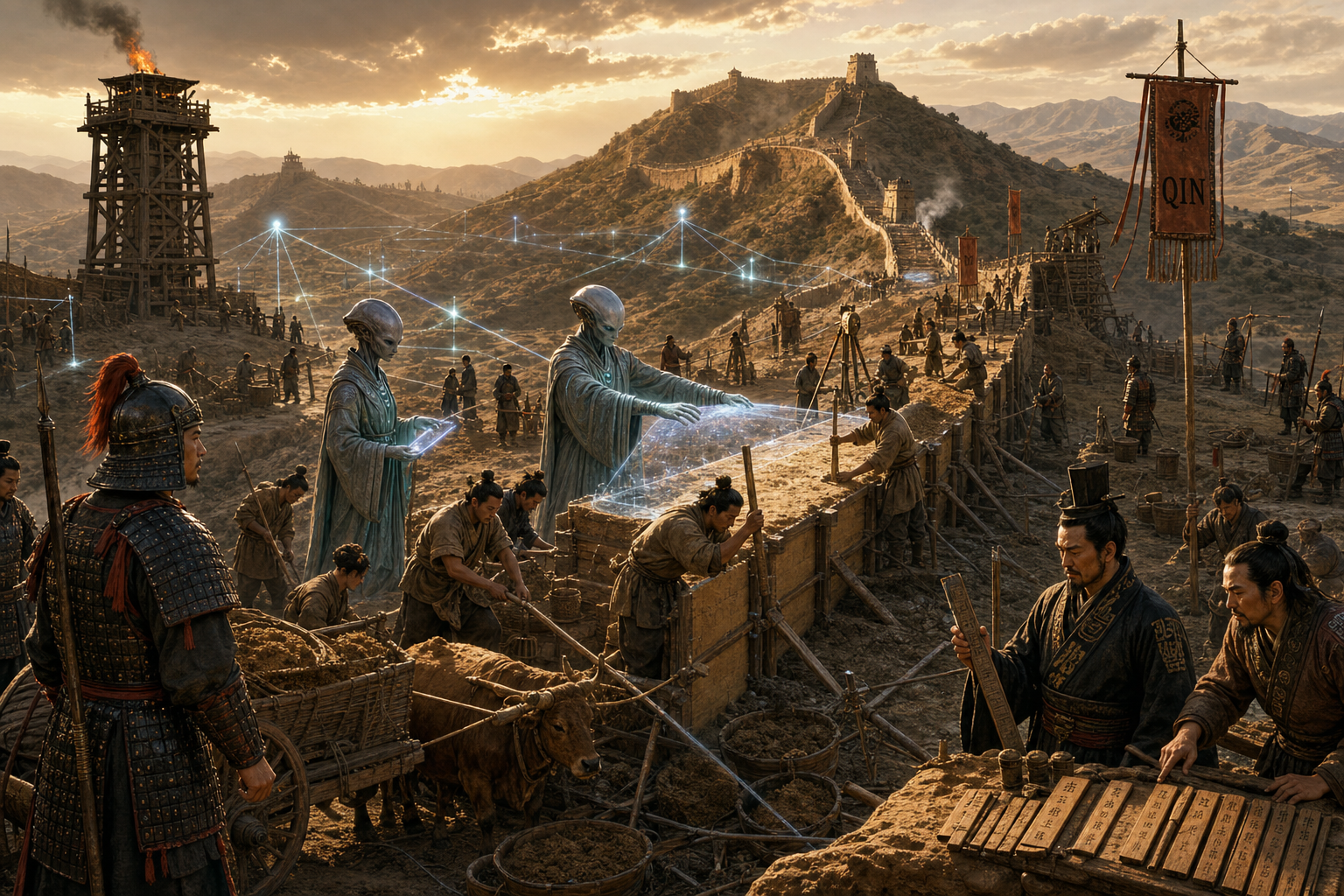
- The image emphasizes rammed-earth earthworks, beacon towers, survey tools, baskets, carts, and Qin-style military supervision rather than later Ming brickwork.
Sources
- https://www.britannica.com/topic/Great-Wall-of-China
- https://www.britannica.com/topic/Qin-dynasty
- https://www.britannica.com/technology/How-Was-the-Great-Wall-of-China-Made
- https://whc.unesco.org/en/list/438
Fiction Boundary
This is alternate-history ancient astronaut fiction. The alien visitors are depicted as a speculative visual layer and do not replace the documented human engineering, labor, administration, or military organization behind Qin construction projects.
Final Prompt
Use case: illustration-story
Asset type: speculative ancient-history image collection entry
Primary request: Create a detailed cinematic illustration for the Ancient Aliens "Qin-Great-Wall" scene, showing Qin dynasty China during imperial standardization and Great Wall fortification work, with fictional ancient alien visitors respectfully interacting with and assisting the people in the scene.
Historical setting: northern frontier of Qin China, approximately 221-206 BCE, after Qin Shi Huang unified China. Show historically grounded architecture, clothing, tools, materials, landscape, art motifs, and daily activity based on research: earlier frontier walls being linked into a defense system, rammed-earth and tamped-clay wall construction, laborers carrying baskets of earth, engineers measuring road and wall alignments with standardized rods, Qin soldiers in lamellar armor, ox carts and pack animals, beacon towers, rugged hills and dry steppe terrain, simple banners, bronze or iron tools, rope lines, wooden scaffolds, and administrative tally tablets.
Alien interaction: show the alien visitors projecting soft luminous survey lines over the landscape and stabilizing a rammed-earth section with a hovering field, integrated into the human construction effort without replacing human skill or agency. Humans remain active as planners, builders, soldiers, surveyors, and supervisors. The mood should be wondrous, collaborative, and mysterious rather than frightening.
Scene/backdrop: a busy Qin frontier construction site at golden hour, with a long earthwork wall tracing over hills into the distance, workers compacting layers of earth, officials checking standardized measurements, soldiers guarding a pass, and alien visitors quietly assisting beside human engineers.
Subject: combine these visual elements into one unified scene: Qin engineers using measuring rods and plumb lines, workers tamping rammed-earth forms between wooden frames, soldiers in Qin-style lamellar armor near a beacon tower, baskets of earth and tools beside ox carts, a partially linked frontier wall crossing rugged hills, luminous alien survey geometry hovering just above the construction line.
Optional text: if text appears, keep it short and integrated naturally on a wooden tally tablet or stone marker, such as "QIN". Do not write sequence numbers. Do not add explanatory captions.
Style/medium: detailed cinematic editorial illustration, polished digital painting, rich historical textures, expressive human figures, subtle luminous alien technology, realistic ancient materials, dramatic but readable lighting, magazine-quality fantasy history art.
Composition/framing: wide landscape image, one unified scene rather than separate panels. Use foreground human activity, midground alien interaction, and background architecture or landscape. Make Qin frontier construction recognizable at web thumbnail size.
Lighting/mood: golden-hour frontier light with dust in the air, warm earth tones, firelit beacon accents, and soft blue-white alien glow that does not overpower the historical setting.
Color palette: varied and historically grounded, based on rammed earth, clay, bronze, dark armor, muted textiles, dry grass, stone, sky, firelight, and alien glow as an accent. Avoid a one-note palette.
Text constraints: no long captions, no fake paragraphs, no modern signage. Any visible text should be short, high-contrast, and correctly spelled.
Avoid: claiming the alien premise is factual, making humans passive or primitive, demeaning cultural caricature, horror, abduction imagery, gore, photorealistic modern celebrities, copyrighted characters, modern logos, disconnected symbol collage, unreadable tiny labels, generic stock sci-fi, Ming-era brick crenellated walls dominating the scene, modern Great Wall tourist architecture.
More from Image Collections