False Positive
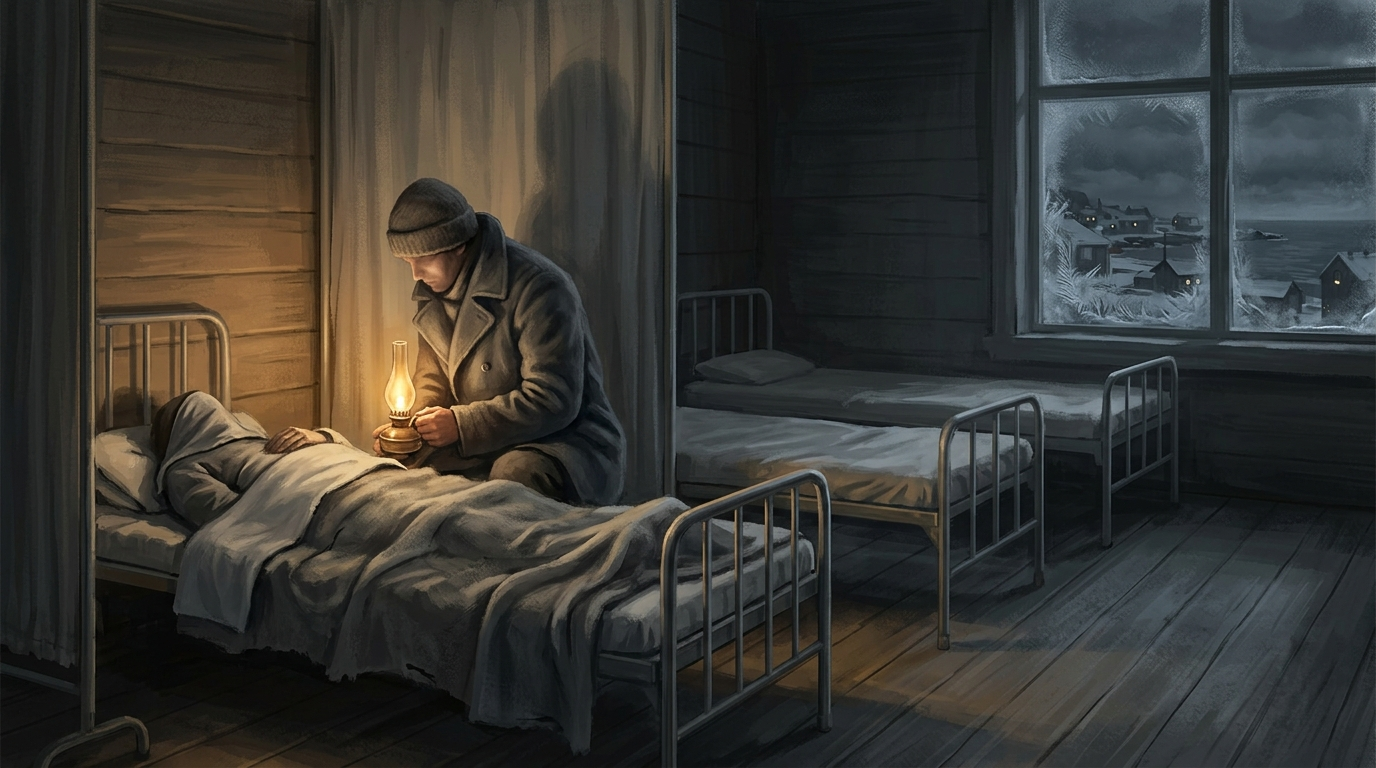
Design brief
Read a colonist's new cough against everything you think you know about what's going around, then send them to work, to bed, or to the isolation tent, because the lab result that would tell you for certain won't arrive until after you've already had to decide.
Date: 2026-10-19 Genre: colony sim Platform: PC (Windows; keyboard & mouse) Status: Concept
Target player
Someone with a long save file in RimWorld or Going Medieval who has stopped being surprised by what their colony throws at them. They know the tech tree, they know the raid timers, and they've started treating their colonists' health tabs as a chore to clear rather than a problem to solve, because in both games disease is a private dice roll — RimWorld's illnesses are drawn per colonist from the local biome and don't spread to anyone else, so a plague is really just bad luck wearing a health bar. This player wants the opposite: a colony sim where sickness is a social problem they have to read, not a stat they wait out. They've also sat with Going Medieval's framing — colonists who already survived one Black Death — and wondered why the plague that defines the setting never shows up as something you actually have to diagnose in the moment it's happening.
Core loop
30-second: Osgith has a cough. So does half the colony, because the granary roof leaks and the infirmary's been running the wood stove hot all week — both known, boring causes of a cough, confirmed a dozen times already this season. But Osgith's cough catches wrong, just slightly, and he's been avoiding the mess hall at meal times for two days. You don't have a lab slot free for six hours. You have three choices sitting in front of you right now: keep him on his smithing shift, send him to a bunk to rest it off, or burn one of your two isolation beds on a hunch. You send him to isolation. Six hours later the test comes back negative — he had the same chimney cough as everyone else — and you've spent a bed, and a day of his labor, on nothing.
30-minute: A full day cycle: morning symptom checks across the roster, the Known Agents board updated with whatever yesterday's lab results and autopsies confirmed, shift assignments made around however many beds and healthy hands you have left, then the day plays out — crops get planted or don't, the wall goes up another course or doesn't — while you watch the ward for anyone who declines faster than their assigned cause should explain. Evenings are triage: tomorrow's test queue, tonight's isolation calls, and the caregiver rotation, because whoever's been sitting with the sick the longest is the one most likely to be sitting with the sick tomorrow for real.
Where it gets boring in hour three: once a player has logged enough confirmed cases to know that a dry cough plus missed meals means chimney smoke, not contagion, the diagnosis puzzle collapses into a lookup table and the isolation tent becomes furniture. The Known Agents board is built to punish that confidence on a schedule: every 20–25 in-game days, the active strain drifts — it drops one of its three tells and picks up a tell currently owned by a mundane cause, so the exact symptom combination the player spent three weeks trusting as "just the chimney" is, for one drift cycle, also what the real thing looks like. The player's own notes become the trap, which is a sharper hook than a new unknown, because it's the one moment in the loop where being right yesterday makes you slower today.
Systems
- The Known Agents board: a reference panel the player builds over the tenure, not one handed to them. It starts with the four mundane causes already guessed at (Chimney Smoke, Overwork, Grief, Cold Exposure) partially filled in and the outbreak strain blank. Each confirmed lab result or autopsy fills in one more tell for whichever cause it matched, so the board is only as good as the testing the player actually did.
- Diagnostic pathway: three ways to know what's wrong, each with a cost. Visual read is free and instant but only shows 2–3 of a case's actual tells at random. A lab test is certain but takes 18 in-game hours and one of a starting stock of six reagents, which resupply at two per week. An autopsy is free and always accurate but only runs after the colonist is already dead, and it's the fastest way to fill in the board for next time.
- Isolation ward capacity: two beds at tenure start, each new bed costing four days of construction and one carpenter off shift to build. Beds do not scale with population — by the point the roster has grown from ten to forty, two or three beds is what most tenures ever manage, so the scarcity that defined week one is still the scarcity that defines week sixty.
- Strain drift: every 20–25 days, the active outbreak strain swaps one of its three tells for a tell currently belonging to a mundane cause, and the swap is never announced — the player finds out by a confirmed case that doesn't match what the board says it should.
- Caregiver fatigue: a colonist tending the isolation ward accrues a rising chance of catching whatever's inside it — 2% per shift for the first three consecutive shifts, doubling each shift after that. Rotating caregivers costs training time on a replacement; not rotating them costs you your most experienced nurse, eventually, to the ward she's running.
- The Containment Index: the Health Authority's single number for the colony, rising when a confirmed case was caught at visible-symptom stage before isolation and falling hard when a case was missed entirely and infected a second colonist. It is a record of how fast you acted, not how healthy the colony looks on a given day.
Progression
A posting runs three in-game years, each divided into four seasons. The strain active at tenure start is drawn from a pool of six profiles that differ in incubation length, lethality, and how aggressively they drift; the player doesn't know which one they have until the first few cases establish a pattern. Population grows by roughly one immigrant every ten days, outpacing bed construction by design. Caregiver training (turning a general laborer into a nurse who starts healthy) takes seven days and one skilled teacher off shift. The loss state is Health Authority revocation, triggered by the infected fraction of the living population exceeding 30% at any single check, or cumulative deaths passing 15% of everyone ever recruited to the posting. The win state is completing the three-year posting with the Containment Index above the renewal line at the final audit. A renewed posting keeps the player's Known Agents board as a starting reference, but draws a new strain from the pool — a veteran's notes are a head start, not an answer key.
World & setting
Harrow's Reach is a quarantine settlement on a cold, isolated coastline, chartered by a distant Health Authority to prove that people can live productively behind a line the mainland drew around them. It's a bureaucratic, lamp-lit world — ledgers, test vials, chalk tallies on the ward door — where the sickness itself rarely gets to be the centerpiece; it's the chimney smoke, the grief, the overwork, and the two beds you have for all of it that carry the tone. Palette: infirmary white, iodine amber, slate grey, lamp-oil yellow.
Differentiators
- Sickness is a social, legible puzzle built from overlapping symptom sets the player has to read and confirm, not a private per-colonist dice roll — the opposite of how RimWorld models disease, where illness draws from the biome and never spreads between colonists at all.
- Isolation beds are a fixed, slow-growing resource that falls further behind the population every season, so the genre's usual plateau — comfortable once the basics are solved — never arrives; the scarcity that defines week one still defines year three.
- The strain actively mutates its own symptom profile against the player's accumulated notes, so being correct for three weeks straight is what sets up the one week you're wrong — a cost for confidence, not just for ignorance.
- Treating a case costs the colony the same whether the call was right or wrong: a bed, a shift, a day of labor. The game never tells you which of your calls were the wasteful ones until the lab result lands.
Monetization notes
Premium purchase around $22.99, with a 12–18 month Early Access run before 1.0 — the path Going Medieval just completed in March 2026 after nearly five years in early access, landing at 76/100 on Metacritic with 83% of critics recommending it on OpenCritic, which says a slow-cooked colony sim can still land solidly even without topping the charts. Post-1.0 content is paid "Outbreak" campaigns, each adding a new strain profile and a new settlement map, rather than cosmetics — there's nothing to skin here that would matter to the diagnosis puzzle. The genre is busy (Going Medieval, Space Haven's 1.0 in May 2026, Timberborn's own 1.0 in March), but none of the current crop makes contagion itself the moment-to-moment system, which is the gap this fills.
Accessibility notes
Fully remappable hotkeys for ward assignment and the diagnostic panel. Symptom tells are icon- and shape-coded in addition to color, so colorblind players read the board the same way everyone else does, with full colorblind palette presets available. Game speed is adjustable and can be hard-paused at any point during a diagnosis decision — nothing in the loop requires fast reflexes. UI text and the Known Agents board scale independently of each other. Ward alert audio carries captions, and the flash effect on a new case can be replaced with a static highlight for players sensitive to flicker. An assist option removes the lab test's 18-hour wait entirely for players who want the puzzle without the pressure.
Risks
- The diagnosis puzzle could collapse into a lookup table once a player has seen every mundane cause confirmed a few times. Mitigation: strain drift events on a 20–25 day cycle keep inflicting one swapped tell at a time, so memorized heuristics expire on a schedule rather than holding indefinitely.
- A loss driven by a wrong read could feel like the game rolling dice behind the scenes rather than a mistake the player can trace. Mitigation: every tell is deterministic given its actual cause — no hidden randomness layered on top of the diagnosis itself — and every lab result or autopsy explains exactly what the colonist had, so a bad call is always traceable afterward.
- The genre is crowded with strong, established names. Mitigation: lead every trailer beat with the misdiagnosis hook specifically, since it's the one mechanic none of the comparison titles run on.
- Four interacting systems (drift, fatigue, reagents, ward construction) could tip into spreadsheet territory before any of them individually prove out. Mitigation: the prototype plan below builds and proves each system in isolation before layering the next one on.
- Reagent scarcity is a hard number to tune — too generous and the lab test stops being a real cost; too scarce and visual-read guessing becomes the only option. Mitigation: tune the two-per-week resupply rate against actual playtest data from weeks four and five, not a guess at the whiteboard.
6-week prototype plan
- Week 1: Core simulation skeleton — ten colonists, one mundane cause (Chimney Smoke) with three tells, a day/night tick, manual shift assignment only, no isolation ward yet. Deliverable: colonists visibly tire and recover based purely on manual rest assignment.
- Week 2: Build the diagnostic panel — visual read, lab test with its 18-hour timer, and the reagent stock — plus the first version of the Known Agents board. Deliverable: a player can run a case from symptom to confirmed lab result inside one in-game day.
- Week 3: Add the isolation ward (two beds), the outbreak strain itself, and caregiver assignment. Deliverable: one full case of misdiagnosis — a Chimney Smoke cough sent to isolation by mistake — playable start to finish.
- Week 4: Add caregiver fatigue and a second mundane cause (Overwork) whose tells partially overlap with the strain's. Deliverable: a caregiver who's pulled three consecutive shifts visibly becomes a new case herself.
- Week 5: Add the first strain drift event and the Containment Index tracking confirmed-before-isolation versus missed-and-spread outcomes. Deliverable: a drift event that turns a previously "safe" tell combination into the real thing, caught live in a playtest.
- Week 6: Vertical slice and playtest milestone — one full in-game season (roughly 20–25 days, through one drift event) with both mundane causes, the strain, ward construction, and a working win/loss check against the Containment Index. Deliverable: five external playtesters finish one season and can each name the specific case where they misdiagnosed someone.
Genre references
- RimWorld Wiki, "Disease" — https://rimworldwiki.com/wiki/Disease — confirms the genre's current standard: a colony's biome sets disease frequency, and illness is not contagious between colonists, which is the exact model False Positive sets out to invert.
- Going Medieval — https://en.wikipedia.org/wiki/Going_Medieval — the genre's biggest 2026 plague-themed launch (1.0 on March 17, 2026, 76/100 Metacritic, 83% OpenCritic recommended) uses a Black Death backdrop as setting dressing, not as a system the player diagnoses turn to turn — the gap this design works from.
- Novo: The Colony, Steam store page — https://store.steampowered.com/app/4991220/Novo_The_Colony/ — a 2026 settlement sim built around "every decision matters" and real mission failure under incomplete information, which informed the decision to make every diagnosis call carry a real cost whether or not it turns out to be right.
- "The Best Colony Sim Games — A Guide for 2026," Cities of the Aegean — https://www.citiesoftheaegean.com/blog/colony-sim-games/ — notes that in Cities of the Aegean, "crowded houses breed illness, and neither gives you an advance warning," confirming that even the genre's closest attempt still treats sickness as ambient background hazard rather than a legible system the player works directly.